
Pole barn · WY
Pole Barns in Wyoming
In most states, a pole barn question starts with square footage. In Wyoming it starts with the ranch. USDA's 2022 Census of Agriculture puts the state's average farm or ranch at 2,729 acres across 28,776,321 total acres in farms, so the storage and equipment demand behind a typical enquiry is large and single-purpose rather than a small mixed-use hobby building. That demand sits on a land area of 97,093.1 square miles — the 9th-largest of any state — where the National Weather Service and Wyoming's own State Climate Office both describe mountain-driven wind and snow patterns that vary sharply within a few miles. And it is being ordered into a residential and light-commercial construction market that just posted the steepest year-over-year permit decline the Census Bureau recorded for any state.
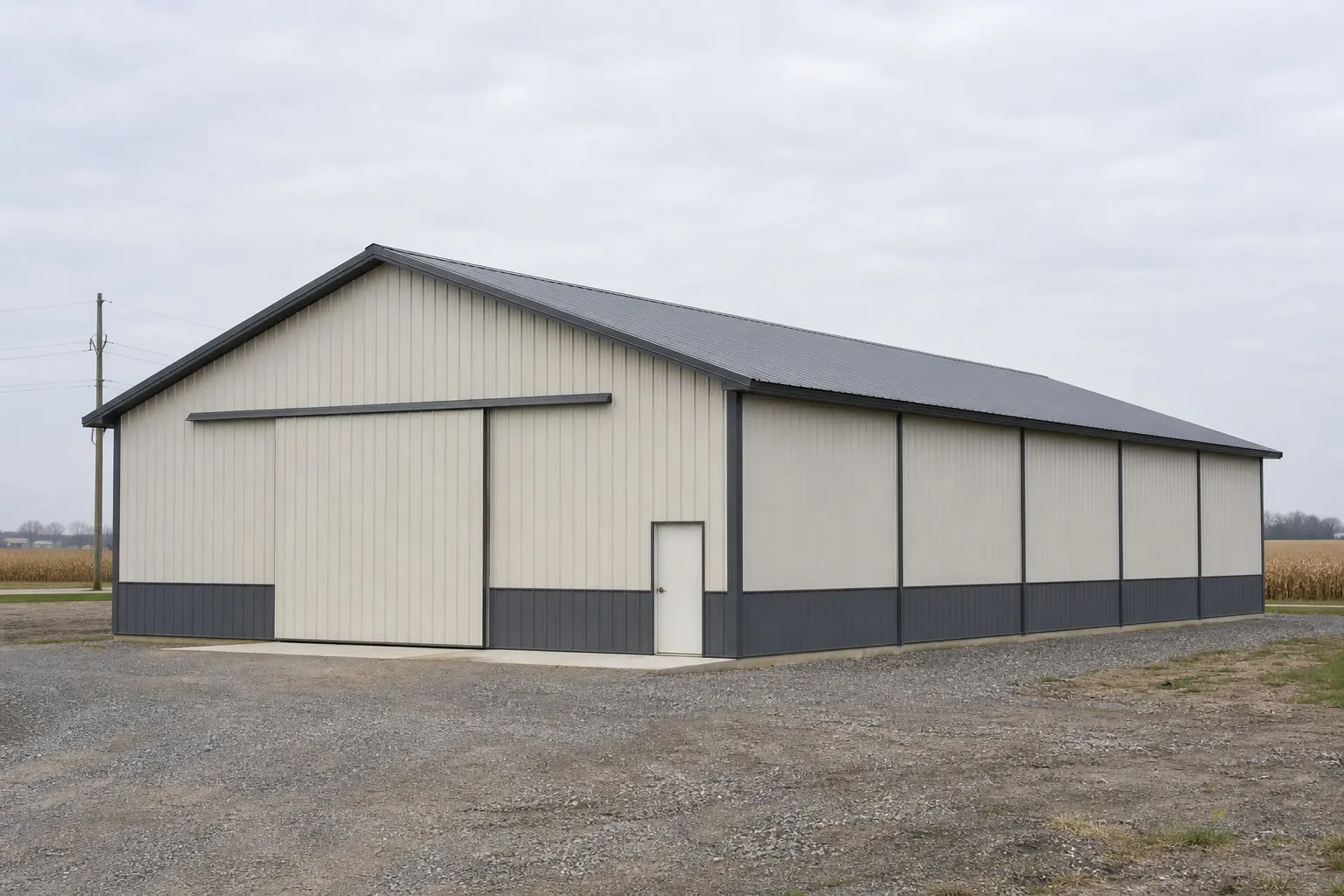
The intersection
What a Wyoming site actually changes about a pole barn
The post-frame building itself is the same everywhere; what a Wyoming parcel changes is the scale it needs to serve and how locally its wind and snow exposure vary.
Start with scale. USDA counted 10,544 farms and ranches in Wyoming in 2022 across 28,776,321 acres of land in farms, for an average operation of 2,729 acres. Divide that acreage by that farm count and the picture is clear: Wyoming has comparatively few, comparatively enormous operations. A pole barn serving one of them is rarely a small mixed-use building; it is far more often sized around one dominant purpose — hay storage, equipment cover or livestock shelter — because the ranch already has separate facilities for its other functions.
Next, exposure. NOAA NCEI's narrative on Wyoming's climate describes a high-elevation, semi-arid continental pattern shaped by the Rocky Mountains, with persistent wind and wide temperature swings, and the University of Wyoming's State Climate Office goes further, noting that the mountains create sharp regional differences in precipitation, snowfall and wind exposure across relatively short distances. That is why the Wyoming Climate Atlas maintained by the university's Water Resources Data System reports snowfall city by city rather than as one statewide figure: a single number would be misleading for most sites. The practical takeaway for a pole barn buyer is to ask for conditions at the nearest station to the actual build site, not a generic Wyoming average.
Finally, geography without people. Wyoming's 97,093.1 square miles rank 9th-largest among states, yet the state ranks 50th in population. For a pole barn project that usually means real delivery distance and a smaller local pool of erectors relative to the size of the land being served, which is worth factoring into scheduling independent of the building's own complexity.
Site context
Reading wind and snow exposure before you fix a footprint
Wyoming's climate offices maintain data at the station and city level rather than a single statewide figure, because the mountains make that necessary.
Open plains ranchland
Persistent wind is the recurring condition NOAA NCEI names for Wyoming's climate generally; door orientation relative to prevailing wind is worth discussing with your builder on open sites.
Foothill and mountain-adjacent parcels
The University of Wyoming's Water Resources Data System compiles snowfall by station precisely because mountain-adjacent sites can differ sharply from open-plains sites only a short distance away.
High basins and valleys
NOAA NCEI describes wide diurnal and seasonal temperature swings across Wyoming's high-elevation terrain, which is a reason to confirm frost and freeze-thaw behavior with a local source rather than assume a single statewide pattern.
Construction market
Ordering into a market that just contracted sharply
The Census Bureau's 2023 Annual Building Permits report recorded Wyoming's authorized housing units falling from 3,005 in 2022 to 1,681 in 2023 — a 44.1% single-year decline, the largest percentage drop of any state.
That figure covers residential permitting broadly, not pole barns specifically, and it says nothing about price. What it reasonably signals is fewer active construction crews statewide, which tends to lengthen lead times before it changes anything else about a quote.
For a post-frame ranch building, the practical response is to confirm current crew and material lead times directly with your builder rather than assuming last year's timeline still holds, and to lock a schedule early if the barn needs to be usable ahead of a specific season, such as before calving or before winter feeding begins.
- Ask for current lead times, not last year's
- A contracting market changes scheduling fast; get a fresh answer from your builder.
- Time the order around your ranch calendar
- If the building needs to be ready before a specific season, say so early and build in a buffer.
- Confirm delivery logistics for remote sites
- Wyoming's large land area and thin population routinely mean longer hauls than a similar order elsewhere.
Get Wyoming pole barn quotes
Tell suppliers your county, the ranch's dominant function for the building and your rough footprint. We route it with the Wyoming and pole barn context already attached.
Configuration
What Wyoming pole barns are usually asked to do
With Wyoming's average operation running 2,729 acres, most enquiries name one dominant function rather than asking for a mixed-use small building.
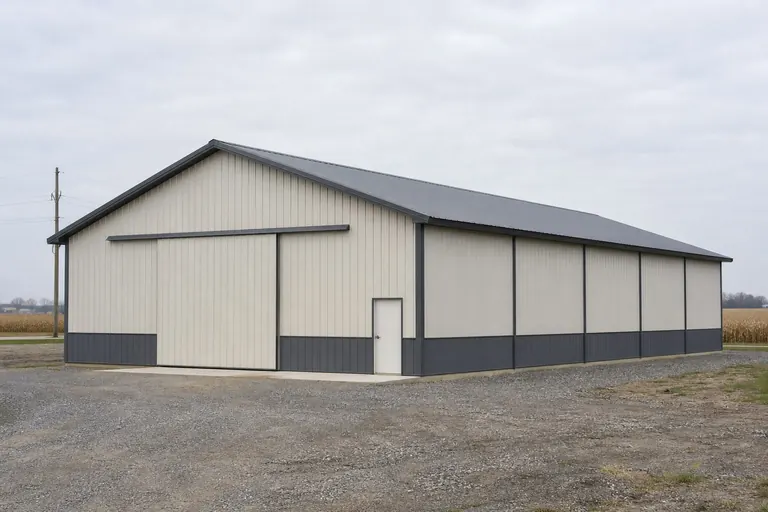 Hay and feed storageVentilation and roofline design matter more than finish level; the priority is keeping stored feed dry across a season.
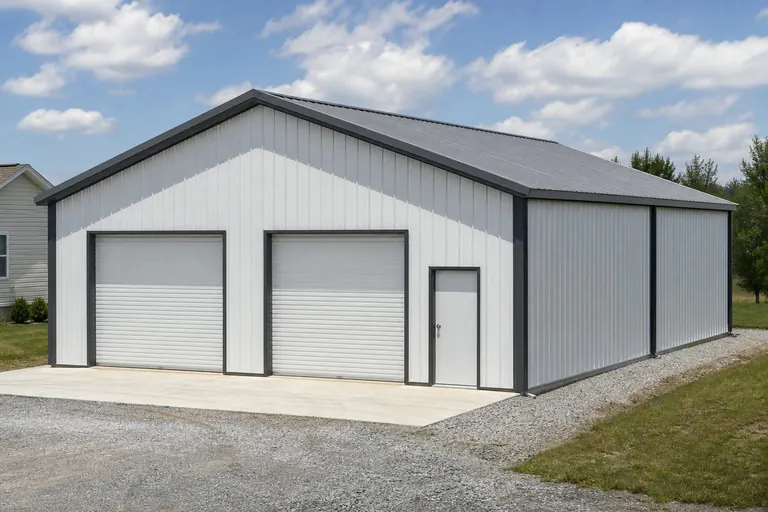 Equipment coverDoor height and clear span for large implements are the constraints ranch buyers regret getting wrong, not floor area.
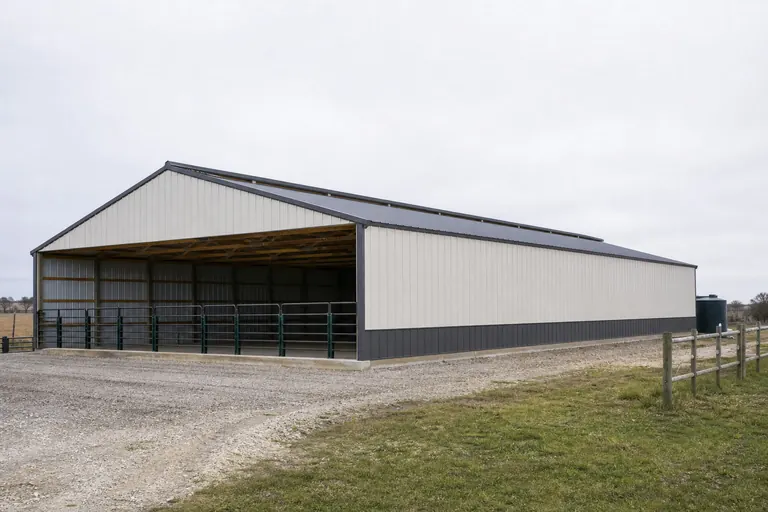 Livestock shelterOpen-sided or partially enclosed configurations respond to Wyoming's persistent wind exposure differently than a fully closed building would.
Example Configuration — for planning purposes only.
Footprint
Sizes that suit a single-purpose Wyoming ranch building
Wyoming's large-ranch scale pushes typical footprints wider and longer than the mixed-use buildings common in small-acreage states.
40′ × 60′
2,400 sq ft
A workable single-purpose equipment or hay building for a smaller operation.
40′ × 80′
3,200 sq ft
Common where a ranch needs both equipment cover and hay storage under one roof.
60′ × 100′
6,000 sq ft
Sized for larger equipment lines or combined livestock and equipment use on a large operation.
60′ × 150′
9,000 sq ft
Where the scale of the ranch calls for a genuinely large single structure rather than several smaller ones.
Example Configuration — for planning purposes only.
Footprint pages carry layout and door detail for each of these; this page only explains why the Wyoming brief lands in this range.
Preparation
Before you request a Wyoming pole barn quote
Four things resolved in advance make a Wyoming quote comparable rather than a guess.
Step 1
Contact your local building department
Permit requirements and any load conditions are set at the county level in Wyoming; ask before you fix a specification.
Step 2
Get station-level snow and wind data for your site
Ask the University of Wyoming's Water Resources Data System or the NWS Riverton office for your nearest station rather than relying on a statewide average.
Step 3
State the building's single dominant purpose
Wyoming's large-operation scale usually favors one clear function; naming it up front avoids a mid-project redesign.
Step 4
Confirm delivery logistics early
Wyoming's size and thin population mean freight distance and access road conditions deserve a specific answer, not an assumption.
Questions
Wyoming pole barn questions
Questions we can answer honestly at state level, with the rest routed to whoever actually owns them.
There is no single typical size, but USDA's 2022 Census of Agriculture puts Wyoming's average operation at 2,729 acres, among the largest of any state, which is why single-purpose buildings from 40x60 up through 60x150 are common here rather than the smaller mixed-use footprints seen in states with smaller average farms.
NOAA NCEI describes persistent wind as part of Wyoming's general climate character, and the state's own climate office notes sharp local variation across short distances. We do not state a design wind speed here; your local building department or the National Weather Service's Riverton office can give you site-specific conditions.
Permit requirements depend on your county, your parcel and how the building will be used. Your local building department is the only reliable source for that answer.
No. The University of Wyoming's Water Resources Data System publishes a Wyoming Climate Atlas of snowfall by city and station precisely because the state's mountainous terrain produces sharply different totals over short distances. Ask for data at your nearest station.
Plan conservatively. The Census Bureau recorded Wyoming's authorized housing units falling 44.1% from 2022 to 2023, the steepest decline of any state that year, which points to a thinner pool of active crews than a year with more housing starts would suggest.
Sources for the Wyoming facts on this page
This page states no code requirement, wind speed, snow load, permit rule, price or supplier claim. The state-specific facts it does use are listed with their publisher below.
Wyoming had 10,544 farms and ranches in 2022, down 12% from 2017.
USDA National Agricultural Statistics Service (NASS) · 2022 · Tier 1
https://www.nass.usda.gov/Publications/AgCensus/2022/Online_Resources/County_Profiles/Wyoming/cp99056.pdfWyoming had 28,776,321 acres of land in farms in 2022, an average farm size of 2,729 acres, up 12% since 2017 — among the largest average farm/ranch sizes of any state.
USDA NASS · 2022 · Tier 1
https://www.nass.usda.gov/Publications/AgCensus/2022/Online_Resources/County_Profiles/Wyoming/cp99056.pdfThe University of Wyoming's Water Resources Data System/State Climate Office maintains a Wyoming Climate Atlas with average, maximum, and minimum monthly and annual snowfall totals compiled by city/station across the state.
Wyoming State Climate Office / Water Resources Data System (University of Wyoming) · Station period-of-record varies by city (e.g., 1957-2013 for some stations) · Tier 2
https://www.wrds.uwyo.edu/sco/data/snow/snowfall-avg.htmlThe U.S. Census Bureau's 2023 Annual Building Permits highlights report shows Wyoming's total housing units authorized by building permit fell from 3,005 in 2022 to 1,681 in 2023, a 44.1% decline — the largest percentage state decline in that report.
U.S. Census Bureau · 2022-2023 · Tier 1
https://www.census.gov/construction/bps/pdf/2023annualhighlights.pdfFEMA's National Risk Index dataset defines and scores 18 natural hazard types (avalanche, coastal flooding, cold wave, drought, earthquake, hail, heat wave, hurricane, ice storm, inland flooding, landslide, lightning, strong wind, tornado, tsunami, volcanic activity, wildfire, winter weather) at the county level nationwide, including all 23 Wyoming counties.
Federal Emergency Management Agency (FEMA) · Current NRI release · Tier 1
https://www.fema.gov/about/openfema/data-sets/national-risk-index-dataWyoming's total land area was measured at 97,093.1 square miles as of the 2010 Census, ranking 9th-largest among states despite ranking 50th in population.
U.S. Census Bureau · 2010 Census · Tier 1
https://www.census.gov/geographies/reference-files/2010/geo/state-local-geo-guides-2010/wyoming.html