
Barndominium · WY
Barndominiums in Wyoming
A Wyoming barndominium is planned differently because the parcel it sits on is different in kind. USDA's 2022 Census of Agriculture puts the state's average farm or ranch at 2,729 acres, among the largest of any state, so the shop half of the building is normally sized for full ranch operations rather than a couple of trucks. The house half sits inside a high-elevation, semi-arid continental climate that NOAA and the National Weather Service describe as mountain-driven, with sharp local variation and persistent wind across short distances. And the project happens inside a residential building market that fell from 3,005 authorized housing units in 2022 to 1,681 in 2023 — a 44.1% single-year decline, the steepest of any state in the Census Bureau's 2023 report.
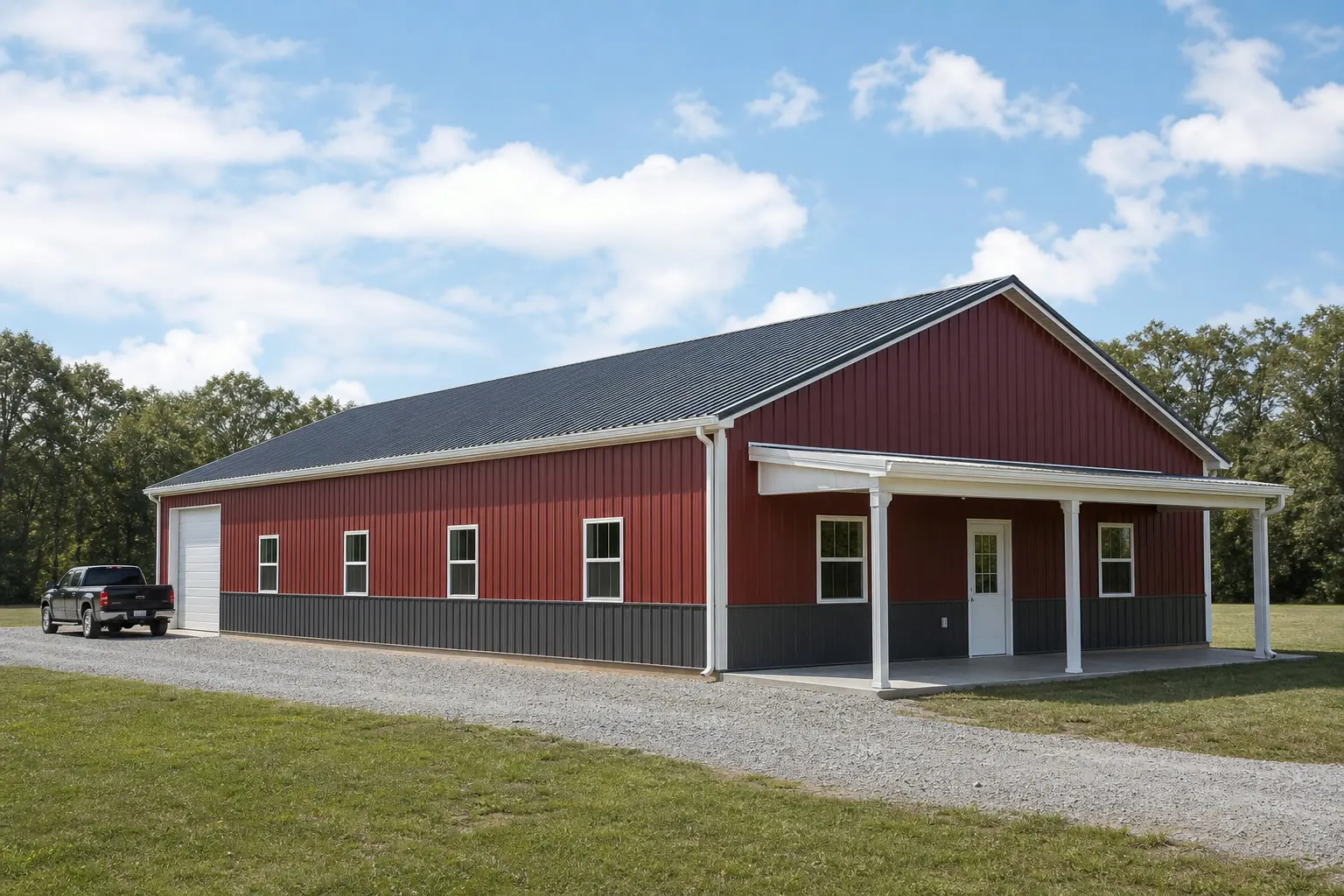
The intersection
What a Wyoming ranch actually asks of a barndominium
The building type does not change across a state line; what changes in Wyoming is the scale of the parcel it serves and the climate variability layered onto that scale.
USDA's National Agricultural Statistics Service counted 10,544 farms and ranches in Wyoming in 2022, spread across 28,776,321 acres, for an average operation of 2,729 acres — among the largest average sizes of any state. That figure alone reframes the brief: a barndominium built to serve a 2,729-acre working ranch is not a house with an attached two-car garage, it is a residence attached to a genuine equipment and livestock building, and the two halves need to be planned as different structures from the first sketch.
The livestock side of that scale is not incidental. USDA figures show livestock made up the large majority of Wyoming's 2022 agricultural production value, running roughly triple crop production. A barndominium's shop half on an operation like that is realistically a livestock-handling and equipment building first, and a hobby space second, which should drive door widths, wash-down surfaces and ventilation before finish selections.
Layered on top of that scale is climate variability that is unusually local for a state this size. NOAA NCEI's narrative on Wyoming's climate describes a high-elevation, semi-arid continental pattern shaped by the Rocky Mountains, with wide diurnal and seasonal swings and persistent wind, and the University of Wyoming's own State Climate Office notes that the mountains create sharp regional differences in precipitation, snowfall and wind exposure across relatively short distances. Two ranch sites in the same county can have meaningfully different exposure, which is a reason to get a site-specific read from the National Weather Service's Riverton office rather than assume a single statewide condition.
Site context
Why the same barndominium plan can behave differently across Wyoming
Wyoming's mountain-driven climate pattern means the honest planning unit is the specific site, not a regional label, but three broad conditions are worth naming before a design is fixed.
High-plains ranchland
Wide, comparatively open country where wind exposure is the recurring siting variable. Orientation of the shop's large doors relative to prevailing wind is worth resolving with a local builder before the pad is set.
Mountain-adjacent and foothill sites
The University of Wyoming's climate reference notes sharp local differences in snowfall and precipitation near the Rockies; a foothill parcel can carry a meaningfully different snow and drainage picture than open plains a short drive away.
High-elevation basins
Semi-arid overall, per NOAA NCEI's state climate narrative, but with wide diurnal temperature swings that put real demand on an envelope expected to hold comfort through both hot afternoons and cold nights in the same season.
Construction market
Building into a market that just contracted sharply
The Census Bureau's 2023 Annual Building Permits report shows Wyoming's authorized housing units falling from 3,005 in 2022 to 1,681 in 2023, a 44.1% single-year decline — the largest percentage drop of any state in that report.
That figure describes the statewide residential permitting trend, not a barndominium-specific number, and it is not a reason to expect a particular price or timeline; it is a reason to plan the schedule conservatively. A sharply contracting residential market generally means fewer active crews with recent finish-carpentry and residential-systems experience, and that scarcity tends to show up as longer lead times before it shows up as anything else.
Practically, that argues for locking a builder's schedule early, confirming who is actually doing the interior residential build-out versus the shell erection, and treating a firm start date as a genuine deliverable to negotiate rather than an assumption.
- Confirm crew availability early
- Ask directly who has done combined residential-and-shop steel work recently in your part of the state.
- Separate shell and finish contracts if needed
- In a thin market, the erector and the interior finisher may not be the same team; sequencing them is your risk to manage.
- Build in schedule contingency
- A contracting permit market is a signal to pad timelines, not a signal about cost.
Get Wyoming barndominium quotes
Tell suppliers your county, the equipment and livestock functions the shop half must hold, and your target living-space finish level. We route it with the Wyoming and barndominium context already attached.
Configuration
What a Wyoming barndominium is usually asked to do
On a ranch averaging 2,729 acres, the realistic brief separates full-scale ranch functions from living space rather than blending them into one undivided room.
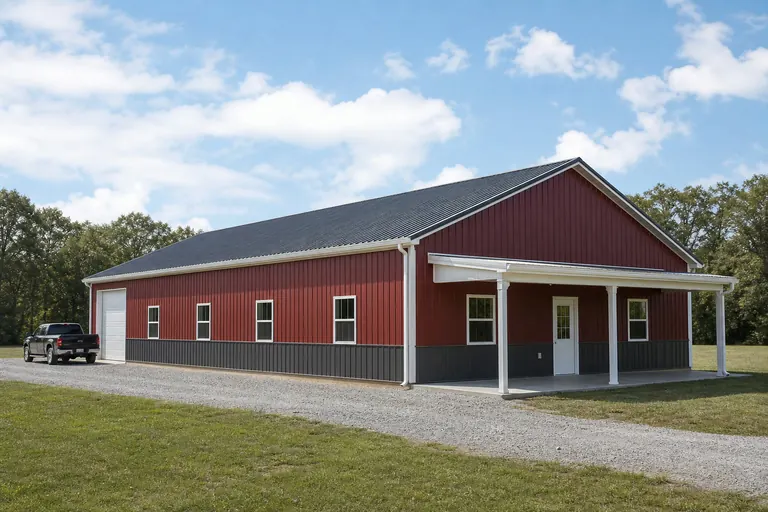 House plus equipment bayA finished residence at one end and a genuine equipment bay at the other, with the shared wall treated as an exterior wall for insulation and air-sealing purposes.
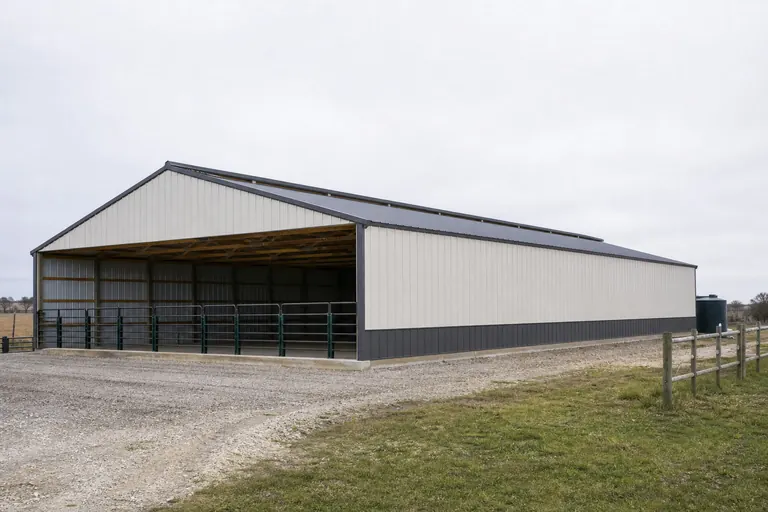 House plus livestock handlingWhere the shop half doubles as a handling or calving space, ventilation, wash-down surfaces and door width matter more than square footage.
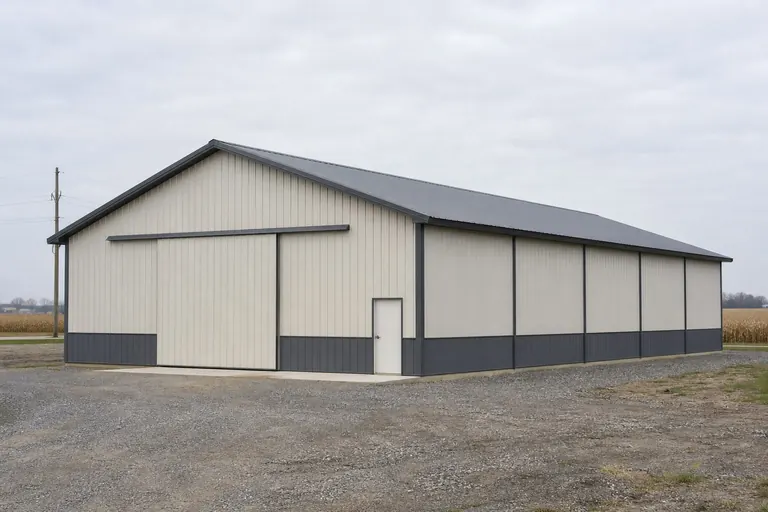 House plus general ranch storageA simpler split favoring flexible dry storage where the ranch's equipment list is modest relative to Wyoming's average scale.
Example Configuration — for planning purposes only.
Footprint
Footprints that suit ranch-scale Wyoming builds
Wyoming's above-average ranch acreage is what pushes typical footprints toward the larger end of the barndominium range.
40′ × 80′
3,200 sq ft
A workable balance of full living quarters and one genuine equipment bay for a smaller operation.
60′ × 100′
6,000 sq ft
The common Wyoming scale where full-size ranch equipment must fit indoors alongside a complete residence.
60′ × 120′
7,200 sq ft
Where livestock handling space, equipment storage and living quarters all need to coexist under one roof.
Example Configuration — for planning purposes only.
Set shop door width and eave height from your actual equipment and livestock handling needs before fixing the overall footprint.
Preparation
Before you request a Wyoming barndominium quote
Five things resolved before the quote is requested keep the process from restarting mid-design.
Step 1
Get a site-specific wind and snow read
Ask your local building department and, where useful, the National Weather Service's Riverton office for site conditions rather than assuming a single statewide figure — Wyoming's terrain makes that variation real.
Step 2
Size the shop from equipment, not floor plan habit
List every vehicle and implement the shop half must hold before dimensions are fixed; Wyoming's 2,729-acre average operation usually means more than a plan book assumes.
Step 3
Ask about dwelling classification early
How your county treats a residence attached to an agricultural-style structure affects inspections and sometimes financing; confirm before design, not during permitting.
Step 4
Confirm crew and schedule availability
With statewide permits down 44.1% year over year, book early and ask contractors directly about current lead times.
Step 5
Check the FEMA National Risk Index for your county
Use the official NRI tool for a citable, parcel-relevant hazard picture rather than a generalized statewide claim.
Questions
Wyoming barndominium questions
Honest state-level answers, with anything jurisdiction- or lender-specific routed to who actually owns it.
Size it from your actual equipment list rather than a standard plan. USDA's 2022 Census of Agriculture puts Wyoming's average operation at 2,729 acres, among the largest of any state, so many Wyoming shops need to hold full-scale ranch machinery rather than personal vehicles.
NOAA NCEI describes Wyoming's climate as high-elevation, semi-arid and continental, shaped by the Rockies, with wide temperature swings and persistent wind, and the state's own climate office notes sharp local variation across short distances. That argues for a site-specific envelope conversation rather than a generic one; we do not publish a statewide design value here.
Plan for a thin and recently contracting market. The Census Bureau recorded Wyoming's authorized housing units falling 44.1% from 2022 to 2023, the steepest decline of any state that year, so booking early and confirming current lead times directly with builders matters more here than in a year with more active permitting.
Permit requirements depend on your county and how the building is classified. Your local building department is the only reliable source for that answer, and it is worth asking before you finalize the split between living space and shop.
FEMA's National Risk Index scores 18 hazard types, including wildfire and strong wind, for all 23 Wyoming counties, but a citable per-hazard figure for your parcel should come from FEMA's own NRI tool rather than a general statement on this page.
Sources for the Wyoming facts on this page
This page states no code requirement, wind speed, snow load, permit rule, price or supplier claim. The state-specific facts it does use are listed with their publisher below.
NOAA NCEI publishes a narrative 'Climate of Wyoming' describing the state's high-elevation, semi-arid continental climate strongly shaped by the Rocky Mountains, with wide diurnal and seasonal temperature swings and persistent wind.
NOAA National Centers for Environmental Information (NCEI) · Historical narrative (NCEI climate normals series) · Tier 1
https://www.ncei.noaa.gov/data/climate-normals-deprecated/access/clim60/states/Clim_WY_01.pdfThe NWS Riverton, WY forecast office publishes 1991-2020 climate normals for Wyoming stations within its area of responsibility.
National Weather Service (NOAA), Riverton WY office · 1991-2020 · Tier 1
https://www.weather.gov/riw/cms_wyclimatenormals_2020Wyoming had 28,776,321 acres of land in farms in 2022, an average farm size of 2,729 acres, up 12% since 2017 — among the largest average farm/ranch sizes of any state.
USDA NASS · 2022 · Tier 1
https://www.nass.usda.gov/Publications/AgCensus/2022/Online_Resources/County_Profiles/Wyoming/cp99056.pdfWyoming had 10,544 farms and ranches in 2022, down 12% from 2017.
USDA National Agricultural Statistics Service (NASS) · 2022 · Tier 1
https://www.nass.usda.gov/Publications/AgCensus/2022/Online_Resources/County_Profiles/Wyoming/cp99056.pdfWyoming's total value of agricultural sector production in 2022 was $2,432,434,000, with livestock production ($1,398,764,000) roughly triple crop production ($514,552,000).
USDA NASS / USDA Economic Research Service · 2022 · Tier 1
https://www.nass.usda.gov/Statistics_by_State/Wyoming/Publications/Brochures/Wyoming-Agricultural-Facts.pdfThe U.S. Census Bureau's 2023 Annual Building Permits highlights report shows Wyoming's total housing units authorized by building permit fell from 3,005 in 2022 to 1,681 in 2023, a 44.1% decline — the largest percentage state decline in that report.
U.S. Census Bureau · 2022-2023 · Tier 1
https://www.census.gov/construction/bps/pdf/2023annualhighlights.pdfFEMA's National Risk Index dataset defines and scores 18 natural hazard types (avalanche, coastal flooding, cold wave, drought, earthquake, hail, heat wave, hurricane, ice storm, inland flooding, landslide, lightning, strong wind, tornado, tsunami, volcanic activity, wildfire, winter weather) at the county level nationwide, including all 23 Wyoming counties.
Federal Emergency Management Agency (FEMA) · Current NRI release · Tier 1
https://www.fema.gov/about/openfema/data-sets/national-risk-index-dataWyoming's total land area was measured at 97,093.1 square miles as of the 2010 Census, ranking 9th-largest among states despite ranking 50th in population.
U.S. Census Bureau · 2010 Census · Tier 1
https://www.census.gov/geographies/reference-files/2010/geo/state-local-geo-guides-2010/wyoming.htmlThe University of Wyoming State Climate Office notes Wyoming's climate and terrain are dominated by the Rocky Mountains, which create sharp regional differences in precipitation, snowfall, and wind exposure across relatively short distances within the state.
Wyoming State Climate Office / Water Resources Data System (University of Wyoming) · WRDS/SCO reference material · Tier 2
https://www.wrds.uwyo.edu/sco/wyoclimate.html