Pole barn · VT
Pole Barns in Vermont
Vermont's farm landscape sets the frame for a pole barn project here. USDA's 2022 Census of Agriculture counted 6,537 farms statewide, down from 6,808 in 2017, working a combined 1,173,890 acres for an average of 180 acres per farm — a mid-sized-parcel pattern that puts most Vermont barns on working land with real terrain, not flat commodity ground. That terrain is genuinely varied: the Champlain Valley sits between the Green Mountains and New York's Adirondacks, and Vermont Fish & Wildlife's own landowner guide names the Green Mountains, Vermont Valley, and Northeastern Highlands as distinct regions. Add Burlington's NOAA normal of 87.5 inches of average annual snowfall, and a pole barn's roof pitch, door placement, and site access become decisions made around the specific hillside or valley floor it's built on.
A Working-Land Building, Not a Commodity Shed
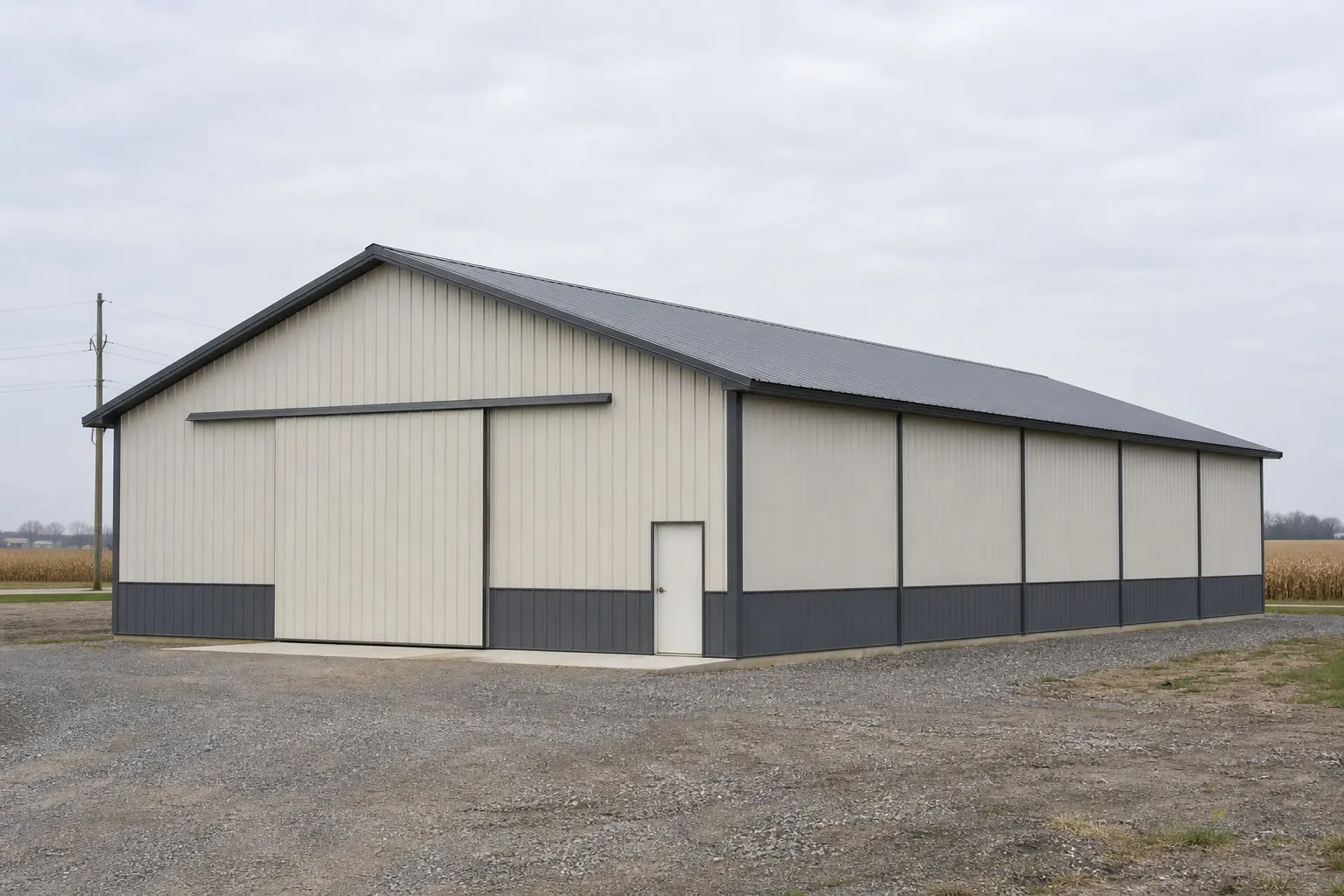
Vermont's 180-acre average farm size sits between hobby-scale and industrial-scale agriculture, which means most pole barns here go up on land with real slope, tree lines, and existing structures to work around — not a graded pad on flat commodity ground.
Land use
What 6,537 farms and 180 average acres mean for barn planning
Vermont's farm-acreage figures point toward mid-sized, multi-purpose operations rather than single-crop commodity scale.
USDA's 2022 Census of Agriculture counted 6,537 farms in Vermont, a decline from 6,808 farms in 2017, working a combined 1,173,890 acres for an average of 180 acres per farm. That average puts a typical Vermont farm well above a residential hobby lot but far below the scale of a large Midwestern commodity operation, and it usually means a pole barn here is asked to do double or triple duty: equipment storage, hay or feed, and often a shop or livestock bay in the same structure.
The declining farm count between the two census years is also worth factoring into a barn's design brief. A structure sized and laid out for a single enterprise today may need to flex toward a different use — rental storage, a different livestock mix, or a non-farm use entirely — if the operation changes over the building's working life. Discussing that flexibility with your builder up front, through wider bay spacing or an extra door, costs less than retrofitting later.
None of this implies a standard Vermont farm size for permitting or exemption purposes; those determinations rest with the town and the local building department, and should be confirmed before a barn's footprint is finalized.
Site context
Terrain differences across Vermont's farm regions
The same farm-acreage statistics land very differently depending on whether the parcel sits in a valley or on a mountain-adjacent slope.
Champlain Valley
Lower-elevation farmland between the Green Mountains and the Adirondacks; typically the most workable grading for a barn pad, though drainage still needs a site check.
Green Mountains
Steeper working parcels where footing depth, access road grade, and equipment turning radius deserve early attention.
Vermont Valley
A narrower lowland corridor; confirm local wind exposure and water flow before fixing door orientation.
Northeastern Highlands
The state's most remote farming region; winter access for both construction and ongoing use is a real planning factor.
Get Vermont pole barn quotes
Tell us your farm's acreage, access road grade, and how many uses the barn needs to serve. We route it with the Vermont and pole-barn context attached.
Climate
Roof and door design around Burlington's snow record
A heavy documented snow normal argues for treating roof and header clearance as core design decisions, not afterthoughts.
Burlington's NOAA 1991-2020 normal puts average annual snowfall at 87.5 inches. For a pole barn, that context is most relevant at the roofline and the large equipment door: a shallow-pitched roof over a wide door opening can accumulate snow right where equipment needs headroom to pass, so shed direction and header height deserve a specific conversation with your builder rather than a generic spec.
Because so much of Vermont's farmland sits at elevation or on sloped ground, a barn's access road and apron also need to handle a wet, snow-heavy shoulder season without becoming impassable to farm equipment. Confirming grading and drainage before the barn's foundation work begins avoids a season of frustration, and it is worth revisiting that grading plan again once the structure is framed, since roof runoff concentrates water in new places the bare site plan never accounted for.
- Door header clearance
- Confirm headroom accounts for equipment plus any snow buildup near the opening.
- Roof shed direction
- Orient the roofline to shed away from the primary equipment approach and walk paths.
- All-season access
- Grade the approach road and apron to stay usable through a wet, snow-heavy shoulder season.
Footprint
Bay sizing for a Vermont operation
Given the state's mid-sized average farm acreage, most Vermont pole barn requests fall into a similar mid-range footprint band.
30′ × 40′
1,200 sq ft
Equipment plus general storage on a smaller working parcel.
40′ × 60′
2,400 sq ft
Separates equipment, feed or hay storage, and a shop or livestock bay.
40′ × 80′
3,200 sq ft
Multi-enterprise layouts where the parcel's acreage supports the added length.
Example Configuration — for planning purposes only.
Footprint pages carry bay spacing and layout detail; this page explains why Vermont's farm scale shapes the range.
Preparation
Before you request a Vermont pole barn quote
These items address the questions that most often reshape a Vermont pole barn quote after the fact.
Step 1
Confirm agricultural status and permit path with your town
Exemptions and permit requirements are set locally in Vermont; confirm before assuming a barn qualifies.
Step 2
Map the access road grade to the site
Steeper Green Mountain or Highlands parcels need this resolved before foundation work is scheduled.
Step 3
Set door header clearance against snow load
Do this at design time using Burlington's snowfall normal as planning context.
Step 4
Plan for flexible bay use
Vermont's declining farm count over 2017-2022 makes multi-use flexibility a reasonable design goal.
Questions
Vermont pole barn questions
Honest state-level answers, with jurisdiction-specific items routed to the office that owns them.
It depends on the town and the barn's use and size. Vermont permitting and agricultural exemption status are handled locally, so confirm with your municipal office first.
USDA's 2022 Census of Agriculture puts the statewide average at 180 acres across 6,537 farms, but that's a state average, not a design standard for any individual site.
We do not state a design load here. Burlington's NOAA normal of 87.5 inches of annual snowfall is planning context; your engineer and local building department determine the actual requirement.
Yes in general terms. Vermont Fish & Wildlife's named regions — including the Champlain Valley and the Green Mountains — reflect real elevation and drainage differences; confirm specifics on-site.
USDA's Census of Agriculture recorded the shift from 6,808 to 6,537 farms; the underlying causes aren't detailed in this dataset, so we note the trend without speculating on its drivers.
There's no official typical size. Requests commonly range from 30x40 on smaller parcels to 40x80 for multi-enterprise operations, reflecting the site rather than a statewide rule.
Sources for the Vermont facts on this page
This page states no code requirement, wind speed, snow load, permit rule, price or supplier claim. The state-specific facts it does use are listed with their publisher below.
Vermont had 6,537 farms in 2022, down from 6,808 farms in 2017.
USDA National Agricultural Statistics Service (NASS) · 2022 (with 2017 comparison) · Tier 1
https://www.nass.usda.gov/Publications/AgCensus/2022/Full_Report/Volume_1,_Chapter_1_State_Level/Vermont/vtv1.txtVermont had 1,173,890 acres of land in farms in 2022, an average farm size of 180 acres.
USDA NASS · 2022 · Tier 1
https://www.nass.usda.gov/Publications/AgCensus/2022/Full_Report/Volume_1,_Chapter_1_State_Level/Vermont/vtv1.txtThe Champlain Valley in northwestern Vermont is bounded by the Green Mountains to the east and the Adirondack Mountains (in New York) to the west, per the Lake Champlain Basin Program's basin atlas.
Lake Champlain Basin Program (federally chartered bi-state/bi-national program) · Reference material, current · Tier 2
https://atlas.lcbp.org/nature-environment/geology/Burlington, VT's 1991-2020 annual climate normal precipitation is 37.53 inches with an annual normal snowfall of 87.5 inches.
NOAA National Centers for Environmental Information (NCEI) · 1991-2020 · Tier 1
https://www.ncei.noaa.gov/access/services/data/v1?dataset=normals-annualseasonal-1991-2020&dataTypes=ANN-PRCP-NORMAL,ANN-SNOW-NORMAL&stations=USW00014742&format=jsonFEMA's National Risk Index tool provides county- and tract-level composite and hazard-specific risk scores for Vermont's 14 counties across 18 natural hazard types.
Federal Emergency Management Agency (FEMA) · Current NRI release · Tier 1
https://www.fema.gov/flood-maps/products-tools/national-risk-index