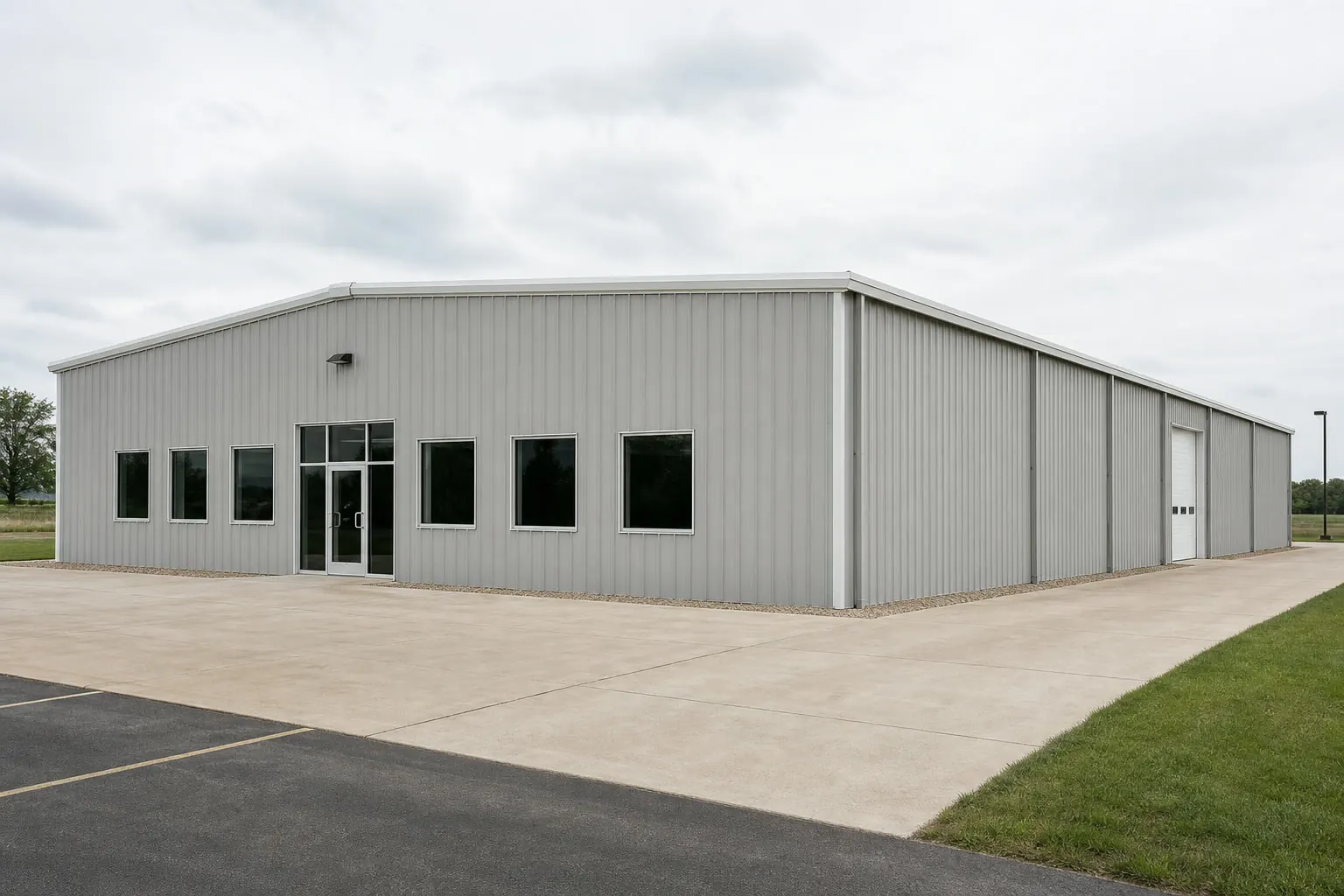
Commercial building · VT
Commercial Steel Buildings in Vermont
Vermont's commercial steel building market runs on small numbers and mountain-shaped geography. The Census Bureau recorded only 2,654 new privately-owned housing units authorized statewide in 2024, and most of the state's flat, buildable commercial ground concentrates in valley corridors — the Champlain Valley bounded by the Green Mountains and New York's Adirondacks, and smaller lowlands Vermont Fish & Wildlife names as the Vermont Valley. That geography narrows where a commercial pad can go before a single design detail is chosen. Once a valley site is found, Burlington's NOAA normal of 87.5 inches of average annual snowfall makes roof design and drainage a genuine engineering conversation rather than a formality, and a small statewide trade base means scheduling deserves as much attention as the building itself.
Valley Geography Decides the Site First
In Vermont, a commercial steel building project usually starts by finding a valley with flat, buildable ground rather than choosing a design and then a location. The state's mountainous shape makes that search narrower than it would be in a flatter, larger state.
Site selection
Why buildable commercial land concentrates in a few corridors
Vermont's terrain narrows where a commercial building can reasonably go before any design decision is made.
Vermont's Champlain Valley sits between the Green Mountains to the east and New York's Adirondack Mountains to the west, a lowland corridor documented by the Lake Champlain Basin Program's basin atlas. Vermont Fish & Wildlife's own landowner guide names additional lowland areas, including the Vermont Valley, alongside the more mountainous Green Mountains and Northeastern Highlands regions. For a commercial buyer, that geography means the realistic search area for a flat, accessible, utility-served parcel is a fraction of the state's total land area — a genuinely different starting point than a flatter, more uniformly buildable state.
Once a valley parcel is identified, the practical commercial questions are the familiar ones: utility access, road frontage, and municipal zoning. But in Vermont those questions are answered against a smaller inventory of candidate sites, which argues for engaging local land-use officials early rather than assuming a suitable parcel will simply turn up.
Site brief
What to resolve before specifying a Vermont commercial building
These items are where Vermont commercial projects most often lose time.
- Confirm the parcel is in a viable valley corridorFlat, utility-served commercial land concentrates in the Champlain Valley and similar lowlands; verify access and utilities early.
- Engage town land use officials before finalizing designVermont zoning and permitting are handled locally; a pre-application conversation surfaces constraints early.
- Design the roof and drainage around Burlington's snow record87.5 inches of average annual snowfall is a real planning input for roof pitch, snow retention, and canopy clearance.
- Book crews against a small statewide trade baseWith only 2,654 housing units authorized statewide in 2024, commercial erection and site crews are a limited resource to schedule around.
- Check for adjacent or prior agricultural useGiven Vermont's substantial farm acreage, a commercial site outside urban centers may carry agricultural zoning history worth clarifying.
- Get design loads from your professional of recordSnow load, wind speed and the adopted code edition come from your design professional and local building department, not from a statewide table.
Footprints
Common Vermont commercial footprints
Valley-corridor sites and a small trade base push most Vermont commercial projects toward efficient, moderately sized clear-span buildings.
40′ × 60′
2,400 sq ft
Small service, trade, or contractor premises that fit comfortably on a valley-corridor parcel.
60′ × 100′
6,000 sq ft
Light industrial or storage use where the site supports truck access as well as the footprint.
80′ × 120′
9,600 sq ft
Larger clear-span requirement, viable where the valley parcel and municipal review support it.
Example Configuration — for planning purposes only.
Coverage, parking and access requirements are municipal; confirm them before fixing a footprint.
Get commercial quotes for your Vermont site
Share your valley or region, required clear span, and access needs. Those inputs make Vermont commercial quotes comparable across builders.
Site context
Three commercial settings in Vermont
Where a Vermont commercial site sits changes both its access profile and its exposure.
Champlain Valley
The state's largest lowland corridor and its most concentrated commercial and population base; still confirm drainage and utility capacity site by site.
Vermont Valley and smaller lowlands
Narrower corridors with less commercial inventory; road frontage and utility runs deserve early confirmation.
Green Mountains and Northeastern Highlands
Higher elevation, more limited flat ground, and heavier local snow exposure; site grading and winter access are bigger project variables.
Evidence position
Sourced facts and deliberate silences
Every Vermont figure above is federal or state-agency sourced; every regulatory number is left to your town and design professional.
Sourced: the Lake Champlain Basin Program's description of the Champlain Valley's bounding mountain ranges, the Census Bureau's 2024 statewide housing authorization count, NOAA's 1991-2020 Burlington snowfall normal, and FEMA's National Risk Index as the federal county-level hazard tool covering Vermont's 14 counties.
Withheld: adopted code editions, occupancy classifications, design snow and wind values, permit fees, review timelines, and prices. Vermont's small commercial market is exactly the context where an invented statewide figure would do real damage, so this page states the shape of the problem and names the authority that answers it.
Before you design
What to confirm before committing to a Vermont commercial site
These items tend to reshape a Vermont commercial project after the fact if they aren't settled early.
- Verify utility capacity on the parcelValley-corridor land is scarcer here, and not every available parcel has water, sewer or three-phase power already at the road; confirm capacity before committing to a site.
- Walk the parcel with a town land-use officialA pre-application conversation in Vermont's local zoning system surfaces setback, coverage and use constraints before a design is drawn.
- Get a roof and drainage sketch reviewed against local snow behaviorEven a preliminary sketch benefits from a second look given Burlington's documented 87.5-inch average annual snowfall normal.
- Ask about seasonal access for construction crewsA small statewide trade base combined with a real winter season can affect scheduling; ask your contractor how they sequence work around it.
Questions
Vermont commercial building questions
The Vermont-specific answers a general commercial steel building page cannot give.
Vermont's mountainous terrain concentrates flat, buildable land in a few valley corridors, including the Champlain Valley bounded by the Green Mountains and the Adirondacks, which narrows the practical site search.
Local zoning and land-use review, plus a small statewide trade base — only 2,654 housing units were authorized statewide in 2024 — which limits how many crews are available at once.
It's a genuine factor. Burlington's NOAA normal of 87.5 inches of average annual snowfall makes roof pitch, drainage, and canopy clearance real design conversations, though the final load value comes from your engineer.
Your design professional and local building department determine them; we do not publish statewide values because none is sourced for general use here.
Yes. Valley sites generally offer more buildable flat land and utility access, while Green Mountains or Northeastern Highlands sites face steeper grading and heavier local snow exposure.
Pricing sits with the cost silo. The Vermont-specific drivers are valley-corridor land scarcity, snow-related roof detailing, and a limited local trade base affecting scheduling.
Sources for the Vermont facts on this page
This page states no code requirement, wind speed, snow load, permit rule, price or supplier claim. The state-specific facts it does use are listed with their publisher below.
The Champlain Valley in northwestern Vermont is bounded by the Green Mountains to the east and the Adirondack Mountains (in New York) to the west, per the Lake Champlain Basin Program's basin atlas.
Lake Champlain Basin Program (federally chartered bi-state/bi-national program) · Reference material, current · Tier 2
https://atlas.lcbp.org/nature-environment/geology/Vermont builders and developers were authorized (by building permit) to build 2,654 total new privately-owned housing units in 2024 (1,404 in single-family buildings, 112 in 2-unit buildings, 73 in 3-4 unit buildings, and 1,065 in buildings of 5+ units).
U.S. Census Bureau · 2024 (final annual) · Tier 1
https://www2.census.gov/econ/bps/State/st2024a.txtBurlington, VT's 1991-2020 annual climate normal precipitation is 37.53 inches with an annual normal snowfall of 87.5 inches.
NOAA National Centers for Environmental Information (NCEI) · 1991-2020 · Tier 1
https://www.ncei.noaa.gov/access/services/data/v1?dataset=normals-annualseasonal-1991-2020&dataTypes=ANN-PRCP-NORMAL,ANN-SNOW-NORMAL&stations=USW00014742&format=jsonFEMA's National Risk Index tool provides county- and tract-level composite and hazard-specific risk scores for Vermont's 14 counties across 18 natural hazard types.
Federal Emergency Management Agency (FEMA) · Current NRI release · Tier 1
https://www.fema.gov/flood-maps/products-tools/national-risk-indexVermont had 6,537 farms in 2022, down from 6,808 farms in 2017.
USDA National Agricultural Statistics Service (NASS) · 2022 (with 2017 comparison) · Tier 1
https://www.nass.usda.gov/Publications/AgCensus/2022/Full_Report/Volume_1,_Chapter_1_State_Level/Vermont/vtv1.txt