
Barndominium · NM
Barndominiums in New Mexico
A barndominium sited in New Mexico is shaped by two facts that reshape the planning conversation early. First, NOAA's Southwest climate summary describes the state as arid to semi-arid with precipitation that swings hard year to year because so much of it arrives in a short monsoon window, not a steady annual drizzle. Second, the working land it usually sits on is large: the 2022 Census of Agriculture puts New Mexico's average farm at 1,865 acres, among the biggest average holdings in the country. The combination pushes the planning conversation toward well and septic capacity, monsoon-season drainage, and a long private access road, well before it reaches interior finish choices.
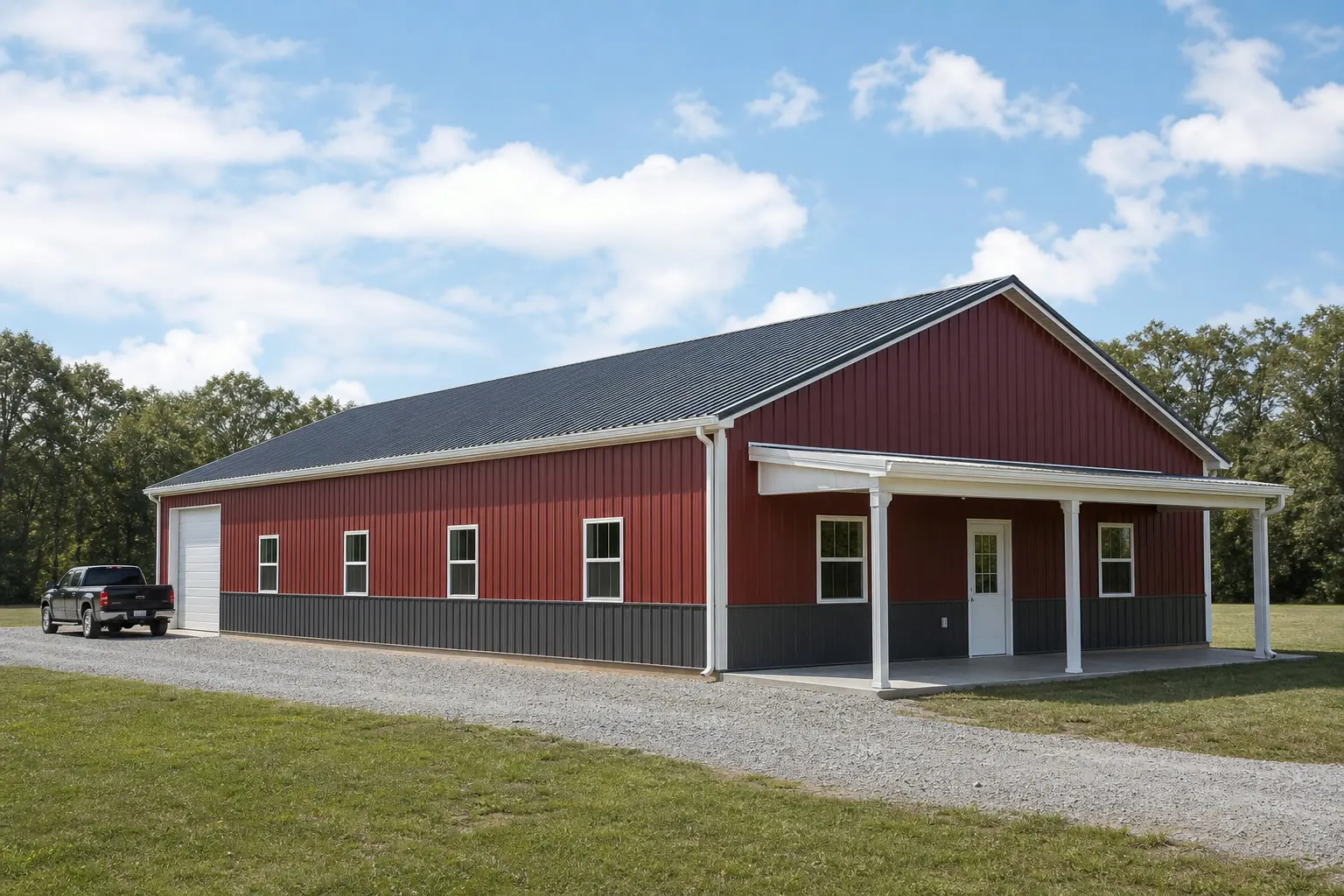
The intersection
What a New Mexico site actually changes about a barndominium
The shell-and-living-space concept is the same everywhere. What a New Mexico site changes is how much of the planning conversation is about water, distance and dust before it ever reaches finishes.
NOAA's State Climate Summaries describe New Mexico's climate as arid to semi-arid with high year-to-year precipitation variability, much of it tied to the North American monsoon. That is a very different planning baseline from a state with steady seasonal rainfall: a barndominium here has to handle long dry stretches and then a short, intense wet window, sometimes in the same year. At the Albuquerque station, NOAA's 1991-2020 normal period puts annual precipitation at 8.84 inches with about 7.9 inches of snow — genuinely low totals that shift the priority from shedding heavy snow loads (a question for the local building department, not this page) toward capturing and routing the water that does arrive, since monsoon storms often deliver it fast.
The second change is distance. The 2022 Census of Agriculture recorded an average New Mexico farm size of 1,865 acres, among the largest average farm sizes in the country, across 39,128,563 total acres of farmland statewide. A barndominium on that kind of parcel is rarely close to a paved road, a utility main or a neighbour. That reframes several decisions that other states treat as minor: how far the well and septic system sit from the building, how long the driveway and utility trench run, and whether the access road itself needs grading before delivery trucks can reach the pad.
The third change is what the state's own hazard planning already names. New Mexico's 2023 Hazard Mitigation Plan, built to FEMA's 44 CFR Part 201 planning criteria, documents drought, wildfire, flooding and severe wind/dust events as the natural hazard profile counties work from. None of that translates into a design value on this page — wind speeds, defensible-space distances and drainage requirements are set locally — but it is a fair reason to raise wildfire and flash-flood exposure with your local building department and fire authority before you fix a site plan, especially on a wooded or arroyo-adjacent parcel.
Site context
How a New Mexico barndominium site differs by setting
New Mexico spans 121,298.2 square miles, the fifth-largest state by land area, and elevation drives more of the difference between sites than county lines do.
High desert ranch parcel
The 1,865-acre average holding sits in this category. Expect a long private road, well and septic that predate the build, and a real conversation about how far utilities travel before they reach the pad.
Arroyo-adjacent or lower-elevation ground
Flash flooding from short, intense monsoon storms is part of the state's documented hazard profile. Grading and drainage away from the pad are worth resolving with a site engineer before a slab is poured, not after.
Higher-elevation or forested edge sites
Wildfire is named in the state hazard plan alongside drought. Ask your local fire authority about defensible-space expectations for a residential structure attached to a metal shell before finalizing landscaping and setback.
Sites nearer a metro building department
New Mexico authorized 7,572 new privately-owned housing units in 2024 through local permit offices, evidence that this remains an active build environment even where lots are smaller and closer to services; your local office is still the only source for what your specific parcel requires.
Exposure
Water is scarce and sudden at the same time
An 8.84-inch annual precipitation normal at Albuquerque sounds like a building that barely needs to think about water. In practice it needs to think about it differently, not less.
Low annual totals concentrated into a monsoon window mean a barndominium's roof and grading plan is designed around brief, intense runoff events rather than a steady drizzle spread across the year. Gutters, downspout placement and where the pad sits relative to surrounding grade matter as much here as in a wetter state — the difference is how rarely they get tested and how hard the test can be when it comes.
Water supply is the other half of the equation. On a large private parcel without municipal service, well capacity and septic system sizing are decided long before interior layout, and they interact directly with how much square footage the barndominium's living quarters can realistically support. None of this is a number this page can hand you; it is the sequence a New Mexico buyer benefits from following in this order.
- Grade before you plan interiors
- Confirm pad elevation and runoff direction relative to the surrounding parcel before layout is finalized.
- Size water and waste systems first
- Well yield and septic capacity are frequently the actual constraint on a rural New Mexico floor plan, not the building shell.
- Plan the access road as part of the budget
- A long, ungraded private road can affect delivery scheduling for a metal building shell; raise it with your builder early.
Get New Mexico barndominium quotes
Tell us your parcel size, well/septic status and the functions the building has to serve. We route it with the New Mexico and barndominium context already attached.
Configuration
What a New Mexico barndominium is usually asked to do
On a large, isolated parcel, the barndominium is often the only structure doing every job at once: home, shop and equipment storage under one roofline.
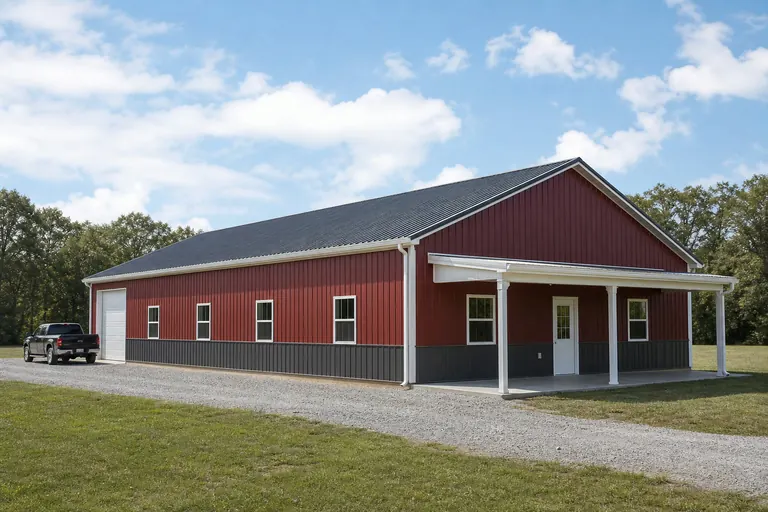 Living quarters plus attached shopA common New Mexico configuration pairs finished living space with an unfinished bay for vehicles, tools or ranch equipment, sharing one foundation and roofline.Primary residence on a working parcelWhere the barndominium is the sole residence on a large holding, utility runs, septic placement and driveway grading typically drive layout more than aesthetic choices.
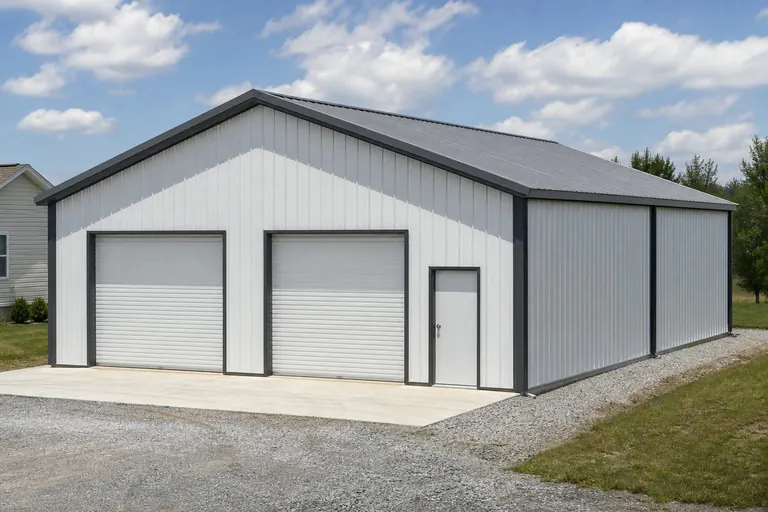 Weekend or seasonal use with storageSome New Mexico parcels host a barndominium used seasonally, with the shop end doing double duty as secure off-season storage for vehicles and equipment.
Example Configuration — for planning purposes only.
Footprint
Sizes that suit a New Mexico ranch-parcel barndominium
Isolation and a combined living-plus-shop brief push New Mexico footprints toward width that supports both functions under one roof.
30′ × 50′
1,500 sq ft
A workable minimum for a living-space-plus-single-bay configuration on a smaller parcel.
40′ × 60′
2,400 sq ft
Common where the living quarters and an equipment bay both need real square footage.
40′ × 80′
3,200 sq ft
Adds a second bay or a larger shop end without widening the frame.
60′ × 80′
4,800 sq ft
For a working ranch parcel where the barndominium anchors both the residence and the main equipment storage.
Example Configuration — for planning purposes only.
Footprint pages carry layout and door detail for each of these; this page only explains why the New Mexico brief tends to land in this range.
Preparation
Before you request a New Mexico barndominium quote
Five things resolved in advance make the difference between a comparable quote and a re-quote on a rural New Mexico parcel.
Step 1
Contact your local building department
New Mexico's permitting and code administration is handled locally; ask what your parcel, elevation and use require before you fix the specification.
Step 2
Confirm well and septic capacity
These frequently size the living quarters more than any design preference does; resolve them before floor planning.
Step 3
Ask about wildfire and flood exposure
The state's hazard mitigation plan names drought, wildfire and flooding among its natural hazards; a local fire authority can speak to your specific site.
Step 4
Measure the access road
A long or ungraded private drive can affect delivery logistics for the building shell; give your builder real distances, not estimates.
Step 5
Describe every function the building serves
A combined home-and-shop brief priced as a residence only is a common cause of a second round of quoting.
Questions
New Mexico barndominium questions
Questions we can answer honestly at state level, with the ones we cannot routed to whoever actually owns them.
No. NOAA describes New Mexico's climate as arid to semi-arid with high year-to-year precipitation variability driven largely by the monsoon, so rainfall is concentrated into short, sometimes intense events rather than being absent. Grading and roof-water routing still matter; ask your site contractor to plan for a heavy monsoon event, not just the annual average.
Permit requirements depend on your county or municipality, your parcel and how the building is used. Local building permit offices in New Mexico authorized 7,572 new housing units in 2024, so this is an active, well-understood process locally — but only your building department can tell you what your specific project needs.
There is no official typical size, but the 2022 Census of Agriculture put the state's average farm at 1,865 acres, among the largest average farm sizes nationally. Many barndominium sites sit on holdings of that scale, which is why access, utilities and distance from services are early planning questions.
We do not publish state-level prices, because a credible number depends on specification, site work, well/septic scope and current material pricing. Our cost pages cover what drives the number; a quote covers your building.
New Mexico's 2023 Hazard Mitigation Plan documents wildfire among the state's natural hazards, particularly at higher elevations and near wooded terrain. Defensible-space expectations and any building restrictions are set locally; ask your local fire authority and building department before finalizing a site plan on that kind of parcel.
Sources for the New Mexico facts on this page
This page states no code requirement, wind speed, snow load, permit rule, price or supplier claim. The state-specific facts it does use are listed with their publisher below.
NOAA's State Climate Summaries key messages for the Southwest region describe New Mexico's climate as arid to semi-arid with high year-to-year precipitation variability driven substantially by the North American monsoon.
NOAA National Centers for Environmental Information (NCEI) · State Climate Summaries 2022 · Tier 1
https://statesummaries.ncics.org/chapter/nm/Albuquerque's 1991-2020 annual normal precipitation is 8.84 inches with 7.9 inches of annual snowfall.
NOAA National Centers for Environmental Information (NCEI) · 1991-2020 · Tier 1
https://www.ncei.noaa.gov/access/services/data/v1?dataset=normals-annualseasonal-1991-2020&dataTypes=ANN-PRCP-NORMAL,ANN-SNOW-NORMAL&stations=USW00023050&format=jsonNew Mexico had 39,128,563 acres of land in farms in 2022, an average farm size of 1,865 acres, among the largest average farm sizes in the country.
USDA NASS · 2022 · Tier 1
https://www.nass.usda.gov/Publications/AgCensus/2022/Online_Resources/County_Profiles/New_Mexico/cp99035.pdfNew Mexico had 20,976 farms in 2022, down 16% from 2017.
USDA National Agricultural Statistics Service (NASS) · 2022 · Tier 1
https://www.nass.usda.gov/Publications/AgCensus/2022/Online_Resources/County_Profiles/New_Mexico/cp99035.pdfNew Mexico's 2022 Census of Agriculture total market value of products sold was $2,949,036,000, up 14% from 2017.
USDA NASS · 2022 · Tier 1
https://www.nass.usda.gov/Publications/AgCensus/2022/Online_Resources/County_Profiles/New_Mexico/cp99035.pdfNew Mexico's total land area was measured at 121,298.2 square miles as of the 2010 Census, making it the fifth-largest state by land area.
U.S. Census Bureau · 2010 Census · Tier 1
https://www.census.gov/geographies/reference-files/2010/geo/state-local-geo-guides-2010/new-mexico.htmlThe 2023 State of New Mexico Hazard Mitigation Plan, prepared to meet FEMA's 44 CFR Part 201 planning criteria, documents the state's natural hazard profile including drought, wildfire, flooding, and severe wind/dust events across its counties.
New Mexico Department of Homeland Security and Emergency Management · 2023-2028 · Tier 2
https://connect.nm.gov/uploads/1/4/1/9/141989814/2023_state_of_new_mexico_hazard_mitigation_plan_3.pdf