Pole barn · AZ
Pole Barns in Arizona
An Arizona pole barn's siting question usually gets answered before its size question. CRS's federal land ownership dataset puts roughly 28.1 million of Arizona's 34.4 million acres in federal hands, and the Arizona State Land Department separately holds more than 9 million acres of state trust land — about 13% of the state's surface — under lease or auction rules rather than ordinary sale. Meanwhile USDA's 2022 Census of Agriculture counted 16,710 Arizona farms, down 12% from 2017 but averaging 1,528 acres each, up about 12%, a consolidation pattern that points toward fewer, larger working parcels. Layer in permitting that runs through the local building department and a fixed June 15–September 30 monsoon calendar with a documented dust-storm hazard, and the practical Arizona pole barn project starts with land tenure, jurisdiction and season, not just clear-span dimensions.
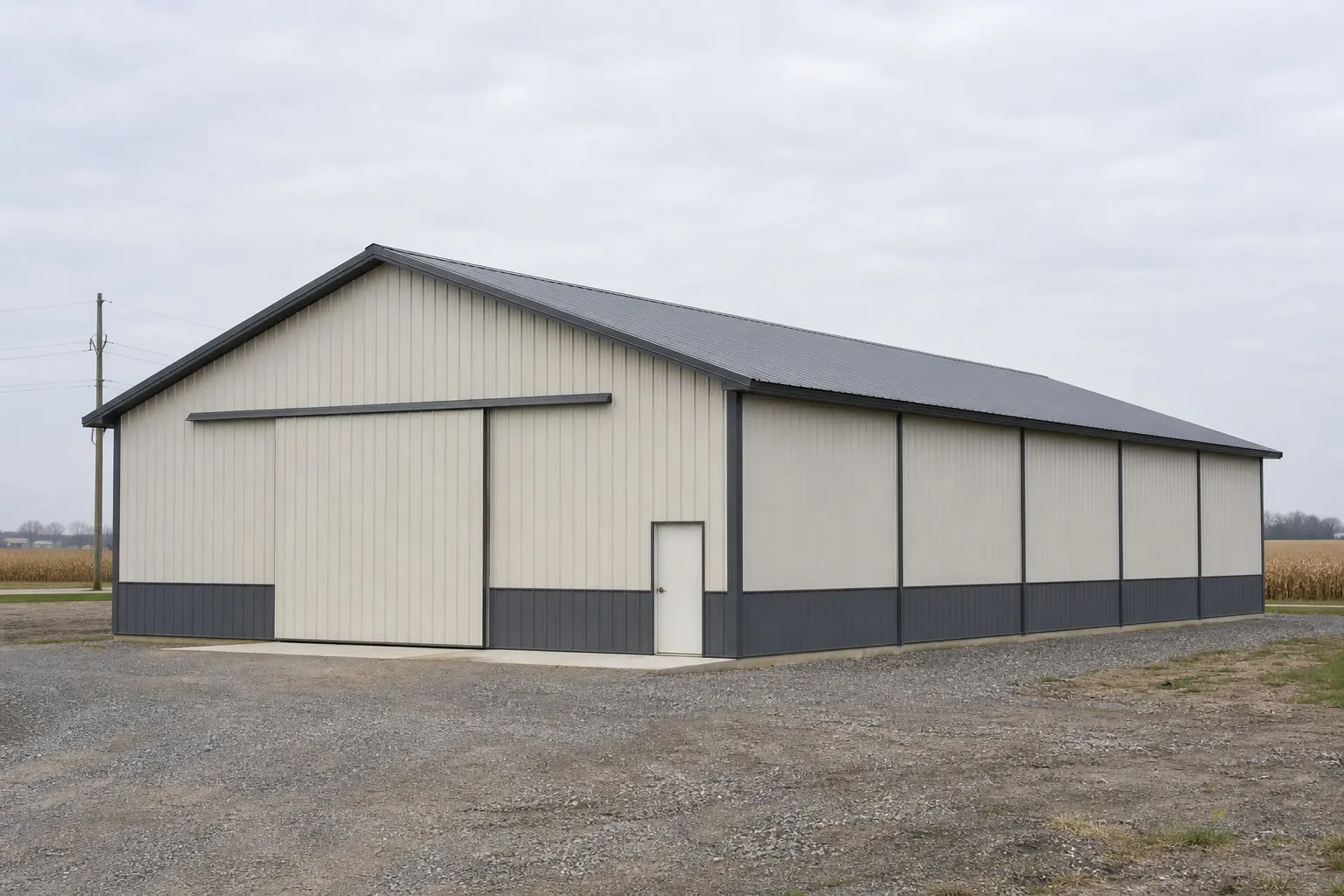
The intersection
Fewer, larger Arizona farms change what a pole barn needs to hold
Arizona's agricultural base is consolidating onto fewer, larger operations, which shifts pole barn briefs toward higher-capacity storage.
USDA's 2022 Census of Agriculture counted 16,710 farms in Arizona, down 12% from 2017. Over the same period, average farm size rose about 12% to 1,528 acres, and total land in farms held nearly steady at 25,525,087 acres. That combination — fewer operations working comparable total acreage — points toward larger individual operations rather than many small hobby-scale parcels.
For a pole barn buyer, that consolidation trend argues for sizing the building against the specific operation's actual equipment, hay volume or livestock count rather than a small-farm default. A 1,528-acre-class Arizona operation is more likely to need a wide clear-span building for larger equipment or bulk feed storage than the smaller structure a hobby-scale parcel would need.
The average is still just a reference point — Arizona's farm mix spans irrigated cropland to large-acreage grazing, and actual needs vary by operation type. What the 2022 Census data supports is the direction of the trend: plan for capacity growth rather than assuming today's herd or equipment list is the ceiling.
Site tenure
Confirm land tenure before committing to a permanent structure
A pole barn is a permanent structure, and Arizona's land-tenure patterns make confirming ownership status before the build a real first step, not paperwork to handle later.
CRS's federal land ownership dataset shows roughly 28.1 million of Arizona's approximately 34.4 million acres are federally owned. Federal land is generally not a candidate for a private agricultural building without a specific federal grazing lease or permit arrangement, and even then a permanent structure typically requires separate authorization.
The Arizona State Land Department separately manages more than 9 million surface acres of state trust land, about 13% of the state's surface area. Trust land is leased or auctioned rather than purchased outright, and building a permanent pole barn on leased trust land is a different conversation with the land department than building on deeded private ground — lease terms, improvement rights and renewal conditions all matter before committing capital to a structure.
Where the parcel is confirmed deeded private land, the pole barn conversation moves straight to size, use and local permitting, without the added lease or auction step trust or federal land would require. The point of confirming tenure early is avoiding a design and budget process built around a site that turns out to require a lease application or auction bid first.
- Confirm deeded status with the county assessor
- A quick title or assessor check before design work avoids planning around land that isn't a straightforward private purchase.
- Ask the State Land Department about improvement rights
- If the site is trust land, confirm what the lease allows in terms of permanent structures before finalizing a design.
- Treat federal land as excluded by default
- Federal acreage generally isn't available for a private agricultural building without a specific lease or permit arrangement.
Permitting & timing
Local permitting and monsoon timing both need early confirmation
Arizona sets construction rules locally and runs a fixed monsoon calendar, both worth checking before a start date is set.
- Identify your building departmentA.R.S. §11-861 and §34-461 confirm counties and municipalities adopt construction codes by reference locally, so agricultural-exemption thresholds and permit requirements vary by jurisdiction.
- Ask about agricultural-use classificationWhether a pole barn qualifies for any local agricultural-building treatment depends on your specific city or county; confirm this before assuming a simplified permit path.
- Sequence exterior work around the monsoon windowNOAA/NWS defines Arizona's monsoon as running June 15 through September 30 each year; scheduling framing and roof work outside that window reduces weather-related risk.
- Plan ventilation with dust events in mindA NOAA technical memorandum documents blowing dust tied to monsoon outflows as an Arizona hazard, relevant to open-sided hay storage and dust ingress on stored feed.
- Confirm water supply for any on-site useNOAA's state climate summary names drought as a serious ongoing Arizona hazard; check well or utility reliability before finalizing site plans that depend on it.
Get Arizona pole barn quotes
Tell us your land tenure status, target jurisdiction and equipment or hay volume. We route it with the Arizona and pole barn context already attached.
Configuration
What Arizona pole barns are commonly asked to do
Consolidating farm scale and land-tenure patterns shape the briefs most often seen in the state.
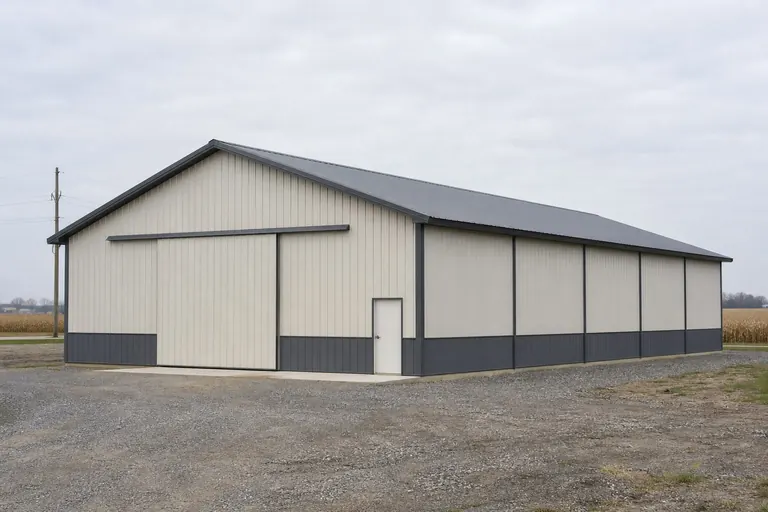 Hay and feed storageVentilation and dry storage sized for a larger operation, consistent with Arizona's rising average farm size.Equipment storage on a working parcelWide clear spans for larger equipment on consolidated operations, whether on deeded land or a state trust lease.Livestock support structureShelter and handling space connected to corrals or fencing, common on larger grazing-oriented parcels.
Example Configuration — for planning purposes only.
Footprint
Sizes that suit a consolidating Arizona operation
A starting range that accounts for Arizona's rising average farm size, before a tenure- and site-specific plan is drawn.
30′ × 40′
1,200 sq ft
A baseline for a smaller hobby-scale parcel or single-vehicle equipment storage.
40′ × 60′
2,400 sq ft
A common starting point for combined hay and equipment storage.
60′ × 100′
6,000 sq ft
Sized for a larger, consolidated operation needing wide clear-span capacity.
Example Configuration — for planning purposes only.
Confirm land tenure and local permit requirements before finalizing a size; footprint pages carry the layout detail.
Questions
Arizona pole barn questions
Questions we can answer honestly at the state level, with jurisdiction- and site-specific items routed to who owns them.
Not automatically. CRS data shows roughly 28.1 of Arizona's 34.4 million acres are federally owned, and the Arizona State Land Department separately holds more than 9 million acres of trust land under lease or auction rules. Confirm deeded private status, or check improvement rights under a trust land lease, before planning.
USDA's 2022 Census recorded Arizona's average farm size at 1,528 acres, up about 12% from 2017, even as total farm count fell 12%. That consolidation trend points toward larger operations needing higher-capacity storage than a small-farm default.
Permit requirements, including any agricultural-use classification, depend on your county or municipality. A.R.S. §11-861 and §34-461 confirm codes are adopted locally, so your specific building department is the only reliable source for that answer.
It can affect scheduling. NOAA/NWS defines Arizona's monsoon as running June 15 through September 30 each year, and a NOAA technical memorandum documents blowing dust tied to monsoon outflows as a hazard worth accounting for in ventilation design and exterior construction timing.
We do not publish state-level prices, because a credible number depends on specification, site work, land tenure path and current material pricing. Our cost pages cover what drives the number; a quote covers your building.
Sources for the Arizona facts on this page
This page states no code requirement, wind speed, snow load, permit rule, price or supplier claim. The state-specific facts it does use are listed with their publisher below.
Arizona has more than 9 million surface acres of State Trust land, about 13% of the state's total surface land ownership.
Arizona State Land Department · current, accessed 2024 · Tier 2
https://land.az.gov/our-agency-missionAverage Arizona farm size in the 2022 Census was 1,528 acres, up about 12% from 2017.
USDA NASS · 2022 · Tier 1
https://www.nass.usda.gov/Publications/AgCensus/2022/Online_Resources/County_Profiles/Arizona/cp99004.pdfThe 2022 Census of Agriculture counted 16,710 farms in Arizona (down 12% from 2017).
USDA National Agricultural Statistics Service (NASS) · 2022 · Tier 1
https://www.nass.usda.gov/Publications/AgCensus/2022/Online_Resources/County_Profiles/Arizona/cp99004.pdfArizona Revised Statutes govern how counties and municipalities adopt construction codes by reference, confirming code adoption is a local government function.
Arizona State Legislature · current statute text · Tier 2
https://www.azleg.gov/ars/11/00861.htmNWS documents blowing dust and dust storms (haboobs) as an underrated Arizona weather hazard, tied to monsoon thunderstorm outflows.
NOAA/National Weather Service · July 2016 · Tier 1
https://www.weather.gov/media/wrh/online_publications/TMs/TM-290.pdf