
Metal Garage · MS
Metal Garages in Mississippi
A metal garage in Mississippi sits on ground that is not uniform across the state: Mississippi State University Extension separates the Mississippi Delta's river-deposited alluvial soils from the loess bluffs and Coastal Plain that make up most of the rest of the state, and that distinction is a real input to how a garage's pad and drainage get planned. Layer on USDA's count of 31,290 Mississippi farms in 2022 — an 11% drop since 2017 — and FEMA's finding that the state's 82 counties average a composite hazard score of 50.9 out of 100, and a Mississippi metal garage buyer has three concrete, sourced reasons to plan the site before picking a size.
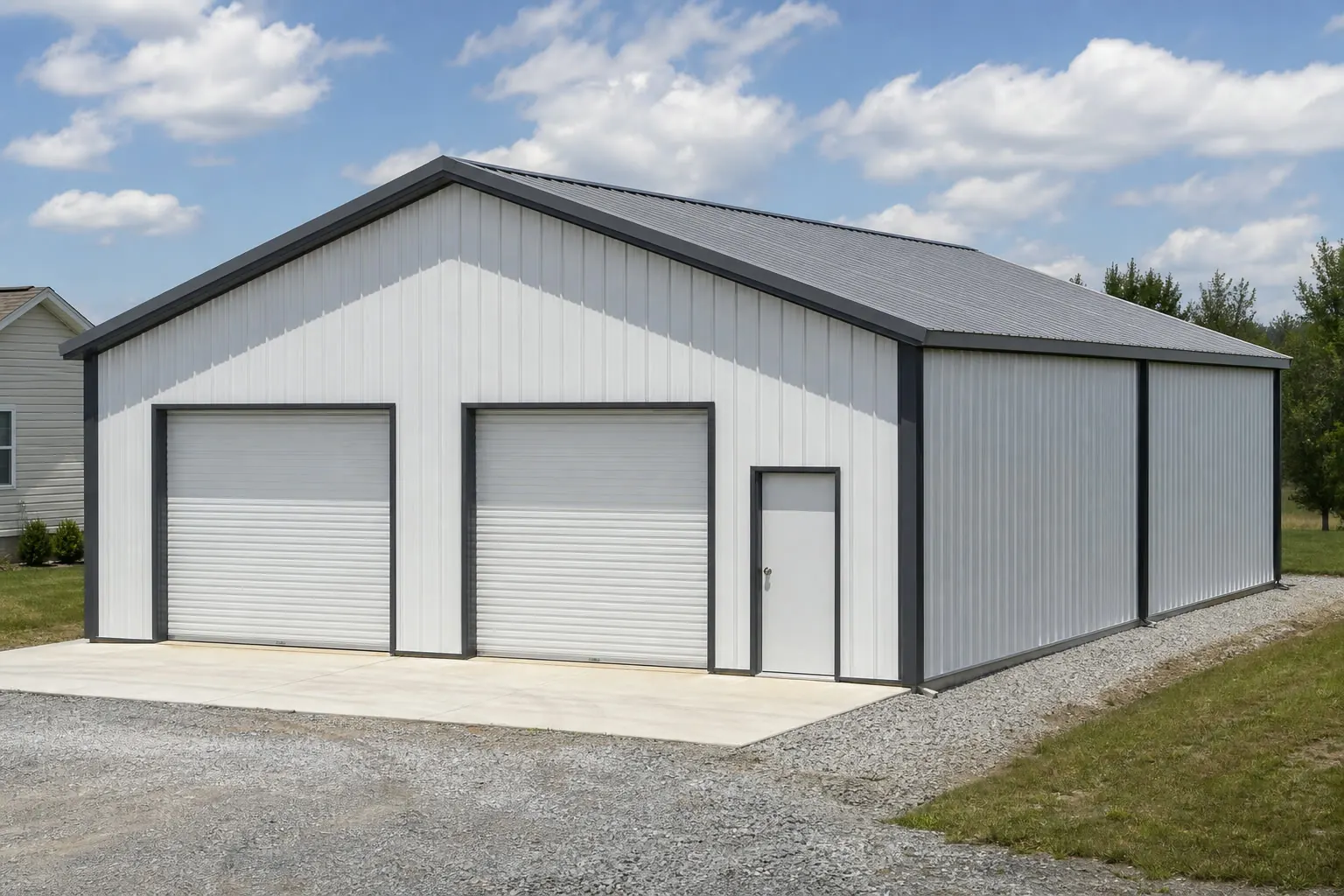
Ground conditions
Delta soil, loess bluffs and Coastal Plain ground are not interchangeable
Mississippi's usable building ground splits into distinct land-resource areas, and that split is a real input to a metal garage's pad and drainage plan.
Mississippi State University Extension's own land-resource-area material identifies the Mississippi Delta as an alluvial-plain region, its soils formed from sediments the Mississippi River deposited over time, and treats it as distinct from the loess bluffs and Coastal Plain that cover most of the rest of the state. A metal garage pad going into Delta alluvium is sitting on materially different soil behavior than one going into loess or coastal ground, which is a reasonable trigger for a site-specific soil check rather than a copied spec from a neighboring county.
This matters for a metal garage specifically because the structure is fully enclosed and typically slab-mounted: standing water, drainage and how a pad settles over its first few seasons show up as sealed-door misalignment or moisture intrusion faster in an enclosed building than in an open carport. Grading the pad to shed water away from the structure, and confirming compaction before the slab is poured, is worth raising with your builder regardless of which of Mississippi's regions the parcel sits in.
None of this becomes a required slab thickness or a compaction spec on this page. Those numbers come from your builder's engineering and, where a permit applies, your local building department. What changes here is that a Mississippi buyer has a documented reason — MSU Extension's own regional soil distinction — to ask the site-prep question before finalizing a foundation type.
Buyer context
Fewer, larger farms are changing what a Mississippi garage buyer stores
USDA's most recent Census of Agriculture shows Mississippi farms shrinking in number while total farmed acreage holds closer to steady, a consolidation pattern that shapes equipment-storage demand.
USDA NASS counted 31,290 farms in Mississippi in 2022, an 11% decrease from 2017, while total land in farms fell by only 2% to 10,251,497 acres, putting the average farm size at 328 acres. A double-digit drop in farm count against a much smaller drop in farmed acreage points toward fewer, larger operations rather than an even statewide decline, and larger operations more often want a single enclosed, lockable bay for consolidated equipment rather than several smaller open sheds spread across separate parcels.
Set against that farm trend, the Census Bureau recorded 7,700 new privately-owned housing units authorized statewide in 2023, including 7,145 single-family buildings. That is a meaningful residential base independent of agriculture, and a share of Mississippi metal garage enquiries are ordinary residential additions — a second bay, a workshop — rather than farm structures, which is why this page treats farm and residential buyers as two separate profiles rather than one blended average.
- Consolidating farm operation
- Wants a single enclosed, lockable bay sized for larger, consolidated equipment rather than several smaller sheds.
- Residential addition
- Wants a garage that matches an existing house and fits inside an active, ordinary local building-permit pattern.
- Both profiles
- Should confirm soil and drainage conditions for their specific land-resource area before finalizing a foundation.
Hazard awareness
Mississippi's county-level hazard scores run above the national middle
FEMA's own data puts Mississippi's average county hazard score above the middle of the national range, which is a reason to check a specific county rather than assume a uniform statewide exposure.
FEMA's National Risk Index reports a mean composite risk score of 50.9 out of 100 across Mississippi's 82 counties, a figure FEMA itself describes as among the higher state averages nationally. That is a statewide mean, not a per-county guarantee, so the practical use of this figure for a metal garage buyer is as a prompt to pull the actual score for the specific county where the garage will be sited, since 82 counties averaging 50.9 can still include counties well above or below that number.
NWS Jackson also compiles long-run Storm Data statistics on Mississippi's tornado history covering 1950 through 2021, and a Mississippi State University Extension bulletin documents the frequency and distribution of thunderstorms, lightning and tornadoes across the state. Together these point toward anchoring and door-track detailing being worth a specific conversation with your builder, rather than a generic assumption carried over from a lower-hazard state.
None of this sets a required wind rating or anchoring spec here — that is your builder's engineering and your local building department's call, tied to your parcel's actual county-level exposure.
Get Mississippi metal garage quotes
Tell us your county and whether you need vehicle or equipment storage. We route it with the Mississippi and metal-garage context already attached.
Configuration
What Mississippi metal garages are usually asked to do
Consolidated equipment storage, residential vehicle bays and workshop combinations are the recurring Mississippi use cases this evidence points toward.
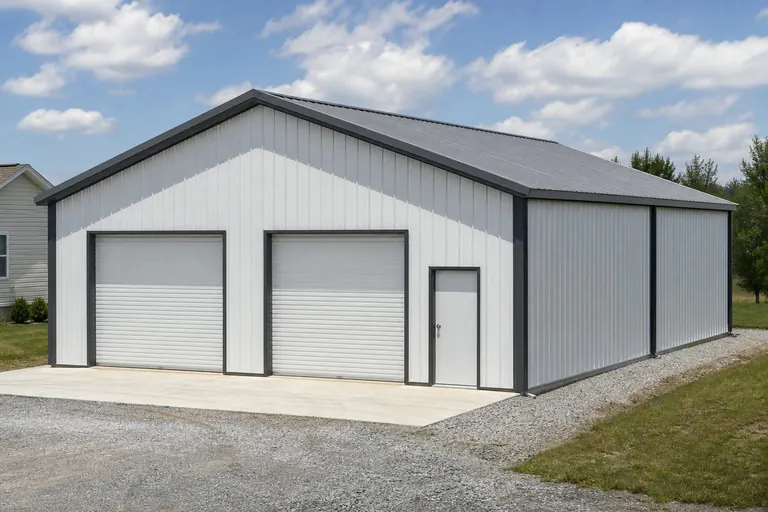 Consolidated equipment bayLockable, enclosed storage sized for larger machinery on a consolidated farm parcel, favoring capacity over multiple smaller sheds.Residential vehicle storageWeather- and moisture-sealed storage for one to three vehicles added to an existing house.Garage-plus-workshopA garage bay combined with a workshop area, common where residential permitting activity stays steady.
Example Configuration — for planning purposes only.
Footprint
Sizes that suit Mississippi vehicle and equipment storage
Mississippi enquiries generally range from a single residential bay up to a multi-bay footprint for a consolidated farm operation.
24′ × 30′
720 sq ft
A single- to two-vehicle residential garage, the common Mississippi enquiry.
30′ × 40′
1,200 sq ft
Two-to-three vehicles or one vehicle plus a workshop bay.
40′ × 60′
2,400 sq ft
Multi-bay equipment storage suited to a consolidated Mississippi farm operation.
Example Configuration — for planning purposes only.
Footprint pages carry the layout detail for each of these; this page only explains why the Mississippi brief lands in this range.
Preparation
Before you request a Mississippi metal garage quote
A few things resolved in advance keep the quote comparable and the structure suited to your parcel's land-resource area.
Step 1
Identify your land-resource area
Confirm with MSU Extension or your local office whether the parcel sits on Delta alluvium, loess or Coastal Plain ground before fixing a foundation type.
Step 2
Pull your county's FEMA NRI score
Check the specific county score rather than relying on the statewide 50.9 average.
Step 3
Contact your local building department
Confirm what your county and parcel require before finalizing slab, anchoring or door placement.
Step 4
Decide vehicle vs. equipment use
Door height, bay width and floor spec differ between a passenger-vehicle garage and a consolidated equipment bay.
Step 5
Plan ventilation up front
Ridge, gable or powered ventilation is worth specifying before the structure is finished given the humid, year-round rainfall pattern NWS Jackson describes.
Questions
Mississippi metal garage questions
Questions we can answer honestly at state level, with the ones we cannot routed to whoever actually owns them.
Yes — MSU Extension's own land-resource-area material distinguishes Delta alluvial soils from loess and Coastal Plain ground elsewhere in the state, so a site-specific soil check before the slab is a reasonable step regardless of which region you're in.
FEMA's National Risk Index puts Mississippi's 82-county mean composite score at 50.9 out of 100, which FEMA describes as among the higher state averages nationally, but that is a statewide mean — check your specific county's score for an accurate picture.
Permit requirements depend on your county and municipality. Your local building department is the only reliable source for that answer.
It depends on your use: a fully enclosed metal garage suits lockable, weather-controlled storage, while a pole barn suits larger open bays. Discuss your specific equipment list with your builder.
There is no official typical size, but USDA's data shows Mississippi farms consolidating toward fewer, larger operations (averaging 328 acres), which tends to favor multi-bay footprints over single-vehicle sizes.
We do not publish state-level prices; a credible number depends on your specification and site work. Our cost pages cover what drives the number.
Sources for the Mississippi facts on this page
This page states no code requirement, wind speed, snow load, permit rule, price or supplier claim. The state-specific facts it does use are listed with their publisher below.
Mississippi State University Extension identifies the Mississippi Delta as an alluvial-plain land resource area with soils formed from sediments left by the Mississippi River, distinct from the state's loess and coastal-plain regions.
Mississippi State University Extension Service · Extension reference material · Tier 2
https://extension.msstate.edu/agriculture/soils/mississippi-land-resource-areasMississippi had 31,290 farms in 2022, an 11% decrease since 2017.
USDA National Agricultural Statistics Service (NASS) · 2022 · Tier 1
https://www.nass.usda.gov/Publications/AgCensus/2022/Online_Resources/County_Profiles/Mississippi/cp99028.pdfMississippi had 10,251,497 acres of land in farms in 2022, a 2% decrease since 2017, with an average farm size of 328 acres.
USDA NASS · 2022 · Tier 1
https://www.nass.usda.gov/Publications/AgCensus/2022/Online_Resources/County_Profiles/Mississippi/cp99028.pdfFEMA's National Risk Index reports Mississippi's 82 counties with a mean composite NRI risk score of 50.9 on FEMA's 0-100 relative scale (v1.20 release), among the higher state averages nationally.
Federal Emergency Management Agency (FEMA) · NRI v1.20 dataset · Tier 1
https://www.fema.gov/flood-maps/products-tools/national-risk-indexBuilding permit offices in Mississippi authorized construction of 7,700 new privately-owned housing units in 2023 (7,145 single-family buildings plus multi-unit structures).
U.S. Census Bureau · 2023 (final annual) · Tier 1
https://www2.census.gov/econ/bps/State/st2023a.txtNWS Jackson publishes 1991-2020 climate normals information for its Mississippi forecast area, describing a humid subtropical climate with year-round rainfall potential.
National Weather Service (NOAA), Jackson MS office · 1991-2020 · Tier 1
https://www.weather.gov/jan/climatenormals1991-2020