
Metal garage · TN
Metal Garages in Tennessee
Nashville's National Weather Service station has published climate records referencing the 1991-2020 normal period with a period of record dating back to 1871, one of the longer continuous local climate histories available for any Tennessee building site. That long record is useful context, but it describes one station, not the whole state: Tennessee runs over 500 miles from the Mississippi River lowlands to the Appalachian highlands, and the Tennessee Division of Geology has separately documented overthrust structure specific to the Cumberland Plateau in the east. A metal garage's slab and drainage plan should be set from the actual site's terrain and local weather station data, not from a single number applied statewide.
Reading Local Climate Data
A long climate record, but a single station
Nashville's unusually long climate record is a useful reference, not a statewide number a Tennessee garage can be designed around blind.
The National Weather Service's Nashville office publishes annual and monthly climate reports for the Nashville station that reference the current 1991-2020 climate normal period while also noting a period of record dating back to 1871. That is a genuinely long station history, useful for understanding how conditions in Middle Tennessee have shifted over a century and a half.
It is still one station. Tennessee is a narrow state running over 500 miles from the Mississippi River lowlands in the west to the Appalachian highlands in the east, and a garage sited near either end of that span is not necessarily experiencing Nashville's conditions. The right move for any Tennessee garage build is to pull climate normals for the nearest official NWS or NCEI station to the actual site, not to apply Nashville's numbers statewide by default.
Terrain adds a second layer to that same caution. The Tennessee Division of Geology has separately documented overthrust structure specific to the Cumberland Plateau in the east, distinct from both the Nashville area and the western lowlands. A garage slab plan should reflect the site's actual regional geology as much as its actual regional climate station.
Slab Planning
Slab and drainage priorities by general Tennessee region
Foundation priorities shift with the terrain a garage sits on.
| General Region | Terrain Note | Slab/Drainage Priority |
|---|---|---|
| West Tennessee | Mississippi River lowlands (NOAA NCEI) | Grading for standing-water drainage away from the slab. |
| Middle Tennessee (Nashville area) | Long NWS climate station record since 1871 | Use the local station's actual normals rather than a statewide assumption when sizing gutters and apron slope. |
| East Tennessee (Cumberland Plateau) | Overthrust structure (TN Division of Geology) | Confirm soil-bearing conditions before pouring; consider a geotechnical check on sloped or plateau lots. |
West Tennessee
- Terrain Note
- Mississippi River lowlands (NOAA NCEI)
- Slab/Drainage Priority
- Grading for standing-water drainage away from the slab.
Middle Tennessee (Nashville area)
- Terrain Note
- Long NWS climate station record since 1871
- Slab/Drainage Priority
- Use the local station's actual normals rather than a statewide assumption when sizing gutters and apron slope.
East Tennessee (Cumberland Plateau)
- Terrain Note
- Overthrust structure (TN Division of Geology)
- Slab/Drainage Priority
- Confirm soil-bearing conditions before pouring; consider a geotechnical check on sloped or plateau lots.
Hazard & Wind Planning
Confirming your specific county's exposure before finalizing specs
FEMA's county-level tool, not a statewide figure, is the right reference for a Tennessee garage's structural detailing.
- Pull your county's FEMA National Risk Index scoreFEMA's National Risk Index provides county- and tract-level natural hazard risk scoring for Tennessee; use your specific county's data when specifying anchoring and wind resistance.
- Use the nearest station's climate normals, not a statewide guessNWS Nashville's published normals reference the 1991-2020 period specifically for the Nashville station; a garage sited elsewhere in Tennessee should reference its own nearest station.
- Treat long-range warming projections as planning contextNOAA's 2022 State Climate Summary notes little overall warming in Tennessee to date but projects historically unprecedented warming later this century, useful for long-range material and ventilation choices rather than an immediate spec change.
- Confirm drainage sizing locally given the declared data gapA single official statewide precipitation normal for Tennessee was not confirmed in this review; size gutters and apron drainage from the nearest official station's data instead of an assumed statewide figure.
Configuration
Garage setups suited to Tennessee's terrain range
How siting decisions change across Tennessee's documented terrain span.
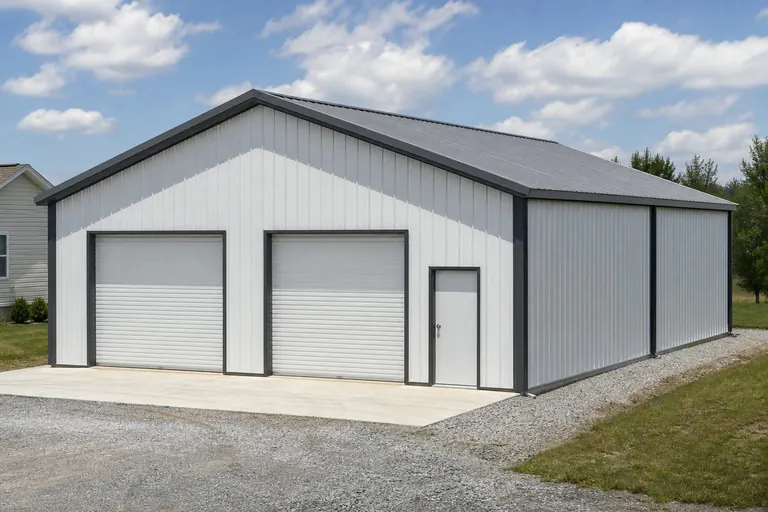 The Lowland Drainage GarageElevated slab and graded apron for west Tennessee's flatter, Mississippi-adjacent ground.The Middle Tennessee Standard GarageA conventional slab plan referenced against the long Nashville-area station record for local normals.The Plateau Site-Check GarageA garage plan that starts with a soils review given the Cumberland Plateau's documented overthrust structure.
Example Configuration — for planning purposes only.
Get your Tennessee garage quote
Tell us your county and terrain, and we'll connect you with builders who plan Tennessee garages site by site.
Regional Siting
What changes for a metal garage across Tennessee's three general regions
West, Middle and East Tennessee each hand a metal garage builder a different starting condition before the slab goes in.
West Tennessee
Flatter, Mississippi-adjacent lowland ground per NOAA NCEI's regional narrative, where grading for drainage away from the garage slab is typically the main site-prep task.
Middle Tennessee
Home to the long-running Nashville climate station; a garage sited here can lean on that record's normals more directly than a site farther from any long-term station.
East Tennessee
Cumberland Plateau overthrust structure documented by the Tennessee Division of Geology means a soils check before pouring is worth the extra step on plateau or sloped lots.
Popular Sizes
Sizing a Tennessee metal garage
Footprint choice depends more on intended use than on which Tennessee region the garage sits in.
24′ × 24′
576 sq ft
A standard two-car footprint suited to a Middle Tennessee suburban lot.
30′ × 40′
1,200 sq ft
Room for a workbench or small equipment bay alongside vehicle storage on a larger parcel.
40′ × 60′
2,400 sq ft
Sized for a larger vehicle, trailer or small shop area, more common on rural West or East Tennessee acreage.
Example Configuration — for planning purposes only.
Confirm door height against your tallest vehicle or trailer, and check your specific county's setback rules before finalizing placement.
Permits & Site Sequencing
Working with county code offices and existing farm access on rural lots
Tennessee has no single statewide accessory-structure permit rule; the practical sequencing question on many rural lots is fitting a garage into land already built around farm access.
Tennessee's building-permit authority sits with individual county and city offices rather than a single state building code office issuing uniform accessory-structure rules, so the first concrete step for any metal garage build is confirming the applicable code and setback requirements with the specific county or city office covering the lot, not assuming a rule that applied on a different Tennessee property still applies here.
The University of Tennessee Institute of Agriculture's Center for Profitable Agriculture has analyzed 2022 Census of Agriculture data on value-added agriculture and specialty crop trends across Tennessee, and USDA NASS separately maintains the underlying farm-count and land-in-farms tables for the state. Neither source is a garage-specific rule, but together they describe a real pattern worth planning around: many rural Tennessee parcels already carry working farm infrastructure, so a new garage's driveway tie-in and slab orientation should be sequenced against existing equipment access lanes and gate locations rather than sited as if the property were an empty lot.
That sequencing matters most at the site-prep stage, before the slab is ordered. Confirming the county's setback and permit requirements, then mapping the garage's door orientation against any existing farm access lane or driveway apron, avoids a rework where a poured slab later conflicts with equipment turning radius or a required setback the county office flags after the fact.
Questions
Tennessee Metal Garage Questions
Direct answers about siting and building a metal garage across Tennessee.
Not reliably. NWS Nashville's published normals, referencing the 1991-2020 period and a record back to 1871, describe the Nashville station specifically. A site in west or east Tennessee should reference its own nearest official station instead.
It can. The Tennessee Division of Geology has documented overthrust structure specific to the Cumberland Plateau in the east, distinct from the flatter Mississippi lowlands in the west. A local soils check is the most reliable way to confirm which conditions apply to your lot.
Use FEMA's National Risk Index, which provides county- and tract-level natural hazard risk scoring for Tennessee. Check your specific county rather than relying on a single statewide figure.
NOAA's 2022 State Climate Summary reports little overall warming in Tennessee to date, with more significant warming projected later this century. That is useful long-range context, but it does not change near-term slab or drainage specs.
A single confirmed statewide annual precipitation normal for Tennessee was not available in this review. Use the annual normal published for the official NWS or NCEI station nearest your actual site instead of an assumed statewide number.
Sources for the Tennessee facts on this page
This page states no code requirement, wind speed, snow load, permit rule, price or supplier claim. The state-specific facts it does use are listed with their publisher below.
NWS Nashville publishes annual and monthly climate reports for the Nashville station referencing the 1991-2020 climate normal period, with a period of record dating back to 1871.
National Weather Service (NOAA), Nashville TN office · 1991-2020 normal period · Tier 1
https://www.weather.gov/ohx/bnaclimateThe Tennessee Encyclopedia's Geologic Zones entry notes Tennessee is a narrow state over 500 miles long, with its long east-west axis crossing the grain of the underlying geology, so that most of the geological provinces of the east-central United States are represented somewhere within the state.
Tennessee Historical Society / Tennessee Encyclopedia · Reference entry · Tier 2
https://tennesseeencyclopedia.net/entries/geologic-zones/The Tennessee Division of Geology (State of Tennessee, Department of Conservation) has published detailed geologic studies of the Cumberland Plateau overthrust and the Crab Orchard Mountains area, documenting the geologic structure of the Cumberland Plateau region in the state.
Tennessee Department of Conservation, Division of Geology (now Tennessee Geological Survey) · Originally published 1954; state agency archival document · Tier 2
https://www.tn.gov/content/dam/tn/environment/geology/documents/geology_bulletin-60txt.pdfNOAA's 2022 State Climate Summary reports Tennessee, like much of the southeastern U.S., has experienced little overall warming since the beginning of the 20th century, though historically unprecedented warming is projected this century, and future droughts are projected to be more intense due to faster soil-moisture depletion at higher temperatures.
NOAA National Centers for Environmental Information (NCEI) · 2022 summary · Tier 1
https://statesummaries.ncics.org/downloads/Tennessee-StateClimateSummary2022.pdfFEMA's National Risk Index is the federal tool providing county- and tract-level natural hazard risk scoring (including tornado, severe storm, and riverine flooding categories relevant to Tennessee) for all Tennessee counties; a state-specific hazard narrative directly from FEMA was not retrieved in this session.
Federal Emergency Management Agency (FEMA) · Current NRI release · Tier 1
https://www.fema.gov/flood-maps/products-tools/national-risk-indexThe University of Tennessee Institute of Agriculture's Center for Profitable Agriculture published an analysis of 2022 Census of Agriculture data covering value-added agriculture and specialty crop production trends in Tennessee.
University of Tennessee Institute of Agriculture, Center for Profitable Agriculture · 2022 Census, published June 2024 · Tier 2
https://cpa.tennessee.edu/wp-content/uploads/sites/106/2024/07/CPA436.pdfUSDA NASS's 2022 Census by State page provides direct access to Tennessee's state-level farm count, land-in-farms, and average farm size tables as part of the 2022 Census of Agriculture.
USDA National Agricultural Statistics Service (NASS) · 2022 · Tier 1
https://www.nass.usda.gov/Census_by_State/Tennessee/