
Metal garage · AL
Metal Garages in Alabama
A metal garage in Alabama sits at the intersection of two facts: the state authorized 20,337 new housing units in 2023, so local building departments handle accessory-structure permits routinely, and Alabama's ground itself is unusually varied. The Alabama Cooperative Extension System maps seven distinct soil areas across the state, from the dark, heavy clay of the Black Belt Prairie to the sandy Coastal Plain in the south, and NOAA describes a statewide humid subtropical climate with hot, humid summers. None of that gets resolved by a single statewide garage spec — the slab, drainage, and ventilation plan that clears review depends on which of those soil areas and moisture conditions your specific lot sits in.
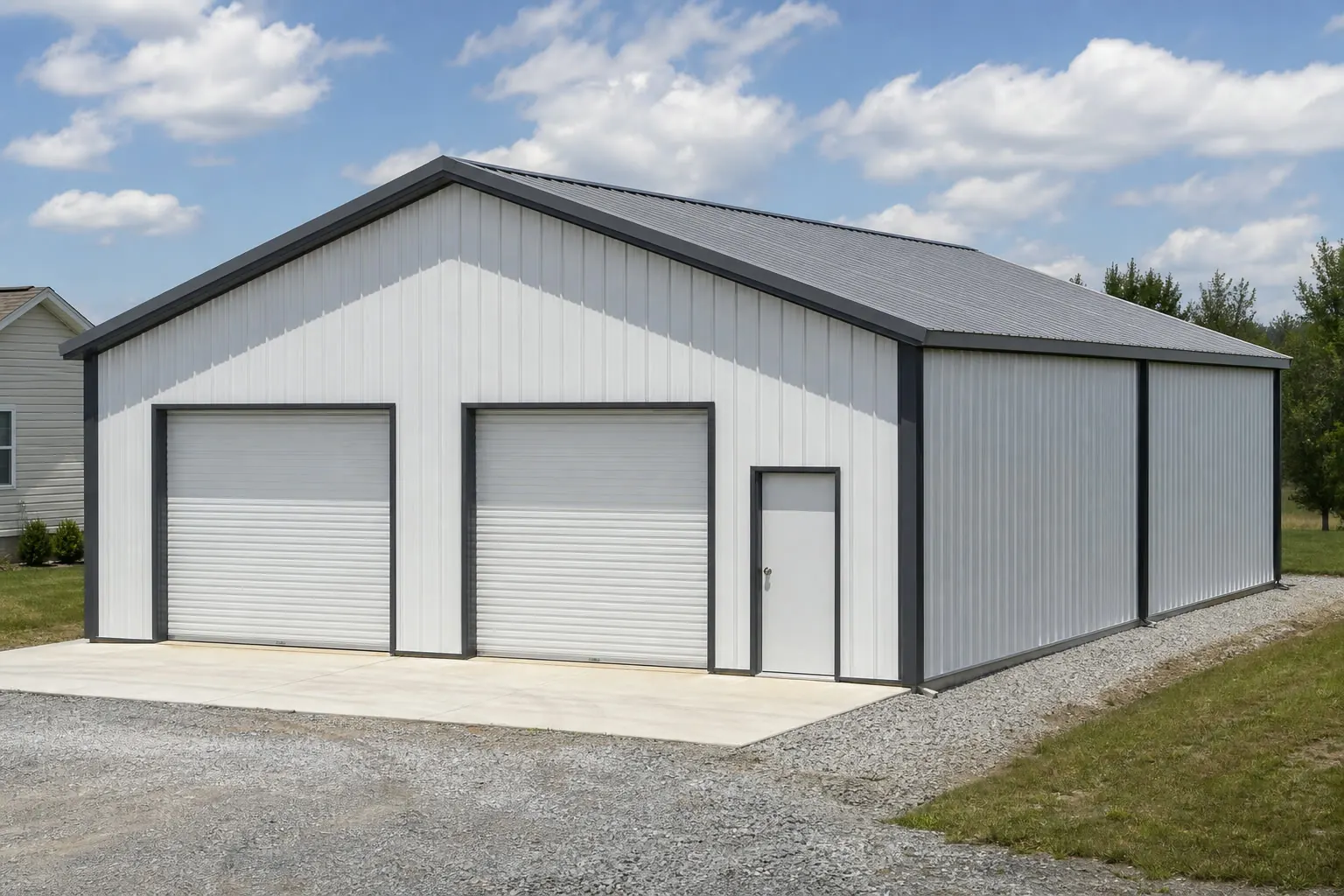
Protecting Your Assets
Garages sited for Alabama's soil map
Alabama's steady permit volume and unusually varied ground both push metal garage design past a generic two-car box.
With 20,337 new housing units authorized statewide in 2023, up 4.3% from the year before, Alabama's building departments process accessory-structure permits, including garages, as routine business rather than a rare filing. That predictable review process means the real design variable is what's under the slab, not the paperwork above it.
The Alabama Cooperative Extension System identifies seven major soil areas statewide, based on an NRCS soil-area map, including the Limestone Valleys and Uplands, the Blackland Prairie, and the Coastal Plain. A garage in the Black Belt sits on dense, dark clay that shrinks and swells with moisture, while one on the Coastal Plain sits on sand that drains quickly but holds less resistance to standing water during wet stretches.
NOAA's climate narrative for Alabama describes a humid subtropical pattern with mild winters and hot, humid, Gulf-influenced summers statewide. That baseline humidity, not just occasional storms, is what a garage's ventilation and vapor-barrier plan needs to be built around.
Dimensions
Common Alabama garage footprints
Selecting a size that fits both suburban vehicle storage and, on rural land, mixed equipment use.
20′ × 20′
400 sq ft
A standard two-car garage suitable for suburban lots around Birmingham and Huntsville.
24′ × 30′
720 sq ft
Adds room for a workbench, a common step-up on Piedmont Plateau commuter lots.
30′ × 40′
1,200 sq ft
A frequent rural choice, sized to hold two vehicles plus a tractor or trailer on larger acreage.
Example Configuration — for planning purposes only.
Larger footprints are common on Alabama's working land, where the average farm spans 231 acres, per the 2022 Census of Agriculture, giving owners room to combine vehicle and equipment storage in one structure.
Configuration
Specialized Alabama garage setups
How owners tailor a garage to their specific soil area and use case.
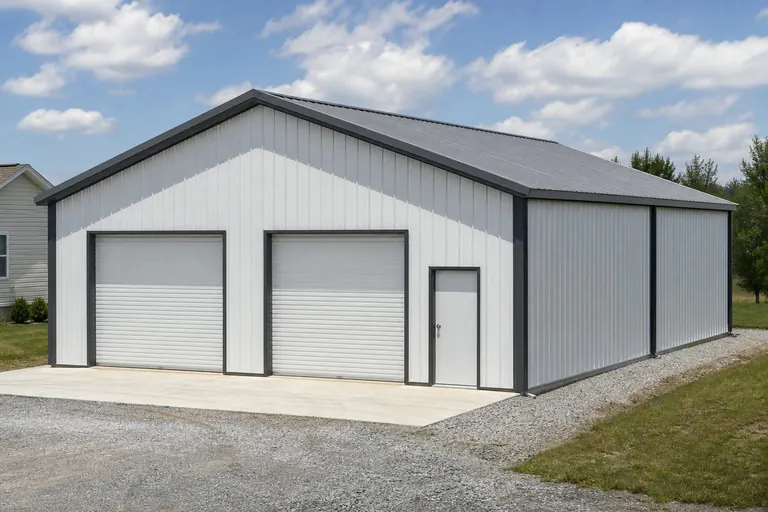 The Black Belt Reinforced GarageA thickened, reinforced slab designed to resist Blackland Prairie clay's seasonal shrink-swell movement.The Coastal Plain Drainage GarageAn elevated pad and strong perimeter grading to manage sandy soil and sustained humid-season rainfall.The Working-Land Equipment GarageA wide clear-span layout sited for combined vehicle and farm equipment storage on larger rural parcels.
Example Configuration — for planning purposes only.
Get your Alabama garage quote
Tell us your location and storage needs, and we'll connect you with local experts who understand Alabama's soil and climate conditions.
Foundation & Soil
The slab: Alabama's most site-specific decision
Alabama's seven-soil-area map means the right foundation approach changes from county to county.
In the Black Belt's Blackland Prairie clay, the defining risk is seasonal movement. A garage slab there benefits from a thickened, reinforced edge and continuous rebar or wire mesh to resist the cracking that untreated clay movement causes over a few years.
On the Coastal Plain, which the Alabama Cooperative Extension System maps as one of the state's seven soil areas, sandy soil drains quickly but offers little resistance to standing water during Alabama's humid, Gulf-influenced wet stretches. There, the priority shifts to grading the pad to shed water rather than reinforcing against soil movement.
- Reinforced Slab
- Recommended in Black Belt and other clay-heavy soil areas to resist seasonal shrink-swell.
- Elevated, Graded Siting
- A practical measure on Coastal Plain sand given Alabama's sustained Gulf-influenced humidity.
- Site-Specific Soil Check
- The reliable way to confirm which of Alabama's seven soil areas applies to your lot.
Siting & Access
Door orientation and delivery access across a big state
Alabama's 50,645.3 square miles mean a garage kit shipped to Huntsville and one shipped to Mobile travel very different routes, and the same distance argues for orienting the door away from prevailing wet-season wind.
Alabama spans 50,645.3 square miles of land, per the U.S. Census Bureau, which is compact next to Texas but still wide enough that a single statewide delivery timeline is unrealistic. A metal garage kit headed to a Coastal Plain address in Mobile County crosses more miles of two-lane road than one headed to a Piedmont Plateau lot outside Birmingham, so confirming site access, driveway width, and unloading space with your builder before delivery day avoids a stalled truck at the curb.
Door orientation is a smaller decision that still benefits from local knowledge. Because Alabama's wettest, most humid weather tends to move in off the Gulf from the south and southeast, siting the roll-up door away from that exposure, where the site allows it, reduces how much wind-driven rain reaches the garage interior during a summer storm.
Seasonal Readiness
Seasonal checks for an Alabama garage
A metal garage protects vehicles daily, but Alabama's humidity and storm exposure both deserve a short seasonal checklist.
Step 1
Confirm your county's FEMA NRI hazard profile
FEMA's National Risk Index scores hurricane, tornado, and flooding exposure across 18 hazard types by county; check yours, such as Mobile or Jefferson, before finalizing anchoring specs.
Step 2
Regrade the apron for drainage
Given Alabama's Gulf-influenced, sustained precipitation pattern, regrading the apron so water flows away from the garage entrance prevents standing water at the threshold.
Step 3
Inspect for condensation and rust
Alabama's humid subtropical climate accelerates interior condensation on unventilated steel; a seasonal check catches early corrosion before it spreads.
Step 4
Plan for severe thunderstorm and tornado season
Alabama sees regular severe convective weather statewide; secured anchoring and properly rated doors reduce wind-related damage risk.
Step 5
Ask about footing depth rather than assuming a deep frost line
NOAA's 1991-2020 Birmingham climate normals show mild winter lows, so Alabama footing depth is typically set by soil type and drainage rather than the deep frost-heave allowance common in colder states; confirm the actual requirement with your local building department.
Questions
Alabama Metal Garage FAQ
Answering local questions about building and owning a metal garage in Alabama.
In nearly all cases, yes. Because a garage is a structural building often paired with a concrete slab and electrical service, your local building department will require a permit and inspections to confirm it meets safety standards.
Yes. The Alabama Cooperative Extension System maps seven soil areas statewide; Black Belt clay generally needs a reinforced slab, while Coastal Plain sand needs elevated siting and stronger drainage grading. A local soil check confirms which applies to your lot.
NOAA describes Alabama's climate as humid subtropical with hot, humid, Gulf-influenced summers, so ventilation and a vapor barrier under the slab are worth building in from the start rather than adding later.
Starting with high-quality galvanized steel is the first step. Ensuring a vapor barrier under the slab and adequate ventilation reduces the interior condensation that leads to corrosion.
It's a good practice. FEMA's National Risk Index scores hurricane, tornado, and flood exposure by county across 18 hazard types, so checking your specific county gives a more accurate picture than assuming a single statewide risk level.
It can. At 50,645.3 square miles, a kit delivered to a Coastal Plain address travels a longer route than one going to a Piedmont Plateau lot near Birmingham, so confirming driveway width and unloading space with your builder ahead of delivery day is worth doing regardless of where in the state you're building.
Sources for the Alabama facts on this page
This page states no code requirement, wind speed, snow load, permit rule, price or supplier claim. The state-specific facts it does use are listed with their publisher below.
Alabama had 20,337 total housing units authorized by building permits in 2023, up 4.3% from 19,499 in 2022.
U.S. Census Bureau · 2023 (annual) · Tier 1
https://www.census.gov/construction/bps/pdf/2023annualhighlights.pdfThe Alabama Cooperative Extension System identifies seven major soil areas across the state, including the Limestone Valleys and Uplands, Blackland Prairie, Coastal Plain, Major Flood Plains and Terraces, Coastal Marshes and Beaches, Appalachian Plateau, and Piedmont Plateau, based on an NRCS soil-area map.
Alabama Cooperative Extension System (Auburn University) · ACES reference publication · Tier 2
https://www.aces.edu/blog/topics/crop-production/major-soil-areas-of-alabama/The Alabama Black Belt, named for its dark, rich prairie soils, spans roughly 12 to 21 counties across the central part of the state depending on the criteria used to define it.
Encyclopedia of Alabama (Auburn University / Alabama Humanities Alliance) · Reference article · Tier 2
https://encyclopediaofalabama.org/article/black-belt-region-in-alabama/NOAA NCEI publishes a narrative 'Climate of Alabama' describing the state's humid subtropical climate with mild winters and hot, humid summers, and Gulf-influenced precipitation.
NOAA National Centers for Environmental Information (NCEI) · Historical narrative (NCEI climate normals series) · Tier 1
https://www.ncei.noaa.gov/data/climate-normals-deprecated/access/clim60/states/Clim_AL_01.pdfFEMA's National Risk Index is an interactive county/tract-level tool covering 18 natural hazards, including hurricane, tornado, flooding, and wildfire, that can be queried for Alabama counties such as Mobile and Jefferson.
Federal Emergency Management Agency (FEMA) · Current NRI release · Tier 1
https://www.fema.gov/flood-maps/products-tools/national-risk-indexNOAA NCEI's 1991-2020 climate normals for Birmingham Airport list station-level monthly and annual temperature, precipitation, and degree-day data for the Birmingham area.
NOAA National Centers for Environmental Information (NCEI) · 1991-2020 · Tier 1
https://www.ncei.noaa.gov/access/services/data/v1?dataset=normals-monthly-1991-2020&endDate=9996-12-31&format=pdf&startDate=0001-01-01&stations=USW00013876Alabama's total land area was measured at 50,645.3 square miles as of the 2010 Census.
U.S. Census Bureau · 2010 Census · Tier 1
https://www.census.gov/geographies/reference-files/2010/geo/state-local-geo-guides-2010/alabama.html