
Livestock barn · KS
Livestock Barns in Kansas
Livestock housing in Kansas is defined by the state's 44,794,702 acres in farms and a massive 804-acre average parcel size. This scale, combined with the rocky substrate of the Flint Hills and a climatic transition from humid to semi-arid, creates a specific set of planning requirements. Whether you are protecting cattle from high-plains wind and hail or managing runoff in the tallgrass prairie, a Kansas livestock barn must be built for resilience. The honest story here is about decentralized shelter: structures that work with the landscape's natural drainage and provide vital protection across a sprawling agricultural footprint.
Landscape and Use
Building for the Unplowed Prairie
In the Flint Hills, livestock barns aren't just buildings; they are strategic outposts on one of the few remaining areas of unplowed tallgrass prairie.
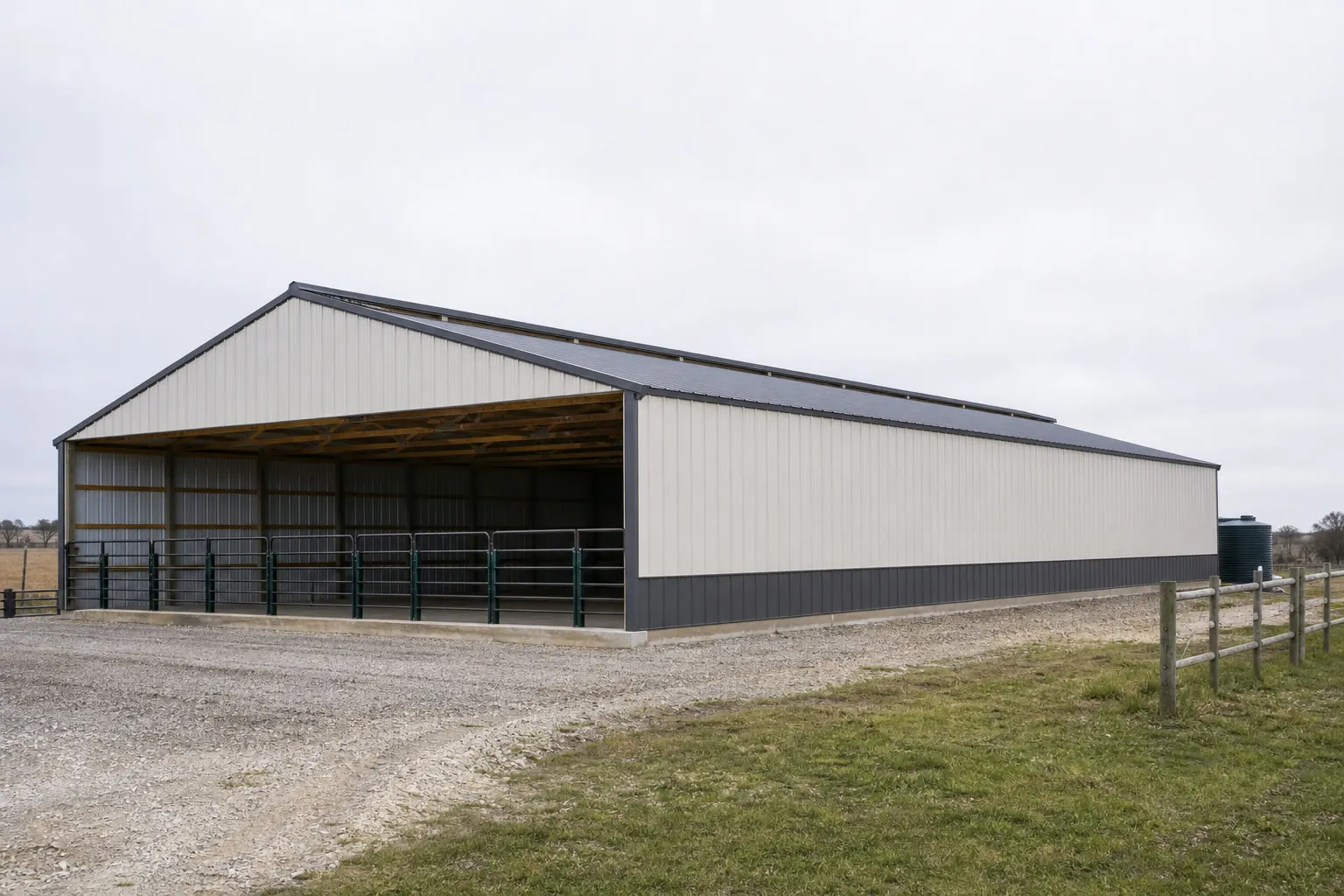
The Kansas Geological Survey notes that the Flint Hills region was historically too rocky to plow, thanks to eroded Permian-age limestones. This has preserved a massive grazing economy that relies on native grasses. For a livestock barn buyer, this means your building is likely serving cattle that spend most of their time on open range. Kansas's grazing-based cattle economy on the unplowed Flint Hills prairie favors open-sided or three-sided run-in barns over enclosed dairy-style structures, since cattle already spend most of their time on open range and simply need a reprieve from the intense sun and the severe wind and hail identified by FEMA as primary Kansas hazards.
Siting a barn in this rocky terrain requires an honest assessment of the ground. Because the soil is thin and the limestone is hard, traditional post-frame construction may be cost-prohibitive. Wet-set brackets on a concrete pad or specialized rock-anchoring systems are often the practical path forward. The goal is to create a structure that stays put during a plains windstorm while providing a dry, protected space for livestock without requiring deep excavation into the Permian substrate.
Environmental Management
Managing the Humid-to-Semi-Arid Gradient
The way you manage air and water in a Kansas livestock barn depends entirely on which side of the state you are building.
Kansas serves as a transition zone between the humid east and the semi-arid west, according to NOAA NCEI. In the eastern third of the state, where humidity is higher and precipitation is more frequent, the primary planning challenge for livestock is mud and moisture management. Barns here must be sited on a positive slope, and large footprints require dedicated gutter and downspout systems to move water away from high-traffic animal areas. Condensation inside the roof can also be a significant issue, requiring 'drip-stop' coatings or insulation to prevent moisture from falling on the animals.
As you move into the semi-arid west, the challenge flips. Humidity is lower, but the sun is more intense and the wind is more persistent. Here, livestock barns are primarily shade structures and windbreaks. Eave heights should be kept high enough to allow for maximum natural airflow, but the building's orientation must be tuned to block the prevailing winter winds. Dust control also becomes a factor; tight seals on the windward side can prevent the interior from becoming a dust bowl during dry summer months.
- East Kansas: Drainage First
- Focus on site elevation and water redirection to prevent mud-related livestock diseases.
- West Kansas: Wind & Shade
- Prioritize building orientation and ventilation to manage heat and winter exposure.
- Scale Efficiency
- On 804-acre average farms, smaller distributed barns can be more efficient than one central complex.
Geographic Specificity
Kansas Livestock Regions
The state's 81,758.7 square miles dictate different livestock housing strategies based on local geology.
Flint Hills (Grazing Belt)
Focus on open-front shelters for cattle. Requires rock-specific foundation work due to Permian limestone.
High Plains (Western KS)
Focus on massive shade structures and wind protection. Deep soils make foundation work easier, but wind loads are a major qualitative factor.
Eastern Valleys
Enclosed or semi-enclosed barns are more common here to protect against higher rainfall and humidity.
Protect Your Herd with a Kansas Livestock Barn
Built for the rocky Flint Hills and the high-plains wind. Request a quote for a cattle-ready shelter today.
Buyer Decision
One Central Barn or Several Distributed Shelters?
On an 804-acre Kansas parcel, the decision between one large livestock barn and several smaller shelters usually comes down to how far cattle travel to water and feed.
A single centralized barn concentrates construction and is easier to service, but on a farm this size it can leave cattle grazing a mile or more from shelter during a sudden hailstorm or a winter wind event. Producers running rotational grazing across the Flint Hills often find that two or three smaller run-in shelters, placed near existing water points, get cattle out of severe weather faster than a single structure ever could, even though the combined material cost is usually higher than one large barn.
The decision also interacts with the state's climate transition. In the humid east, a single well-drained central barn can work because pasture rotations tend to be tighter and water is more evenly distributed. In the semi-arid west, where water points are sparser and pastures larger, distributing shelter alongside stock tanks or wells is usually the more defensible plan, since cattle will naturally congregate near water anyway and a nearby shelter reduces trampling damage around a single water source.
Either way, the honest guidance is to map existing water infrastructure and grazing rotation before finalizing barn count and placement; a barn sited for convenience during construction, rather than for the cattle's actual daily movement pattern, tends to go underused.
Application
Kansas Livestock Configurations
Typical builds for the Kansas agricultural landscape.
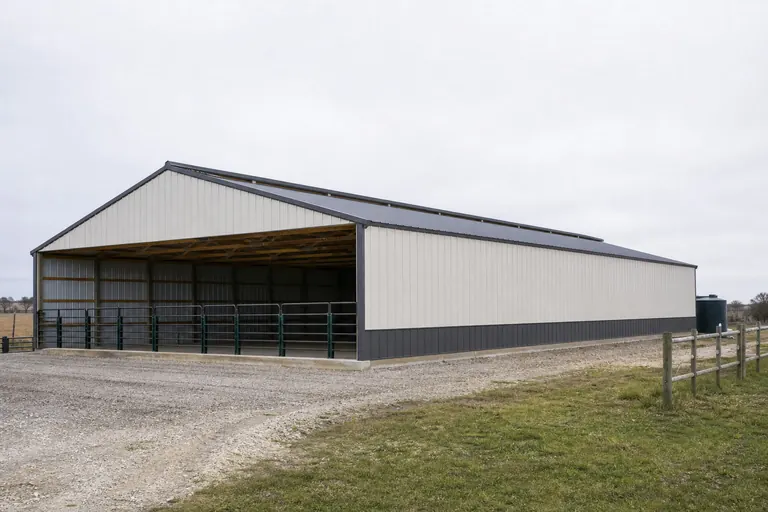 Cattle Run-InA three-sided shelter oriented to block the wind, common on large grazing tracts.Calving BarnSemi-enclosed structures with interior partitions for maternal care during spring storms.
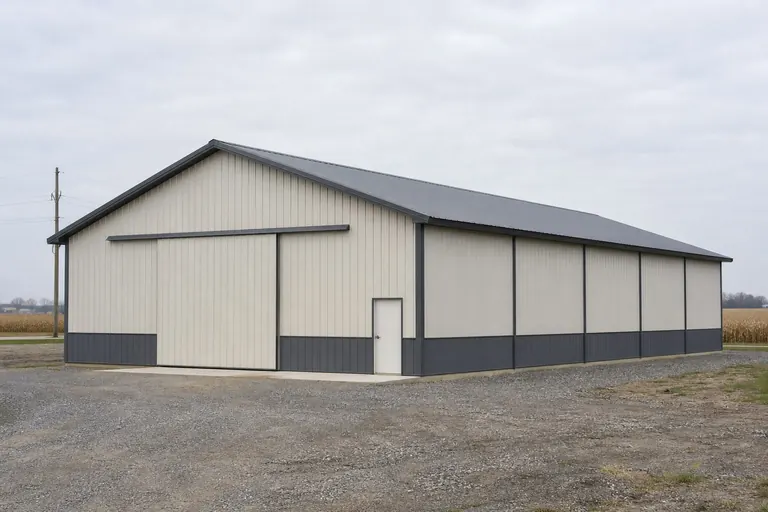 Hay & Shelter ComboCombining feed storage with animal protection on remote 800-acre parcels.
Example Configuration — for planning purposes only.
Dimensions
Sizing for Kansas Herds
Reflecting the 804-acre average farm, these sizes allow for animal density without crowding.
30′ × 40′
1,200 sq ft
Ideal for a small herd or as a distributed shelter on a larger tract.
40′ × 60′
2,400 sq ft
A common 'Kansas Standard' for cattle run-ins.
50′ × 80′
4,000 sq ft
Professional-grade shelter for larger herds or combined hay storage.
Example Configuration — for planning purposes only.
Animal headcount determines the required square footage; consult a livestock specialist for specific density recommendations.
Questions
Kansas Livestock Barn FAQ
Honest answers for Sunflower State producers.
Ignoring the rock. The thin soil and Permian limestone make traditional digging difficult. If you don't account for this in your foundation quote, you'll face unexpected costs when the posts can't reach their required depth.
It's all about site preparation. Elevate the barn site, use heavy-duty gutters to move roof water 20 feet away from the building, and consider using a geotextile fabric under your gravel to keep the pad from sinking into the clay.
Rarely. In a grazing economy like ours, three-sided shelters that block the wind are usually sufficient and provide better ventilation than fully enclosed structures, which can trap humidity and pathogens.
We don't provide specific design loads, but FEMA NRI identifies severe wind as a major Kansas hazard. Qualitatively, your building should be engineered for high-velocity plains gusts, which often requires robust bracing and anchoring.
It depends on your grazing rotation and water layout. On large, rotationally grazed Flint Hills parcels, several smaller shelters near existing water points usually get cattle out of severe weather faster than one central barn that may sit a mile from where the herd is grazing that week.
Sources for the Kansas facts on this page
This page states no code requirement, wind speed, snow load, permit rule, price or supplier claim. The state-specific facts it does use are listed with their publisher below.
Kansas had 44,794,702 acres of land in farms in 2022, an average farm size of 804 acres — the largest average farm size figure among the four-state group reviewed here (IL, IA, KS, LA).
USDA NASS · 2022 · Tier 1
https://www.nass.usda.gov/Publications/AgCensus/2022/Full_Report/Volume_1,_Chapter_1_State_Level/Kansas/st20_1_001_001.pdfKansas had 44,794,702 acres of land in farms in 2022, an average farm size of 804 acres — the largest average farm size figure among the four-state group reviewed here (IL, IA, KS, LA).
USDA NASS · 2022 · Tier 1
https://www.nass.usda.gov/Publications/AgCensus/2022/Full_Report/Volume_1,_Chapter_1_State_Level/Kansas/st20_1_001_001.pdfThe Flint Hills region, running north-south through east-central Kansas, is one of the few large remaining areas of unplowed tallgrass prairie in North America because the region's thin, rocky (chert-bearing) soils formed from eroded Permian-age limestones and shales were historically too hard to plow, so the land has mainly been used for cattle grazing rather than row crops.
Kansas Geological Survey, University of Kansas · KGS reference material · Tier 2
https://www.kgs.ku.edu/Physio/flinthil.htmlThe Flint Hills region, running north-south through east-central Kansas, is one of the few large remaining areas of unplowed tallgrass prairie in North America because the region's thin, rocky (chert-bearing) soils formed from eroded Permian-age limestones and shales were historically too hard to plow, so the land has mainly been used for cattle grazing rather than row crops.
Kansas Geological Survey, University of Kansas · KGS reference material · Tier 2
https://www.kgs.ku.edu/Physio/flinthil.htmlNOAA NCEI's State Climate Summary for Kansas states the state is a region of transition between the humid conditions to the east and semi-arid conditions to the west, and that temperatures have risen about 1.5°F since the beginning of the 20th century, with greater warming in winter and spring than summer and fall.
NOAA National Centers for Environmental Information (NCEI) · State Climate Summaries series, 2022 · Tier 1
https://statesummaries.ncics.org/downloads/Kansas-StateClimateSummary2022.pdfFEMA's National Risk Index dataset assesses 18 natural hazards (including tornado, hail, drought, and severe wind, all historically significant to Kansas) at the county and Census tract level via its interactive online tool.
Federal Emergency Management Agency (FEMA) · Current NRI release · Tier 1
https://www.fema.gov/about/openfema/data-sets/national-risk-index-dataKansas had 55,734 farms in 2022, down from 58,569 in 2017.
USDA National Agricultural Statistics Service (NASS) · 2022 (with historical comparison back to 1992) · Tier 1
https://www.nass.usda.gov/Publications/AgCensus/2022/Full_Report/Volume_1,_Chapter_1_State_Level/Kansas/st20_1_001_001.pdf