
Hobby shop · MA
Hobby Shops in Massachusetts
A hobby shop in Massachusetts usually exists because the house can't absorb the workshop. Census Bureau data shows only 5,626 of the 14,338 new privately-owned housing units authorized in Massachusetts during 2024 were single-unit structures, and much of the state's existing housing stock is older still, with garages sized for one car and basements too finished or too small for serious project space. Add close to 49 inches of average annual snowfall at Boston Logan, and a fully enclosed, insulated hobby shop stops being a seasonal nicety and becomes the only place a Massachusetts hobbyist can work in January.
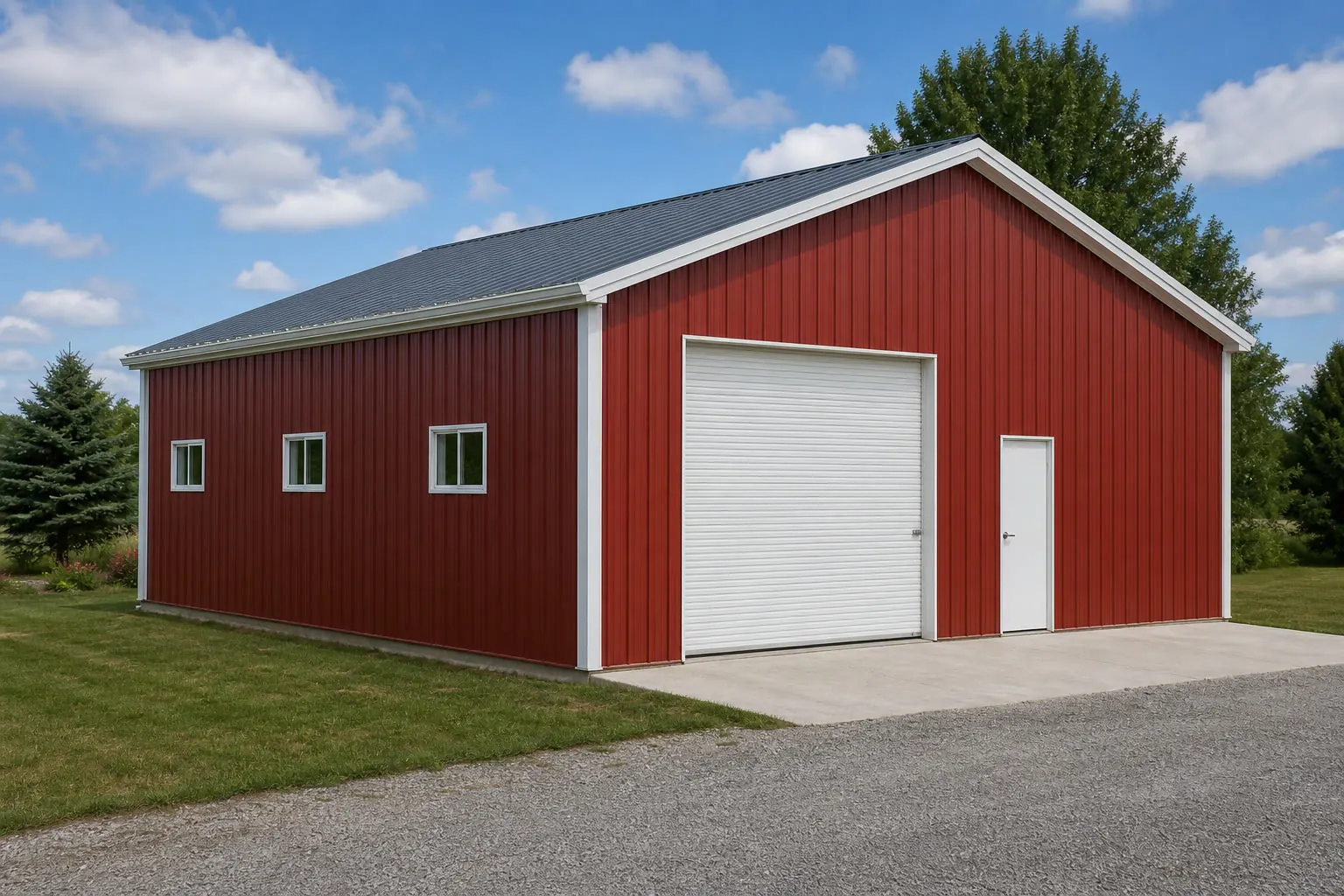
The intersection
What a Massachusetts site changes about a hobby shop
The building is standard steel-frame construction. What differs is why owners here need a dedicated one, and how it has to be built to earn year-round use.
The Census Bureau's Building Permits Survey shows Massachusetts builders were authorized for 14,338 new privately-owned housing units in 2024, with only 5,626 of those single-unit structures. Much of the state's existing single-family stock is older still, built at a time when a one-car garage was standard and a finished basement, if present, was not meant to host woodworking or metalworking equipment. For a Massachusetts hobbyist, a dedicated hobby shop is frequently the only realistic answer to 'where do I actually do this,' not an upgrade over an already-adequate garage.
Winter turns that need from occasional to structural. Boston Logan's NOAA 1991-2020 normals put January and February snowfall at close to 14 inches each, on the way to nearly 49 inches for the season, with about 43.6 inches of annual precipitation. None of that is a design load -- that conversation belongs to an engineer and the local building department -- but it is a strong planning reason to insulate and fully enclose a Massachusetts hobby shop from the start, since an unheated, uninsulated outbuilding effectively closes for several months a year here.
Floor stability matters more in a hobby shop than in most outbuildings, because a workbench, a table saw, or a lathe needs a level, vibration-resistant surface, not just a dry one. USGS's mapped division between western crystalline upland ground, including the Berkshires, and the southeastern Coastal Plain's sandier sediment means the concrete and moisture-barrier detailing that keeps a workshop floor stable can differ meaningfully between a hillside Worcester County lot and a flatter South Shore parcel, which is worth flagging to whoever pours the slab.
Site context
How terrain changes hobby shop siting across Massachusetts
The USGS upland/coastal split is the most useful lens for anticipating site prep before a quote.
Western uplands and Berkshires
Rolling terrain with occasional shallow bedrock; a workshop slab here often needs a site-specific excavation plan rather than a standard flat pour, since a tilted or uneven floor is a real problem for stationary tools.
Central valleys
Generally the easiest grading in the state for a workshop pad; access for delivering equipment and materials is usually the bigger planning question here.
Southeastern Coastal Plain
Sandy, flatter ground that drains quickly in some spots and holds moisture in others; a workshop's finish floor and any wood storage benefit from confirming which condition applies before the pad goes in.
Exposure
Insulation and heat matter more here than the layout
With close to 49 inches of average annual snow, whether the shop is heated and insulated decides how much of the year it's actually usable.
A hobby shop left as an uninsulated shell in Massachusetts is a fair-weather building at best. Owners who add insulation, a vapor barrier appropriate to the region's humidity, and some form of heat during design get a space they can use through a New England winter; owners who skip that step often end up retrofitting it later at greater expense.
Ventilation deserves the same early attention, especially for woodworking or finishing work: a sealed, insulated shop needs a deliberate airflow plan, not just a door left open, once outdoor temperatures make that impractical for months at a time.
- Insulate at build time
- Retrofitting insulation into a finished steel shell costs more than specifying it up front.
- Plan a heat source before framing
- Electrical or fuel-source needs are easier to route before walls and roof are closed in.
- Add deliberate ventilation
- A sealed, insulated shop needs planned airflow, particularly for dust or finish work.
Get Massachusetts hobby shop quotes
Tell us your lot size, terrain, and how you plan to condition the space. We route it with the Massachusetts and hobby shop context attached.
Configuration
What Massachusetts hobby shops are usually asked to do
Given the retrofit pattern on older housing stock, most Massachusetts hobby shops solve a specific workspace gap rather than serving a generic purpose.
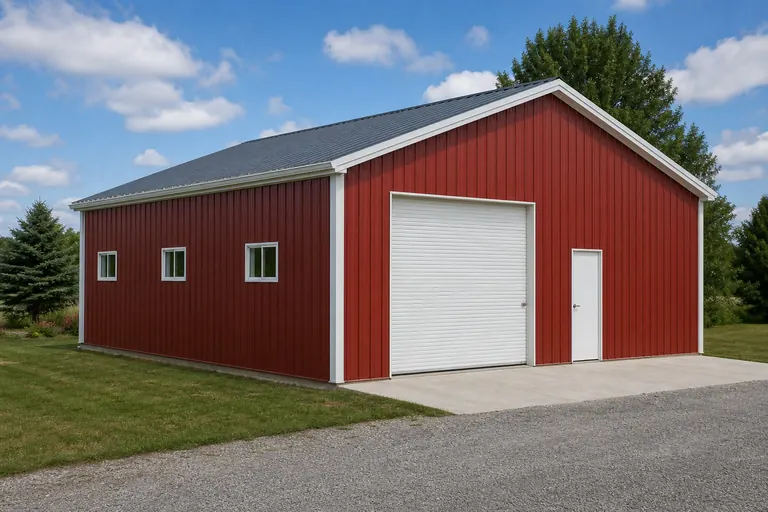 Woodworking or metalworking shopA dedicated, insulated bay sized for stationary tools and material storage, added where the house has no equivalent space.Workshop plus small vehicle bayA partitioned end for a project car or motorcycle alongside bench and tool space.Studio or craft workspaceA conditioned, insulated space for art, textiles, or other work that needs consistent indoor conditions year-round.
Example Configuration — for planning purposes only.
Footprint
Sizes that fit a Massachusetts retrofit lot
Retrofitting onto an established lot generally means working within a tighter footprint than a new-build accompaniment would allow.
16′ × 24′
384 sq ft
A compact single-user workshop that fits many older suburban side yards.
20′ × 30′
600 sq ft
Comfortable bench and tool storage space with room to move around larger projects.
24′ × 36′
864 sq ft
Workshop plus a partitioned bay for a project vehicle.
30′ × 40′
1,200 sq ft
Larger multi-use shop with separate work and storage zones.
Example Configuration — for planning purposes only.
Footprint pages carry the door and layout detail; this page explains why the Massachusetts brief tends to stay compact.
Preparation
Before you request a Massachusetts hobby shop quote
These items address frequent re-quote triggers for a Massachusetts hobby shop.
Step 1
Confirm accessory-structure setbacks with your town
Massachusetts setback rules are set locally, not by the state, so ask your local building department before fixing a footprint on a tight lot.
Step 2
Tell your builder which terrain you have
Western ledge and Coastal Plain sand call for different slab and moisture-barrier prep for a workshop floor.
Step 3
Lock in insulation and a heat source at design time
Adding these after the shell is closed in costs meaningfully more than specifying them up front.
Step 4
Inventory your stationary tools and their draw
Table saws, dust collectors, and welding equipment shape the electrical panel size before framing starts, not after.
Questions
Massachusetts hobby shop questions
Honest state-level answers, with jurisdiction-specific items routed to the office that owns them.
Permit requirements depend on your municipality, lot, and structure size. Your local building department is the only reliable source; ask before finalizing dimensions.
We don't set engineering or code requirements here, but Boston Logan's climate normals -- close to 14 inches of snowfall in each of January and February -- make insulation and a heat source a practical priority if you want to use the space through winter; confirm any code specifics with your local building department.
A meaningful share of the state's housing stock is older or multi-unit; Census data shows single-unit homes were a minority of 2024 authorized construction. That's context, not a rule, and it's part of why detached hobby shops are common retrofits here.
There's no official typical size. Retrofit lots tend to favor 16x24 through 30x40, driven by available yard space rather than any state requirement.
Yes -- USGS maps meaningfully different ground across the state, from western ledge to sandier Coastal Plain soil in the southeast, and a workshop floor's flatness and moisture control depend on that site-specific condition rather than a statewide rule.
Sources for the Massachusetts facts on this page
This page states no code requirement, wind speed, snow load, permit rule, price or supplier claim. The state-specific facts it does use are listed with their publisher below.
Builders in Massachusetts were authorized to construct 14,338 new privately-owned housing units in 2024, of which 5,626 were single-unit structures.
U.S. Census Bureau · 2024 (final annual estimates) · Tier 1
https://www.census.gov/construction/bps/stateannual.htmlThe Boston Logan NOAA 1991-2020 normals show winter monthly snowfall means around 14 inches in both January and February.
NOAA National Centers for Environmental Information (NCEI) · 1991-2020 · Tier 1
https://www.ncei.noaa.gov/access/services/data/v1?dataset=normals-monthly-1991-2020&format=pdf&stations=USW00014739Boston Logan Airport's NOAA 1991-2020 climate normals show total annual precipitation of about 43.6 inches and average annual snowfall of about 49 inches.
NOAA National Centers for Environmental Information (NCEI) · 1991-2020 · Tier 1
https://www.ncei.noaa.gov/access/services/data/v1?dataset=normals-monthly-1991-2020&format=pdf&stations=USW00014739USGS Geomorphology of New England (Professional Paper 1208) describes Massachusetts as spanning crystalline upland terrain (including the Berkshires in the west) and Coastal Plain sediments along the southeast, reflecting a mix of glacially shaped hill country and low coastal terrain.
U.S. Geological Survey · 1982 · Tier 1
https://pubs.usgs.gov/pp/1208/report.pdf