
Carport · MI
Carports in Michigan
In Michigan, a carport isn't just for shade; it's a critical defense against lake-effect snow and the ice storms that define Great Lakes winters. Search demand for 'carport michigan' is steady at 30 monthly searches, reflecting a buyer base that prioritizes utility over aesthetics. With annual precipitation averaging 35 inches and a geography that touches four Great Lakes, your carport must be engineered to handle sustained moisture and heavy vertical loads. This guide looks at how Michigan's peninsula divide and its 9.47 million acres of agricultural land influence your carport planning and installation.
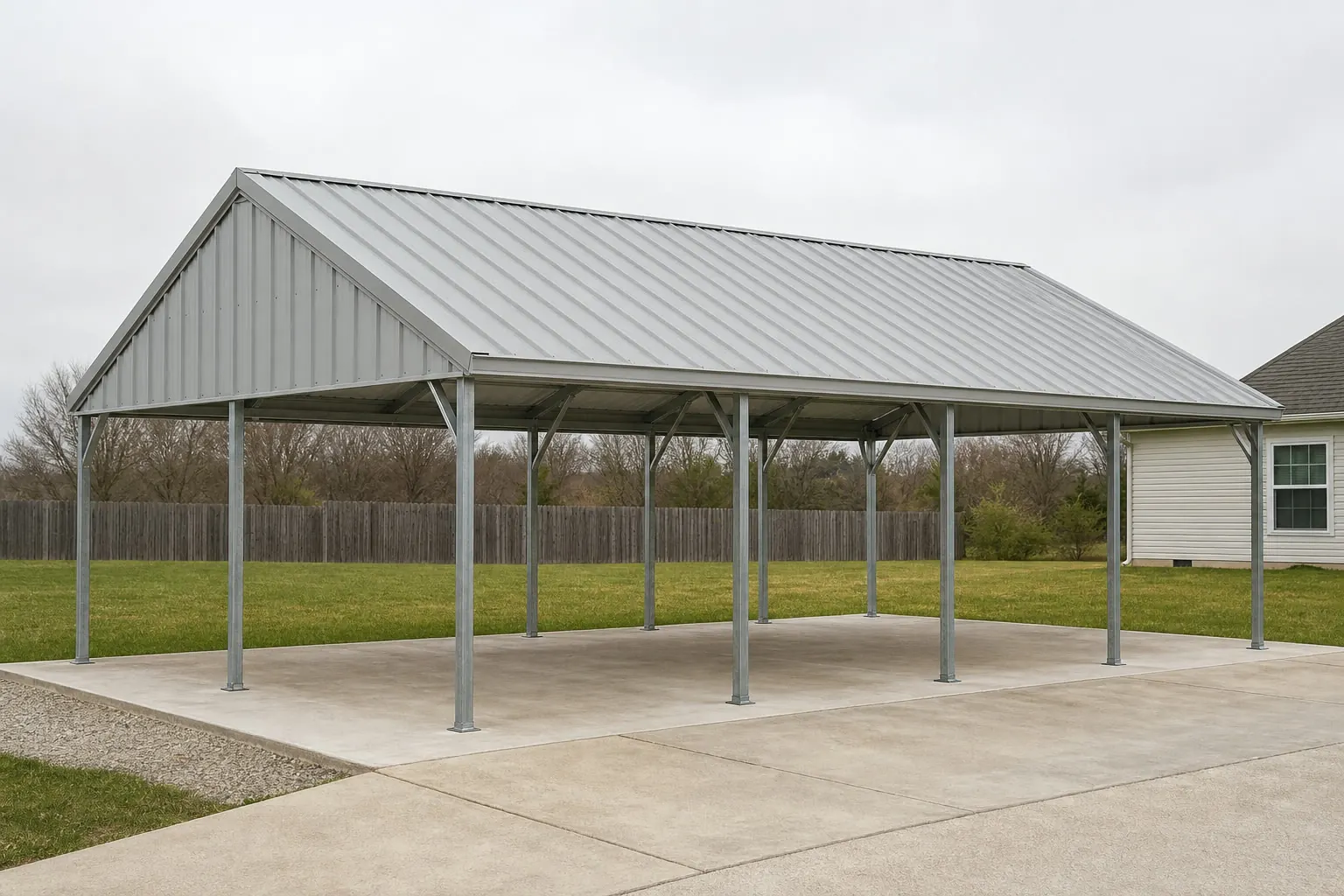
Protecting Your Assets in the Great Lakes State
In Michigan, a carport is a functional necessity born from a climate that doesn't forgive thin materials or poor engineering. With 3,288 miles of freshwater coastline and a weather pattern heavily influenced by four of the five Great Lakes, the Michigan carport must withstand everything from humid summer thunderstorms to brutal winter ice storms. Whether you are building on a 208-acre farm in the central plains or a suburban lot near Detroit, your planning begins with load. With annual precipitation averaging 35 inches and significant winter snowfall being a standard expectation, we look at how Michigan's unique geography and climate data dictate your choice of carport design and installation.
Structural Planning
The Ice and Snow Challenge: Beyond the Detroit Baseline
A Michigan carport must be engineered for the 'worst-case' winter scenario, which often includes heavy ice accumulation.
While NOAA climate normals for Detroit Metro show a January/February snowfall average of roughly 14 inches, this figure doesn't capture the volatility of Michigan winters. FEMA's National Risk Index identifies ice storms and severe winter weather as primary hazards for the state's 83 counties. For a carport, this means the 'vertical' load is the most critical design factor. A budget carport with a horizontal roof orientation (where the ribs run parallel to the ground) is a risk in Michigan; snow and ice can easily pile up in the ridges, leading to buckling. The recommendation for Michigan installs is always a vertical roof design, which allows snow and ice to slide off more easily, reducing the sustained load on the steel frame.
The divide between the two peninsulas is another critical factor. The Upper Peninsula (UP) experiences lake-effect snow accumulation that is significantly higher than the Lower Peninsula. If you are building in the UP, your carport isn't just a shelter; it's a heavy-duty structure that must meet extreme snow-load requirements. This often means using 12-gauge steel for the frame instead of the standard 14-gauge, and increasing the frequency of the support posts. Even in the Lower Peninsula, proximity to Lake Michigan creates 'snowbelts' where the standard regional kit might be insufficient. We don't have a single 'Michigan-wide' snow load figure because the state's geography is too varied for one number to be safe.
Data Reference
Michigan Environmental Context for Carports
These sourced data points frame the engineering requirements for carports in Michigan.
| Measure | Value | Source |
|---|---|---|
| Annual Precipitation | 34-35 Inches | NOAA NCEI |
| Avg Winter Snow (Detroit) | 12-14 Inches/mo | NOAA NCEI |
| Primary Hazards | Ice Storm, Winter Weather | FEMA NRI |
| Land in Farms | 9,472,069 Acres | USDA NASS |
| Great Lakes Exposure | 4 of 5 Lakes | USGS |
| Total Counties | 83 | FEMA NRI |
Annual Precipitation
- Value
- 34-35 Inches
- Source
- NOAA NCEI
Avg Winter Snow (Detroit)
- Value
- 12-14 Inches/mo
- Source
- NOAA NCEI
Primary Hazards
- Value
- Ice Storm, Winter Weather
- Source
- FEMA NRI
Land in Farms
- Value
- 9,472,069 Acres
- Source
- USDA NASS
Great Lakes Exposure
- Value
- 4 of 5 Lakes
- Source
- USGS
Total Counties
- Value
- 83
- Source
- FEMA NRI
Protect Your Vehicle from Michigan Winters
Ready for a carport that won't buckle under ice and snow? Tell us your location and we'll help you find a Michigan-spec solution.
Installation
Anchoring and the Michigan Freeze-Thaw Cycle
Michigan's soil and water conditions make proper anchoring the difference between a permanent structure and a seasonal liability.
As the only state touching four Great Lakes, Michigan has high groundwater levels and varied hydrologic provinces. This means your soil might be sandy in one county and heavy clay in the next. The Michigan freeze-thaw cycle is notorious for moving structures that aren't properly anchored. While carports are often considered 'portable' or 'temporary,' a Michigan install should be treated with more permanence. If you are anchoring to a concrete pad, the pad must be designed to handle the localized frost depth—a figure that is a recorded gap in our evidence and must be confirmed with your local building office.
For carports installed on dirt or gravel—common on Michigan's 208-acre average farms—helical anchors or 'mobile home' anchors are often used. However, these must penetrate deep enough to resist the upward pressure of frost heaving. In the central plains where 'severe/strong wind' is a recorded FEMA hazard, these anchors also provide the necessary lateral stability to prevent the carport from becoming a sail during a summer thunderstorm. The open nature of a carport makes it particularly vulnerable to wind-lift, so over-engineering your anchoring system is a sound investment in a state with Michigan's wind profile.
- Vertical Roof Orientation
- Essential for shedding Michigan's heavy lake-effect snow and preventing ice damming.
- Heavy-Gauge Steel
- 12-gauge steel is recommended for the Upper Peninsula and lake-effect snowbelt regions.
- Frost-Line Anchoring
- Ensure all anchors or footings exceed the local frost depth to prevent seasonal displacement.
Questions
Michigan Carport FAQ
Honest answers regarding carport planning in the Great Lakes State.
It depends on where you are. A standard kit sized for the Detroit-area baseline may be under-built for the Upper Peninsula or a western snowbelt; confirm the required roof-load rating with your local building department before ordering, rather than assuming one kit spec fits the whole state.
Possibly, and the threshold is set locally rather than statewide. Because there are 83 counties and decentralized township enforcement, you must check the specific square-footage and setback rules with your local municipal office before committing to a footprint.
It means higher sustained humidity. Steel carports in Michigan should be galvanized and have a high-quality paint finish to resist the moisture-laden air that can accelerate rust.
A carport is more cost-effective and provides essential overhead protection, but it doesn't offer the total wind and cold protection of a garage. For many Michigan farm owners, a carport is an ideal secondary structure for equipment.
A vertical-panel roof sheds lake-effect snow and ice more reliably than a horizontal-rib roof, which can let snow and ice build up in the seams and add sustained load to the frame. Decide the orientation before the pad or footings are set, since the drip line and snow-shed zone shift with it.
Before You Order
Michigan Carport Site-Prep Checklist
A carport is a fast install, but a Michigan carport that is sited without planning becomes a snow-shed and plowing headache by the first storm. Work through these before the frame arrives.
Step 1
Pick the roof orientation before the pad, not after
A vertical-panel roof sheds Michigan's lake-effect snow far better than a horizontal one. Decide this before you pour or grade, because the drip line and snow-shed zone shift with orientation and change where you can safely park under the roof edge.
Step 2
Keep the open face off the prevailing wind side
An open-sided structure catches blowing and drifting snow on whichever face is unprotected. In most of the Lower Peninsula that means avoiding a west or northwest opening; in the lake-effect belt and the Upper Peninsula, check local wind patterns rather than assuming the Detroit-area default.
Step 3
Route the plow path before you set posts
Michigan carports are frequently installed close to a driveway that gets ploughed all winter. Confirm the post spacing and clearance leave room for a plow blade, and that roof runoff doesn't drain directly onto the path a plow or snow blower needs to use.
Step 4
Ask your township about accessory-structure limits before ordering
With 83 counties and decentralized enforcement, some Michigan townships cap accessory structure square footage or require a permit well below the thresholds buyers assume; confirm this with your local zoning office before committing to a footprint.
Step 5
Plan the anchor system for your actual ground, not a generic pad
Michigan's soils range from sandy coastal strips to heavy clay till, and the correct anchor or footing detail differs between them. A gravel-set carport on clay is far more exposed to frost heave than the same install on well-drained sand, so confirm your soil type before choosing anchors.
Sources for the Michigan facts on this page
This page states no code requirement, wind speed, snow load, permit rule, price or supplier claim. The state-specific facts it does use are listed with their publisher below.
Detroit Metro Airport's NOAA 1991-2020 climate normals show total annual precipitation of roughly 34-35 inches, with January and February mean snowfall near 12-14 inches each.
NOAA National Centers for Environmental Information (NCEI) · 1991-2020 · Tier 1
https://www.ncei.noaa.gov/access/services/data/v1?dataset=normals-monthly-1991-2020&format=pdf&stations=USW00094847USGS describes Michigan as consisting of two peninsulas -- the Upper Peninsula and Lower Peninsula, separated by the Straits of Mackinac -- and notes it is the only U.S. state touching four of the five Great Lakes, giving it the longest freshwater coastline in the country.
U.S. Geological Survey · 2021 · Tier 1
https://pubs.usgs.gov/publication/fs20213047FEMA's National Risk Index is the federal tool for county- and state-level natural hazard exposure data for Michigan's 83 counties, covering 18 hazard types including winter weather, ice storm, and severe/strong wind.
Federal Emergency Management Agency (FEMA) · Current NRI release · Tier 1
https://www.fema.gov/flood-maps/products-tools/national-risk-indexMichigan had 9,472,069 acres of land in farms in 2022, an average farm size of 208 acres.
USDA NASS · 2022 · Tier 1
https://www.nass.usda.gov/Publications/AgCensus/2022/Full_Report/Volume_1,_Chapter_1_State_Level/Michigan/st26_1_001_001.pdfMichigan had 9,472,069 acres of land in farms in 2022, an average farm size of 208 acres.
USDA NASS · 2022 · Tier 1
https://www.nass.usda.gov/Publications/AgCensus/2022/Full_Report/Volume_1,_Chapter_1_State_Level/Michigan/st26_1_001_001.pdfUSGS describes Michigan as consisting of two peninsulas -- the Upper Peninsula and Lower Peninsula, separated by the Straits of Mackinac -- and notes it is the only U.S. state touching four of the five Great Lakes, giving it the longest freshwater coastline in the country.
U.S. Geological Survey · 2021 · Tier 1
https://pubs.usgs.gov/publication/fs20213047