
Carport · IN
Carports in Indiana
Indiana calls itself the Crossroads of America for a reason: its transportation and warehousing sector alone counts 171,310 jobs, about 6% of total state employment, and it has been the fastest-growing sector in the state's economy over the prior decade. That workforce drives home in personal trucks and vans every day, and a steel carport is the cheapest way to keep that vehicle fleet road-ready through Indiana's mixed seasons. On the state's 53,599 farms, spread across 14.6 million acres, the same open-sided structure shelters a tractor or a grain truck instead. What actually differs about building one here is procedural: Indiana runs building-code adoption and plan review through a single state agency rather than leaving it entirely to a patchwork of local officials, and that agency path is worth understanding before you sketch a footprint.
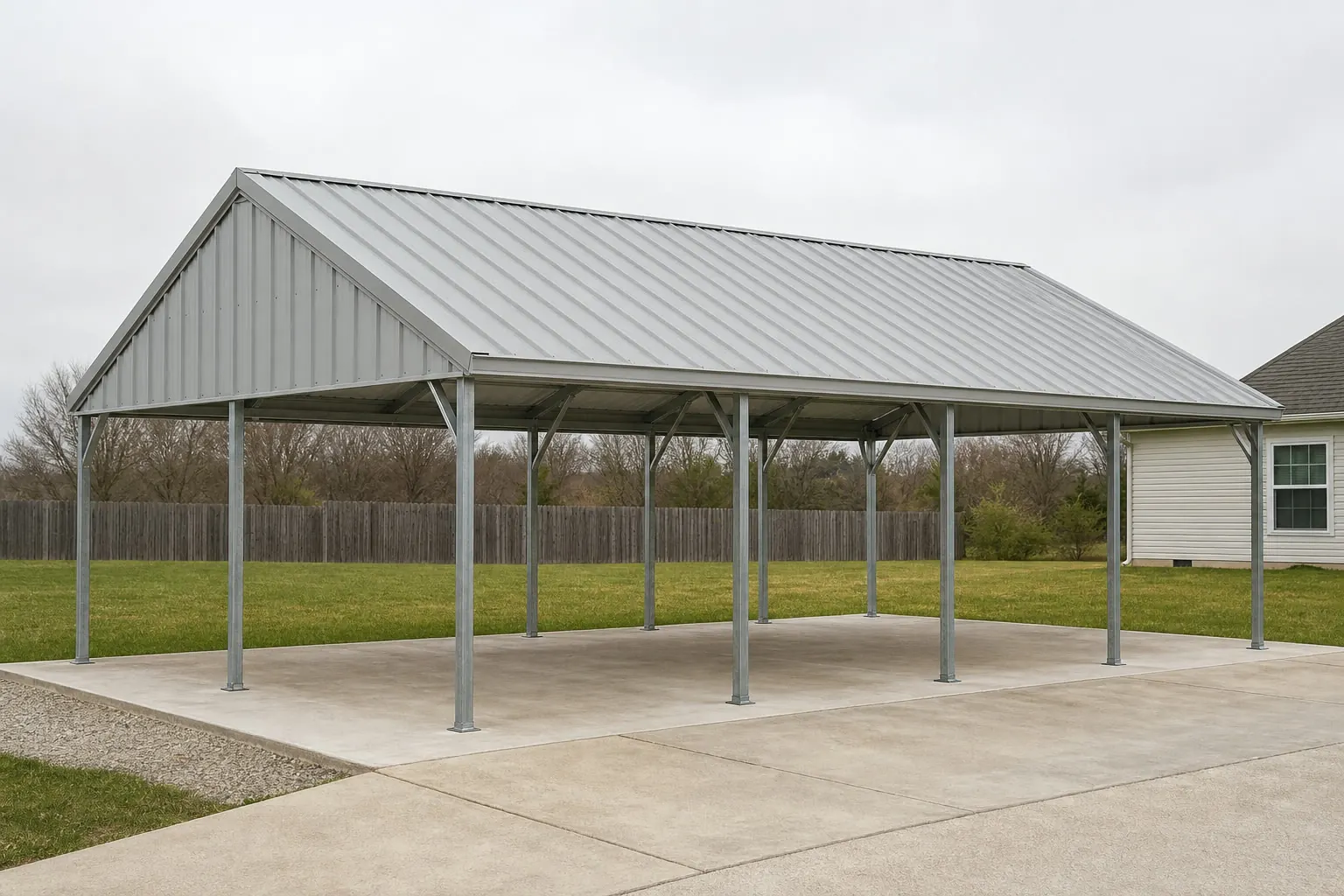
A Crossroads State's Case for Covered Parking
Indiana's economy runs on the movement of goods, and 171,310 people work directly in transportation and warehousing — about 6% of everyone employed in the state, and the fastest-growing sector here over the prior decade. Add 53,599 working farms spread across 14.6 million acres, and you have two very different reasons the same structure — a steel carport — shows up across Indiana properties: fleet and commuter vehicle protection near warehouses and distribution hubs, and open-sided equipment shelter on farms. What ties both together procedurally is that Indiana's building code is adopted and administered at the state level, which changes who you actually talk to before you build.
State Reference
Indiana Figures Behind This Page
Sourced figures only; no design values are implied by this table.
| Metric | Value | Source |
|---|---|---|
| Transportation & warehousing jobs | 171,310 (~6% of state employment) | Indiana Business Research Center |
| Farms (2022) | 53,599 | USDA NASS |
| Land in farms (2022) | 14,602,240 acres | USDA NASS |
| Total land area | 36,420 sq mi | U.S. Census Bureau |
| Code adoption/enforcement | Fire Prevention and Building Safety Commission / IDHS | Indiana DHS |
Transportation & warehousing jobs
- Value
- 171,310 (~6% of state employment)
- Source
- Indiana Business Research Center
Farms (2022)
- Value
- 53,599
- Source
- USDA NASS
Land in farms (2022)
- Value
- 14,602,240 acres
- Source
- USDA NASS
Total land area
- Value
- 36,420 sq mi
- Source
- U.S. Census Bureau
Code adoption/enforcement
- Value
- Fire Prevention and Building Safety Commission / IDHS
- Source
- Indiana DHS
Permitting Path
How Indiana's State-Run Plan Review Changes the First Step
Indiana handles building-code adoption and plan review through one state agency, not a patchwork of independent local codes.
In many states, a carport's permit path depends entirely on which of dozens of independent local building departments has jurisdiction. Indiana runs it differently: the Fire Prevention and Building Safety Commission adopts the statewide building code by rule, and the Indiana Department of Homeland Security carries out building plan review and code enforcement functions through its own program. Indiana's building code adoption is also actively in progress for 2026 per an Indiana Register filing at the time this page was written, which is a reason to confirm the current adopted edition directly with the authority having jurisdiction rather than assume last year's rule still applies.
For a carport, this means your first real step is not guessing whether your township requires a permit; it is finding out how your specific project routes through the state's plan review process versus any local building department delegated to handle it in your area. That routing detail can change your timeline more than the carport's design does.
Because Indiana's own climate documentation is a narrative summary rather than one statewide snow or rain figure, the specific wind and snow values used for your carport's structural design should come from the nearest NWS station's normals, applied through whichever official reviews your plans.
Use Cases
Two Different Carport Briefs, One State
Indiana's logistics workforce and its farm base ask for the same structure for different reasons.
Near Indianapolis, Fort Wayne, and the logistics corridors that give Indiana its fastest-growing job sector, a carport is usually protecting a personal truck or a small fleet vehicle used for a warehousing or distribution job. These builds tend to favor higher clearance for full-size trucks and a footprint that fits a driveway or a small commercial lot rather than open acreage.
On the state's 53,599 working farms, the same open-sided steel structure more often shelters a grain truck, a tractor, or seasonal implements that do not justify the cost of a fully enclosed building. With 14.6 million acres still in production, that low-cost shelter role remains a routine, unglamorous part of Indiana's working landscape.
Either way, an open-sided structure lets wind-driven rain and snow reach whatever is parked underneath regardless of the steel gauge used. Orienting the open face away from the prevailing storm direction at your specific site — a question for your local official or builder, not a statewide assumption — is a free design decision if it is made before the posts are set.
Get an Indiana Carport Quote
Tell us your vehicle or equipment and your rough footprint; we'll route your quote with Indiana's plan-review context attached.
Preparation
Before You Request an Indiana Carport Quote
Steps specific to Indiana's state-run review path.
- Confirm your plan-review pathAsk whether your project routes through IDHS directly or through a locally delegated building department.
- Ask about the current code editionIndiana's 2026 building code adoption was in progress per the Indiana Register at time of writing; confirm the currently adopted edition.
- Get station-level design valuesRequest wind and snow figures from the nearest NWS station rather than assuming a single statewide number.
- Describe the vehicle or equipment being shelteredA fleet truck and a grain truck need different clearance and footprint; be specific in your quote request.
Configurations
Common Indiana Carport Uses
These reflect the two demand drivers documented above.
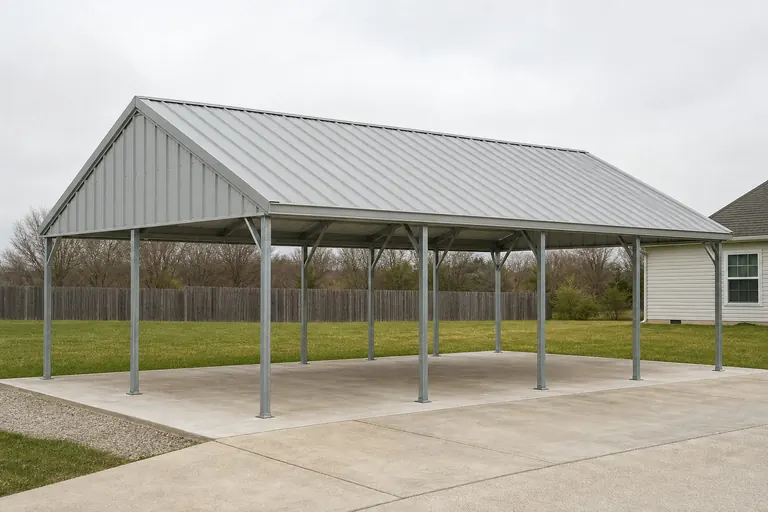 The Logistics CommuterSized for a full-size personal or fleet truck, near Indiana's warehousing and distribution corridors.The Farm Equipment ShelterOpen-sided coverage for a grain truck, tractor, or seasonal implements on working farmland.The Multi-Vehicle PadA wider footprint for households running more than one vehicle off a shared driveway.
Example Configuration — for planning purposes only.
Popular Sizes
Sizing an Indiana Carport
Footprints should reflect the vehicle or equipment and any local setback rules.
12′ × 20′
240 sq ft
A single-vehicle shelter for a compact commuter car.
20′ × 30′
600 sq ft
Room for a full-size truck plus limited storage.
30′ × 40′
1,200 sq ft
A heavy-duty option for farm equipment or multi-vehicle coverage.
Example Configuration — for planning purposes only.
Confirm setbacks and any required review path with the authority having jurisdiction before finalizing a footprint.
Indiana FAQ
Carport Questions for Indiana Buyers
Straight answers, with local specifics routed to the right office.
Building-code adoption and plan review sit with the state (the Fire Prevention and Building Safety Commission and IDHS), but confirm with your specific project whether it is reviewed directly by IDHS or by a locally delegated department.
Indiana's code adoption was actively in progress for 2026 per an Indiana Register filing at the time this page was written; confirm the current adopted edition with the reviewing authority rather than assuming.
There is no single statewide figure to cite; get station-level wind and snow values from the nearest NWS station through your reviewing official.
Yes — Indiana's transportation and warehousing sector employs 171,310 people, many of whom rely on a personal or fleet vehicle daily, and a carport is a low-cost way to protect that vehicle.
A 30x40 footprint is a common heavy-duty choice for a farm truck or tractor, but confirm clearance needs for your specific equipment before ordering.
Sources for the Indiana facts on this page
This page states no code requirement, wind speed, snow load, permit rule, price or supplier claim. The state-specific facts it does use are listed with their publisher below.
Indiana's Department of Homeland Security, through its Fire Prevention and Building Safety Commission and Code Enforcement/Building Plan Review functions, adopts and administers the state building code.
Indiana Department of Homeland Security (IDHS) · Current program pages; 2026 Indiana Building Code adoption in progress per Indiana Register filing · Tier 2
https://www.in.gov/dhs/building-plan-review/Indiana's transportation and warehousing sector employment and share of total state employment, using state QCEW-derived data.
Indiana Business Research Center, Indiana University (InContext, using state/federal labor data) · 2023 article, referencing prior-decade trend · Tier 2
https://www.incontext.indiana.edu/2023/mar-apr/article1.aspNumber of farms in Indiana in 2022, per the state statistician's public comments on the Census of Agriculture.
USDA NASS (data); Brownfield Ag News (reporting) · 2022 Census of Agriculture · Tier 1
https://www.nass.usda.gov/Publications/AgCensus/2022/Full_Report/Volume_1,_Chapter_2_County_Level/Indiana/st18_2_045_045.pdfLand in farms in Indiana in 2022 per NASS county-level state total table.
USDA National Agricultural Statistics Service · 2022 · Tier 1
https://www.nass.usda.gov/Publications/AgCensus/2022/Full_Report/Volume_1,_Chapter_2_County_Level/Indiana/st18_2_045_045.pdfIndiana total land area per US Census Bureau state area measurements.
U.S. Census Bureau · 2010 measurement basis · Tier 1
https://www.census.gov/geographies/reference-files/2010/geo/state-area.htmlNWS Indianapolis publishes daily 1991-2020 climate normals for Indianapolis including precipitation and snowfall by date.
National Weather Service (NOAA) · 1991-2020 · Tier 1
https://preview.weather.gov/media/ind/climatenormals.pdf