
Aircraft Hangar · AZ
Steel Aircraft Hangars in Arizona
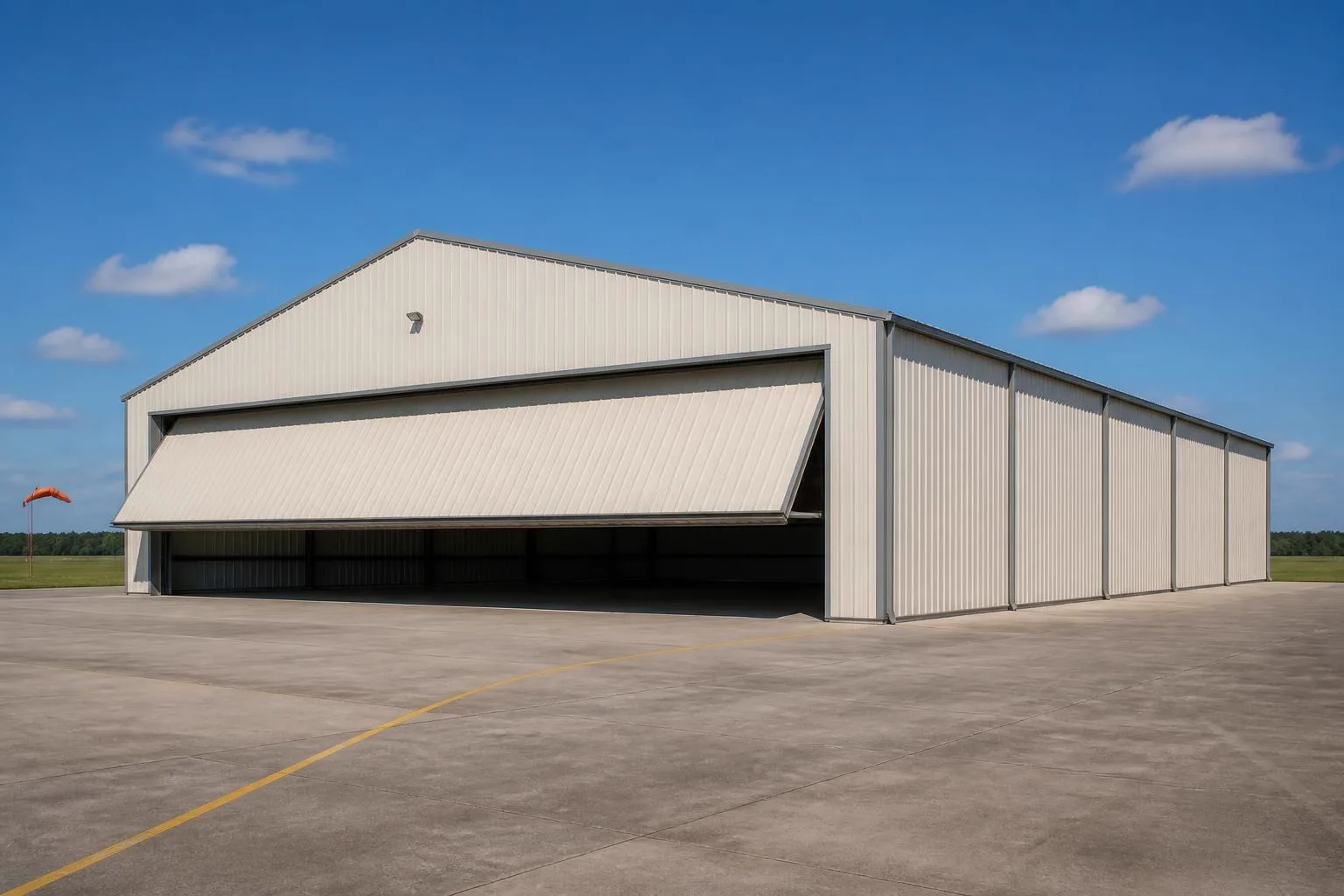
An Arizona hangar owner is not really planning around 'desert weather' in the abstract — they are planning around a calendar window the National Weather Service defines exactly: the North American Monsoon runs June 15 through September 30 every year, a fixed date range rather than a rainfall trigger. NWS also documents blowing dust and dust storms, the haboobs, as tied specifically to monsoon thunderstorm outflow, which is a door-and-apron problem before it is anything else. Layer that onto a state where roughly 28.1 million of about 34.4 million acres are federally owned, and where there is no single statewide building-code agency governing general construction, and the practical hangar project becomes a question of which county or city handles your parcel, how close your strip sits to federal land, and how the building's largest opening handles a dust-laden outflow gust rather than steady wind.
The Arizona variable
A fixed monsoon window, not a vague dry season
NWS treats the Arizona monsoon as a defined calendar period, June 15 through September 30, and separately documents blowing dust and haboob events as tied to monsoon thunderstorm outflow — two facts that change how a hangar door and apron get planned.
Because the monsoon window is a fixed calendar definition rather than a rainfall trigger, an Arizona hangar buyer has an actual planning boundary: door installation, apron pours and any exterior sealant work scheduled to finish before June 15 avoid the season altogether, while work planned during the window should assume sudden outflow events rather than steady conditions.
The outflow-driven haboob is the specific hazard worth naming here. NWS technical memoranda describe these dust storms as an underrated Arizona hazard tied to the leading edge of collapsing monsoon thunderstorms, arriving with little warning and carrying airborne particulate that finds its way into any gap around a hangar's largest moving part — the door. A door track, seal and drainage detail suited to steady prevailing wind is not automatically suited to a sudden sideways outflow gust carrying dust.
NOAA's state climate summary adds useful context rather than a design number: it records roughly 2.5°F of warming since the early 1900s and names drought as a serious, ongoing threat in an already water-scarce state. That is background for why dust exposure has become a documented seasonal pattern rather than an occasional nuisance, not a load figure to build to.
Site context
Plateau strips and low-desert strips are different sites
Early USGS survey work splits Arizona into three physiographic regions, and where a strip sits within that split changes access, elevation and seasonal conditions.
Colorado Plateau (northeast)
Covers roughly 45,000 square miles of Arizona's northeast per historical USGS mapping. Higher, cooler ground with its own access and winter-weather considerations distinct from the low desert.
Low desert basins (south and central)
Where most population centers sit, and where the monsoon outflow and haboob pattern documented by NWS is most consistently reported.
Transition and mountain terrain
Between the plateau and the low desert, elevation changes quickly and access roads to a private strip can vary sharply within a short distance.
Land base
A hangar site is more likely to border public land here
Arizona's federal and state trust land holdings are large enough that access and easement questions come up more often than in a state with a smaller public-land base.
The Congressional Research Service's federal land ownership dataset lists Arizona federal acreage at roughly 28.1 million acres against a total state acreage of about 34.4 million — meaning a large majority of Arizona's land base is federally managed. A private airstrip or hangar site adjoining that land can face access-easement, fencing or right-of-way questions that a hangar buyer in a state with modest federal holdings would not typically encounter.
Arizona also holds more than 9 million surface acres of State Trust land, roughly 13% of the state's surface area, managed by the Arizona State Land Department. That is a separate category from federal land with its own lease and use process, and a strip located near a trust-land boundary should confirm the relevant access arrangement with that department rather than assume it works the way an adjoining federal parcel would.
Get Arizona hangar quotes
Tell us your county, your strip's terrain and your aircraft dimensions. We route it with the Arizona and hangar context already attached.
Configuration
What Arizona hangar briefs are usually asked to do
Arizona hangar enquiries split between private-strip storage, agricultural or ranch aviation use, and backcountry or remote-strip access, each with different door and access priorities.
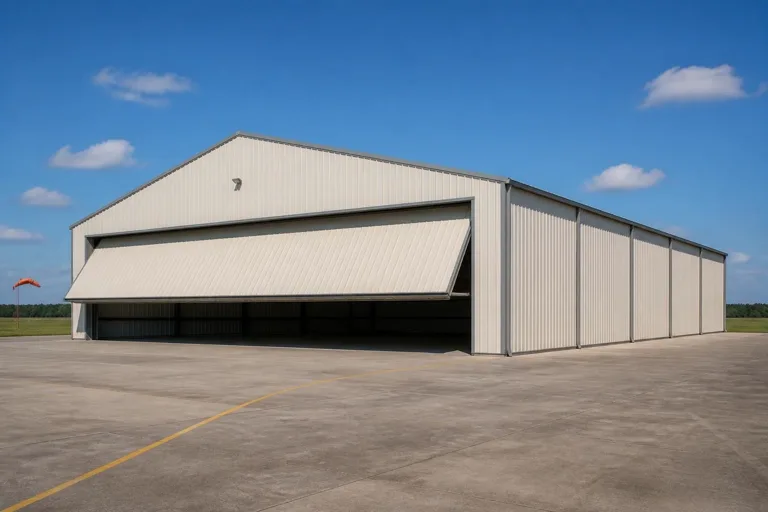 Private strip hangarSized to one or two aircraft with a door matched to wingspan. Door seal and track detail matter more here given documented monsoon-season dust exposure.Ranch and agricultural aviationStorage for utility or crop-related aircraft, often on land adjoining federal or state trust parcels where access arrangements need separate confirmation.Backcountry and remote stripSites reached via roads that may cross federal land; access and delivery logistics deserve attention before ordering a building sized for the airframe alone.
Example Configuration — for planning purposes only.
Footprint
Sizes that suit common Arizona hangar briefs
Hangar footprints are set by aircraft dimensions and door clearance rather than by Arizona-specific land constraints, which are rarely the limiting factor here.
40′ × 50′
2,000 sq ft
A common minimum for a single light aircraft with room to move around it.
60′ × 100′
6,000 sq ft
Single or twin GA aircraft with working room, a common private-strip footprint.
80′ × 80′
6,400 sq ft
Maximizes door width on a wide, shallow parcel.
100′ × 120′
12,000 sq ft
Where a hangar starts to serve multiple aircraft or small commercial use.
Example Configuration — for planning purposes only.
Footprint pages carry layout and door detail; this page explains why Arizona briefs land in this range.
Preparation
Before you request an Arizona hangar quote
Four items resolved in advance make the difference between a comparable quote and a re-quote.
Step 1
Contact your local building department
Arizona has no single statewide building-code agency for general construction, so your city or county is the reliable source on what your strip requires.
Step 2
Ask about door seal and track detail for monsoon season
NWS-documented blowing dust and outflow events during June 15 - September 30 make seal and drainage detail worth a specific conversation with your builder.
Step 3
Confirm any access arrangement across federal or trust land
With most of the state under federal ownership and a further share under State Trust management, verify access before assuming a route to your strip is settled.
Step 4
Give exact aircraft dimensions and door clearance needs
A hangar priced to a rough aircraft size is a frequent cause of a second round of quoting once wingspan and tail height are confirmed.
Questions
Arizona aircraft hangar questions
Questions we can answer honestly at state level, with the rest routed to whoever actually owns them.
Arizona has no single statewide building-code agency for general construction; its uniform statewide code adoption applies only to the Fire Code. Permit requirements are set locally under Arizona Revised Statutes provisions governing city and county code adoption, so your local building department is the source to confirm with.
NWS defines the monsoon as running June 15 through September 30 and documents blowing dust and dust storms as tied to monsoon thunderstorm outflow. That is a reasonable prompt to discuss door seal, track and drainage detail with your builder, though we do not publish a design specification here.
Possibly, but confirm the access arrangement first. Roughly 28.1 million of Arizona's 34.4 million acres are federally owned, and over 9 million surface acres are State Trust land, each with its own access and easement process.
There is no official typical size. Enquiries most often fall between roughly 40x50 for a single light aircraft and 100x120 for larger or multi-aircraft configurations, driven by the aircraft rather than a regional norm.
We do not publish state-level prices, because a credible number depends on specification, door type, site work and current material pricing. Our cost pages cover what drives the number.
It can. A Colorado Plateau site in the northeast sits in a genuinely different elevation and access context than a low desert basin site further south, but the right siting decision for your parcel is a local, site-specific one.
Sources for the Arizona facts on this page
This page states no code requirement, wind speed, snow load, permit rule, price or supplier claim. The state-specific facts it does use are listed with their publisher below.
The North American Monsoon in Arizona runs from June 15 to September 30 each year (a fixed calendar definition, not a rainfall trigger).
NOAA/National Weather Service (Tucson office) · current/ongoing definition · Tier 1
https://www.weather.gov/media/twc/Monsoon.pdfNWS documents blowing dust and dust storms (haboobs) as an underrated Arizona weather hazard, tied to monsoon thunderstorm outflows.
NOAA/National Weather Service · July 2016 · Tier 1
https://www.weather.gov/media/wrh/online_publications/TMs/TM-290.pdfNOAA's State Climate Summary reports Arizona temperatures have risen about 2.5°F since the early 20th century and identifies drought as a serious threat in the water-scarce state.
NOAA National Centers for Environmental Information (NCEI) · 2022 summary · Tier 1
https://statesummaries.ncics.org/downloads/Arizona-StateClimateSummary2022.pdfCRS's federal land ownership dataset lists Arizona federal acreage at roughly 28.1 million acres (2013 data) against total state acreage of approximately 34.4 million acres.
Congressional Research Service · data as of FY2013, report dated March 3, 2017 · Tier 1
https://www.everycrsreport.com/files/20170303_R42346_95ce191e74ed8e08054bb5476971544bc55823f2.htmlArizona has more than 9 million surface acres of State Trust land, about 13% of the state's total surface land ownership.
Arizona State Land Department · current, accessed 2024 · Tier 2
https://land.az.gov/our-agency-missionEarly USGS geological survey work divides Arizona into three physiographic regions, with the Colorado Plateau occupying the northeast portion of the state (about 45,000 sq. mi. within Arizona).
U.S. Geological Survey · historical USGS publication · Tier 2
https://pubs.usgs.gov/gf/111/text.pdfArizona building codes are governed at the local jurisdiction level rather than by a single statewide building code agency; the state's uniform statewide adoption applies only to the Fire Code.
UpCodes (citing Arizona State Fire Marshal statewide fire code adoption) · current, accessed 2024/2025 · Tier 3
https://up.codes/codes/arizonaArizona Revised Statutes govern how counties and municipalities adopt construction codes by reference, confirming code adoption is a local government function.
Arizona State Legislature · current statute text · Tier 2
https://www.azleg.gov/ars/11/00861.htm