
Shouse · WI
Shouses in Wisconsin
A Wisconsin shouse puts the working bay first and the living space second — the opposite emphasis of a barndominium, where the residence usually drives the floor plan. That ordering matters here because Wisconsin's agricultural base is dairy-heavy and equipment-intensive: the state counted 6,216 dairy farms as of the end of 2022 and produced more than 3.5 billion pounds of cheese that year, a scale of operation that runs on tractors, milking equipment and cold storage a shop bay has to be sized around before a floor plan for the attached quarters is even sketched. This page covers what a shop-first brief actually needs to account for on a Wisconsin parcel.
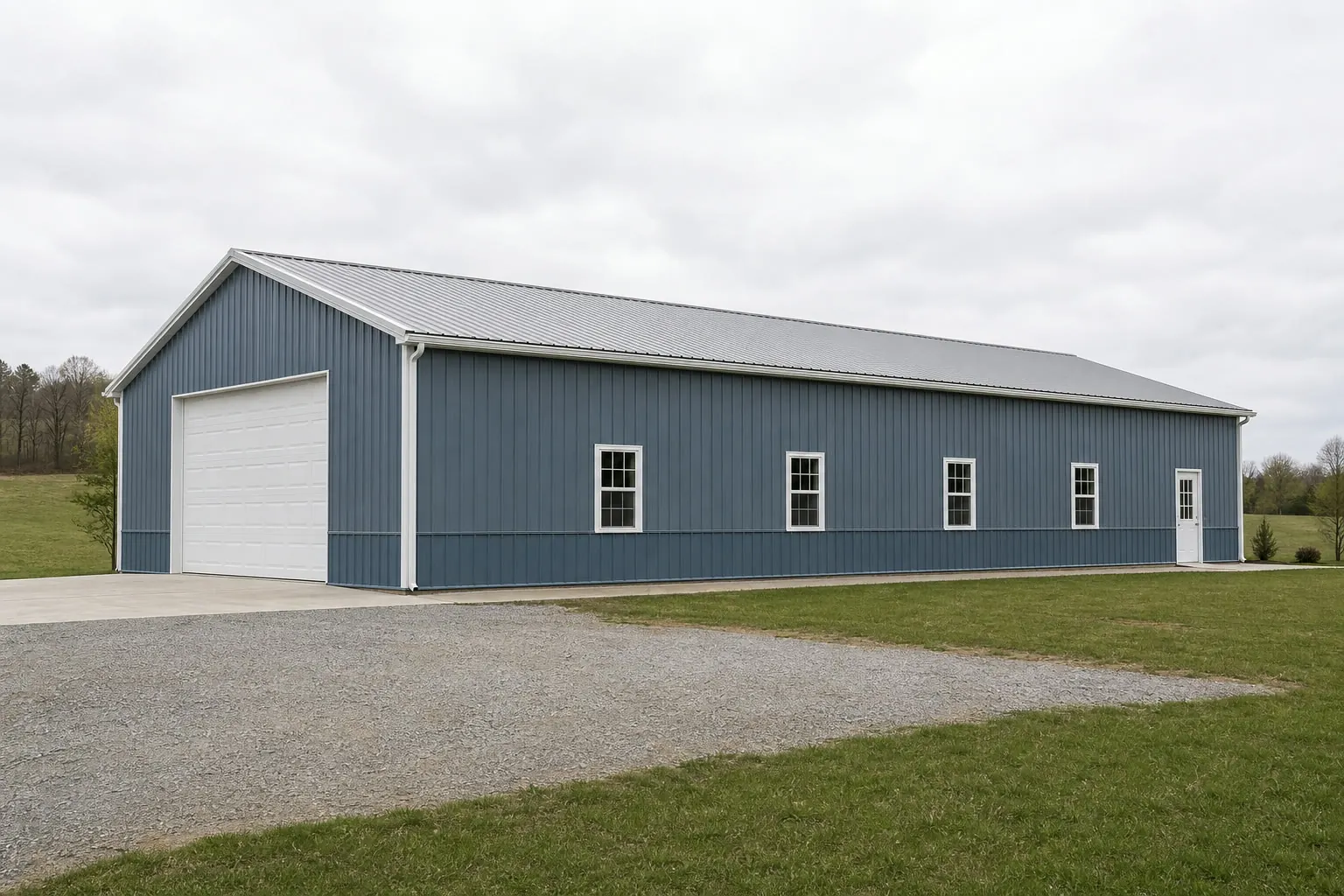
The intersection
What a Wisconsin site actually changes about a shouse
A shouse brief starts with the shop bay, and Wisconsin's dairy-heavy agricultural base plus its fast-moving metro construction markets both shape how big that bay needs to be.
Wisconsin's 2022 dairy count of 6,216 farms and cheese production north of 3.5 billion pounds describe a working economy that runs on equipment: milking systems, tractors, feed handling and cold storage all need covered space, and a shouse built on or near an active or former dairy operation is frequently sized around that equipment footprint first, with the attached living quarters fitted into whatever length remains. That is the opposite design order from a barndominium, where living space usually sets the footprint and a shop bay is added alongside it.
A second, distinct Wisconsin shouse buyer is not agricultural at all. Census data shows Sheboygan (+283.6%) and Racine (+221.5%) among the state's fastest-growing metro areas for housing units authorized year-over-year, and growing metro fringes are where a home-based trade business — an auto restorer, a fabricator, a contractor storing equipment — is more likely to want a shop-first building near town rather than on working farmland. Both buyer types are shopping the same building type for different reasons, and the shop-bay specification (door height, bay depth, floor load) should be nailed down before the residential portion is discussed either way.
None of this substitutes for your local building department, who determines what your specific parcel and occupancy require, particularly since a shop bay attached to living space can raise different classification questions than a stand-alone residence. What this page adds is the honest planning order: size the shop first, then the house.
Exposure
Sizing and protecting the shop bay against Wisconsin's climate
Statewide normals of roughly 34.9 inches of annual precipitation and about 51 inches of annual snowfall matter differently in a shouse because the shop bay is often left unconditioned while the attached living space is fully conditioned.
A shop bay that stores equipment, vehicles or agricultural machinery through a Wisconsin winter needs its own moisture plan even if it is not heated to residential comfort levels: door seals, floor drainage and roof-water routing away from the bay opening all matter regardless of whether the space is conditioned. That is a different set of priorities from the attached living quarters, where vapor management and continuous insulation follow the same logic as any year-round residence.
Because the shop bay is unconditioned or minimally conditioned in many Wisconsin shouse builds, the thermal break between the bay and the living space becomes one of the more consequential design decisions on the project — get it wrong and the house side inherits the bay's temperature swings. This is a conversation to have directly with your builder using the state's published climate-division normals as a reference, not a single statewide figure.
- Size the bay to actual equipment, not a guess
- Door height, bay depth and floor load should be set from the largest equipment or vehicle you expect to store, before the living-space layout is finalized.
- Detail the thermal break
- Confirm with your builder how the unconditioned or minimally conditioned shop bay is separated from the living space's insulation envelope.
- Route water away from the bay opening
- Roughly 34.9 inches of annual precipitation and 51 inches of snow statewide means drainage at a large bay door deserves the same attention as the roofline over the house.
Site context
How the shop-first brief differs across Wisconsin
The two shouse buyer profiles in Wisconsin — dairy/agricultural and metro trade/hobby — cluster in different parts of the state.
Dairy-concentrated interior
With 6,216 dairy farms statewide and over 3.5 billion pounds of cheese produced in 2022, this is where a shouse's shop bay is most likely sized around milking, feed and cold-storage equipment, with living quarters fitted around that program.
Broader working-farm counties
Wisconsin's 58,521 farms across 13,784,678 acres extend well beyond dairy alone; a shouse on a row-crop or mixed-operation parcel is more likely sized around tractors and implement storage than dairy-specific equipment.
Southeastern metro fringe (Racine, Sheboygan, Kenosha corridors)
Census data shows Racine (+221.5%) and Sheboygan (+283.6%) among the state's fastest-growing metro areas for housing units authorized. A shouse here is more likely a home-based trade or hobby workshop with a smaller, more finished shop bay than an agricultural build.
Any county, on hazard exposure
FEMA's National Risk Index scores 18 hazard types at the county level across all 72 Wisconsin counties. Because a shouse's shop bay often stores vehicles or equipment, checking your county's specific record is worth doing before finalizing siting.
Get Wisconsin shouse quotes
Tell us your equipment list, your bay conditioning plans and your living-space program. We route it with the Wisconsin and shouse context already attached.
Configuration
What Wisconsin shouse buyers are usually building
The shop-first ordering shows up differently depending on whether the buyer is agricultural or metro-based.
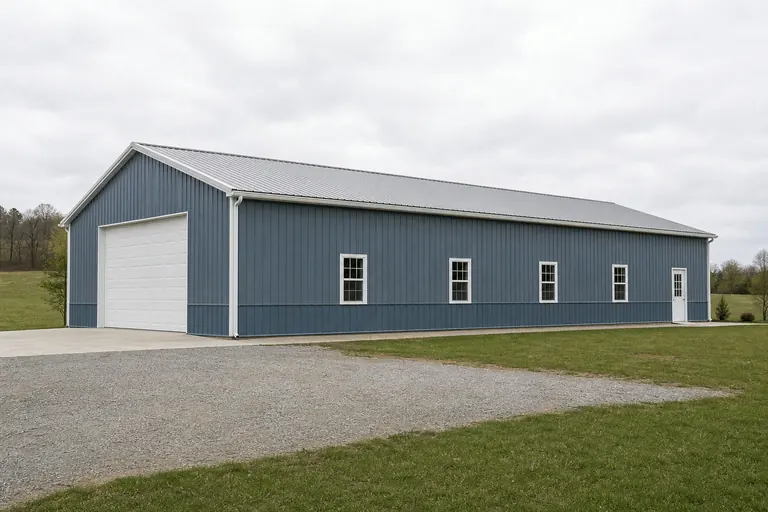 Dairy or livestock equipment shouseA large, deep shop bay sized for milking equipment, feed handling or livestock trailers, with attached living quarters fitted around the remaining footprint.Mixed-operation farm shouseA shop bay sized for tractors and implements on a row-crop or mixed-use parcel, paired with modest attached living space.Home-based trade or hobby shouseA smaller, more finished shop bay near a growing metro fringe, built for a home-based business or hobby with living quarters as the secondary program.
Example Configuration — for planning purposes only.
Footprint
Sizes that suit a Wisconsin shouse brief
Because the shop bay drives the footprint, Wisconsin shouse sizing tends to track equipment needs first and living-space needs second.
40′ × 60′
2,400 sq ft
A starting point for a smaller shop bay with compact attached living quarters, suited to a metro-fringe trade or hobby build.
50′ × 80′
4,000 sq ft
Adds bay depth for larger equipment or a livestock trailer alongside modest living space.
60′ × 100′
6,000 sq ft
A deep shop bay for full agricultural equipment storage plus a fuller living-quarters footprint.
Example Configuration — for planning purposes only.
Footprint pages carry bay-depth and layout detail for each of these; this page explains only why Wisconsin shop-first briefs tend to land in this range.
Preparation
Before you request a Wisconsin shouse quote
Resolving these in advance keeps quotes comparable and avoids a costly re-quote later.
Step 1
Measure your equipment before you size the bay
List the largest vehicles or equipment the shop bay must hold, including door clearance, before quoting the footprint.
Step 2
Decide the bay's conditioning level up front
Tell your builder whether the shop bay will be unconditioned, minimally heated, or fully conditioned, since this changes the thermal-break detailing between bay and living space.
Step 3
Contact your local building department early
Occupancy classification for a shop bay attached to living space is set locally and can differ from a stand-alone residence; ask before finalizing dimensions.
Step 4
Check your county's hazard record
Pull your specific county's data from FEMA's National Risk Index rather than assuming a statewide hazard picture, particularly if the bay will store valuable equipment.
Questions
Wisconsin shouse questions
Questions we can answer honestly at the state level, with the rest routed to whoever actually owns them.
Zoning, occupancy classification and permitting for a shop bay attached to living space are decided locally, parcel by parcel. Your local building department is the only reliable source on whether and how a shouse is permitted on your specific site.
There is no official standard size. With 6,216 dairy farms and 58,521 total farms statewide as of 2022, equipment needs vary widely; measure your actual vehicles and equipment, including door clearance, before sizing the bay.
That is your decision and your builder's engineering call, not something this page specifies. What matters is deciding the bay's conditioning level early, since it changes the thermal-break detailing between the bay and the attached living space.
We do not publish prevalence or popularity claims. What Census data does show is fast year-over-year growth in housing units authorized in Sheboygan (+283.6%) and Racine (+221.5%), which is relevant to construction lead times, not to how common any building type is.
Statewide normals of roughly 34.9 inches of annual precipitation and about 51 inches of snow mean drainage, door seals and roof-water routing at a large bay opening need attention even if the bay isn't heated. We do not convert these normals into design values here.
Sources for the Wisconsin facts on this page
This page states no code requirement, wind speed, snow load, permit rule, price or supplier claim. The state-specific facts it does use are listed with their publisher below.
As of December 31, 2022, Wisconsin had 6,216 dairy farms, and Wisconsin produced just over 3.5 billion pounds of cheese in 2022.
U.S. Department of Agriculture (USDA) · 2022 · Tier 1
https://www.usda.gov/about-usda/news/blog/wisconsin-2022-census-agriculture-highlightsWisconsin had 58,521 farms in 2022, down 10% from 2017.
USDA National Agricultural Statistics Service (NASS) · 2022 · Tier 1
https://www.nass.usda.gov/Publications/AgCensus/2022/Online_Resources/County_Profiles/Wisconsin/cp99055.pdfWisconsin had 13,784,678 acres of land in farms in 2022, an average farm size of 236 acres, up 7% since 2017.
USDA NASS · 2022 · Tier 1
https://www.nass.usda.gov/Publications/AgCensus/2022/Online_Resources/County_Profiles/Wisconsin/cp99055.pdfThe Census Bureau's 2023 Annual Building Permits highlights report tracks year-over-year percent change in total housing units authorized by state, with Wisconsin metro areas Sheboygan (+283.6%) and Racine (+221.5%) among the report's largest percentage gainers from 2022 to 2023.
U.S. Census Bureau · 2022-2023 · Tier 1
https://www.census.gov/construction/bps/pdf/2023annualhighlights.pdfWisconsin's statewide 1991-2020 annual normal precipitation is about 34.9 inches with roughly 51 inches of annual snowfall, per the Wisconsin State Climatology Office's statewide averages.
Wisconsin State Climatology Office (UW-Madison) · 1991-2020 · Tier 2
https://climatology.nelson.wisc.edu/wisconsin-historic-climate-data/statewide-climate-normals/FEMA's National Risk Index dataset defines and scores 18 natural hazard types (avalanche, coastal flooding, cold wave, drought, earthquake, hail, heat wave, hurricane, ice storm, inland flooding, landslide, lightning, strong wind, tornado, tsunami, volcanic activity, wildfire, winter weather) at the county level nationwide, including all 72 Wisconsin counties.
Federal Emergency Management Agency (FEMA) · Current NRI release · Tier 1
https://www.fema.gov/about/openfema/data-sets/national-risk-index-data