
Steel home · IN
Steel Homes in Indiana
Indiana's economy is built on moving things: transportation and warehousing alone accounts for 171,310 jobs, about 6% of total state employment, and has been the fastest-growing sector in the state over the prior decade, while a separate state-linked report benchmarks Indiana's advanced manufacturing and logistics industries directly against neighboring states. A workforce this steeped in freight, fabrication, and supply chains tends to arrive at a steel home already comfortable with the material rather than needing to be sold on it. Layer in 53,599 working farms across 14.6 million acres, where a residence often sits beside working buildings on the same parcel, and a building-code system where the state itself — through IDHS — runs plan review rather than leaving it purely to a scattered set of local offices, and the Indiana steel-home conversation is really about a logistics-minded buyer and one procedural route to learn.
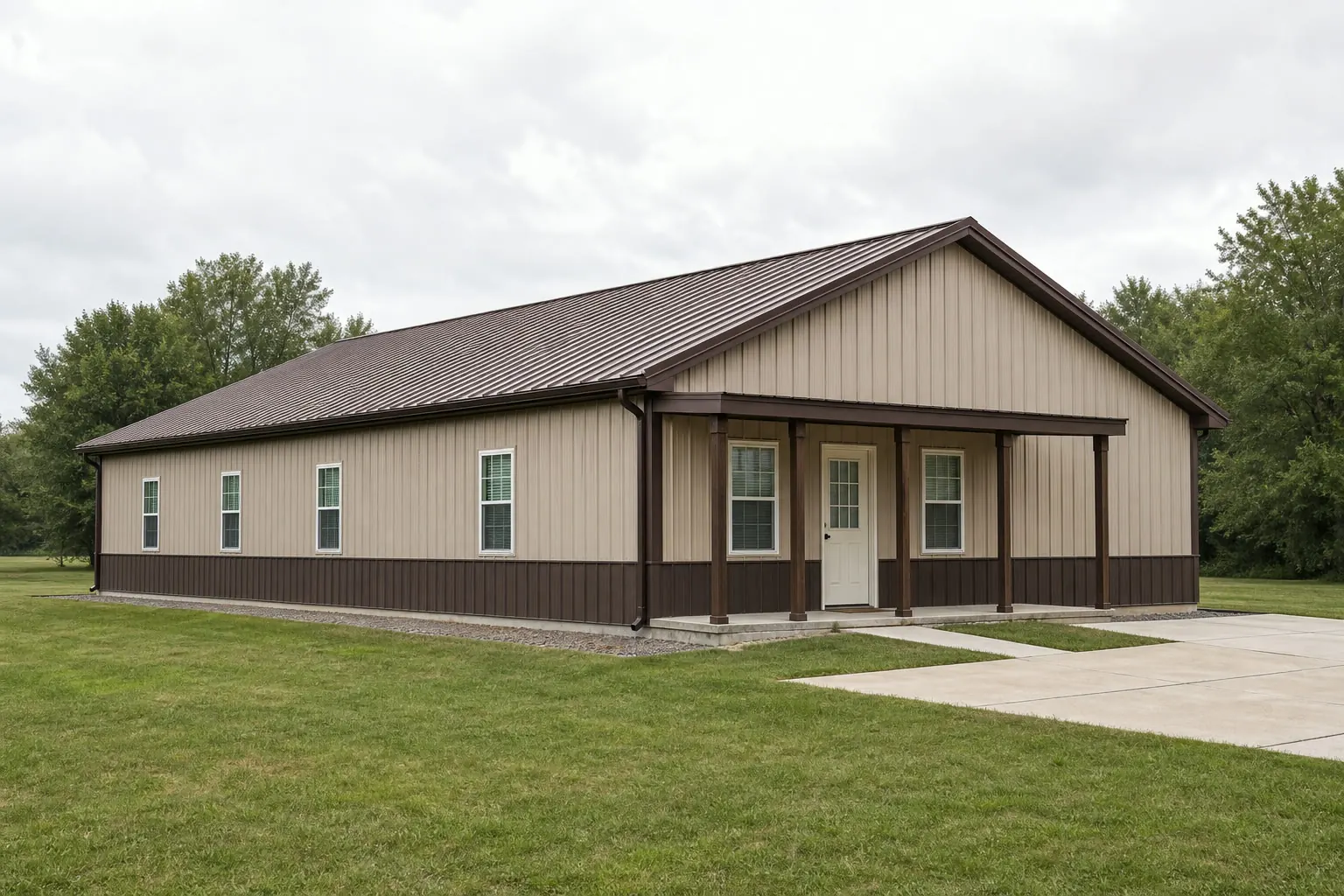
A Logistics Economy Building in Steel
Indiana's 171,310 transportation and warehousing jobs (about 6% of state employment, and the fastest-growing sector here over the prior decade) sit alongside a state-linked report that actively benchmarks Indiana's advanced manufacturing and logistics industries against neighboring states. That is an economy where steel is a familiar material long before it becomes a residential decision. On the state's 53,599 farms across 14.6 million acres, a steel home often sits beside other working steel buildings on the same parcel. What changes the actual build here is less about persuading a skeptical buyer and more about navigating Indiana's centralized, state-run plan-review process.
Buyer Profile
Why Indiana's Freight Economy Produces Steel-Ready Buyers
A workforce built around transportation, warehousing, and manufacturing tends to specify steel with fewer questions.
Transportation and warehousing alone employs 171,310 people in Indiana, roughly 6% of the state's total workforce, and it has been the fastest-growing sector in the state's economy over the prior decade. Separately, a 2023 industry report benchmarks Indiana's advanced manufacturing and logistics (AML) sector directly against neighboring states, which signals that industrial capacity — and by extension steel as a working material — is treated as a competitive asset in Indiana's economic identity, not a niche interest.
For a homebuilder, that translates into a buyer who is often already specifying steel professionally, whether in a warehouse racking system or a manufacturing floor, and who arrives at a residential steel-home conversation without needing the basic material case made from scratch. The conversation shifts faster to layout, insulation package, and finish than it would with a buyer encountering steel construction for the first time.
That said, this page does not have a confirmed, single BLS figure isolating Indiana's manufacturing employment concentration (its location quotient); the state-linked Conexus/IBRC benchmarking report was used instead, and that distinction is worth knowing if you go looking for a harder number yourself.
State Reference
Indiana Figures Behind This Page
Sourced figures only; nothing here is a design value or code requirement.
| Metric | Value | Source |
|---|---|---|
| Transportation & warehousing jobs | 171,310 (~6% of state employment) | Indiana Business Research Center |
| Farms (2022) | 53,599 | USDA NASS |
| Land in farms (2022) | 14,602,240 acres | USDA NASS |
| Total land area | 36,420 sq mi | U.S. Census Bureau |
| Code adoption/enforcement | Fire Prevention and Building Safety Commission / IDHS | Indiana DHS |
| Named natural hazards scored | 18 (FEMA National Risk Index) | FEMA |
Transportation & warehousing jobs
- Value
- 171,310 (~6% of state employment)
- Source
- Indiana Business Research Center
Farms (2022)
- Value
- 53,599
- Source
- USDA NASS
Land in farms (2022)
- Value
- 14,602,240 acres
- Source
- USDA NASS
Total land area
- Value
- 36,420 sq mi
- Source
- U.S. Census Bureau
Code adoption/enforcement
- Value
- Fire Prevention and Building Safety Commission / IDHS
- Source
- Indiana DHS
Named natural hazards scored
- Value
- 18 (FEMA National Risk Index)
- Source
- FEMA
Site Planning
Steel Homes Next to Working Farm Buildings
On many Indiana parcels, a steel home shares a site with existing farm structures, which changes utility and access planning more than it changes the home's frame.
With 14,602,240 acres still in farm production across the state, a meaningful share of Indiana steel-home projects are sited on or adjacent to working farmland rather than in a purely residential subdivision. That context often means an existing well, septic system, driveway, or outbuilding already defines part of the site plan before the home design starts.
Coordinating utility routing, setbacks from existing farm structures, and shared driveway access with your local reviewing authority early avoids redesign later. It's a site-logistics question more than a structural one, but it is genuinely more common in Indiana than in a state with less farmland in active use.
FEMA's National Risk Index scores the same 18 named hazards for every Indiana county that it scores nationwide, but the relative score for your specific county has to be looked up individually — there is no single statewide hazard label that applies evenly across all 92 counties.
Start Your Indiana Steel Home
Tell us your household size, site context, and rough footprint. We route it with Indiana's logistics and plan-review context attached.
Preparation
Steel Home Planning Steps for Indiana
Steps specific to Indiana's review structure and site context.
- Confirm your plan-review pathAsk whether your project is reviewed directly by IDHS or by a locally delegated department.
- Check your county's National Risk Index scoresLook up your specific county's FEMA hazard scores rather than relying on a general statewide impression.
- Map existing farm infrastructureIf the site has an existing well, septic, or outbuildings, plan utility routing and setbacks around them early.
- Ask about the current code editionIndiana's 2026 building code adoption was in progress per the Indiana Register at time of writing.
Configurations
Common Indiana Steel Home Approaches
Reflecting the logistics workforce and farm-adjacent siting documented above.
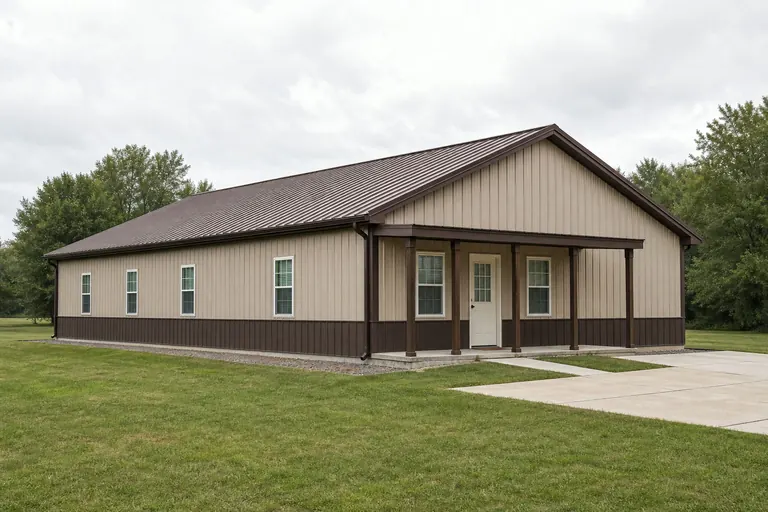 The Logistics Professional's HomeA straightforward steel shell for a buyer already comfortable specifying steel through warehousing or manufacturing work.The Farm-Adjacent ResidenceSited near existing farm buildings, with utility routing planned around what's already on the parcel.The Acreage Lifestyle HomeA residence paired with an attached or nearby workshop/storage bay on a larger rural lot.
Example Configuration — for planning purposes only.
Footprints
Sizing an Indiana Steel Home
Select a footprint that fits your household size and site constraints.
30′ × 50′
1,500 sq ft
A compact home suited to a smaller acreage lot or secondary residence.
40′ × 60′
2,400 sq ft
A family-sized footprint with room for an open living area.
Example Configuration — for planning purposes only.
Confirm setbacks from any existing farm structures with your local reviewing authority before finalizing a plan.
Indiana FAQ
Steel Home Questions for Indiana Buyers
Direct answers, with local-specific items routed to the right office.
The Fire Prevention and Building Safety Commission adopts the state's residential code by rule, and IDHS carries out plan review and enforcement; confirm whether your project is reviewed directly by IDHS or a locally delegated department.
We can't claim prevalence, but Indiana's 171,310 transportation and warehousing jobs and its benchmarked advanced manufacturing sector do mean many buyers already work around steel professionally.
FEMA's National Risk Index scores 18 named hazards for every county, but you need to look up your specific county's score rather than rely on a statewide label.
Often yes, and many sites already have a well, septic system, or outbuildings that should shape the site plan; coordinate that with your local reviewing authority before finalizing utility routing.
Indiana's 2026 building code adoption was in progress per an Indiana Register filing at the time this page was written; confirm the current adopted edition with the reviewing authority.
We don't publish state-level prices here; cost depends on specification, site work, and current material costs. Our cost pages explain the drivers, and a quote covers your specific building.
Sources for the Indiana facts on this page
This page states no code requirement, wind speed, snow load, permit rule, price or supplier claim. The state-specific facts it does use are listed with their publisher below.
Indiana's transportation and warehousing sector employment and share of total state employment, using state QCEW-derived data.
Indiana Business Research Center, Indiana University (InContext, using state/federal labor data) · 2023 article, referencing prior-decade trend · Tier 2
https://www.incontext.indiana.edu/2023/mar-apr/article1.aspIndiana's advanced manufacturing and logistics (AML) industries are benchmarked against neighboring states in a state economic development-linked report.
Conexus Indiana (in partnership with state workforce data) · August 2023 · Tier 2
https://www.conexusindiana.com/wp-content/uploads/2023/08/2023-Benchmarking-Indianas-Advanced-Manufacturing-and-Logistics-Industries-Report-1.pdfNumber of farms in Indiana in 2022, per the state statistician's public comments on the Census of Agriculture.
USDA NASS (data); Brownfield Ag News (reporting) · 2022 Census of Agriculture · Tier 1
https://www.nass.usda.gov/Publications/AgCensus/2022/Full_Report/Volume_1,_Chapter_2_County_Level/Indiana/st18_2_045_045.pdfIndiana total land area per US Census Bureau state area measurements.
U.S. Census Bureau · 2010 measurement basis · Tier 1
https://www.census.gov/geographies/reference-files/2010/geo/state-area.htmlIndiana's Department of Homeland Security, through its Fire Prevention and Building Safety Commission and Code Enforcement/Building Plan Review functions, adopts and administers the state building code.
Indiana Department of Homeland Security (IDHS) · Current program pages; 2026 Indiana Building Code adoption in progress per Indiana Register filing · Tier 2
https://www.in.gov/dhs/building-plan-review/FEMA's National Risk Index scores the same 18 named natural hazards for Indiana counties as for all other states.
FEMA · Current release · Tier 1
https://www.fema.gov/flood-maps/products-tools/national-risk-index