
Shouse · TX
Steel Shouses in Texas
A shouse — a steel building combining a residence with an attached or integrated shop — carries a different Texas planning path than a standalone shed or garage, because part of it is a home. Texas has no single statewide building code authority for most construction, so the residential portion and the shop portion of the same building can face review from the same local office under different expectations, decided city by city and county by county. If the parcel sits inside the Texas Department of Insurance's designated coastal catastrophe area, an occupied structure like a shouse faces its own windstorm certification question before it can be insured. And with 230,662 farms across 125,471,325 acres of working Texas land, a shouse is frequently the way an owner combines a home with equipment storage on acreage rather than building two separate structures. This page addresses those Texas-specific realities rather than repeating generic barndominium-style advice.
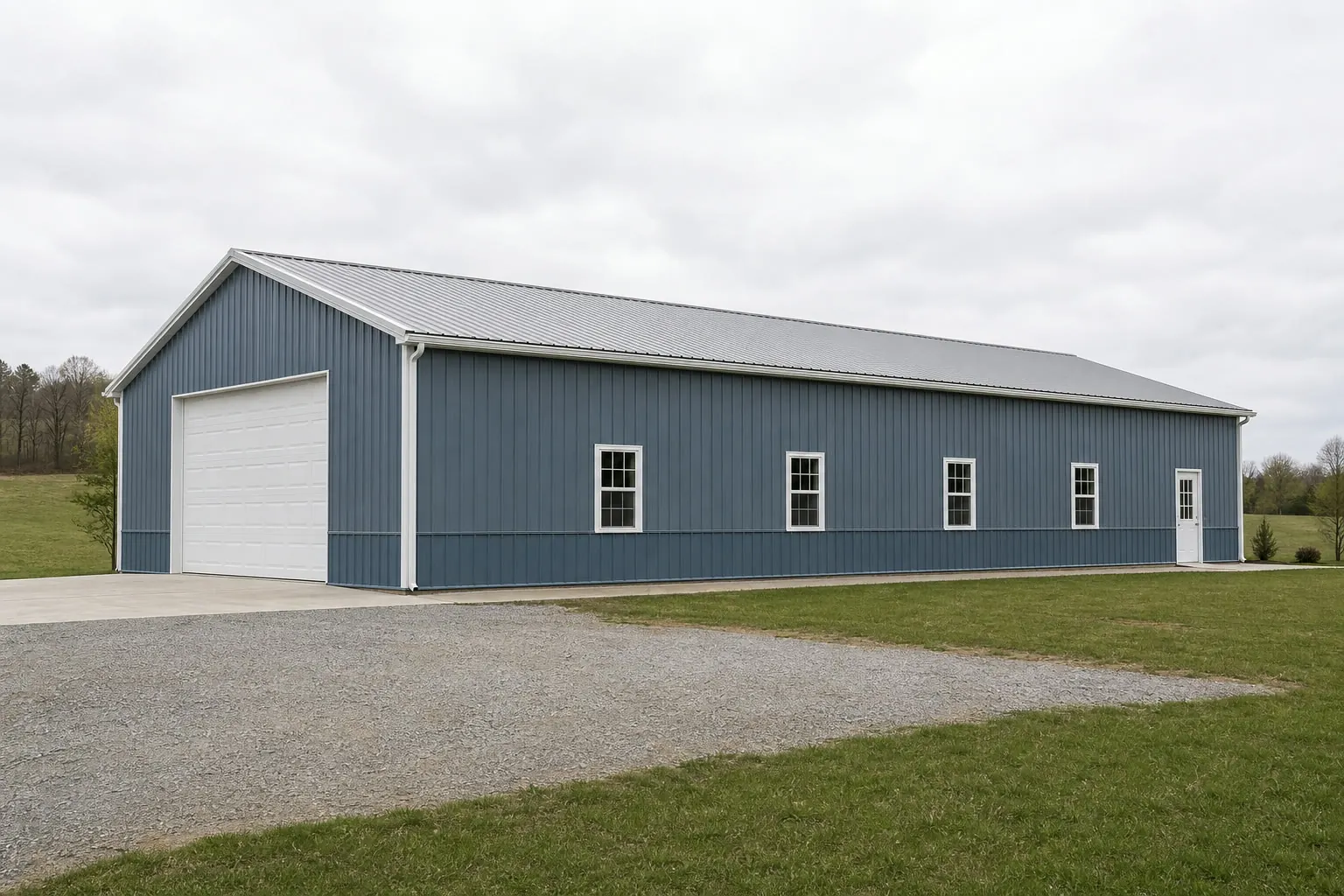
The intersection
What a Texas site actually changes about a shouse
A shouse's dual identity as a home and a shop means Texas's fragmented local review structure and coastal insurance rules reach it in ways a single-purpose building never faces.
Texas does not have a single statewide building code authority enforcing a mandatory code for most construction; adoption and enforcement happen primarily at the local and municipal level. For a shouse, that matters more than for most steel buildings because the project has two functional halves — living space and shop — and a local department may apply different expectations to each. Confirm with your local building department how it treats a combined residential-and-shop structure before finalizing a floor plan, since the answer genuinely varies by city and county.
Coastal siting adds an insurance-driven layer specific to occupied structures. The Texas Department of Insurance administers a Windstorm Inspection Program under a 1987 state law, and the Texas Windstorm Insurance Association requires a Windstorm Certificate of Compliance for structures inside a designated catastrophe area covering 14 coastal counties plus part of Harris County east of Highway 146. A shouse in that zone is an occupied residence as well as a structure, so the windstorm certification conversation carries more weight here than it would for an unoccupied storage building on the same parcel.
Terrain and land scale shape the site-work side of a shouse project. The Bureau of Economic Geology maps Texas's major physiographic regions as Gulf Coastal Plains, Interior Plains and Blackland Prairies, Great Plains or High Plains, and the Basin and Range Trans-Pecos, and the state's 261,226 square miles of land area means a shouse foundation on Blackland clay is a different job than one on High Plains ground or Gulf Coast alluvium. Because a shouse's footprint is typically larger than a single-purpose shed, getting the pad and foundation right for your specific region matters more, not less.
Site context
How the build site differs across Texas
The Bureau of Economic Geology's physiographic regions are a practical lens for anticipating shouse foundation and site work before you request a quote.
Gulf Coastal Plains
Low, often flat and wet ground plus, for coastal-zone parcels, the windstorm certification question for an occupied shouse. Drainage planning around a larger footprint matters here.
Interior Plains / Blackland Prairies
Central Texas clay-heavy soils that shrink and swell with moisture; a stable, well-engineered slab matters more under a shouse's combined living-and-shop load than under a simple shed.
Great Plains (High Plains)
Flat, elevated terrain in the Panhandle and West Texas with open exposure; anchoring and orientation of the living-space side toward wind protection are worth planning early.
Basin and Range (Trans-Pecos)
Mountainous, arid far-west Texas. Access and grading for a level, larger pad are the binding constraints on many sites in this region.
Use case
Texas shouses are frequently a working-acreage home
With 230,662 farms recorded in the 2022 Census of Agriculture — the most of any U.S. state — across 125,471,325 acres of land in farms, a shouse is a common way Texas landowners combine a residence with equipment or shop space on working acreage.
That statewide farm count does not describe any one buyer's parcel; it explains why a Texas shouse brief so often pairs a modest living footprint with a larger shop bay for equipment, feed handling or a home-based trade rather than a purely residential layout. An average farm size of 544 acres statewide means many of these sites have room to separate the residence entrance and yard from shop and loading traffic, which is a layout decision worth making before the slab is poured rather than after.
That same acreage context also shapes utility planning: a shouse further from existing service lines needs realistic conversations about well, septic and electrical runs early, since these decisions affect where the residential half of the building can practically sit relative to the shop half.
Get Texas shouse quotes
Tell us your region, your parcel's coastal status and your living-to-shop split. We route it with the Texas and shouse context already attached.
Configuration
What Texas shouse briefs are usually asked to do
Texas shouse enquiries split between working-acreage homes and coastal or suburban combined-use builds, and the priorities differ accordingly.
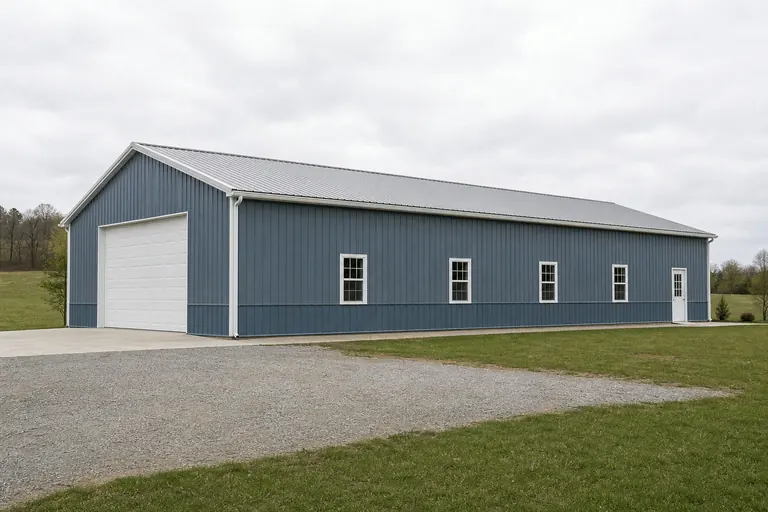 Working-acreage shouseA residence attached to a shop bay for equipment, feed or a home-based trade. Separating living and shop traffic on the site plan is the detail most often underspecified.Home-shop hybridA smaller living footprint with a larger shop for a hobby, small business or vehicle storage. Utility runs between the two halves need early planning.Coastal-zone shouseA shouse inside the TDI catastrophe area that will need windstorm certification as an occupied structure before it can be insured. Confirm the certification path before ordering.
Example Configuration — for planning purposes only.
Footprint
Sizes that suit common Texas shouse briefs
Texas shouse footprints tend to run larger than a single-purpose shed because the living and shop portions both need to fit under one roof.
40′ × 60′
2,400 sq ft
A compact shouse pairing a small residence with a modest shop bay.
50′ × 80′
4,000 sq ft
A common step up when a full shop bay is added alongside a family-sized living area.
60′ × 100′
6,000 sq ft
Room for a larger shop with equipment access plus a full residence.
80′ × 120′
9,600 sq ft
Where the shop side starts to handle heavier equipment or multiple bays.
Example Configuration — for planning purposes only.
Footprint pages carry layout and door detail; this page explains why Texas briefs land in this range.
Preparation
Before you request a Texas shouse quote
Four things resolved in advance make the difference between a comparable quote and a re-quote.
Step 1
Contact your local building department about the combined use
Texas has no single statewide authority for most construction, so your city or county is the only reliable source on how it treats a residential-and-shop structure.
Step 2
Check whether your parcel is in the coastal catastrophe area
If it is, ask about the Windstorm Certificate of Compliance process before ordering, since a shouse is an occupied structure that will need to be insured.
Step 3
Describe your region, not just your county
Blackland clay, High Plains ground and Gulf Coast alluvium each call for different foundation work under a shouse's larger footprint.
Step 4
Give the split between living space and shop space
A shouse priced without a clear living-to-shop ratio is a frequent cause of a second round of quoting.
Questions
Texas shouse questions
Questions we can answer honestly at state level, with the rest routed to whoever actually owns them.
Texas has no single statewide building code authority for most construction, so permit rules are set locally, and a combined residential-and-shop structure may face review from more than one department function. Your local building department is the only reliable source on what your parcel requires.
Only if your parcel is inside TDI's designated catastrophe area — 14 coastal counties plus part of Harris County east of Highway 146 — and you intend to insure the building under a windstorm policy. As an occupied structure, confirm this with TDI or your insurer before ordering.
There is no official typical size. Enquiries most often fall between roughly 40x60 for a compact home-and-shop combination and 80x120 for a larger residence paired with heavier equipment storage.
We do not publish state-level prices, because a credible number depends on the living-to-shop split, finish level, site work and current material pricing. Our cost pages cover what drives the number.
Site conditions vary by region — Blackland clay, High Plains ground and Gulf Coast soils behave differently — but the right foundation for your parcel is a site-specific decision for your builder, not a statewide rule.
Financing terms depend on your lender and how the building is classified for residential use, which this page does not set. Check with your lender or local appraisal district.
Sources for the Texas facts on this page
This page states no code requirement, wind speed, snow load, permit rule, price or supplier claim. The state-specific facts it does use are listed with their publisher below.
Texas does not have a single statewide building code authority enforcing a mandatory building code for most construction; code adoption and enforcement occur primarily at the local/municipal level.
KHOU 11 (Verify) / Texas State Law Library · current · Tier 3
https://www.khou.com/article/news/verify/verify-statewide-enforced-residential-building-code-texas/285-cc7c6343-cdf1-4751-b855-713601cf6b8bThe Texas Department of Insurance (TDI) administers a Windstorm Inspection Program for coastal construction, established under a 1987 state law, to allow structures to qualify for windstorm coverage.
Texas Department of Insurance (TDI) · since 1988 · Tier 2
https://www.tdi.texas.gov/wind/generalquestio.htmlThe Texas Windstorm Insurance Association (TWIA) requires coastal properties to hold a Windstorm Certificate of Compliance under Texas Insurance Code Chapter 2210 before TWIA wind/hail coverage is issued; TDI states the designated catastrophe area covers 14 coastal counties and part of Harris County east of Highway 146.
Texas Windstorm Insurance Association (TWIA) / Texas Department of Insurance (TDI) · current · Tier 2
https://www.tdi.texas.gov/tips/need-windstorm-inspection.htmlTexas had 230,662 farms in 2022 per the USDA Census of Agriculture, the most of any U.S. state.
USDA National Agricultural Statistics Service (NASS) · 2022 · Tier 1
https://www.nass.usda.gov/Publications/AgCensus/2022/Full_Report/Volume_1,_Chapter_1_State_Level/Texas/Land in farms in Texas totaled 125,471,325 acres in 2022.
USDA NASS · 2022 · Tier 1
https://www.nass.usda.gov/Publications/AgCensus/2022/Full_Report/Volume_1,_Chapter_1_State_Level/Texas/The average farm size in Texas was 544 acres in 2022.
USDA NASS · 2022 · Tier 1
https://www.nass.usda.gov/Publications/AgCensus/2022/Full_Report/Volume_1,_Chapter_1_State_Level/Texas/The USGS-published Bureau of Economic Geology map identifies major Texas physiographic regions including the Gulf Coastal Plains, Interior Plains, Great Plains, and Basin and Range provinces.
Bureau of Economic Geology, University of Texas at Austin · 1996 · Tier 2
https://txmn.org/st/files/2022/09/BEG_PHYSIOGRAPHY_1996.pdfTexas's total land area was 261,226 square miles per the 2008 Census Bureau state area measurements, the largest of the contiguous 48 states.
U.S. Census Bureau, Statistical Abstract of the United States: 2011 · 2008 · Tier 1
https://www2.census.gov/library/publications/2010/compendia/statab/130ed/tables/11s0355.pdf