
Shed · GA
Steel Sheds in Georgia
A backyard or rural shed in Georgia is shaped less by the building itself than by where in the state it sits. The New Georgia Encyclopedia maps the state across five distinct physiographic provinces — the Appalachian Plateau, Valley and Ridge, Blue Ridge, Piedmont and Coastal Plain — so a shed pad in the north Georgia mountains and one on the flat, humid Coastal Plain are answering different grading and drainage questions. Georgia still counted 39,264 farms in 2022, even after a 7% decline since 2017, with an average farm size up 8% to 253 acres, which keeps a meaningful share of shed demand rural and working-oriented rather than purely suburban. This page addresses those Georgia-specific realities rather than repeating generic shed advice.
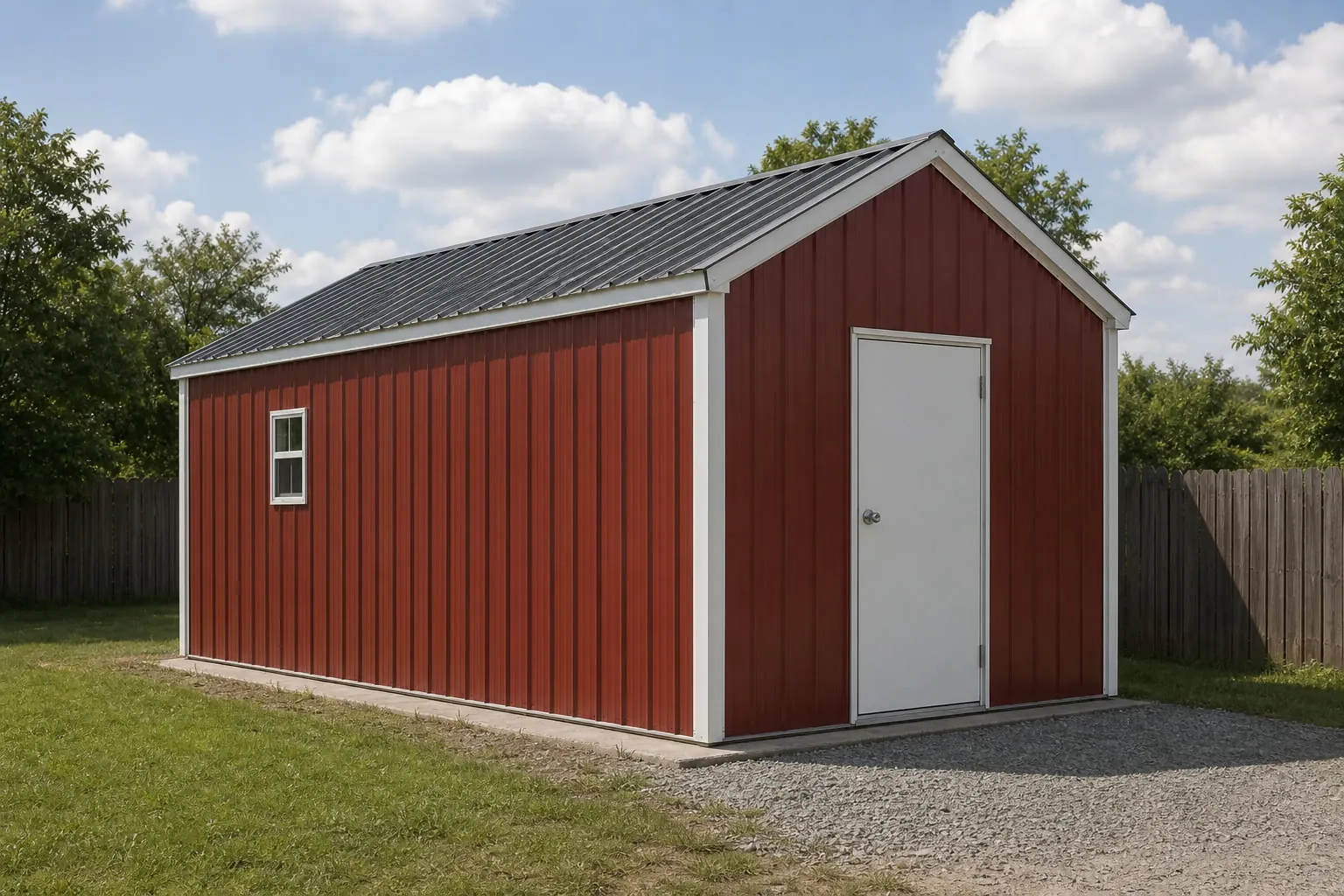
The intersection
What a Georgia site actually changes about a shed
A shed is a simple building, but in Georgia the terrain it sits on and the land base around it vary meaningfully across the state.
Start with the province, not the building. Georgia's remaining farms, 39,264 of them in 2022, average 253 acres each — up 8% since 2017 even as the total farm count fell 7% — and that trend toward fewer, larger operations is exactly what keeps equipment- and feed-storage sheds a meaningful share of Georgia demand alongside ordinary backyard storage. A rural shed brief in Georgia is as likely to include a tractor bay or feed room as a suburban brief is to be pure tool storage.
Where that shed sits then determines the site work. The New Georgia Encyclopedia's five-province map — Appalachian Plateau, Valley and Ridge, Blue Ridge, Piedmont, Coastal Plain — puts a Blue Ridge foothill pad on sloped, sometimes rocky ground and a Coastal Plain pad on flat, humid, low-lying ground, and those are genuinely different grading jobs even for an identical footprint. The Georgia Geologic Survey maps finer sub-sections still, such as the Lookout Mountain District in the far northwest, which is a reason to walk your specific pad location with a contractor rather than assume a province label tells the whole story.
None of that terrain detail settles the paperwork question, because Georgia permitting is a local matter: cities and counties, not a state agency, decide whether a given shed footprint needs a permit. Georgia's local offices processed 63,621 new housing unit authorizations in 2023 — the 5th-most of any state — so that volume shows the departments are busy, not that a statewide shed rule exists; your county or city building department remains the only reliable answer for your parcel.
Site context
How the build site differs across Georgia
Georgia's physiographic provinces are a practical lens for anticipating shed site work before you request a quote.
Appalachian Plateau / Blue Ridge
Sloped, sometimes rocky northern terrain. Grading and delivery access are the practical concerns.
Valley and Ridge
Alternating ridge and valley terrain in the northwest. A level pad may take more prep than the footprint suggests.
Piedmont
Rolling clay-soil uplands across the state's middle. Drainage around the pad matters more here than in sandier regions.
Coastal Plain
Flat, humid ground in south Georgia. Drainage away from the pad and ventilation for stored goods are the two items worth resolving early.
Practical Factors
Two things a province label doesn't tell you: access and humidity
Beyond terrain, two practical factors shape a Georgia shed project regardless of which province the parcel is in: how a delivery vehicle reaches the pad, and how much ventilation the contents need.
On larger rural tracts — and Georgia's remaining farms now average 253 acres — the shed site is often set well back from the public road, so a delivery route wide and firm enough for a loaded trailer matters as much as the pad itself. Walking that route with your builder before the pad location is fixed avoids discovering a gate, culvert, or soft-shoulder problem on delivery day.
Humidity is the second constant. Atlanta's climate normal of roughly 50.4 inches of annual precipitation is a station-level figure, but it is a fair proxy for how much moisture a Georgia shed's contents are exposed to statewide, on top of whatever drainage challenge the specific province adds. Ridge vents or gable vents are worth specifying up front if the shed will store anything feed-, fabric-, or electronics-based.
Get Georgia shed quotes
Tell us your province, your intended use and site conditions. We route it with the Georgia and shed context already attached.
Configuration
What Georgia sheds are usually asked to do
Georgia shed briefs split between suburban storage and working-land support, and configuration choices differ accordingly.
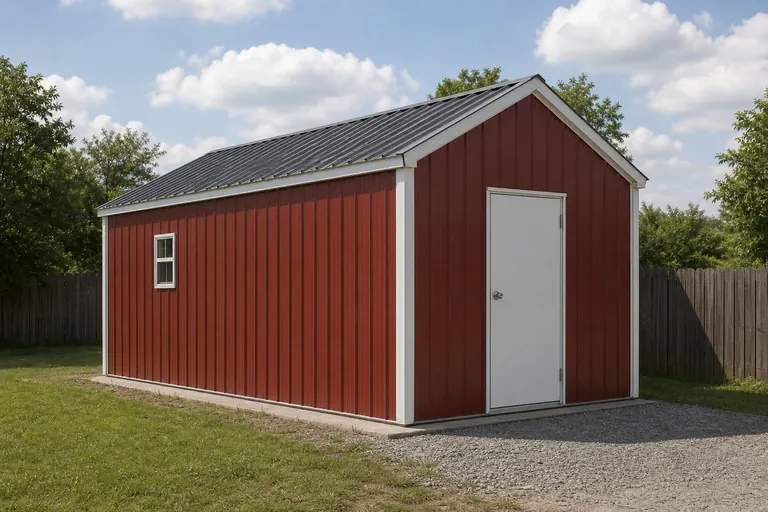 Backyard storageA compact, single-purpose building for tools, mowers and seasonal items. Door width for the largest item you own is the detail buyers most often underspecify.
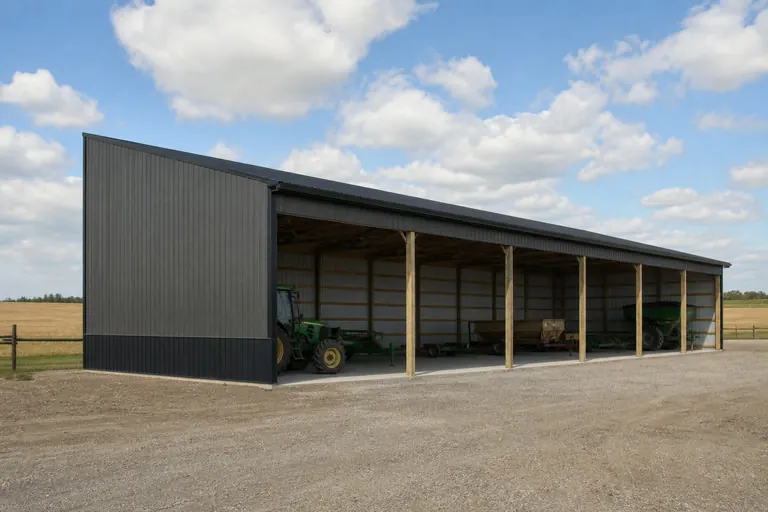 Rural feed and equipment storageA working building for feed, tack and small equipment. Ventilation and a durable floor matter more here than finish quality.Coastal Plain accessory buildingA shed on flat, humid ground where drainage and ventilation deserve early attention.
Example Configuration — for planning purposes only.
Footprint
Sizes that suit common Georgia shed briefs
Most Georgia shed enquiries stay compact because the building supplements an existing structure rather than replacing one, even on larger acreage.
10′ × 12′
120 sq ft
The smallest practical footprint for tool and mower storage.
12′ × 20′
240 sq ft
A common step up when feed or tack storage is added to general storage.
16′ × 24′
384 sq ft
Enough depth for a small equipment bay alongside storage.
20′ × 30′
600 sq ft
Where the building starts to double as a small workshop.
Example Configuration — for planning purposes only.
Footprint pages carry layout and door detail; this page explains why Georgia briefs land in this range.
Preparation
Before you request a Georgia shed quote
A short list resolved before you request a quote keeps a Georgia shed project on one round of pricing instead of two.
Step 1
Call your county or city building department first
Georgia sets shed permit and setback rules locally, so this call, not a general assumption, is the accurate starting point for your parcel.
Step 2
Name your province
Blue Ridge slope terrain, Piedmont clay and Coastal Plain flatland each need different pad preparation, so tell your builder which one applies before they quote.
Step 3
State the full intended use, including future changes
A shed quoted as tool storage but later loaded with feed or equipment is a common cause of a second, higher quote.
Step 4
Confirm the delivery route can handle a loaded trailer
Especially on larger rural tracts, a route check before ordering avoids a delivery-day surprise.
Questions
Georgia shed questions
Questions we can answer honestly at state level, with the rest routed to whoever actually owns them.
Permit rules are set locally in Georgia, so your local building department is the only reliable source on what your city or county requires for a shed on your parcel.
Site conditions vary by physiographic province — Blue Ridge slope terrain and Coastal Plain flatland behave differently — but the right foundation for your parcel is a site-specific decision for your builder, not a statewide rule.
There is no official typical size. Most enquiries stay in the 10x12 to 20x30 range because the building usually supplements an existing structure rather than replacing one.
We do not publish state-level prices, because a credible number depends on specification, site work and current material pricing. Our cost pages cover what drives the number.
Both are common. Georgia still counted 39,264 farms in 2022, which keeps working-land sheds a real share of demand, alongside suburban backyard storage.
Sources for the Georgia facts on this page
This page states no code requirement, wind speed, snow load, permit rule, price or supplier claim. The state-specific facts it does use are listed with their publisher below.
The New Georgia Encyclopedia (citing University of Georgia geography scholarship) describes Georgia as encompassing parts of five distinct physiographic provinces: the Appalachian Plateau, the Valley and Ridge, the Blue Ridge, the Piedmont, and the Coastal Plain.
New Georgia Encyclopedia (University of Georgia Press / Georgia Humanities) · Reference overview · Tier 2
https://www.georgiaencyclopedia.org/articles/geography-environment/geographic-regions-of-georgia-overview/The Georgia Environmental Protection Division / Georgia Geologic Survey publishes a detailed physiographic map and regional descriptions of Georgia, including named sections such as the Lookout Mountain District of the Appalachian Plateau province in the state's northwest corner.
Georgia Environmental Protection Division, Georgia Geologic Survey · 1988 (state reference map) · Tier 2
https://epd.georgia.gov/document/publication/sm-4-physiographic-map-georgia-12000000-1988/downloadGeorgia had 39,264 farms in 2022, down 7% from 2017, covering 9,939,313 acres of land in farms with an average farm size of 253 acres (up 8% since 2017).
USDA National Agricultural Statistics Service (NASS) · 2022 · Tier 1
https://www.nass.usda.gov/Publications/AgCensus/2022/Online_Resources/County_Profiles/Georgia/cp99013.pdfAtlanta's (Hartsfield-Jackson) 1991-2020 annual climate normal precipitation is about 50.4 inches with roughly 2.2 inches of annual snowfall.
NOAA National Centers for Environmental Information (NCEI) · 1991-2020 · Tier 1
https://www.ncei.noaa.gov/access/services/data/v1?dataset=normals-monthly-1991-2020&dataTypes=MLY-PRCP-NORMAL,MLY-SNOW-NORMAL&format=csv&stations=USW00013874FEMA's National Risk Index platform (hazards.fema.gov) is the authoritative county/tract-level source for Georgia natural hazard exposure scores across 18 hazard types.
Federal Emergency Management Agency (FEMA) · Current NRI dataset · Tier 1
https://www.fema.gov/flood-maps/products-tools/national-risk-indexGeorgia local building permit offices authorized 63,621 new privately-owned housing units in 2023, ranking 5th among states, down from 77,542 units in 2022.
U.S. Census Bureau · 2023 (with 2022 comparison) · Tier 1
https://www.census.gov/construction/bps/pdf/2023annualhighlights.pdf