
Self-storage building · FL
Self-Storage Buildings in Florida
A self-storage facility in Florida is a commercial, multi-tenant development, and the state's specific geography makes site selection the first real design decision. USGS elevation mapping shows large parts of Florida sitting low, and the Floridan aquifer system underlies every county, so drainage design for a large paved lot with multiple buildings is a genuine engineering question almost anywhere in the state. Layered on top of that, the Florida Building Code carries a distinct High-Velocity Hurricane Zone covering Broward and Miami-Dade counties, and NOAA's Hurricane Research Division records Florida as the U.S. state with the most historical hurricane landfalls — both facts a self-storage developer needs in the site-selection and insurance conversation from day one.
The intersection
Florida's terrain and wind zones drive self-storage site selection
A commercial self-storage development in Florida is planned around drainage on low ground and around whether the parcel sits inside the state's hurricane wind-zone overlay.
Every Florida self-storage site plan starts with the same two questions a developer in a hillier state can often defer: where does the water go, and how far above the surrounding grade does the pad need to sit? USGS elevation data describing large portions of Florida as low-lying, combined with the roughly 100,000-square-mile Floridan aquifer underlying every county, means a multi-building facility's stormwater retention and pad-elevation design carries real engineering weight almost anywhere in the state, not only in obviously coastal locations.
Layered on top of that is code geography. The Florida Building Code's High-Velocity Hurricane Zone applies specifically to Broward and Miami-Dade counties, and a facility inside that zone follows an additional local product-approval and inspection track. Outside those two counties, the standard statewide Florida Building Code applies, though individual cities and counties can still add local amendments and their own site-plan review requirements — commercial zoning for a multi-tenant facility is a local process everywhere in Florida.
Wind exposure is a statewide underwriting consideration even outside the HVHZ. NOAA's Hurricane Research Division 1851-2018 dataset places Florida first among U.S. states for historical hurricane direct hits, so a self-storage developer's insurance conversation should treat storm exposure as a standing planning input across the state rather than a coastal-only line item.
Site context
Regional site factors for a Florida self-storage facility
The same facility design meets different local drainage and code conditions depending on where in Florida it is developed.
| Region | Site consideration | Administrative note |
|---|---|---|
| Broward / Miami-Dade (HVHZ) | Low elevation, high water table, coastal wind exposure | Florida Building Code HVHZ product-approval and inspection track applies |
| Rest of coastal Florida | Drainage and wind exposure still significant | Standard statewide Florida Building Code; local zoning and site-plan review still apply |
| Inland flatwoods and citrus counties | Seasonal standing water, shallow water table | Local zoning and drainage permitting; foundation and paving design a local engineering question |
| Panhandle counties | Slightly higher average elevation in places | Local zoning still applies; confirm wind and flood requirements with the jurisdiction |
Broward / Miami-Dade (HVHZ)
- Site consideration
- Low elevation, high water table, coastal wind exposure
- Administrative note
- Florida Building Code HVHZ product-approval and inspection track applies
Rest of coastal Florida
- Site consideration
- Drainage and wind exposure still significant
- Administrative note
- Standard statewide Florida Building Code; local zoning and site-plan review still apply
Inland flatwoods and citrus counties
- Site consideration
- Seasonal standing water, shallow water table
- Administrative note
- Local zoning and drainage permitting; foundation and paving design a local engineering question
Panhandle counties
- Site consideration
- Slightly higher average elevation in places
- Administrative note
- Local zoning still applies; confirm wind and flood requirements with the jurisdiction
Site context
How candidate sites differ across Florida
Florida's subregional variation shapes the site-selection conversation for a multi-building commercial footprint.
Southeast Florida (HVHZ)
Broward and Miami-Dade's High-Velocity Hurricane Zone status means the design and permitting timeline typically runs longer than elsewhere in the state.
Gulf and Atlantic coastal counties outside the HVHZ
Wind exposure and drainage remain central concerns, with standard statewide code applying alongside local zoning.
Central and North Florida interior
Lower flood exposure in places but still subject to the statewide shallow water table and seasonal wet-season drainage planning.
Panhandle
Distinct climate and storm track from the peninsula, but the same statewide Florida Building Code baseline and local zoning process apply.
Get Florida self-storage development quotes
Tell us your candidate site, whether it sits inside the HVHZ, and its regional drainage conditions, and we route it with the Florida context already attached.
Configuration
Storage facility formats suited to Florida conditions
Florida's humidity and storm exposure make certain facility formats a more common developer consideration than in drier, calmer states.
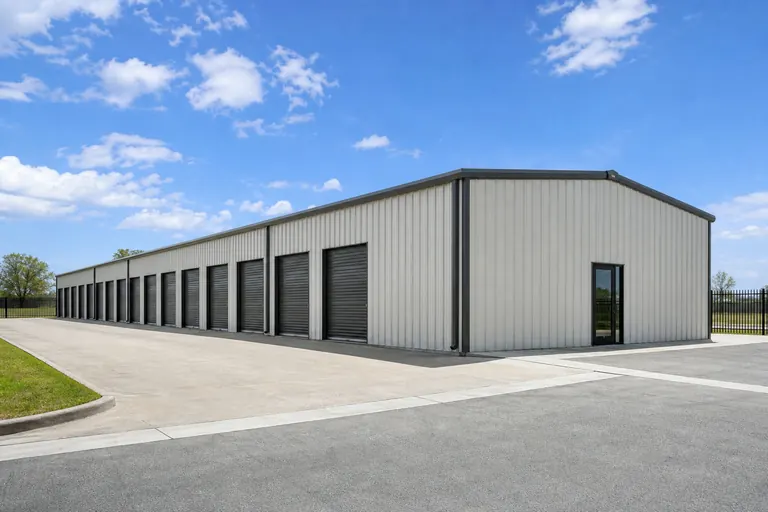 Climate-controlled interior corridorsEnclosed buildings with interior hallways, a common format in Florida given persistently high humidity documented in state climate normals.Drive-up unit rowsSingle-story buildings with exterior access, straightforward to lay out on flatter inland parcels where drainage grading is manageable.Boat and RV storage baysTaller, deeper bays for large vehicles, often paired with standard unit rows given Florida's extensive marine and RV activity.
Example Configuration — for planning purposes only.
Preparation
Before you evaluate a Florida self-storage site
A handful of Florida-specific due-diligence steps matter more here than in a drier or higher-elevation state.
- Confirm whether the parcel sits inside the HVHZOnly Broward and Miami-Dade carry the Florida Building Code's High-Velocity Hurricane Zone requirements; confirm status with the county before budgeting design time.
- Commission a site-specific elevation and drainage studyGiven broad low-elevation terrain statewide and the Floridan aquifer's shallow water table, a stormwater plan is a core site-feasibility item, not a late-stage add-on.
- Pull your county's FEMA National Risk Index ratingFEMA scores 18 hazard types by community; check your specific county rather than assume uniform statewide exposure.
- Confirm local commercial zoning and site-plan review requirementsZoning and fire-access requirements for a multi-building facility are set locally by the city or county where the site sits.
- Discuss wind coverage with your insurer earlyFlorida's documented hurricane-landfall history makes early insurance conversations worthwhile regardless of exact site location within the state.
- Confirm fire-lane and drive-aisle width with the local jurisdictionEmergency-vehicle access rules for a multi-building layout are set locally and are worth confirming during site planning.
Questions
Florida Self-Storage Building Questions
Honest answers scoped to Florida's site conditions, with zoning, insurance and pricing questions routed to whoever actually owns them.
Permit and site-plan review requirements are set locally by the city or county, operating under the statewide Florida Building Code. Your local planning department is the authority for your specific site and process.
Yes. Those two counties fall inside the Florida Building Code's High-Velocity Hurricane Zone, which carries additional product-approval and inspection requirements beyond the standard statewide code.
It's a central one. USGS mapping shows large portions of Florida sitting at low elevation, and the Floridan aquifer keeps the water table shallow statewide, so stormwater and pad-elevation planning matter across most of the state, not just near the coast.
That depends on market and site-specific factors we don't assess here. Expect different drainage, wind-zone and zoning conditions across South Florida's HVHZ, the rest of the coast, the interior, and the Panhandle; confirm specifics with local planning staff and a site engineer.
We do not publish state-level development prices, since cost depends on site work, size, specification and market conditions. Our cost pages explain what drives the number; a builder or contractor quote covers your specific project.
It's a relevant underwriting factor. NOAA's Hurricane Research Division records Florida as the state with the most historical hurricane landfalls, so discuss wind coverage and site-hardening options with your insurer early in the development process.
Sources for the Florida facts on this page
This page states no code requirement, wind speed, snow load, permit rule, price or supplier claim. The state-specific facts it does use are listed with their publisher below.
USGS mapping highlights that large portions of Florida are low-lying, derived from USGS digital elevation models.
U.S. Geological Survey · n/a (map publication) · Tier 2
https://pubs.usgs.gov/sim/3047/The Floridan aquifer system, a principal USGS-studied aquifer, underlies all of Florida and covers about 100,000 square miles across the southeastern U.S.
U.S. Geological Survey · n/a · Tier 2
https://fl.water.usgs.gov/floridan/intro.htmlThe Florida Building Code defines a High-Velocity Hurricane Zone (HVHZ) consisting of Broward and Miami-Dade counties.
Florida Building Commission (via UpCodes republication) · 2023 FBC, 8th edition · Tier 3
https://up.codes/d/high-velocity-hurricane-zone-hvhzNOAA's Hurricane Research Division records Florida as the U.S. state with the most historical hurricane direct hits/landfalls, based on the 1851-2018 dataset.
NOAA Atlantic Oceanographic and Meteorological Laboratory (AOML), Hurricane Research Division · 1851-2018 · Tier 1
https://www.aoml.noaa.gov/hrd/tcfaq/E19.htmlFEMA's National Risk Index scores U.S. communities, including Florida counties, across 18 defined natural hazard types.
FEMA · current dataset · Tier 1
https://www.fema.gov/about/openfema/data-sets/national-risk-index-data