
RV Garage · FL
RV Garages in Florida
An RV garage lives or dies on one dimension most garages never worry about: the height of a single overhead door built to swallow a Class A motorhome. In Florida that tall opening sits on ground USGS mapping describes as low-lying across large portions of the state, above the Floridan aquifer system that underlies all of Florida across roughly 100,000 square miles. Before anyone talks about door height, the slab elevation and drainage plan for that footprint need answering, because a fully enclosed structure this size traps water differently than an open carport does. Layer on NOAA's Hurricane Research Division data naming Florida the U.S. state with the most recorded direct hurricane hits, and the enclosed RV garage's wall bracing and opening protection become a documented conversation with your local building department rather than an afterthought. And with USDA's 2022 Census of Agriculture putting the average Florida farm at 217 acres, an RV garage here is often one structure among several on a working rural parcel, not a single stand-alone build.
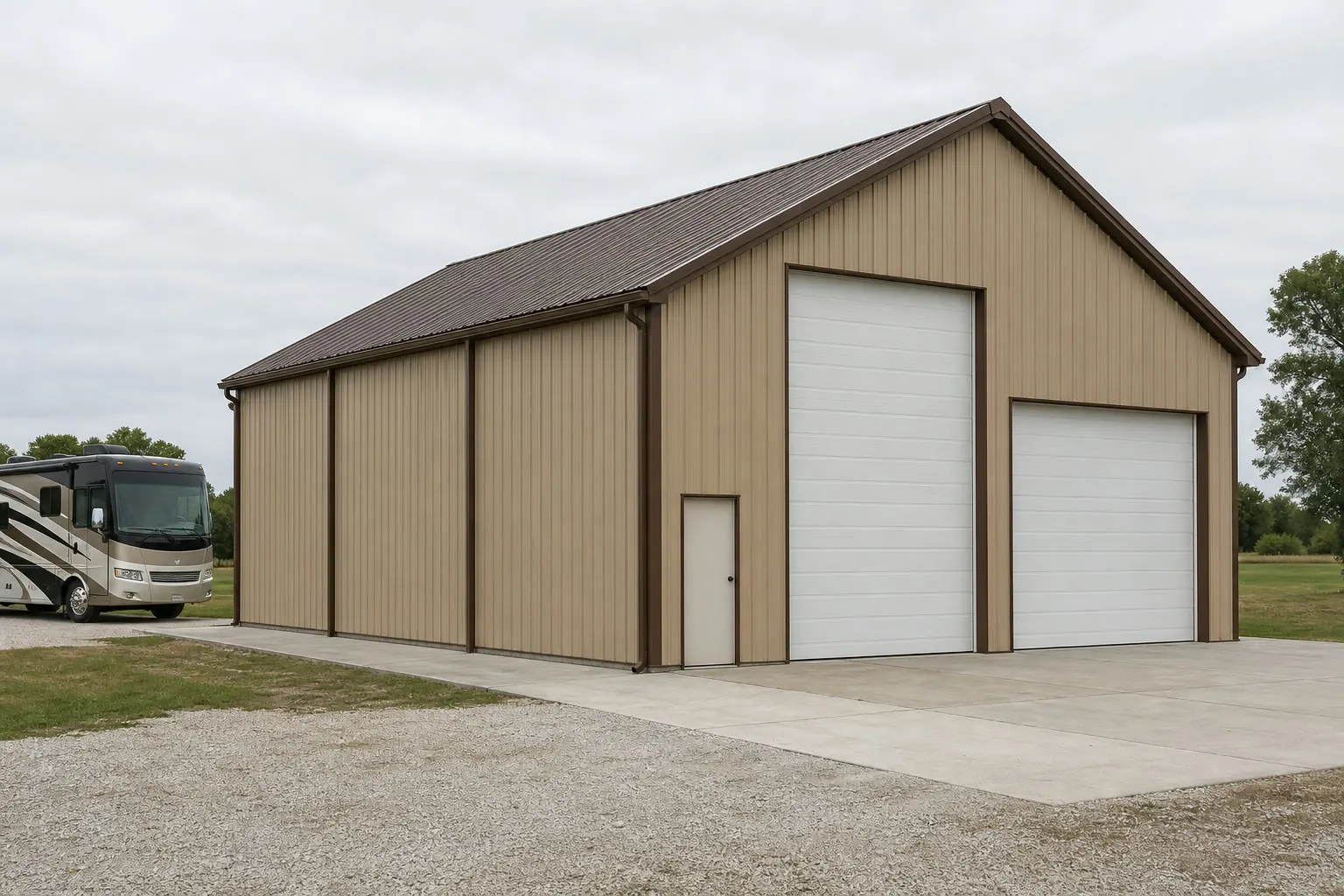
The intersection
Why the ground matters before the door height does
An RV garage is usually specified by door height first. In Florida, the slab underneath it deserves the first conversation.
USGS elevation mapping documents large portions of Florida as low-lying terrain. Because an RV garage is a fully enclosed structure with a large footprint and a wide, tall door opening, water management around that slab works differently than it does for an open carport: standing water has fewer places to drain away from an enclosed perimeter. Florida also sits above the Floridan aquifer system, a USGS-studied groundwater system covering roughly 100,000 square miles of the southeastern U.S., which is part of why a shallow water table shows up as a real site consideration even on land that never floods visibly.
None of this tells you your specific parcel's elevation or drainage requirement — that is a site survey and local building department question. What it does mean is that a Florida RV garage buyer should ask about finished slab elevation, perimeter grading and gutter/downspout routing before finalizing a floor plan, rather than treating those as closeout details.
Exposure
Hurricane history changes how the enclosed shell is documented
A tall door opening is a large point of vulnerability on an enclosed building in a hurricane-exposed state.
NOAA's Hurricane Research Division records Florida as the state with the most historical direct hurricane hits of any U.S. state, based on its 1851-2018 landfall dataset. An RV garage's tall overhead door — the feature that defines the building type — is also its largest single opening, so wind-load documentation for that opening and its header framing is a standard part of a Florida permit review. The Florida Building Commission administers one statewide Florida Building Code, so the documentation framework is consistent, though the specific wind-speed value your project must design to is set locally and confirmed through your building department.
FEMA's National Risk Index also evaluates Florida communities across 18 separate hazard categories, from strong wind to inland flooding, which is a useful reminder that a permit reviewer's checklist for a large enclosed structure rarely stops at hurricane wind alone.
- Confirm your county's design wind speed
- This is set locally, not by a single statewide number; your building department has the current requirement.
- Ask about header and opening bracing for the tall door
- The RV garage's largest opening carries the largest share of the wall's wind-load conversation.
- Check whether your county follows any special enclosed-structure provisions
- Documentation requirements can differ by jurisdiction even under one statewide code.
Configuration
How Florida RV garage projects typically split
Given a large-parcel rural context alongside suburban RV ownership, Florida RV garage projects span a wider range of use cases than in a smaller, more uniform state.
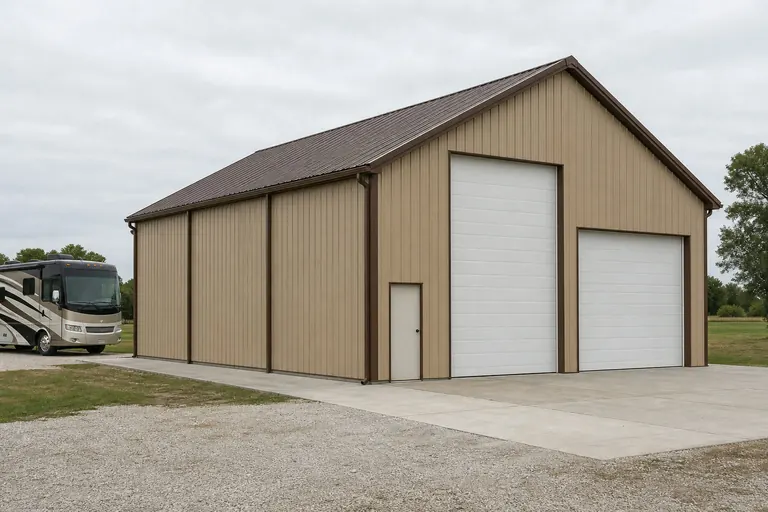 Single-RV garage with standard vehicle bayOne tall overhead door beside a standard-height door, the type's defining configuration, common on suburban lots.RV garage with attached workshopAdded bay space for maintenance or storage, more feasible on the larger rural parcels the state's farm data documents.Multi-RV enclosed storageSeveral tall doors under one roofline, suited to a working rural property already carrying other accessory structures.
Example Configuration — for planning purposes only.
Get Florida RV garage quotes
Tell us your RV height, footprint and whether you need an attached workshop bay. We route it with the Florida and RV-garage context already attached.
Footprint
Sizes that fit a Florida RV garage site
Door height, not floor area, usually sets the starting point, but Florida's larger rural parcels also support longer footprints than a tight suburban lot.
30′ × 40′
1,200 sq ft
A single Class A motorhome bay with a standard vehicle bay alongside.
40′ × 60′
2,400 sq ft
Room for the motorhome bay plus a workshop or extra storage bay.
50′ × 80′
4,000 sq ft
Multi-bay enclosed storage, more realistic on a larger rural parcel.
60′ × 100′
6,000 sq ft
Where a working rural property is consolidating several accessory buildings into one enclosed structure.
Example Configuration — for planning purposes only.
Footprint pages carry the room-by-room layout and door-height detail; this page only explains why the Florida brief spans this range.
Preparation
Before you request a Florida RV garage quote
These items address the sources of re-quoting we see most often on a Florida RV garage project.
- Confirm finished slab elevation with a site surveyFlorida's low-lying terrain in many areas makes this a genuine site question, not a formality.
- Ask your building department for the current design wind speedThis value is set locally and drives the header bracing for the tall RV door opening.
- Verify whether your parcel is inside a special flood hazard areaThis affects foundation and slab-elevation requirements beyond the general low-lying-terrain guidance above.
- Plan for multiple accessory structures if your parcel is largerFlorida's rural parcels average 217 acres, so siting the RV garage relative to other buildings is a real layout decision.
Questions
Florida RV garage questions
Straight state-level answers, with anything site-specific routed to the office that actually owns it.
USGS mapping documents large portions of Florida as low-lying, and the state sits above the Floridan aquifer system. That combination makes slab elevation and drainage a genuine planning question for a large enclosed structure, though your specific parcel's grade and water table depth need a site survey to confirm.
NOAA records Florida as the U.S. state with the most historical direct hurricane hits, so wind-load documentation for a large opening like an RV garage's tall door is a standard part of permit review here. The specific design value is set by your local building department.
The Florida Building Commission administers one statewide Florida Building Code, so the documentation framework is consistent. Wind-speed values, flood-zone requirements and inspection specifics are confirmed locally, not from a single statewide number.
There is no official minimum. Florida farms averaged 217 acres in the 2022 Census of Agriculture, which is part of why many RV garages here sit alongside other accessory buildings on larger rural parcels, but your specific lot's zoning and setback rules still apply.
We do not publish state-level prices, because a credible number depends on door height, footprint, site work and current material costs. Our cost pages explain what drives the number; a quote reflects your specific project.
Sources for the Florida facts on this page
This page states no code requirement, wind speed, snow load, permit rule, price or supplier claim. The state-specific facts it does use are listed with their publisher below.
USGS mapping highlights that large portions of Florida are low-lying, derived from USGS digital elevation models.
U.S. Geological Survey · n/a (map publication) · Tier 2
https://pubs.usgs.gov/sim/3047/The Floridan aquifer system, a principal USGS-studied aquifer, underlies all of Florida and covers about 100,000 square miles across the southeastern U.S.
U.S. Geological Survey · n/a · Tier 2
https://fl.water.usgs.gov/floridan/intro.htmlNOAA's Hurricane Research Division records Florida as the U.S. state with the most historical hurricane direct hits/landfalls, based on the 1851-2018 dataset.
NOAA Atlantic Oceanographic and Meteorological Laboratory (AOML), Hurricane Research Division · 1851-2018 · Tier 1
https://www.aoml.noaa.gov/hrd/tcfaq/E19.htmlFEMA's National Risk Index scores U.S. communities, including Florida counties, across 18 defined natural hazard types.
FEMA · current dataset · Tier 1
https://www.fema.gov/about/openfema/data-sets/national-risk-index-dataThe average farm size in Florida was 217 acres in 2022.
USDA NASS · 2022 · Tier 1
https://www.nass.usda.gov/Publications/AgCensus/2022/Full_Report/Volume_1,_Chapter_1_State_Level/Florida/