
RV carport · FL
RV Carports in Florida
Florida is recorded by NOAA's Hurricane Research Division as the U.S. state with the most historical direct hurricane hits in the 1851-2018 dataset, and an RV carport is by design an open-sided structure with no walls to help carry lateral wind load — a combination that makes siting and anchoring the first conversation for this project, ahead of layout or finish. It also matters where in the state the carport sits: the Florida Building Code defines a High-Velocity Hurricane Zone covering Broward and Miami-Dade counties, a review track that differs from the rest of the state, and either way it is the Florida Building Commission and your local building department, not this page, that set the applicable requirements for your address.
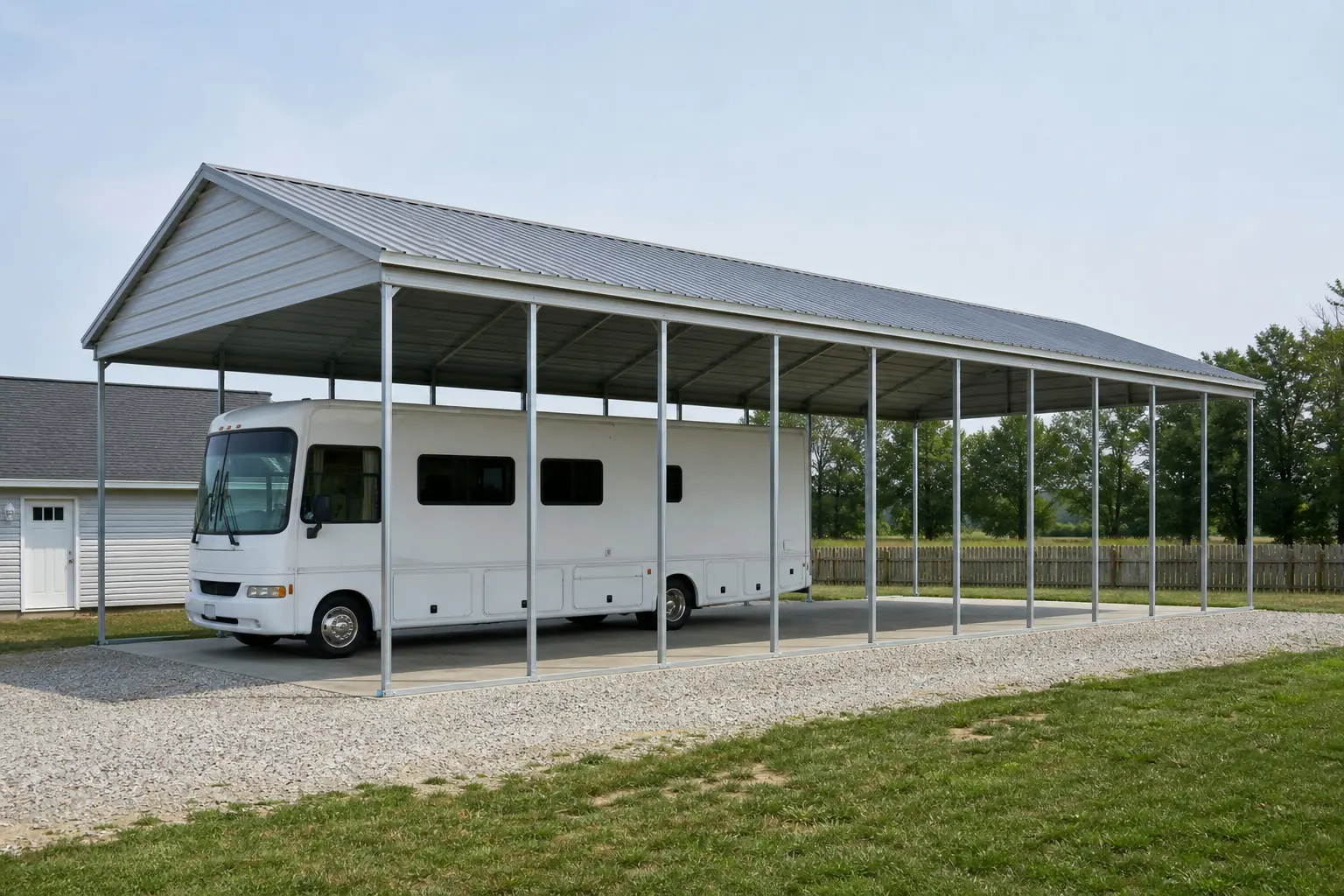
The intersection
Hurricane history is the starting point for a Florida RV carport
An RV carport's open-sided design means Florida's recorded hurricane history is the first thing to plan around, not an afterthought.
NOAA's Hurricane Research Division records Florida as the U.S. state with the most historical direct hurricane hits in its 1851-2018 dataset. An RV carport has no walls to help resist lateral wind load, and the vehicle parked beneath it adds a tall profile that can act like a sail during a storm event, so anchoring detail matters here more than it does for most structures on a residential lot.
Where in Florida the carport sits changes which review track applies. The Florida Building Code, administered statewide by the Florida Building Commission, designates Broward and Miami-Dade counties as a High-Velocity Hurricane Zone with its own plan-review and product-approval requirements, separate from the rest of the state. Outside those two counties, the same statewide code still applies, but local amendments and permit procedure are set by your county or municipal building department.
None of this translates into a wind speed or engineering value on this page. That number is determined by your design-build engineer and confirmed through your local plan review, and it depends on your exact site, structure height and orientation — the honest answer is to ask before you finalize dimensions, not to assume a figure that may not apply to your address.
Jurisdiction
HVHZ counties versus the rest of Florida
The review process for an RV carport differs by county even though one statewide code applies.
| Question | Broward / Miami-Dade (HVHZ) | Rest of Florida |
|---|---|---|
| Governing code | Florida Building Code, HVHZ provisions | Florida Building Code, standard provisions |
| Product approval | HVHZ-specific approval documentation typically required | Standard state or local product approval process applies |
| Plan review authority | County/municipal building department under HVHZ rules | County/municipal building department under standard rules |
| What to confirm | HVHZ approval status of the specific carport product | Local permit and setback requirements for accessory structures |
Governing code
- Broward / Miami-Dade (HVHZ)
- Florida Building Code, HVHZ provisions
- Rest of Florida
- Florida Building Code, standard provisions
Product approval
- Broward / Miami-Dade (HVHZ)
- HVHZ-specific approval documentation typically required
- Rest of Florida
- Standard state or local product approval process applies
Plan review authority
- Broward / Miami-Dade (HVHZ)
- County/municipal building department under HVHZ rules
- Rest of Florida
- County/municipal building department under standard rules
What to confirm
- Broward / Miami-Dade (HVHZ)
- HVHZ approval status of the specific carport product
- Rest of Florida
- Local permit and setback requirements for accessory structures
Site context
Low-lying terrain changes how a Florida RV carport slab is planned
USGS elevation data showing large low-lying portions of the state is a reason to plan the pad and drainage before the anchoring detail.
Coastal and low-lying interior sites
USGS digital elevation mapping documents extensive low-lying ground across Florida; confirm site drainage and slab elevation with your builder before pouring.
HVHZ counties
Broward and Miami-Dade sit inside the designated High-Velocity Hurricane Zone, where product approval documentation is part of the permit file.
Rural and acreage parcels
At an average 217-acre farm size statewide, some Florida RV carports sit on rural land as a semi-permanent fixture rather than a short-term cover.
Get Florida RV carport quotes
Tell us your county, RV height and site conditions, and we route it with the Florida jurisdiction and terrain context already attached.
Configuration
How a Florida RV carport is typically configured
Configuration depends on the vehicle, the site's exposure and whether full enclosure is worth the added protection.
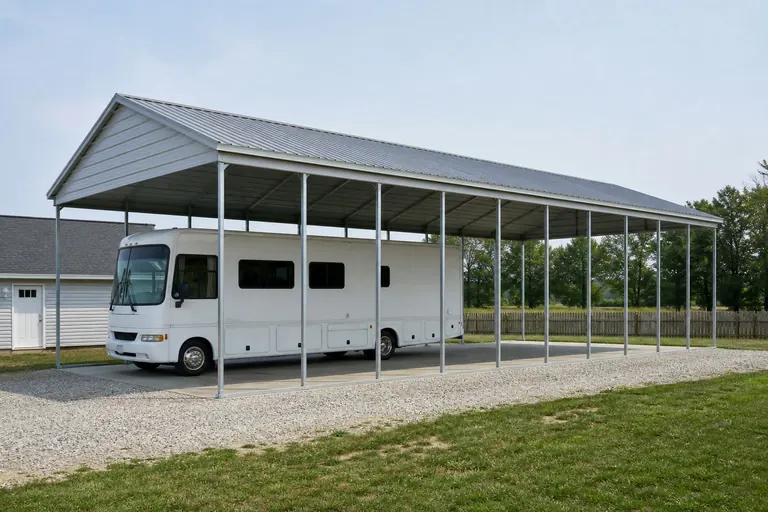 Open single-bay coverA simple open bay sized to one motorhome or travel trailer, most exposed to wind-driven rain.
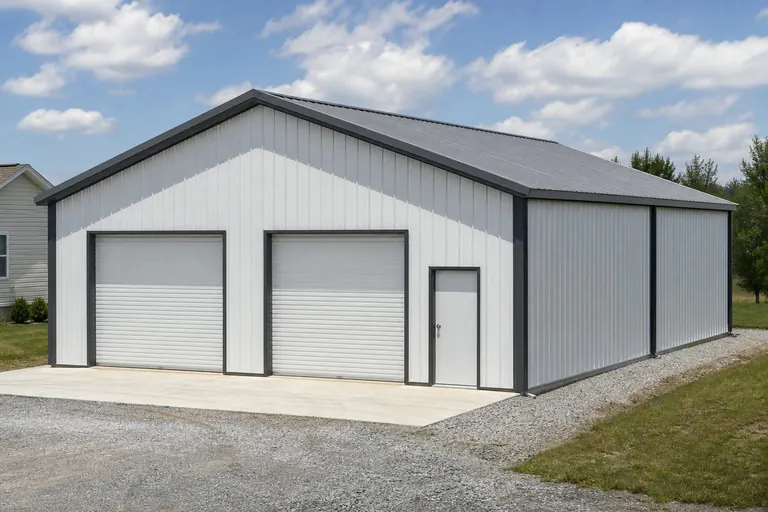 Partially enclosed coverSide panels on the windward faces reduce wind-driven rain exposure while keeping the drive-through open.
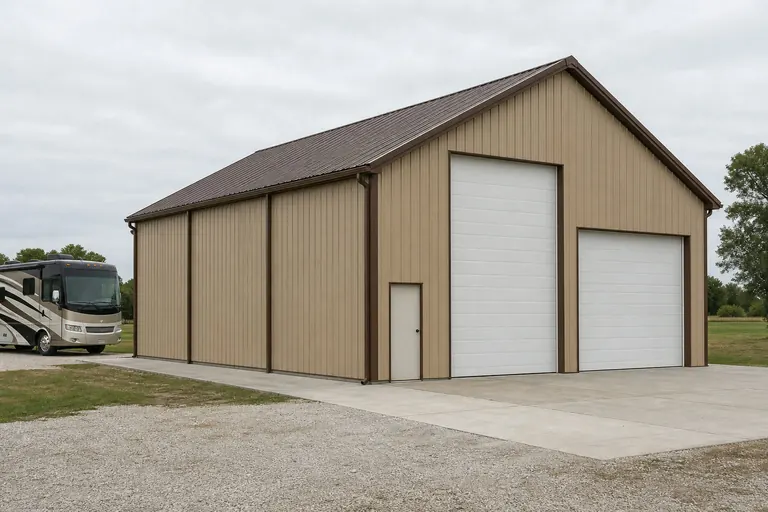 Fully enclosed RV garageWhere hurricane exposure or humidity protection matters most, a fully enclosed structure is the alternative worth comparing.
Example Configuration — for planning purposes only.
Footprint
Sizes that suit a Florida RV carport
Vehicle clearance and length set the footprint; Florida's siting conditions affect anchoring detail more than the dimensions themselves.
14′ × 36′
504 sq ft
A single-bay footprint sized for one motorhome or long travel trailer.
14′ × 40′
560 sq ft
Added length for a longer Class A motorhome or a trailer with a full-length awning.
24′ × 40′
960 sq ft
A two-bay footprint for an RV alongside a second vehicle or equipment.
Example Configuration — for planning purposes only.
Footprint pages carry post spacing and clearance detail for each size; this page explains only the Florida siting and jurisdiction context.
Preparation
Before you request a Florida RV carport quote
These details help avoid a second round of quoting on a Florida RV cover project.
Step 1
Confirm whether your parcel sits inside Broward or Miami-Dade County
HVHZ status changes which product approval documentation your permit application needs.
Step 2
Ask your local building department about setback and permit requirements
Requirements are administered locally even though one statewide code applies.
Step 3
Discuss anchoring detail with your design-build engineer
Wind-load values are site- and structure-specific; do not assume a figure without confirmation.
Step 4
Check your site's elevation and drainage plan
Low-lying ground is common across Florida, so slab elevation and drainage deserve attention before the pad is poured.
Step 5
Measure your RV's full height including roof-mounted equipment
Clearance needs to account for AC units, antennas and vents, not just the body height.
Step 6
Ask how the carport's clear height affects future vehicle upgrades
A clearance sized tightly to your current RV can rule out a taller replacement vehicle down the road without adding roof height later.
Questions
Florida RV carport questions
Honest answers at the state level, with engineering, permitting and pricing questions routed to whoever actually owns them.
Those two counties fall inside the Florida Building Code's High-Velocity Hurricane Zone, which typically requires specific product approval documentation. Confirm with your local building department before ordering.
Florida is recorded as the U.S. state with the most historical direct hurricane hits, and an open-sided structure has no walls to help resist wind load, so anchoring deserves real attention. Specific engineering values are set by your engineer and confirmed through local plan review.
Yes, the Florida Building Commission administers the Florida Building Code statewide, but plan review, permit issuance and any local amendments are handled by your county or municipal building department.
USGS elevation data shows large low-lying portions of Florida, which is a reason to plan slab elevation and site drainage carefully with your builder rather than assume standard footing depth applies everywhere.
That depends on how much wind-driven rain and humidity protection you want for the vehicle. A fully enclosed rv-garage is the comparison worth making before you decide.
We do not publish state-level prices, since cost depends on size, height, HVHZ product approval requirements and site work. A builder quote covers your specific project.
Sources for the Florida facts on this page
This page states no code requirement, wind speed, snow load, permit rule, price or supplier claim. The state-specific facts it does use are listed with their publisher below.
NOAA's Hurricane Research Division records Florida as the U.S. state with the most historical hurricane direct hits/landfalls, based on the 1851-2018 dataset.
NOAA Atlantic Oceanographic and Meteorological Laboratory (AOML), Hurricane Research Division · 1851-2018 · Tier 1
https://www.aoml.noaa.gov/hrd/tcfaq/E19.htmlFEMA's National Risk Index scores U.S. communities, including Florida counties, across 18 defined natural hazard types.
FEMA · current dataset · Tier 1
https://www.fema.gov/about/openfema/data-sets/national-risk-index-dataThe Florida Building Code defines a High-Velocity Hurricane Zone (HVHZ) consisting of Broward and Miami-Dade counties.
Florida Building Commission (via UpCodes republication) · 2023 FBC, 8th edition · Tier 3
https://up.codes/d/high-velocity-hurricane-zone-hvhzThe Florida Building Commission administers the Florida Building Code statewide.
Florida Building Commission · 8th Edition (2023), effective Dec 31, 2023 · Tier 2
https://www.floridabuilding.org/USGS mapping highlights that large portions of Florida are low-lying, derived from USGS digital elevation models.
U.S. Geological Survey · n/a (map publication) · Tier 2
https://pubs.usgs.gov/sim/3047/The average farm size in Florida was 217 acres in 2022.
USDA NASS · 2022 · Tier 1
https://www.nass.usda.gov/Publications/AgCensus/2022/Full_Report/Volume_1,_Chapter_1_State_Level/Florida/