
RV carport · OK
RV Carports in Oklahoma
An RV carport is a longer, taller open structure than a standard vehicle carport, and where you site one in Oklahoma is not a generic decision. NOAA's NCEI climate narrative for Oklahoma and the Oklahoma Climatological Survey both describe the same underlying shape of the state: broad, largely level terrain across most of Oklahoma giving way to genuinely mountainous ground in two corners, the Ouachita Mountains in the southeast and the Ozark Plateau in the northeast, where the Oklahoma Geological Survey notes ranges built from resistant folded, faulted and thrust rock. A pad and post-footing plan that works on flat interior ground is not automatically the plan that works on sloped, rocky ground near those ranges, so the terrain under a specific parcel is worth confirming before a footprint is finalized. Layer in how permitting actually works here — the Oklahoma Uniform Building Code Commission (OUBCC) is a state body created by statute to issue rules on how local jurisdictions and other political subdivisions adopt codes, which is different from a state that writes and enforces one uniform building code itself — and an Oklahoma RV carport brief comes down to two confirmations: what the ground under the pad actually looks like, and which local office administers the permit for that specific parcel.
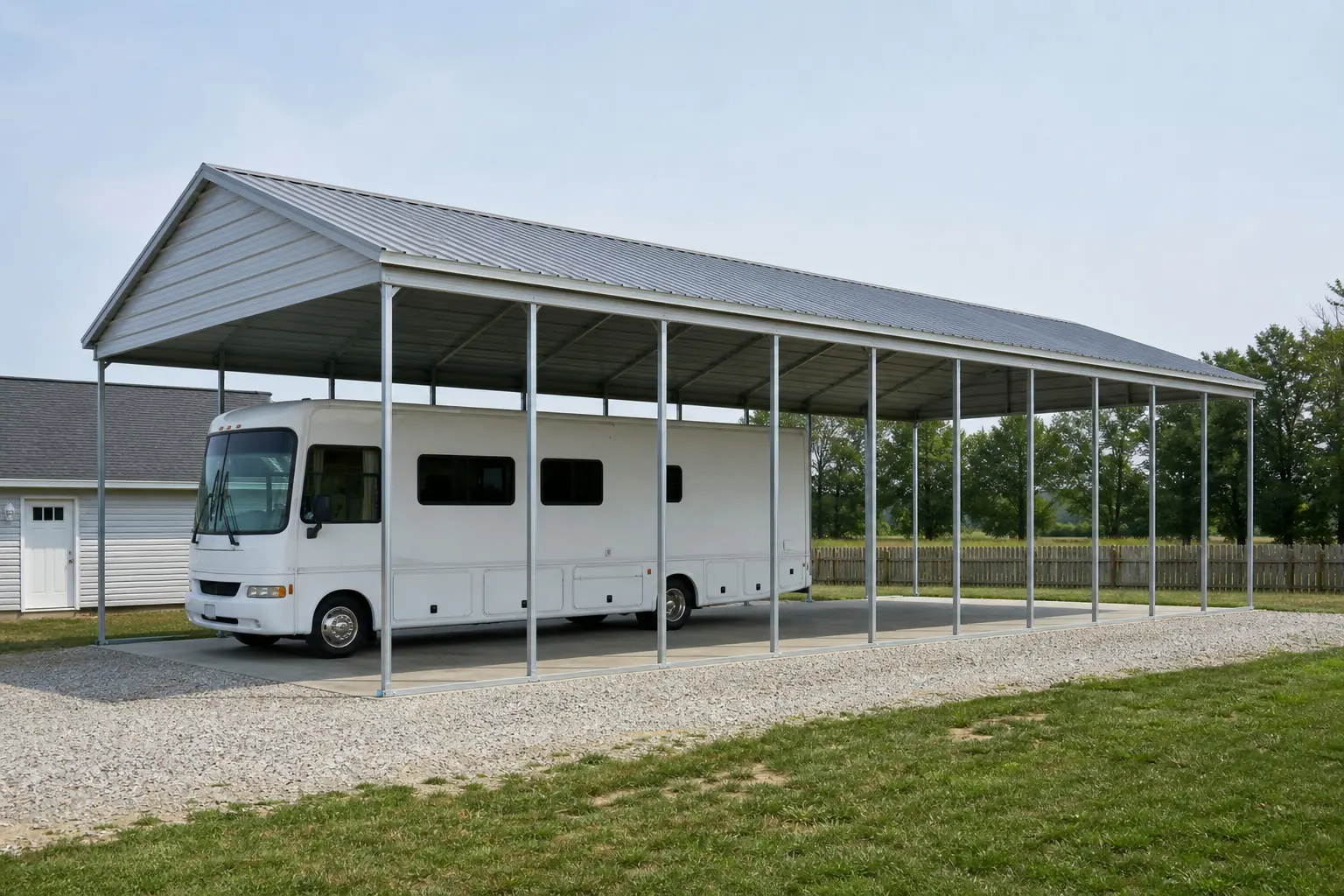
The intersection
One state, two very different sites for a carport pad
Oklahoma's terrain runs from flat interior plains across most of the state to genuinely mountainous ground in two corners, and an RV carport's pad plan should follow whichever ground a given parcel actually has.
NOAA's NCEI narrative for Oklahoma describes the state's southern Great Plains location alongside named topographic features: the Ouachita Mountains, the Arkansas River Valley and the Ozark Plateau in the northeast. The Oklahoma Climatological Survey adds detail on the Ouachita range specifically, describing peaks up to 2,000 feet above their base dominating the southeast. USGS physiographic mapping (Fenneman, Bulletin 730-D) classifies western Oklahoma within the Great Plains province, with the terrain transitioning toward the Central Lowland province further east.
For an RV carport, that split matters because a longer, taller open structure carries its load down through fewer, larger posts than a fully-walled building, and the ground those posts land on is not the same ground statewide. A pad excavated and graded on level interior plains is a different job than a pad set on the folded, rock-influenced ground the Oklahoma Geological Survey describes near the Ouachita and Ozark ranges. Neither this page nor a generic spec sheet can tell you which one applies to your parcel — that is a site visit and a local contractor's call.
The practical takeaway is to treat terrain as a first question, not an afterthought: ask a builder to look at the actual grade and soil on the parcel before finalizing footing depth or post spacing for an RV-scale span.
Jurisdiction
OUBCC sets the rules; your local office still runs the review
Oklahoma's building-code structure routes rulemaking on code adoption through a state commission, but the actual permit review still happens with the local jurisdiction covering your parcel.
The Oklahoma Uniform Building Code Commission Act (59 O.S. §§ 1000.20-1000.30) established the OUBCC as the state body that governs code matters and issues rules addressing how local jurisdictions and other political subdivisions adopt codes. That is a different structure from a state that writes and directly enforces one uniform building code itself: OUBCC's role is rulemaking around adoption, and the day-to-day review of a specific RV carport application still runs through the office covering the parcel.
Because a taller, longer RV carport footprint is more likely to prompt questions about setback, footing documentation or engineering review than a small accessory structure, it is worth calling the local building department early with the RV's actual dimensions rather than assuming a small-structure exemption applies.
- Call the local office before you spec the footprint
- OUBCC issues adoption rules; the local jurisdiction runs the actual review for your parcel.
- Bring the RV's real height and length
- Clearance and span drive both the structural spec and which local threshold applies.
- Ask about the ground, not just the code
- Terrain near the Ouachita or Ozark corners can change footing depth independent of any permit question.
Site context
Where an Oklahoma RV carport sits changes the checklist
Farm acreage, interior plains and the state's two mountainous corners each raise a slightly different set of questions before a footprint is finalized.
Working farm and ranch acreage
USDA counts 70,378 Oklahoma farms in 2022 averaging 467 acres; confirm access, drainage and any agricultural-exemption rules with the local office rather than assuming residential rules apply.
Interior Great Plains terrain
USGS mapping places most of Oklahoma within the Great Plains province; a level pad here is typically the simpler of the state's two site conditions to grade and footing to spec.
Ouachita Mountains corner (southeast)
Peaks up to 2,000 feet above their base, per the Oklahoma Climatological Survey, mean sloped or rocky ground is a realistic condition to check before setting footing depth.
Ozark Plateau corner (northeast)
NCEI's narrative places the Ozark Plateau in the northeast; as with the Ouachitas, confirm actual grade and soil rather than assuming plains-typical conditions.
Get Oklahoma RV carport quotes
Tell us your RV's dimensions, planned use and rough footprint, plus whether the site sits on plains or mountainous ground. We route it with the Oklahoma and RV carport context already attached.
Configuration
What Oklahoma RV carport enquiries are usually asked to do
Long-term cover for a motorhome, travel trailer or boat-and-tow combination kept on acreage is the recurring brief, scaled taller and longer than an everyday-vehicle carport.
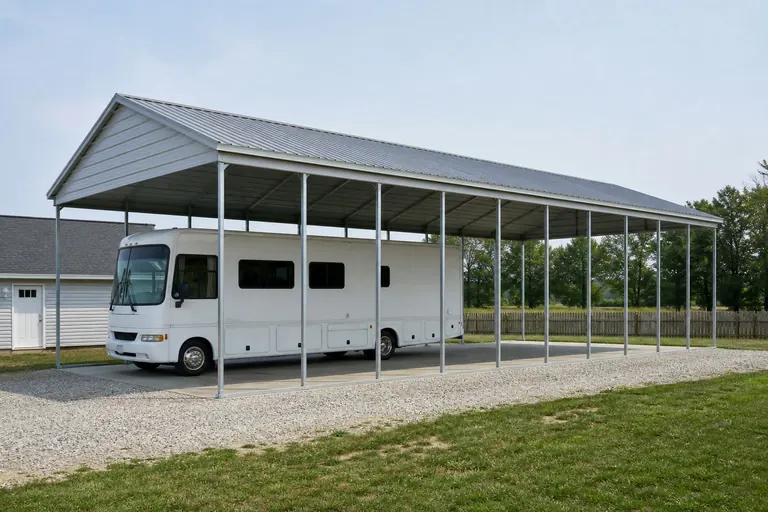 Motorhome or Class A storageA tall clearance and long roof span cover a parked motorhome kept between trips on farm or ranch acreage.Travel trailer and toy hauler coverA lower-clearance but still long open structure suits trailers stored between seasonal trips.
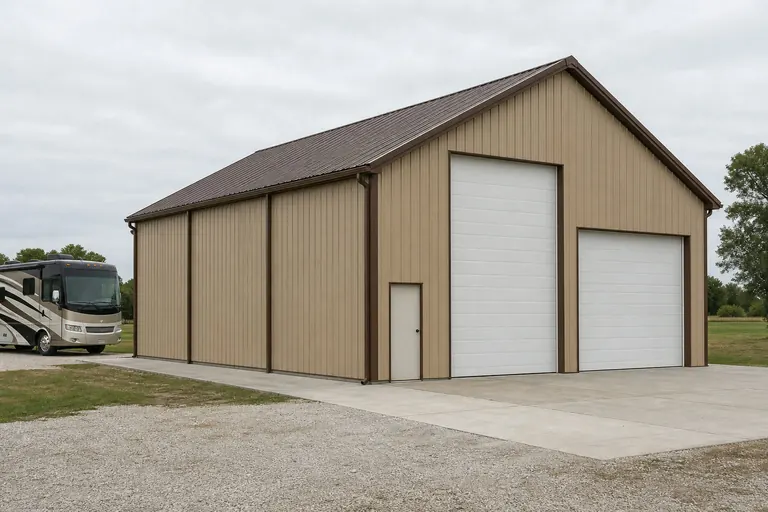 Enclosed upgrade pathWhere full weather protection or security matters more than budget, an RV garage is the enclosed alternative worth comparing.
Example Configuration — for planning purposes only.
Footprint
Sizes that suit Oklahoma RV carport projects
Oklahoma RV carport enquiries are sized around the specific vehicle's height and length, running longer and taller than a standard vehicle carport.
14′ × 36′
504 sq ft
A common single-RV footprint sized for a mid-size motorhome or large trailer.
18′ × 40′
720 sq ft
Adds width and length for a larger motorhome or a trailer-plus-tow-vehicle combination.
20′ × 50′
1,000 sq ft
Fits longer Class A motorhomes or a toy hauler with additional storage needs.
24′ × 60′
1,440 sq ft
A wider, longer footprint for multiple RVs or an RV plus a boat under one roof.
Example Configuration — for planning purposes only.
Footprint pages carry clearance-height detail for each of these; this page only explains why the Oklahoma brief centers on terrain variation and locally administered permitting.
Preparation
Before you request an Oklahoma RV carport quote
Resolving these in advance makes the difference between a comparable quote and a re-quote on an Oklahoma RV storage site.
Step 1
Confirm your RV's exact height and length
Clearance and span are sized to the specific vehicle, not a generic carport footprint.
Step 2
Have the parcel's terrain checked
Interior-plains ground and the Ouachita/Ozark corners are different footing conditions; do not assume one applies statewide.
Step 3
Call the local building department
OUBCC sets adoption rules, but your local jurisdiction runs the actual review for the parcel.
Step 4
Note any agricultural-land status
Farm or ranch acreage can carry different local review steps than a residential lot; ask directly.
Questions
Oklahoma RV carport questions
Questions we can answer honestly at state level, with the ones we cannot routed to whoever actually owns them.
It can affect how the pad and footings are built. NCEI and the Oklahoma Climatological Survey both describe a state that is mostly level Great Plains terrain but includes genuinely mountainous ground in the Ouachita and Ozark corners, so a local site check matters more than a statewide assumption.
No single statewide code enforces itself here. The Oklahoma Uniform Building Code Commission issues rules on how local jurisdictions and other political subdivisions adopt codes, and the actual permit review runs through your local office.
Many Oklahoma RV carports do sit on working acreage — USDA counts 70,378 Oklahoma farms averaging 467 acres in 2022 — but confirm any agricultural-exemption or access rules with your local building department directly.
Not necessarily. Ground near the Ouachita Mountains or Ozark Plateau can differ meaningfully from interior plains terrain, so footing depth should follow a site-specific check rather than one statewide number.
We do not publish a statewide design value here; that is set by the authority having jurisdiction for your specific parcel and should come from your local building department or a licensed engineer.
We do not publish state-level prices, because a credible number depends on your specification, site work and current material pricing. Our cost pages cover what drives the number; a quote covers your building.
Sources for the Oklahoma facts on this page
This page states no code requirement, wind speed, snow load, permit rule, price or supplier claim. The state-specific facts it does use are listed with their publisher below.
NOAA NCEI publishes a narrative 'Climate of Oklahoma' noting the state's southern Great Plains location and topographic features including the Ouachita Mountains, the Arkansas River Valley, and the Ozark Plateau in the northeast.
NOAA National Centers for Environmental Information (NCEI) · Historical narrative (NCEI climate normals series) · Tier 1
https://www.ncei.noaa.gov/data/climate-normals-deprecated/access/clim60/states/Clim_OK_01.pdfThe Oklahoma Climatological Survey describes the Ouachita Mountains dominating southeast Oklahoma with peaks up to 2,000 feet above their base, and the Ozark Plateau marking the extreme northeast.
Oklahoma Climatological Survey, University of Oklahoma · OCS reference page · Tier 2
http://www.ou.edu/ocs/oklahoma-climate.htmlUSGS historical survey work (Fenneman, USGS Bulletin 730-D) classifies western Oklahoma within the Great Plains physiographic province, part of the larger interior plains distinguished from the Central Lowland province to the east.
U.S. Geological Survey (USGS Bulletin 730-D, Nevin M. Fenneman) · Originally published 1923; USGS reference · Tier 1
https://pubs.usgs.gov/bul/0730d/report.pdfOklahoma's total land area was measured at 68,594.2 square miles as of the 2010 Census.
U.S. Census Bureau · 2010 Census · Tier 1
https://www.census.gov/geographies/reference-files/2010/geo/state-local-geo-guides-2010/oklahoma.htmlOklahoma had 70,378 farms in 2022, down from 78,531 in 2017.
USDA NASS · 2022 (with 2017 comparison) · Tier 1
https://www.nass.usda.gov/Publications/AgCensus/2022/Full_Report/Volume_1,_Chapter_1_State_Level/Oklahoma/st40_1_001_001.pdfOklahoma had 32,897,563 acres of land in farms in 2022, an average farm size of 467 acres.
USDA NASS · 2022 · Tier 1
https://www.nass.usda.gov/Publications/AgCensus/2022/Full_Report/Volume_1,_Chapter_1_State_Level/Oklahoma/st40_1_001_001.pdfThe Oklahoma Uniform Building Code Commission (OUBCC) is the state body established by the Oklahoma Uniform Building Code Commission Act (59 O.S. §§ 1000.20-1000.30) that governs code matters and issues rules addressing code adoption by local jurisdictions and other political subdivisions.
State of Oklahoma (oklahoma.gov/oubcc) · Current statute/administrative rules · Tier 2
https://oklahoma.gov/oubcc/faqs.html