
Pole barn · MT
Pole Barns in Montana
A Montana pole barn brief usually starts with the land, not the floor plan. USDA's 2022 Census of Agriculture puts the state's average farm or ranch at 2,374 acres across 57,601,320 total acres in farms — the largest average of the states covered in this evidence set — and NASS's own Montana Ag Facts sheet reports that land as 28% cropland, 5% woodland, and the balance chiefly permanent pasture and rangeland. That scale sits across a state the University of Montana describes as split by the Continental Divide into a mountainous west and a high-plains grassland east, two genuinely different site conditions inside one state. And the order is landing in a residential and light-commercial construction market where the Census Bureau recorded a 33.3% single-year permit decline, one of the five sharpest of any state in 2023.
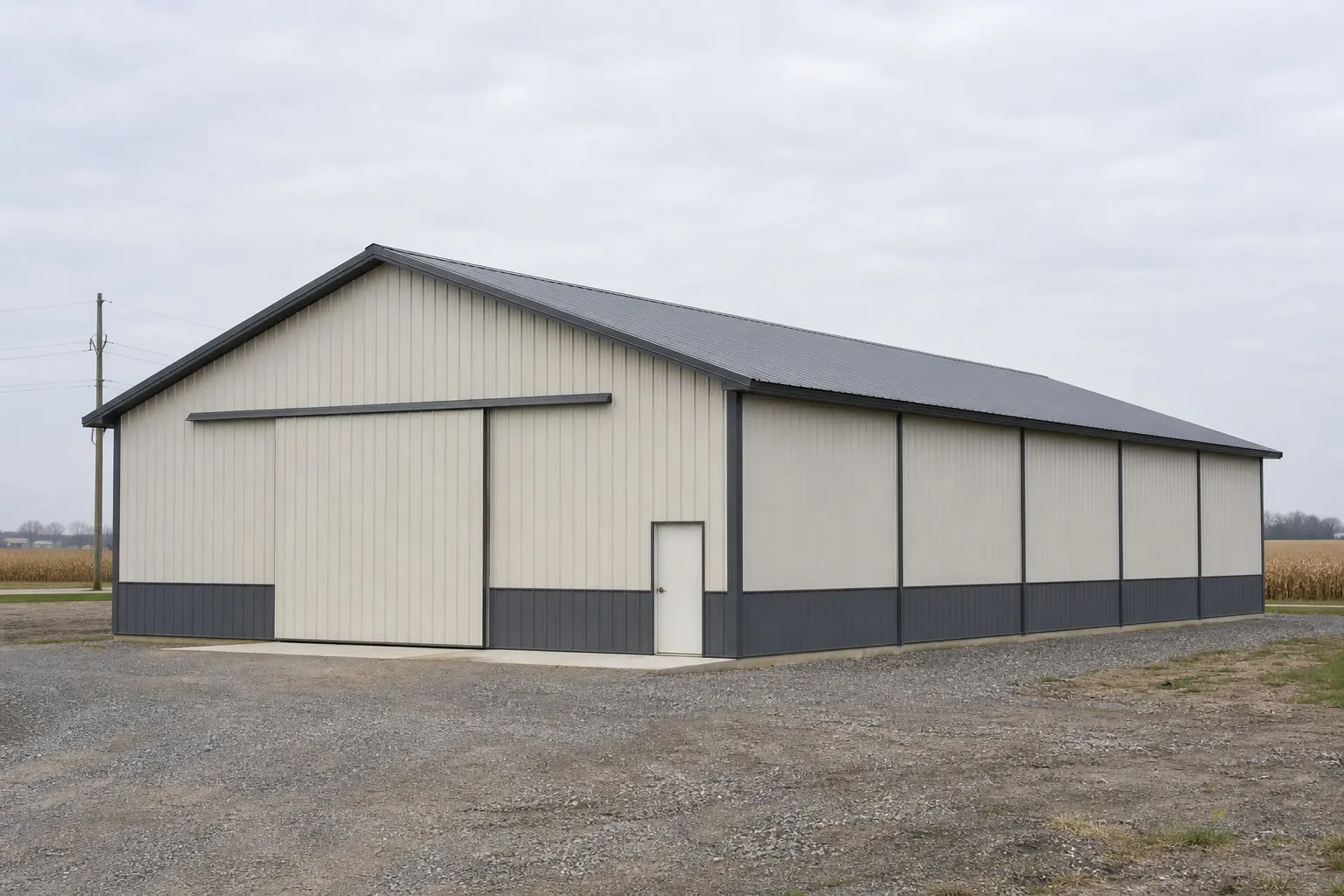
The intersection
Montana's land is mostly rangeland, and that shapes the barn
A Montana pole barn is usually equipping grazing operations rather than row-crop storage, and the state's own land-use figures show why.
NASS's Montana Ag Facts sheet breaks the state's 2022 farm and ranch land into roughly 28% cropland, 5% woodland, and a remainder that's chiefly permanent pasture and rangeland. That means a majority of the ground a Montana pole barn sits on is grazing land, not cropland, which typically shifts the brief toward hay storage, calving shelter and equipment cover rather than grain bins or row-crop handling equipment.
That land supports comparatively few, comparatively large operations: USDA's 2022 Census counted 24,266 farms across 57,601,320 acres, an average of 2,374 acres per operation — the largest average in this evidence set. A pole barn serving an operation at that scale is far more often built around one dominant purpose, because the ranch generally already has separate facilities covering its other functions.
None of this means every Montana pole barn buyer runs a large cattle operation. A smaller acreage close to town is just as plausible, and the honest starting point is the buyer's actual use — hay, livestock, equipment or a mix — rather than the state average.
Site context
Reading the Divide before you fix a footprint
The University of Montana's regional description splits the state into two genuinely different site environments for a post-frame building.
Mountainous west
Slope, drainage and site-access grading typically dominate early planning here more than the building spec itself.
High-plains east
Open grassland terrain where wind exposure and door orientation matter more than grading in most cases.
Near the Divide itself
Watersheds split toward the Pacific, the Gulf of Mexico and Hudson Bay here, per the University of Montana, and site drainage should be assessed locally rather than assumed from either regional generalization.
Configuration
Matching the barn to Montana's land-use mix
A quick reference for how the state's land-use split typically maps to pole barn function.
| Land use share | Typical pole barn role | What to confirm |
|---|---|---|
| Permanent pasture / rangeland (majority) | Hay storage, calving shelter, livestock equipment cover | Ventilation and floor needs for feed vs. equipment |
| Cropland (about 28%) | Grain or bulk crop storage, implement cover | Door width and clear span for the largest implement |
| Woodland (about 5%) | Less commonly the direct site; more often adjacent to a working clearing | Access-road grading if the site is at a woodland edge |
Permanent pasture / rangeland (majority)
- Typical pole barn role
- Hay storage, calving shelter, livestock equipment cover
- What to confirm
- Ventilation and floor needs for feed vs. equipment
Cropland (about 28%)
- Typical pole barn role
- Grain or bulk crop storage, implement cover
- What to confirm
- Door width and clear span for the largest implement
Woodland (about 5%)
- Typical pole barn role
- Less commonly the direct site; more often adjacent to a working clearing
- What to confirm
- Access-road grading if the site is at a woodland edge
Get Montana pole barn quotes
Tell suppliers your county, which side of the Divide the parcel is on, and the barn's dominant function. We route it with the Montana and pole barn context already attached.
Construction market
Ordering into a market that cooled sharply in 2023
The Census Bureau's 2023 Annual Building Permits report recorded Montana's authorized housing units falling from 6,460 in 2022 to 4,307 in 2023, a 33.3% decline, one of the five largest percentage drops of any state.
That figure covers residential permitting broadly, not pole barns specifically, and it says nothing about price. What it reasonably signals is fewer active construction crews statewide, which tends to lengthen lead times before it changes a quoted number.
For a post-frame ranch building, the practical response is confirming current lead times directly with your builder and timing the order around your own ranch calendar — for example, ahead of calving or before winter feeding starts — rather than assuming last year's schedule still holds. Because Montana's building season is compressed by the length of winter on both sides of the Divide, a tighter crew pool also means booking the foundation and post-set crew earlier in the year matters more here than in a state with a longer year-round construction window; a buyer who waits until spring to schedule risks losing a summer slot entirely.
- Ask for current lead times
- A cooling market shifts crew availability quickly; get a fresh estimate.
- Time it to your ranch calendar
- If the barn needs to be usable before a specific season, say so early and build in a buffer.
- Confirm delivery logistics
- Montana's size and terrain split mean freight distance and access road conditions deserve a specific answer, not an assumption.
Preparation
Before you request a Montana pole barn quote
Four things resolved in advance make a Montana quote comparable rather than a guess.
- Contact your local building departmentPermit requirements and any load conditions are set at the county level in Montana; ask before you fix a specification.
- State the building's single dominant purposeMontana's large-operation average and rangeland-heavy land use usually favor one clear function; naming it up front avoids a mid-project redesign.
- Confirm which side of the Divide you're building onMountainous-west and high-plains-east sites carry different grading and wind-orientation questions.
- Check the FEMA National Risk Index for your countyUse the official NRI tool for a citable, county-specific hazard picture rather than a single statewide figure.
Questions
Montana pole barn questions
Questions we can answer honestly at state level, with the rest routed to whoever actually owns them.
NASS's Montana Ag Facts sheet shows the state's farm and ranch land is mostly permanent pasture and rangeland (with 28% cropland and 5% woodland), so hay storage, calving shelter and livestock equipment cover are common uses; crop or grain storage is less common but not rare.
There is no single typical size, but USDA's 2022 Census puts Montana's average farm at 2,374 acres, the largest average in this evidence set, which is why single-purpose buildings sized for real equipment are common here.
Yes. The University of Montana describes the state as split by the Continental Divide into a mountainous west and a high-plains grassland east, and those carry different grading and wind-exposure considerations for a post-frame building.
Permit requirements depend on your county, your parcel and how the building will be used. Your local building department is the only reliable source for that answer.
Plan conservatively. The Census Bureau recorded Montana's authorized housing units falling 33.3% from 2022 to 2023, one of the five steepest declines of any state that year, pointing to a thinner pool of active crews than a stronger year would suggest.
Sources for the Montana facts on this page
This page states no code requirement, wind speed, snow load, permit rule, price or supplier claim. The state-specific facts it does use are listed with their publisher below.
Montana had 24,266 farms in 2022, a 10% decrease since 2017.
USDA National Agricultural Statistics Service (NASS) · 2022 · Tier 1
https://www.nass.usda.gov/Publications/AgCensus/2022/Online_Resources/County_Profiles/Montana/cp99030.pdfMontana had 57,601,320 acres of land in farms in 2022, the largest average farm size of any of the four states covered here at 2,374 acres.
USDA NASS · 2022 · Tier 1
https://www.nass.usda.gov/Publications/AgCensus/2022/Online_Resources/County_Profiles/Montana/cp99030.pdfA NASS Montana Ag Facts sheet reports the state's farm and ranch land in 2022 broken down as 28% cropland, 5% woodland, and the remainder chiefly permanent pasture and rangeland.
USDA National Agricultural Statistics Service (NASS), Montana Field Office · Based on 2022 Census of Agriculture · Tier 1
https://www.nass.usda.gov/Statistics_by_State/Montana/Publications/Special_Interest_Reports/MT-Montana-Ag-Facts-04082025.pdfMontana is split into two broad geographic regions by the Rocky Mountains: mountainous terrain in the west and rolling high-plains grassland in the east, with the Continental Divide separating watersheds draining to the Pacific, the Gulf of Mexico, and Hudson Bay.
University of Montana · Reference material · Tier 2
https://www.umt.edu/this-is-montana/columns/stories/montana_regions_1of3.phpBuilding permit offices in Montana authorized construction of 4,307 new privately-owned housing units in 2023, a 33.3% decrease from 6,460 units in 2022, one of the five largest percentage declines of any state that year.
U.S. Census Bureau · 2023 (final annual) · Tier 1
https://www.census.gov/construction/bps/pdf/2023annualhighlights.pdfFEMA's National Risk Index reports Montana's 56 counties with a mean composite NRI risk score of 33.3 on FEMA's 0-100 relative scale (v1.20 release).
Federal Emergency Management Agency (FEMA) · NRI v1.20 dataset · Tier 1
https://www.fema.gov/flood-maps/products-tools/national-risk-index