
Mini-storage building · FL
Mini-Storage Buildings in Florida
A mini-storage building in Florida is a commercial, multi-tenant self-storage development, and the site due-diligence for one looks different here than in most states because Florida records the most direct hurricane landfalls of any U.S. state going back to 1851. Two counties, Broward and Miami-Dade, sit inside the Florida Building Code's High-Velocity Hurricane Zone, a stricter regional code track for the buildings and product approvals in a facility, while the rest of the state applies the standard statewide code through the local building department. USGS elevation mapping also shows large portions of Florida as low-lying, which matters directly to a facility with a large paved footprint, multiple buildings and drive aisles that all have to shed water reliably.
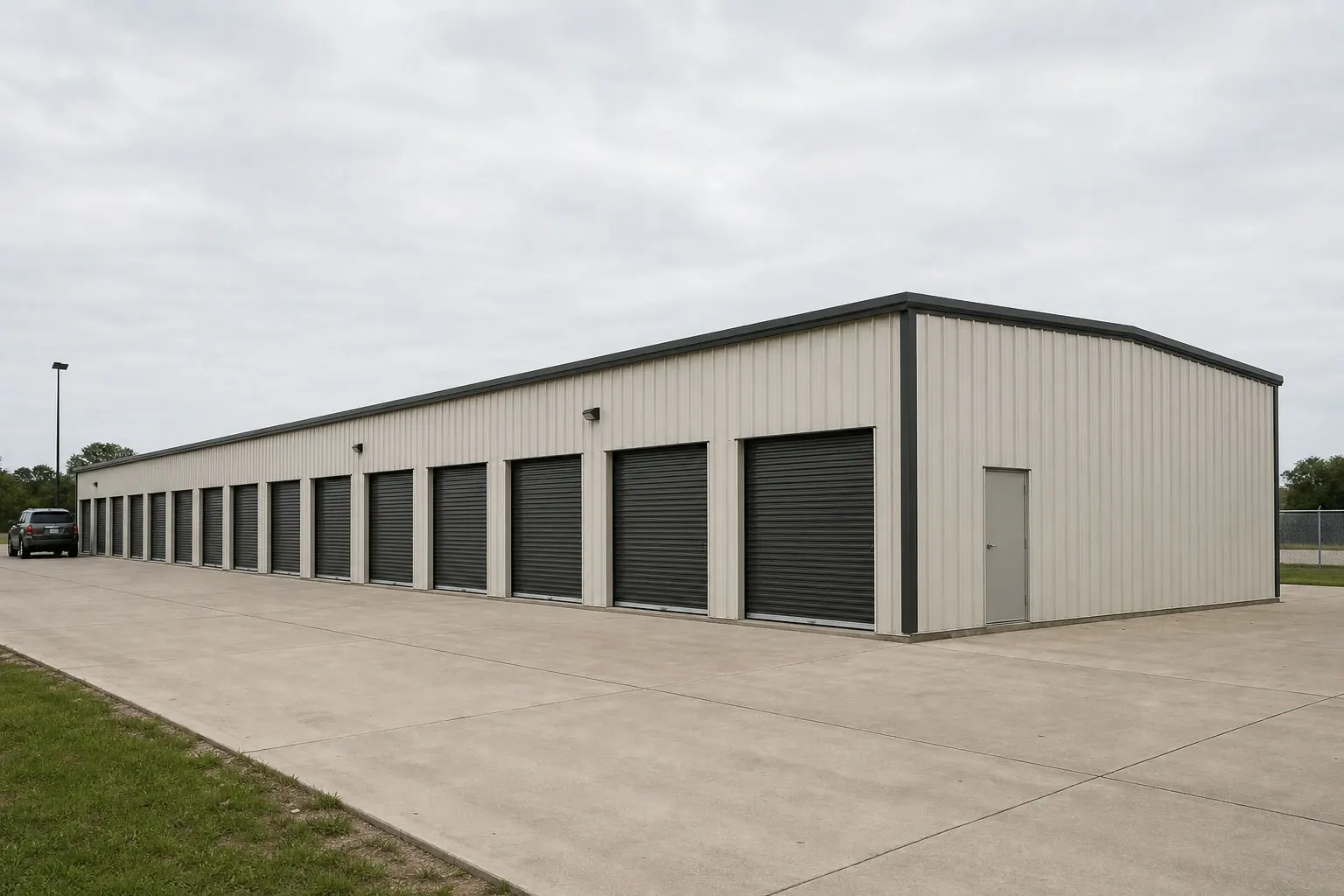
The intersection
A Florida storage site is chosen around water and wind, not just traffic count
A commercial mini-storage development in Florida is planned around hurricane exposure, an HVHZ code split, and terrain that sheds water unevenly — factors a developer weighs before layout or unit mix.
NOAA's Hurricane Research Division dataset, spanning 1851-2018, records Florida as the U.S. state with the most direct hurricane landfalls. For a commercial facility holding other people's property across multiple buildings, that history is a reasonable basis for treating construction specification and insurance planning as an early-stage question rather than something addressed after a site is already under contract.
Two counties carry a stricter version of that conversation. The Florida Building Code's High-Velocity Hurricane Zone covers Broward and Miami-Dade, with its own product-approval and construction standards administered locally within the statewide code. A developer comparing candidate sites in and outside those two counties should expect a genuinely different specification and approval process, not a single statewide checklist.
Terrain adds a second, statewide layer that applies whether or not a site is inside the HVHZ. USGS elevation mapping shows large portions of Florida as low-lying, and the Floridan aquifer system underlies the entire state across roughly 100,000 square miles. For a facility with a large paved footprint, multiple buildings and drive aisles, that combination makes drainage and grading design a first-order site question — a shallow water table and flat terrain do not forgive an undersized stormwater plan the way they might on a single small building.
Site context
Regional site factors for a Florida mini-storage facility
The same multi-unit facility design meets different code and terrain conditions depending on where in Florida it is developed.
| Location | Code track | Terrain and drainage note |
|---|---|---|
| Broward or Miami-Dade County | High-Velocity Hurricane Zone (FBC) | Confirm HVHZ product approval and stricter regional construction standards |
| Coastal county outside HVHZ | Standard Florida Building Code | Confirm storm surge and drainage requirements with local water management district |
| Inland, low-lying county | Standard Florida Building Code | Grading and stormwater design carry more weight than wind anchoring alone |
Broward or Miami-Dade County
- Code track
- High-Velocity Hurricane Zone (FBC)
- Terrain and drainage note
- Confirm HVHZ product approval and stricter regional construction standards
Coastal county outside HVHZ
- Code track
- Standard Florida Building Code
- Terrain and drainage note
- Confirm storm surge and drainage requirements with local water management district
Inland, low-lying county
- Code track
- Standard Florida Building Code
- Terrain and drainage note
- Grading and stormwater design carry more weight than wind anchoring alone
Site context
How candidate Florida sites differ
Two overlapping factors, not one, frame the site-selection conversation for a multi-building commercial footprint in Florida.
HVHZ counties (Broward, Miami-Dade)
Sites here fall under a stricter regional Florida Building Code track, with product-approval documentation for doors, walls and roofing that a non-HVHZ site would not require.
Statewide low-lying terrain
USGS elevation mapping across large portions of Florida means grading and drainage design deserve real engineering attention regardless of which code track applies.
Floridan aquifer influence
The aquifer system underlying the entire state can put the water table close to the surface on a given parcel, a foundation and stormwater factor worth confirming with a site engineer.
Get Florida mini-storage development quotes
Tell us your candidate site, county and whether it's inside the HVHZ, and we route it with the Florida hazard and drainage context already attached.
Configuration
Common Florida mini-storage facility formats
Operators typically choose among a small number of unit formats, and the choice interacts with the site conditions above.
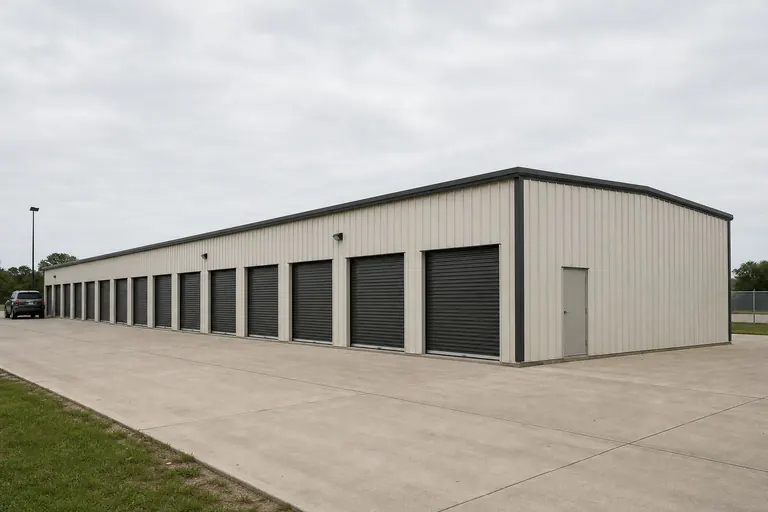 Drive-up unit rowsSingle-story buildings with exterior access, common on larger, flatter parcels where drainage design for paved drive aisles is a central concern.Climate-controlled interior corridorsEnclosed buildings with interior hallways, a common choice where humidity control is a differentiator for tenants.Boat and RV storage baysTaller, deeper bays for large vehicles, frequently paired with standard unit rows given Florida's coastal and waterway geography.
Example Configuration — for planning purposes only.
Preparation
Before you evaluate a Florida mini-storage site
A handful of due-diligence steps matter more here than in a state without Florida's hurricane and drainage profile.
- Confirm whether the site sits inside the HVHZBroward and Miami-Dade counties apply a stricter FBC track; every other county applies the standard statewide code.
- Commission a site-specific drainage and grading studyLow-lying terrain and a shallow water table on some parcels make this a first-order engineering step, not an afterthought.
- Ask the local water management district about stormwater permittingA large paved, multi-building footprint typically triggers stormwater review that a single small building would not.
- Confirm insurance requirements before finalizing site selectionHurricane exposure and, inside the HVHZ, product approval documentation can affect underwriting for a commercial facility.
- Confirm local commercial zoning and fire-access requirementsThese are set by the city or county where the site sits, not by a single statewide standard.
- Ask about fire-lane width and turning radius for emergency vehiclesA multi-building layout with narrow drive aisles can fail a fire-access review after the site plan is otherwise finished, so raise it during initial layout rather than at permit submission.
Questions
Florida mini-storage building questions
Honest answers at the state level, with zoning, insurance and pricing questions routed to whoever actually owns them.
Yes, if the site is in Broward or Miami-Dade County. The Florida Building Code applies a stricter regional track there, including specific product-approval requirements for buildings and components.
USGS mapping shows large portions of Florida as low-lying, and the Floridan aquifer underlies the entire state. A multi-building facility with a large paved footprint needs a real grading and stormwater plan to avoid standing water.
NOAA's Hurricane Research Division records Florida as the U.S. state with the most direct hurricane landfalls in its 1851-2018 dataset, which is a reasonable input for construction specification and insurance planning statewide.
Permitting runs through the local building department under the statewide Florida Building Code, with the HVHZ track applying only in Broward and Miami-Dade. Your local department is the authority for a specific parcel.
We do not publish state-level prices, since development cost depends on site work, size, specification and market conditions. Our cost pages explain what drives the number; a builder or contractor quote covers your specific project.
No. A mini-storage building is a commercial, multi-tenant facility with its own zoning, drainage and HVHZ considerations. A personal storage building is a small, single-owner accessory structure with simpler local requirements.
Yes. Local fire-access rules govern drive-aisle width and turning radius between building rows, and these are set by the jurisdiction rather than a statewide standard, so confirming them early avoids reworking an otherwise finished site plan.
Sources for the Florida facts on this page
This page states no code requirement, wind speed, snow load, permit rule, price or supplier claim. The state-specific facts it does use are listed with their publisher below.
NOAA's Hurricane Research Division records Florida as the U.S. state with the most historical hurricane direct hits/landfalls, based on the 1851-2018 dataset.
NOAA Atlantic Oceanographic and Meteorological Laboratory (AOML), Hurricane Research Division · 1851-2018 · Tier 1
https://www.aoml.noaa.gov/hrd/tcfaq/E19.htmlThe Florida Building Code defines a High-Velocity Hurricane Zone (HVHZ) consisting of Broward and Miami-Dade counties.
Florida Building Commission (via UpCodes republication) · 2023 FBC, 8th edition · Tier 3
https://up.codes/d/high-velocity-hurricane-zone-hvhzUSGS mapping highlights that large portions of Florida are low-lying, derived from USGS digital elevation models.
U.S. Geological Survey · n/a (map publication) · Tier 2
https://pubs.usgs.gov/sim/3047/The Floridan aquifer system, a principal USGS-studied aquifer, underlies all of Florida and covers about 100,000 square miles across the southeastern U.S.
U.S. Geological Survey · n/a · Tier 2
https://fl.water.usgs.gov/floridan/intro.htmlFlorida's total land area was 53,603 square miles per the 2008 Census Bureau state area measurements.
U.S. Census Bureau, Statistical Abstract of the United States: 2011 · 2008 · Tier 1
https://www2.census.gov/library/publications/2010/compendia/statab/130ed/tables/11s0355.pdf