Carport · WA
Carports in Washington
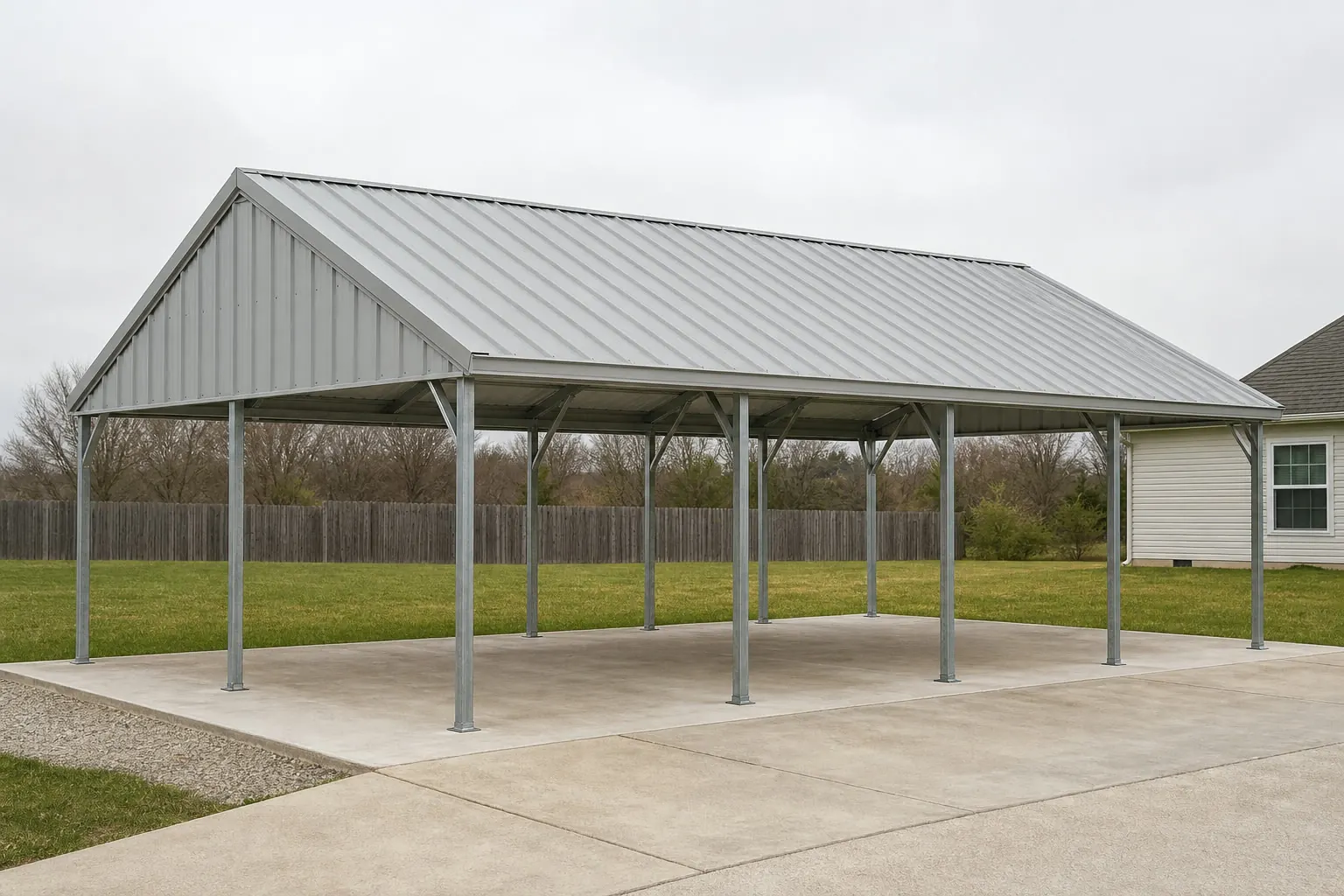
A carport's only job is keeping weather off a vehicle, so the state it sits in matters more than for almost any other structure. Washington's west side, represented by NOAA's Sea-Tac normal of 39.34 inches of annual precipitation, asks a carport to shed sustained rain for months at a time. The Columbia Basin, the arid lowland the Washington Geological Survey maps across the state's entire southeastern portion, asks the opposite: sun and dust management rather than runoff. A carport chosen for one side of the Cascades without adjustment is a carport built for the wrong climate.
The intersection
What a Washington site changes about a carport
A carport's whole purpose is weather protection, so Washington's split climate is the single biggest variable in how one should be specified here.
NOAA's 1991-2020 climate normal for Sea-Tac Airport lists 39.34 inches of annual precipitation and 6.3 inches of annual snowfall, representative of the wetter, Cascades-influenced west side that the National Weather Service's Seattle office documents separately from the state's drier interior. A carport on a west-side parcel is protecting a vehicle from sustained rain across most months of the year, which makes roof slope, gutter placement and how water is directed away from parked vehicles and foot traffic a genuinely important decision rather than an afterthought.
East of the Cascades, the Washington Geological Survey identifies the Columbia Basin as a wide, arid lowland occupying the entire southeastern portion of the state. A carport there is doing a different job: shading a vehicle from sun exposure and reducing dust and debris accumulation, with drainage as a secondary concern rather than the primary one. Because Washington genuinely contains both conditions, this page does not recommend one carport specification for the whole state — it explains why the conversation should start with which side of the state the parcel is on.
Siting
Cascade-adjacent sites need a grading conversation
A carport near the Cascade foothills sits on different ground than one on a flat Puget Sound or Columbia Basin lot, and that changes pad prep more than the structure itself.
Sites closer to the Cascade Range, home to Mount Rainier and other prominent peaks in the state's DNR geologic reference, more often have slope, tree cover and uneven drainage paths compared with flat lowland or basin sites. None of that changes what a carport is, but it changes how the pad is prepared and how water is routed away from it, which is worth confirming with a local site contractor before a concrete pad is poured.
On flatter Puget Sound or Columbia Basin ground, site prep is typically simpler, and the conversation shifts back to the roof and drainage decisions driven by which climate zone the site is in.
Whichever side of the state a carport sits on, the pad itself does more work than the frame. A west-side pad benefits from a slight crown and perimeter drainage so standing rain doesn't pool under a parked vehicle; an east-side pad in the Columbia Basin is more often about a compacted, dust-resistant base than about shedding water.
- Pad grading
- Confirm the pad sits above surrounding grade on any site with meaningful slope or seasonal runoff.
- Roof-water routing (west side)
- Gutters and discharge points matter more here than in drier comparison states.
- Sun orientation (east side)
- Orienting the carport to reduce peak-sun exposure is a bigger factor than drainage in Columbia Basin conditions.
Configuration
How Washington carport briefs differ by property type
A driveway carport and a rural equipment carport are answering different questions, and Washington has a large base of both property types.
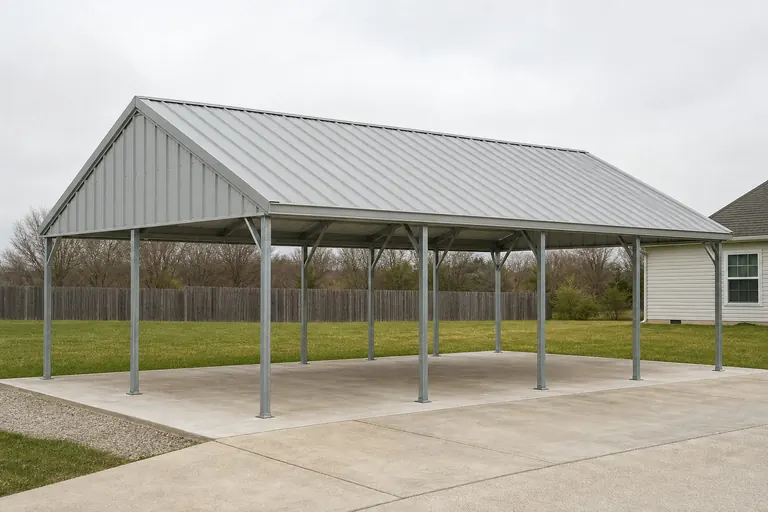 Residential driveway carportA single- or double-bay cover for household vehicles, where west-side drainage or Columbia Basin sun exposure is the main design variable.Rural equipment carportSized for tractors, trailers, or a truck and implement, common on Washington's larger farm parcels (432-acre average per USDA's 2022 count), where clearance height and bay width matter more than footprint alone.
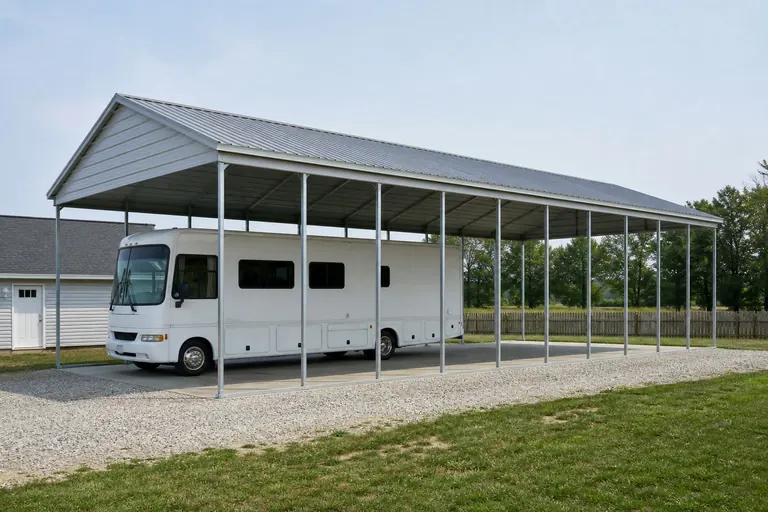 RV or boat carportTaller clearance and longer bays, sited with west-side roof-water routing or east-side sun exposure in mind depending on location.
Example Configuration — for planning purposes only.
Get Washington carport quotes
Tell us which side of the Cascades your site is on and its grade. We route it with the Washington and carport context already attached.
Specification
Panel choice and orientation follow the same climate divide
Once the side of the state is known, panel finish and orientation decisions follow logically from the same wet-versus-dry split that drives the roof-water conversation.
On the west side, a carport's exposed steel is in sustained contact with moisture for a large share of the year, which is the practical reason galvanized or painted panel finishes and properly flashed ridge and end caps matter more here than in a drier state. Orientation also plays a role: positioning the open side away from the prevailing wet-weather wind reduces how much rain is driven in under the roofline.
On the Columbia Basin side, the same panel choices are instead about reflectivity and heat: a lighter panel finish reduces interior heat buildup under a carport roof exposed to long, high-sun days, and orientation is more about shading a parked vehicle during peak afternoon sun than about wind-driven rain. Neither of these is a code requirement; they are practical responses to how differently the two halves of Washington actually behave.
A rural equipment carport adds a third variable that a driveway carport rarely faces: clearance height and bay depth for a tractor, a loaded trailer, or an implement, which on Washington's 432-acre-average farm parcels is often the deciding factor over any climate detail. Confirming the tallest piece of equipment the carport needs to clear, before fixing post height, avoids the single biggest source of rural re-quotes we see.
Preparation
Before you request a Washington carport quote
These points shorten the path to a comparable quote.
- State which side of the state your site is onWest-side and Columbia Basin carports are reasonably different projects; say which applies.
- Describe the pad and gradeSlope near Cascade-adjacent land changes site prep more than flat lowland ground does.
- Check with your local building departmentSnow-load and permit questions are jurisdiction-specific; we do not state them here.
Questions
Washington carport questions
Honest state-level answers, with jurisdiction-specific items routed appropriately.
The basic structure is similar, but the climate priorities differ. West-side sites, represented by Sea-Tac's 39.34-inch annual precipitation normal, benefit from stronger roof-water routing; Columbia Basin sites are more about sun and dust exposure.
Permit requirements depend on your county or city jurisdiction and the carport's size and placement. Your local building department is the only reliable source for that answer.
Snowfall varies significantly across Washington's elevations and sides of the Cascades. We do not state a snow-load design value here; check with your local building department or a licensed engineer for site-specific requirements.
Sites with slope, tree cover or drainage complexity near Cascade-adjacent land often benefit from a site-specific grading review before the pad is set, more so than a flat lowland lot would.
We do not publish state-level prices; costs depend on size, materials and site work. Our cost pages cover what drives the number.
Sources for the Washington facts on this page
This page states no code requirement, wind speed, snow load, permit rule, price or supplier claim. The state-specific facts it does use are listed with their publisher below.
Seattle-Tacoma International Airport's 1991-2020 annual climate normal precipitation is 39.34 inches with an annual normal snowfall of 6.3 inches.
NOAA National Centers for Environmental Information (NCEI) · 1991-2020 · Tier 1
https://www.ncei.noaa.gov/access/services/data/v1?dataset=normals-annualseasonal-1991-2020&dataTypes=ANN-PRCP-NORMAL,ANN-SNOW-NORMAL&stations=USW00024233&format=jsonNWS Seattle publishes climate information pages for western Washington, including precipitation plots distinguishing the wetter coastal/Cascades-influenced west side from the drier interior.
National Weather Service (NOAA), Seattle WA office · Ongoing NWS climatology records · Tier 1
https://www.weather.gov/sew/CliPlotThe Washington Geological Survey (part of the state Department of Natural Resources) names and maps distinct geologic/physiographic provinces across the state, including the Cascade Range and the Columbia Basin, the latter a wide, arid lowland occupying the entire southeastern portion of Washington.
Washington State Department of Natural Resources, Washington Geological Survey · Reference material, current · Tier 2
https://dnr.wa.gov/washington-geological-survey/explore-popular-geology/geologic-provinces-washington/columbia-basinWashington had 13,855,414 acres of land in farms in 2022, an average farm size of 432 acres.
USDA NASS · 2022 · Tier 1
https://www.nass.usda.gov/Publications/AgCensus/2022/Full_Report/Volume_1,_Chapter_1_State_Level/Washington/wav1.txt