
Metal garage · AR
Metal Garages in Arkansas
A metal garage built in eastern Arkansas is answering a different site question than one built in the northern or western hill country. The Arkansas Delta sits within the Mississippi Alluvial Plain, a low, flat, historically flood-prone region, while the Ozark Plateau and Ouachita Mountains to the west and north put a garage pad on sloped ground with entirely different drainage behavior. Add in the fact that Arkansas's 75 counties each carry their own FEMA hazard profile across tornado, riverine flooding and other risks, and it becomes clear a single statewide garage spec doesn't fit the state's actual terrain split. This page works through what that Delta-versus-highland divide changes about slab, drainage and door planning for an Arkansas metal garage.
Two Different Sites
Why a Delta garage and a highland garage aren't the same build
Arkansas's geography splits roughly along a line running from the northeast to the southwest, and a metal garage's site plan should follow that split rather than a single statewide template.
Eastern Arkansas — the Delta — sits within the Mississippi Alluvial Plain, a region the U.S. Geological Survey describes as low, flat, and historically flood-prone. A garage on Delta ground is fighting standing water more than soil movement: heavy silty or clay soils drain slowly, and a flat lot gives runoff nowhere obvious to go unless the pad and apron are graded deliberately.
Move west or north into the Ozark Plateau or Ouachita Mountains, and the problem flips. These are higher, rock-influenced landscapes where a garage pad often sits on a sloped lot, and cut-and-fill grading before slab work becomes the bigger site-prep item. Drainage still matters, but the direction of the fight changes: shedding water off a slope rather than getting it off a flat surface.
Because Arkansas's total land area runs 52,035.5 square miles across those two very different terrain types, a builder quoting a project needs to know which side of the state the lot is on before the foundation conversation can even start. Neither region's approach transfers cleanly to the other.
Door orientation follows the same logic. On a sloped Ouachita or Ozark lot, placing the door on the downhill side of the pad collects runoff at the threshold every time it rains; turning the approach toward the graded high side avoids that problem before it starts. On the flatter Delta, apron slope away from the door matters more than which direction the door faces, since there's less natural grade to lean on.
The Little Rock station's 1991-2020 NOAA normals also point to a humid climate that affects an enclosed metal garage differently than a dry one would: condensation on the underside of an uninsulated steel roof panel is a more persistent issue in humid air, since moisture in the shop has fewer dry-air days to evaporate through. A vapor-retarding underlayment beneath the roof panel and, for a garage used as a workspace, a vented ridge cap are worth raising with an installer before the roof goes on, regardless of which side of the state the garage sits on.
Site Planning
Garage siting notes by Arkansas region
The same metal garage shell resolves into a different slab and drainage plan depending on which side of the state the lot sits.
| Region | Ground condition | Garage siting priority |
|---|---|---|
| Arkansas Delta (Mississippi Alluvial Plain) | Low, flat, historically flood-prone | Elevate the pad slightly and grade the apron to move water away from the slab |
| Ozark Plateau (north) | Higher elevation, rock-influenced, sloped | Cut-and-fill grading before slab work; orient the door toward the graded high side |
| Ouachita Mountains (west/central) | Sloped, ridge-and-valley terrain | Wider apron pad to compensate for limited flat grading room |
Arkansas Delta (Mississippi Alluvial Plain)
- Ground condition
- Low, flat, historically flood-prone
- Garage siting priority
- Elevate the pad slightly and grade the apron to move water away from the slab
Ozark Plateau (north)
- Ground condition
- Higher elevation, rock-influenced, sloped
- Garage siting priority
- Cut-and-fill grading before slab work; orient the door toward the graded high side
Ouachita Mountains (west/central)
- Ground condition
- Sloped, ridge-and-valley terrain
- Garage siting priority
- Wider apron pad to compensate for limited flat grading room
Configuration
Common Arkansas garage setups
How owners tailor a garage to their region and use case.
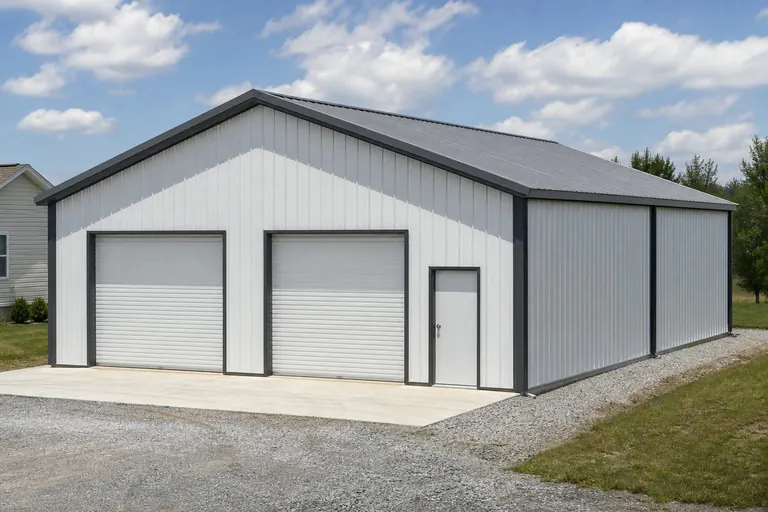 The Delta Equipment GarageElevated pad and reinforced apron drainage to hold up on flat, flood-prone bottomland.The Highland Slope GarageCut-and-fill graded pad with the door sited on the uphill approach to avoid runoff at the threshold.The Farm GarageWide clear-span layout sized for both passenger vehicles and equipment, common on Arkansas's larger rural tracts.
Example Configuration — for planning purposes only.
Get your Arkansas garage quote
Tell us your region and storage needs, and we'll connect you with local experts who understand Arkansas's Delta and highland siting differences.
Dimensions
Sizing an Arkansas metal garage
Selecting a footprint that fits both daily-driver storage and, on rural tracts, farm equipment.
24′ × 24′
576 sq ft
A standard two-car garage that fits most suburban Arkansas lots.
24′ × 30′
720 sq ft
Extra depth for a workbench or storage wall.
30′ × 40′
1,200 sq ft
A frequent choice on larger rural parcels, room for vehicles plus a tractor or implement.
Example Configuration — for planning purposes only.
Confirm setback and lot-coverage limits with your local building department before finalizing a footprint.
Before You Build
Steps for planning a garage in Arkansas
These steps translate the Delta-versus-highland split into a concrete pre-construction checklist.
- Identify your terrain regionConfirm whether the lot sits on Delta bottomland or Ozark/Ouachita highland ground, since that determines the slab and drainage approach above.
- Check your county's FEMA NRI hazard profileFEMA's National Risk Index scores tornado, flooding and other hazards for each of Arkansas's 75 counties; pull your county's data before finalizing anchoring and roof specs.
- Plan door orientation with the slopeOn a sloped lot, site the door away from the downhill runoff path rather than deciding orientation last.
- Confirm design values with your local building departmentWind and structural design values are set locally, not by a single statewide figure; your building department is the authority for your specific site.
Questions
Arkansas Metal Garage FAQ
Answering local questions about building and owning a metal garage in Arkansas.
In most cases, yes, since a garage is a structural building that typically requires a slab and often electrical service. Your county or city building department is the authority on requirements for your specific project.
Yes. Delta ground within the Mississippi Alluvial Plain calls for elevated siting and strong apron drainage, while Ozark and Ouachita highland lots call for cut-and-fill grading before slab work. A local soil check confirms which applies to your lot.
FEMA's National Risk Index is queryable at the county and tract level across Arkansas's 75 counties and covers tornado, riverine flooding, earthquake and other hazards, giving you a starting point beyond a single statewide assumption.
Many owners do combine the two. With 37,756 farms across the state, a wider clear-span layout and taller door are common choices for rural garages that need to hold both vehicles and equipment.
On Ozark or Ouachita highland ground, yes — a door on the downhill side of the pad collects runoff at the threshold every time it rains, so orienting toward the graded high side avoids a recurring drainage problem.
NOAA publishes station-level climate normals, including a 1991-2020 dataset for the Little Rock station; if you're building elsewhere in the state, check the normals for your nearest station rather than assuming the Little Rock figures apply statewide.
Sources for the Arkansas facts on this page
This page states no code requirement, wind speed, snow load, permit rule, price or supplier claim. The state-specific facts it does use are listed with their publisher below.
The Arkansas Delta in the eastern part of the state lies within the Mississippi Alluvial Plain, a low, flat, historically flood-prone floodplain region distinct from the higher Ozark Plateau and Ouachita Mountains to the west.
U.S. Geological Survey (USGS) · Originally published 1923; USGS reference · Tier 1
https://pubs.usgs.gov/bul/0730d/report.pdfArkansas's total land area was measured at 52,035.5 square miles as of the 2010 Census.
U.S. Census Bureau · 2010 Census · Tier 1
https://www.census.gov/geographies/reference-files/2010/geo/state-local-geo-guides-2010/arkansas.htmlFEMA's National Risk Index is an interactive county/tract-level tool covering 18 natural hazards, including tornado, riverine flooding, and earthquake, that can be queried for Arkansas's 75 counties.
Federal Emergency Management Agency (FEMA) · Current NRI release · Tier 1
https://www.fema.gov/flood-maps/products-tools/national-risk-indexArkansas had 37,756 farms in 2022, down 11% from 2017.
USDA National Agricultural Statistics Service (NASS) · 2022 · Tier 1
https://www.nass.usda.gov/Publications/AgCensus/2022/Online_Resources/County_Profiles/Arkansas/cp99005.pdfNOAA NCEI's 1991-2020 climate normals for Little Rock Adams Field list station-level monthly and annual temperature, precipitation, and degree-day data for the Little Rock area.
NOAA National Centers for Environmental Information (NCEI) · 1991-2020 · Tier 1
https://www.ncei.noaa.gov/access/services/data/v1?dataset=normals-monthly-1991-2020&endDate=9996-12-31&format=pdf&startDate=0001-01-01&stations=USW00013963