
Hobby shop · ME
Hobby Shops in Maine
A hobby shop in Maine is judged by whether it is still comfortable to work in during the second week of February, not by how it photographs in September. Portland's benchmark NOAA 1991-2020 normals record January and February snowfall means of roughly 15-19 inches each month and annual precipitation near 51 inches spread fairly evenly across the year, so the building has to shed snow, resist moisture intrusion, and hold heat for months at a time. Because Maine's farmland averages 174 acres per operation across 1,225,046 acres in farms statewide, a meaningful share of hobby shops here go up on larger, more rural parcels than the compact suburban lots typical elsewhere, which changes the access and utility planning as much as the climate does.
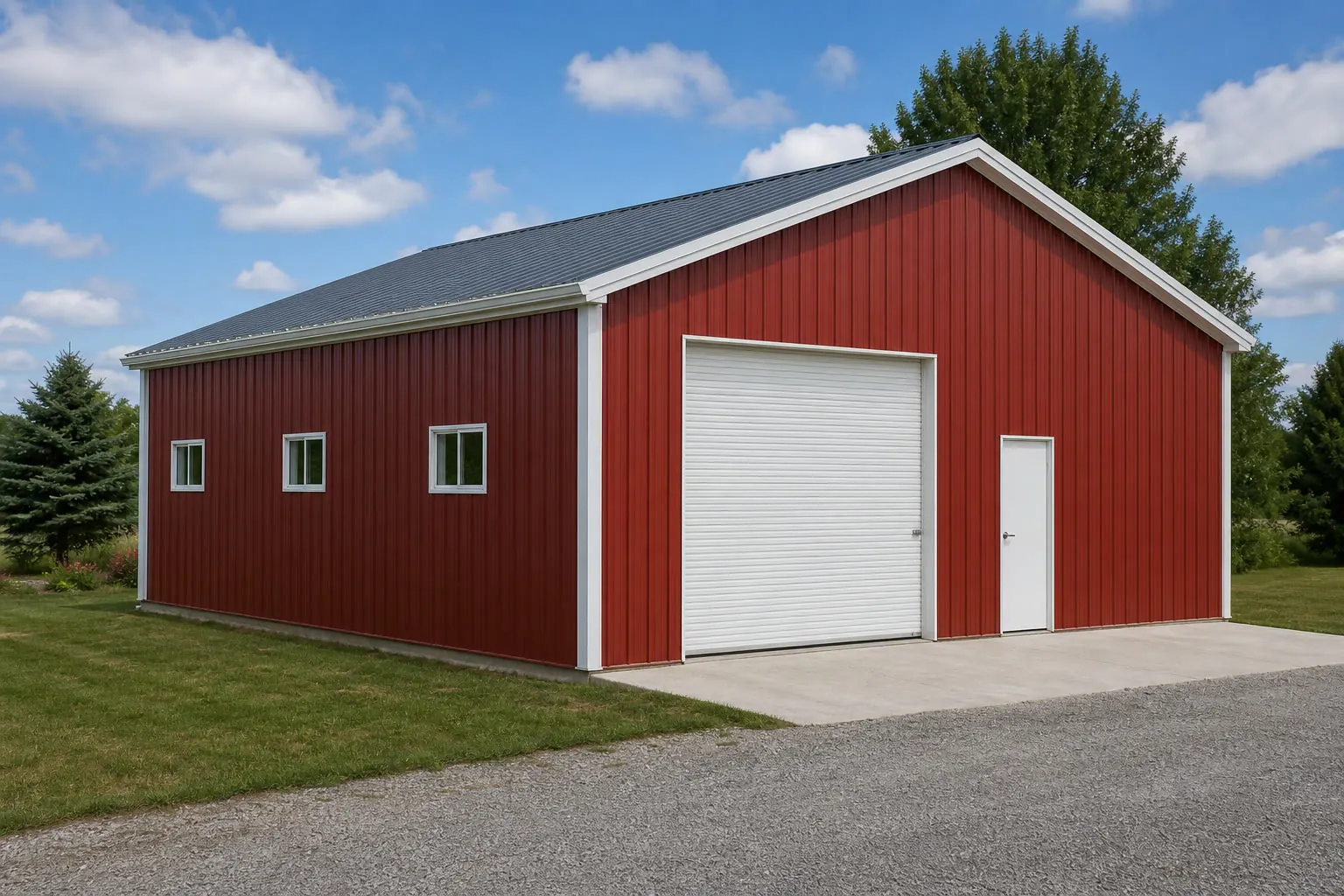
The Building Has to Survive Its Own Winter
A hobby shop is a discretionary building, which means a Maine owner has to actually want to walk out to it once the snow starts sticking. That comes down to three things decided before the slab goes in: whether the roof sheds snow away from the door, whether the envelope holds heat through a long cold season, and whether moisture from roughly 51 inches of annual precipitation is kept out of the building rather than trapped inside it. None of that is exotic construction, but all of it has to be decided deliberately rather than defaulted to a warm-state spec.
Envelope
Snow Load, Moisture, and the Maine Envelope
A Maine hobby shop's roof geometry and envelope package are driven by persistent snow and year-round moisture, not by a single design threshold.
Portland's NOAA 1991-2020 normals put January and February snowfall means at roughly 15-19 inches each month. That is not a single storm to plan around; it is a season-long accumulation, and the practical question is where that snow ends up. A shop sited so its main door faces the prevailing shed line loses days of access every winter to a drift that never had anywhere else to go.
Moisture works on a different timeline. With annual precipitation near 51 inches spread fairly evenly through the year rather than concentrated seasonally, a Maine shop's vapour barrier, insulation, and ventilation are working against a near-constant condition rather than a wet month or two. Skipping any one of those measures shows up as condensation on tools and stored material long before it shows up as a structural issue.
The heating plan follows both. A well-sealed, insulated shop can be held at a workable temperature economically through a Maine winter; an uninsulated shell cannot, regardless of the heater size. Size the heat only after the envelope decision is made, and confirm the electrical service can actually carry it alongside any tools you plan to run.
Siting
Siting a Shop on a Maine Property
Maine's larger, more rural parcels change what needs planning before the pad location is fixed.
- Confirm local accessory-structure rules firstSize, height and setback allowances for a detached building are set locally in Maine. Ask your town or county code enforcement officer before you settle on a footprint.
- Walk the site in a thaw, not in summerThe Maine Geological Survey documents widespread glacial and post-glacial surficial deposits statewide, so drainage and soil behaviour can differ meaningfully between two spots on the same lot.
- Plan the electrical run before the padOn a larger rural Maine parcel, the distance from the house panel to the shop site is often the single biggest unplanned cost. Settle it before pouring anything.
- Choose the roof line to protect the doorWith winter snowfall means of 15-19 inches in January and February at the state's benchmark station, a door on the shed side of the roof loses access for weeks at a time.
- Plan delivery access for winter, not just for the install dayA rural Maine driveway that is fine in October can be impassable to a delivery vehicle after the first real snowfall; confirm the access route holds up in winter conditions.
- Ask about your county's hazard exposureFEMA's National Risk Index scores 18 hazard types across Maine's 16 counties. Check the tool for your county rather than assuming a statewide figure applies evenly.
Get hobby shop quotes for your Maine property
Tell suppliers your county, your intended footprint, and how far the site sits from existing power. That framing is what makes Maine hobby shop quotes comparable.
Footprints
Hobby Shop Footprints for Maine Properties
Maine's larger rural parcels give buyers more footprint flexibility than a dense suburban lot would, within whatever the town allows.
20′ × 24′
480 sq ft
A one-person shop with bench and storage, small enough to sit comfortably within most accessory-structure allowances.
24′ × 32′
768 sq ft
Room for a second work zone or a small vehicle bay while remaining practical to insulate and heat through a Maine winter.
30′ × 40′
1,200 sq ft
For larger rural parcels where the property supports a bigger footprint and the town confirms it.
Example Configuration — for planning purposes only.
Confirm accessory-structure size, height and setback allowances with your town before selecting a footprint.
Site Context
Coast, Interior and North Maine Change the Brief
Maine's geography is not uniform, and neither is the shop planning conversation across it.
Southern coastal strip
Closer to the Portland benchmark station's normals, with somewhat milder winters than the interior but still meaningful snowfall and near-constant precipitation to design the envelope around.
Interior and western hills
Colder and generally snowier than the coast, where the roof shed line and heating plan carry more weight and where surficial deposits mapped by the Maine Geological Survey vary the ground conditions site to site.
Northern and Downeast Maine
The most rural stretch of the state's 1,225,046 acres in farms, where delivery access, distance to utilities and winter road conditions typically outweigh any other siting factor.
Evidence Position
What Is Sourced and What Is Withheld
Climate, land and geology figures on this page are federal or state agency data; every regulatory number is left to your town or county.
Sourced above: NOAA NCEI 1991-2020 normals for the Portland Jetport station, USDA NASS 2022 Census of Agriculture farmland figures for Maine, the Maine Geological Survey's statewide surficial-deposit description, and FEMA's National Risk Index as the federal hazard tool covering Maine's 16 counties.
Withheld deliberately: permit thresholds, accessory-structure dimensions, snow loads, wind speeds, frost depths, adopted code editions and prices. Our evidence pack also notes that a single official statewide (rather than single-station) NOAA precipitation or snowfall figure for Maine was not located, which is why the Portland station value is described as representative rather than statewide.
Questions
Maine Hobby Shop Questions
Maine-specific answers for buyers planning a backyard or rural workshop.
If you plan to use it through the winter, effectively yes. Maine's winter snowfall and near-constant precipitation mean an uninsulated steel shell is both hard to heat economically and prone to condensation. Insulation, air sealing and a slab vapour barrier work together to fix both problems.
We do not publish a statewide snow load figure because it is set locally. The Portland benchmark station's January and February snowfall means of 15-19 inches each month give a sense of scale, but your building department sets the design value for your site.
Often yes, but plan the electrical run and delivery access before choosing the site. Maine's average farm size of 174 acres shows how spread out rural properties here can be, and both trenching distance and winter road access get harder the farther the shop sits from the house.
It can vary more than buyers expect. The Maine Geological Survey documents statewide glacial and post-glacial surficial deposits — till, marine clay, sand and gravel — so two sites on the same property can behave differently. A site-specific look is worth it before choosing a foundation.
Ask your town or county code enforcement officer. Maine administers accessory-structure rules locally, and because a hobby shop is occupied working space rather than plain storage, it is worth confirming how your jurisdiction classifies that use.
Pricing is handled by the cost silo. The Maine-variable drivers are the insulation package, the length of the electrical run to a rural site, and the foundation detail chosen for your specific ground conditions.
Sources for the Maine facts on this page
This page states no code requirement, wind speed, snow load, permit rule, price or supplier claim. The state-specific facts it does use are listed with their publisher below.
The Portland, ME NOAA 1991-2020 normals show winter monthly snowfall means around 15-19 inches in January and February, indicative of a snow-heavy northern New England winter.
NOAA National Centers for Environmental Information (NCEI) · 1991-2020 · Tier 1
https://www.ncei.noaa.gov/access/services/data/v1?dataset=normals-monthly-1991-2020&format=pdf&stations=USW00014764Portland, ME's NOAA 1991-2020 climate normals show annual precipitation totals of about 51 inches, distributed fairly evenly through the year with over 3 inches of rain most months.
NOAA National Centers for Environmental Information (NCEI) · 1991-2020 · Tier 1
https://www.ncei.noaa.gov/access/services/data/v1?dataset=normals-monthly-1991-2020&format=pdf&stations=USW00014764Maine had 1,225,046 acres of land in farms in 2022, an average farm size of 174 acres.
USDA NASS · 2022 · Tier 1
https://www.nass.usda.gov/Publications/AgCensus/2022/Full_Report/Volume_1,_Chapter_1_State_Level/Maine/st23_1_001_001.pdfThe Maine Geological Survey describes most of the state's surface as mantled by glacial and post-glacial sediments (till, marine clay, sand and gravel) deposited during and after the last ice age, which ended roughly 10,000-16,000 years ago.
Maine Geological Survey (Dept. of Agriculture, Conservation & Forestry) · MGS reference material · Tier 2
https://www.maine.gov/DACF/mgs/explore/surficial/facts/surficial.htmFEMA's National Risk Index is the federal tool for county- and state-level natural hazard exposure data for Maine's 16 counties, covering 18 hazard types including winter weather, coastal flooding, and strong wind.
Federal Emergency Management Agency (FEMA) · Current NRI release · Tier 1
https://www.fema.gov/flood-maps/products-tools/national-risk-index