Garden shed · FL
Garden Sheds in Florida
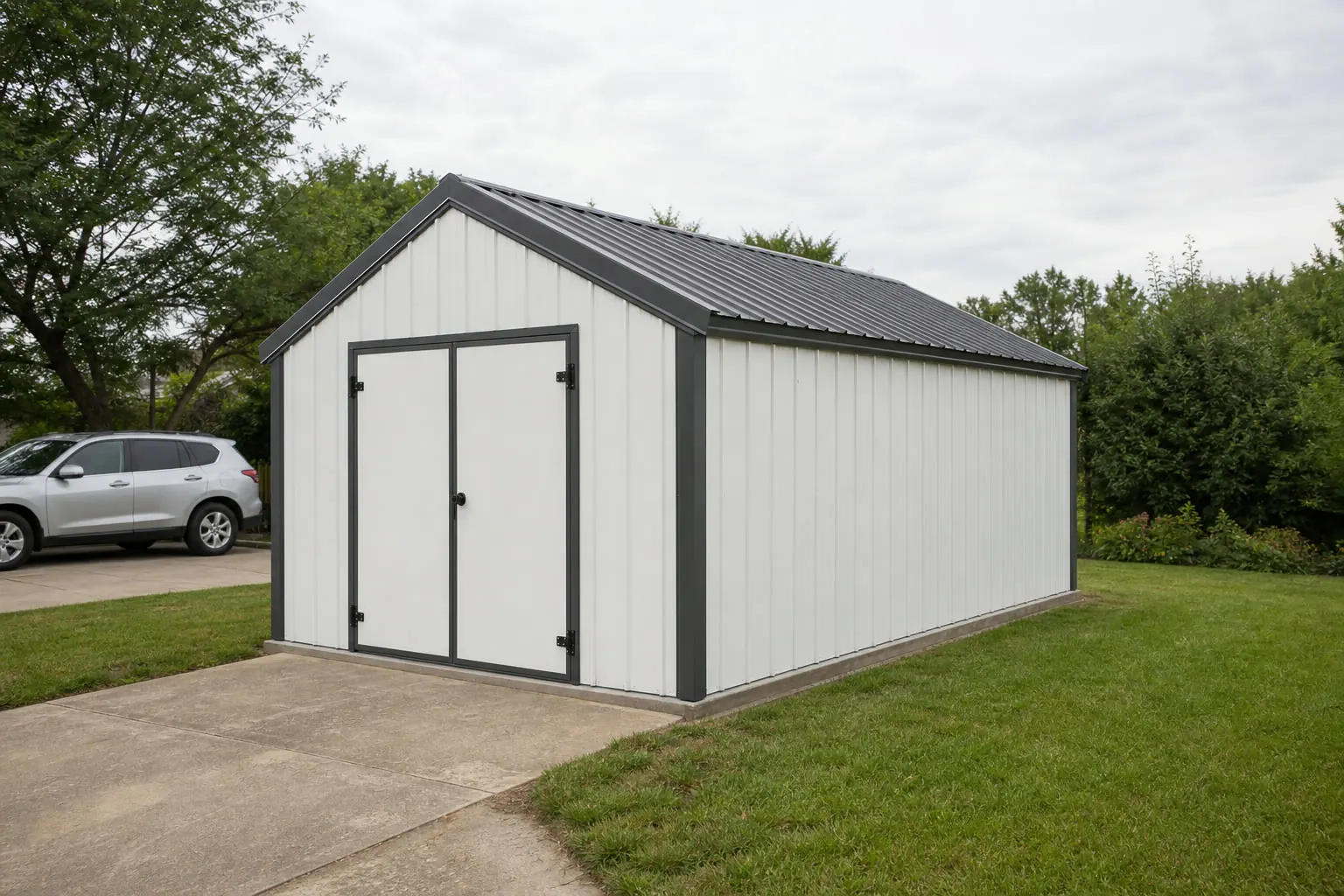
A Florida garden shed answers to a growing calendar that barely pauses, but the bigger planning question is what the state's wind and water exposure means for siting and anchoring. NOAA's Atlantic Oceanographic and Meteorological Laboratory records Florida, using its 1851-2018 dataset, as the U.S. state with the most historical hurricane direct hits and landfalls, and the Florida Building Commission's 8th Edition code, effective December 31, 2023, defines a High-Velocity Hurricane Zone covering Broward and Miami-Dade counties specifically — not the whole state. Add USGS mapping that flags large portions of Florida as low-lying terrain drawn from digital elevation models, and a garden shed here is sited with drainage and wind exposure in mind well before anyone discusses paint color or door style.
The intersection
A garden shed sited for wind and water, not frost
Florida's hurricane history and low-lying terrain reorganize garden-shed siting around anchoring and drainage rather than a seasonal cold calendar.
NOAA's Atlantic Oceanographic and Meteorological Laboratory, working from an 1851-2018 dataset, records Florida as the U.S. state with the most historical hurricane direct hits and landfalls. That single fact reorders the garden-shed conversation: instead of asking how to winterize a structure, a Florida buyer is better served asking how the shed is anchored to its pad and whether its door and window openings are specified against wind pressure, questions your local building department and, where applicable, a structural engineer are positioned to answer for your specific footprint.
USGS elevation mapping, drawn from digital elevation models, highlights that large portions of Florida sit on low-lying ground. That matters for a garden shed more than it might for a taller structure, because a shed's floor sits close to grade; confirming the pad sheds water away from the structure, and checking whether the parcel sits in a mapped flood-prone area, is worth doing before a foundation choice is finalized.
The Florida Building Commission administers the Florida Building Code as a single statewide framework, currently the 8th Edition, effective December 31, 2023. That gives every Florida garden-shed project one code body to reference, which is simpler than a state with no statewide authority — but it does not mean every county applies the same wind-exposure detailing. The code's own High-Velocity Hurricane Zone definition names Broward and Miami-Dade counties specifically, so a buyer in those two counties should expect a different, more stringent review path than a buyer elsewhere in the state, and should not assume the rest of the state follows the same detailing by default.
Hazard breadth
Hurricane wind is the headline, but not the only hazard
FEMA's National Risk Index scores Florida communities across 18 hazard types, and a garden shed inland from the coast still carries some of that exposure.
FEMA's National Risk Index catalogs 18 defined natural hazard types, from inland flooding and hail to lightning and strong wind, and applies that scoring to communities across Florida, not only coastal counties. A garden shed sited well inland from any hurricane storm-surge zone can still sit in a county flagged for inland flooding or lightning frequency, which is worth a quick look at your county's own profile rather than assuming distance from the coast removes all weather exposure.
USDA's 2022 Census of Agriculture recorded 44,703 farms across Florida, a base broad enough that garden-shed demand here spans backyard vegetable growers, ornamental gardeners and small working-acreage operations rather than one uniform use case. That range means a garden-shed brief in Florida is worth defining by what it stores — irrigation gear, hand tools, potting supplies, or small equipment — before settling on a footprint.
- Confirm your county's hazard profile
- FEMA's National Risk Index covers 18 hazard types; check your county rather than assuming coastal-only exposure.
- Ask whether HVHZ detailing applies to your parcel
- It is defined as Broward and Miami-Dade counties only; confirm with your local building department if you sit near that boundary.
- Plan drainage before the pad, not after
- USGS mapping flags large low-lying areas statewide; grade the pad to shed water away from the shed floor.
Configuration
What a Florida garden shed is usually asked to do
A near-year-round growing calendar and wind exposure shape a few recurring Florida garden-shed briefs.
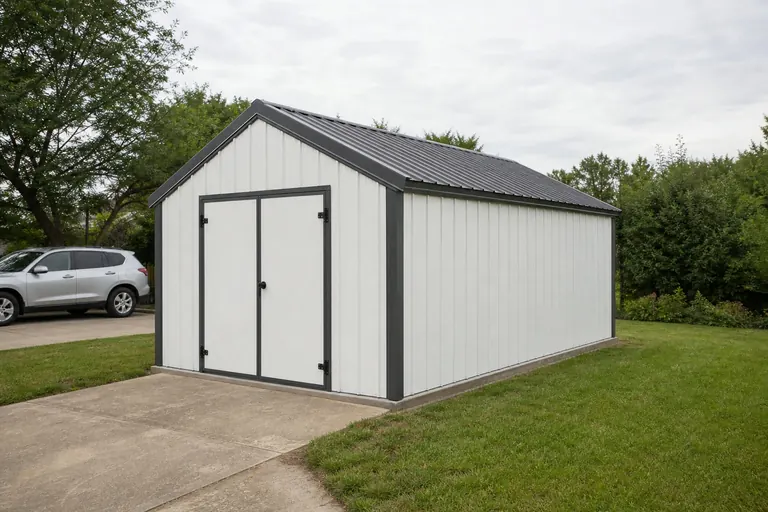 Anchored tool and irrigation storageHand tools, hose reels and irrigation fittings organized for a growing season that runs close to twelve months, secured against wind uplift.Potting and propagation benchA workbench and shelving for potting soil and starts, positioned with ventilation in mind for Florida's humid interior air.Small working-acreage supportA larger garden shed on agricultural land supporting a broader growing operation, distinct from a purely ornamental backyard garden.
Example Configuration — for planning purposes only.
Get Florida garden shed quotes
Tell us your gardening setup and whether your parcel falls in the HVHZ counties if known, and we route it with the Florida context already attached.
Preparation
Before you order a Florida garden shed
A few Florida-specific checks keep a garden shed project simple.
Step 1
Confirm whether your parcel sits in the HVHZ
The Florida Building Code's High-Velocity Hurricane Zone applies to Broward and Miami-Dade counties; confirm with your local building department if unsure.
Step 2
Ask your local department about anchoring and wind detailing
The Florida Building Commission sets the statewide framework, but wind-exposure detailing is applied locally to your specific structure.
Step 3
Check drainage and grade before siting
USGS mapping flags large low-lying areas statewide; a shed pad that traps water is a recurring, avoidable problem.
Step 4
Pull your county's FEMA hazard profile
The National Risk Index covers 18 hazard types; inland flooding and lightning exposure can matter even away from the coast.
Step 5
Size shelving for near-year-round use
A growing season that runs close to twelve months typically means steadier shed use than in states with a dormant winter period.
Footprint
Common Florida garden shed sizes
Florida garden sheds tend to stay compact, sized around tools and irrigation equipment rather than large machinery.
8′ × 10′
80 sq ft
A compact footprint for hand tools and irrigation supplies.
10′ × 16′
160 sq ft
Room for a potting bench alongside general garden storage.
12′ × 20′
240 sq ft
Suited to small working-acreage gardening support with more equipment and supply storage.
Example Configuration — for planning purposes only.
Confirm local wind-exposure and anchoring requirements with your building department before finalizing a footprint.
Questions
Florida garden shed questions
Honest answers at the state level, with parcel-specific and pricing questions routed to whoever actually owns them.
It affects anchoring and wind-exposure planning more than daily use. NOAA's Hurricane Research Division records Florida as the state with the most historical hurricane landfalls, which is why confirming wind-detailing with your local building department matters even for a small shed.
Only if your parcel is in Broward or Miami-Dade county, where the Florida Building Code defines the HVHZ. Elsewhere in Florida, different local detailing applies; confirm with your building department.
The Florida Building Commission administers the Florida Building Code statewide, currently the 8th Edition effective December 31, 2023, but how it applies to a specific garden shed size is a question for your local building department.
There is no official typical size. Most Florida garden sheds run from about 8x10 to 12x20 depending on tool and irrigation-equipment storage needs.
We do not publish state-level prices, since cost depends on size, specification and site work. Our cost pages explain what drives the number.
It is worth checking. USGS elevation mapping highlights that large portions of Florida are low-lying, so grading the pad to shed water away from the structure is a reasonable precaution before placement.
Sources for the Florida facts on this page
This page states no code requirement, wind speed, snow load, permit rule, price or supplier claim. The state-specific facts it does use are listed with their publisher below.
NOAA's Hurricane Research Division records Florida as the U.S. state with the most historical hurricane direct hits/landfalls, based on the 1851-2018 dataset.
NOAA Atlantic Oceanographic and Meteorological Laboratory (AOML), Hurricane Research Division · 1851-2018 · Tier 1
https://www.aoml.noaa.gov/hrd/tcfaq/E19.htmlFEMA's National Risk Index scores U.S. communities, including Florida counties, across 18 defined natural hazard types.
FEMA · current dataset · Tier 1
https://www.fema.gov/about/openfema/data-sets/national-risk-index-dataThe Florida Building Commission administers the Florida Building Code statewide.
Florida Building Commission · 8th Edition (2023), effective Dec 31, 2023 · Tier 2
https://www.floridabuilding.org/The Florida Building Code defines a High-Velocity Hurricane Zone (HVHZ) consisting of Broward and Miami-Dade counties.
Florida Building Commission (via UpCodes republication) · 2023 FBC, 8th edition · Tier 3
https://up.codes/d/high-velocity-hurricane-zone-hvhzUSGS mapping highlights that large portions of Florida are low-lying, derived from USGS digital elevation models.
U.S. Geological Survey · n/a (map publication) · Tier 2
https://pubs.usgs.gov/sim/3047/Florida had 44,703 farms in 2022 per the USDA Census of Agriculture.
USDA National Agricultural Statistics Service (NASS) · 2022 · Tier 1
https://www.nass.usda.gov/Publications/AgCensus/2022/Full_Report/Volume_1,_Chapter_1_State_Level/Florida/