
Garden shed · CO
Garden Sheds in Colorado
A garden shed is small enough that Colorado buyers treat it as an afterthought, but the state's physiography does not shrink to match the building. Colorado carries the highest mean elevation of any U.S. state and 54 peaks above 14,000 feet, yet its eastern two-fifths sit flat, and the Colorado Geological Survey maps that split into the Southern Rocky Mountains, the Great Plains' own High Plains and Colorado Piedmont subprovinces, the Wyoming Basin and the Colorado Plateau. Which of those a parcel a shed sits on is worth knowing before assuming a roof, footing or orientation choice that was really only tested for a different part of the state. On permitting, Colorado's Office of the State Architect sets minimum codes only for state-owned or state-lease-purchased buildings, so a private garden shed's exempt-size threshold and any permit trigger are questions for the county or municipal building department, not this page.
Siting
Placing a small shed on a state with no flat answer
Colorado's elevation range means a garden shed's roof and footing should be set by the parcel's own province, not by the state as a whole.
Colorado holds the highest mean elevation of any U.S. state, with 54 named peaks above 14,000 feet including Mount Elbert at 14,440 feet, but that headline hides a real split: the eastern two-fifths of the state are flat plains. A garden shed proposed for a Front Range foothill lot and one proposed for a lot east of Denver are not facing the same conditions, even though both are technically in Colorado.
The Colorado Geological Survey's own physiographic map gives a more precise way to place a parcel than 'mountain' or 'plains' alone. It divides the state into the Southern Rocky Mountains, the Great Plains — itself split into the High Plains, the Colorado Piedmont and the Raton Basin — the Wyoming Basin, and the Colorado Plateau. A shed sited in the Colorado Piedmont sits in different terrain than one on the High Plains proper or in a Rocky Mountain valley, and the roof pitch, footing depth and orientation choices that make sense for a small structure follow from that province, not from a single 'Colorado' assumption.
For a mountain or foothill parcel, the practical takeaway is that snow accumulation and drift against the shed's uphill wall are the design questions worth resolving with a local supplier before ordering a flat- or low-pitch roof. For a plains parcel, the practical questions shift toward sustained wind exposure and anchoring, since open eastern terrain gives wind a long run at an unshielded structure with none of the windbreak a mountain valley or a treed foothill lot can provide.
Configuration
What a Colorado garden shed is usually asked to do
Which physiographic province a parcel sits in shapes the shed brief more than the fact that it is in Colorado at all.
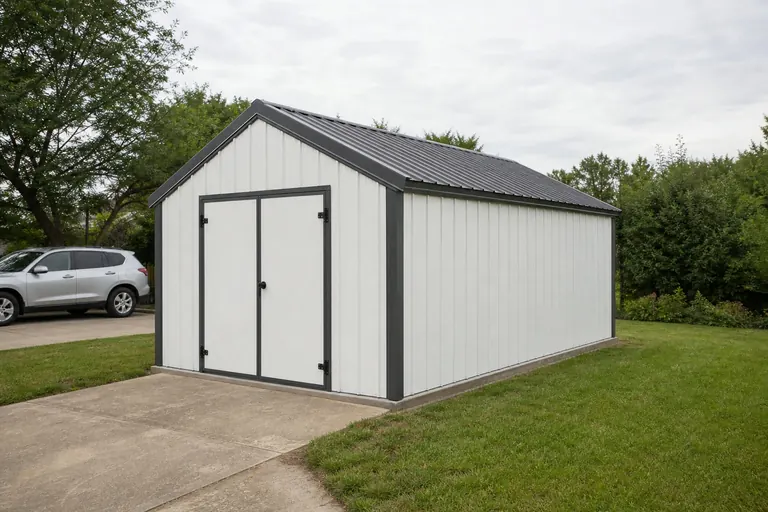 Mountain and foothill tool storageSteeper roof planning and drift-aware siting for parcels in the Southern Rocky Mountains province, where snow behavior differs sharply from the plains.Piedmont and High Plains storageA shed sited on the Great Plains' Colorado Piedmont or High Plains subprovinces, where wind exposure and open terrain are the driving siting factors.Plateau-country storageWestern Colorado Plateau parcels, where terrain and access can differ again from both the mountain and plains cases.
Example Configuration — for planning purposes only.
Get Colorado garden shed quotes
Tell us your property's terrain and elevation, and we route your request with that context attached.
Preparation
Before you order a Colorado garden shed
A short list of checks keeps a small shed from being the one structure on the property nobody planned around Colorado's terrain.
Step 1
Identify your physiographic province
Check whether your parcel falls in the Southern Rocky Mountains, the Great Plains (and which subprovince), the Wyoming Basin or the Colorado Plateau before assuming a roof pitch or footing approach.
Step 2
Call the county or city building department first
The Office of the State Architect's authority covers only state-owned buildings, so a private shed's exempt-size threshold and any permit trigger are set by that local department.
Step 3
Plan the footing for your elevation band, not the state average
A mountain or foothill parcel and a plains parcel see different frost and snow behavior even within the same county in some cases; confirm with the local department rather than assuming a single Colorado standard.
Step 4
Account for wind anchoring on open plains sites
Sustained wind exposure on the flat eastern piedmont and High Plains has no natural windbreak the way a treed foothill or mountain-valley lot does.
Step 5
Ask about drift clearance on mountain and foothill lots
A shed sited against an uphill slope in the Rocky Mountains province can accumulate drifted snow well beyond a flat-ground design; discuss placement with your local supplier before finalizing the pad.
Footprint
Garden shed sizes that fit Colorado properties
Colorado garden shed buyers generally size around tool and equipment storage first, then confirm the footprint against their county's exempt-size threshold.
8′ × 10′
80 sq ft
A compact footprint for hand tools and mower storage, sized to clear many county exempt-size thresholds.
10′ × 12′
120 sq ft
Room for larger equipment or a small workbench, common on suburban Front Range and Piedmont lots.
12′ × 16′
192 sq ft
A larger option suited to rural mountain or plains acreage with more equipment to store.
Example Configuration — for planning purposes only.
Confirm your county or city's exempt-size threshold and any permit requirement before finalizing a footprint.
Questions
Colorado garden shed questions
Honest answers scoped to what Colorado's terrain and permitting structure actually change, with sizing and pricing routed to the pages that own them.
Yes, indirectly. The same mountain-to-plains range that drives snow and wind exposure for larger buildings still applies to a shed roof and footing, so a mountain-parcel shed and a plains-parcel shed reasonably use different roof pitch and anchoring choices.
The Office of the State Architect's authority covers only state-owned or state-lease-purchased buildings, so a private shed's rules come from whatever code the county or municipality has adopted, not a single statewide source.
The Colorado Geological Survey publishes a physiographic map dividing the state into the Southern Rocky Mountains, the Great Plains with its subprovinces, the Wyoming Basin and the Colorado Plateau; that map is a useful starting reference before assuming your parcel's conditions.
There is no official typical size. Most Colorado garden sheds we see specified run from roughly 8x10 up to 12x16 depending on equipment storage needs and the property's own exempt-size threshold.
It's worth asking your local supplier about anchoring on open, flat plains sites, since sustained wind has a longer unobstructed run there than in a treed foothill or mountain-valley setting.
We do not publish state-level prices, since cost depends on size, specification and site work. Our cost pages explain what drives the number.
Sources for the Colorado facts on this page
This page states no code requirement, wind speed, snow load, permit rule, price or supplier claim. The state-specific facts it does use are listed with their publisher below.
Colorado's highest point, Mount Elbert, reaches 14,440 feet elevation (NAVD 88), reflecting the extreme high-mountain-to-plains elevation range relevant to mountain snow load versus valley/plains conditions.
Wikipedia (cross-referencing USGS elevation data) · current · Tier 1
https://en.wikipedia.org/wiki/Mount_ElbertColorado is described as having the highest mean elevation of any U.S. state and contains 54 peaks above 14,000 feet, with the eastern two-fifths of the state being flat plains, underscoring the mountain-vs-plains contrast for snow and wind exposure.
NETSTATE.com (general geography reference) · current reference page · Tier 2
https://www.netstate.com/states/geography/co_geography.htmThe Colorado Geological Survey's physiographic map divides the state into the Southern Rocky Mountains, the Great Plains (with High Plains, Colorado Piedmont, and Raton Basin subprovinces), the Wyoming Basin, and the Colorado Plateau.
Colorado Geological Survey · current reference map · Tier 2
https://coloradogeologicalsurvey.org/wp-content/uploads/ON-010-09-04.pdfColorado has no single statewide building code agency for general construction; the state's Office of the State Architect only sets minimum codes for state-owned/state-lease-purchased buildings, while other construction is subject to local adoption per the Division of Housing and Colorado's Planning for Hazards program.
Colorado Office of the State Architect; Colorado Department of Local Affairs, Division of Housing · current, accessed 2024/2025 · Tier 2
https://osa.colorado.gov/building-codesColorado has no single statewide building code agency for general construction; the state's Office of the State Architect only sets minimum codes for state-owned/state-lease-purchased buildings, while other construction is subject to local adoption per the Division of Housing and Colorado's Planning for Hazards program.
Colorado Office of the State Architect; Colorado Department of Local Affairs, Division of Housing · current, accessed 2024/2025 · Tier 2
https://osa.colorado.gov/building-codes