
Equipment shed · MN
Equipment Sheds in Minnesota
Minnesota does not hand an equipment-shed buyer one statewide winter number. The Minneapolis-St. Paul area's 1991-2020 normal runs 31.62 inches of precipitation and 51.2 inches of snow, while the National Weather Service's Duluth office tracks International Falls as one of the coldest recording stations in the contiguous 48 states, with a period of record back to 1895. A shed sized and sited correctly near the Twin Cities can be under-built for a farm near the Canadian border. Layer onto that Minnesota's 65,531 farms in 2022 — down 5% in count since 2017 but averaging a larger 388 acres per operation — and the honest planning question becomes: which of Minnesota's climate zones and which scale of operation is this shed actually built for?
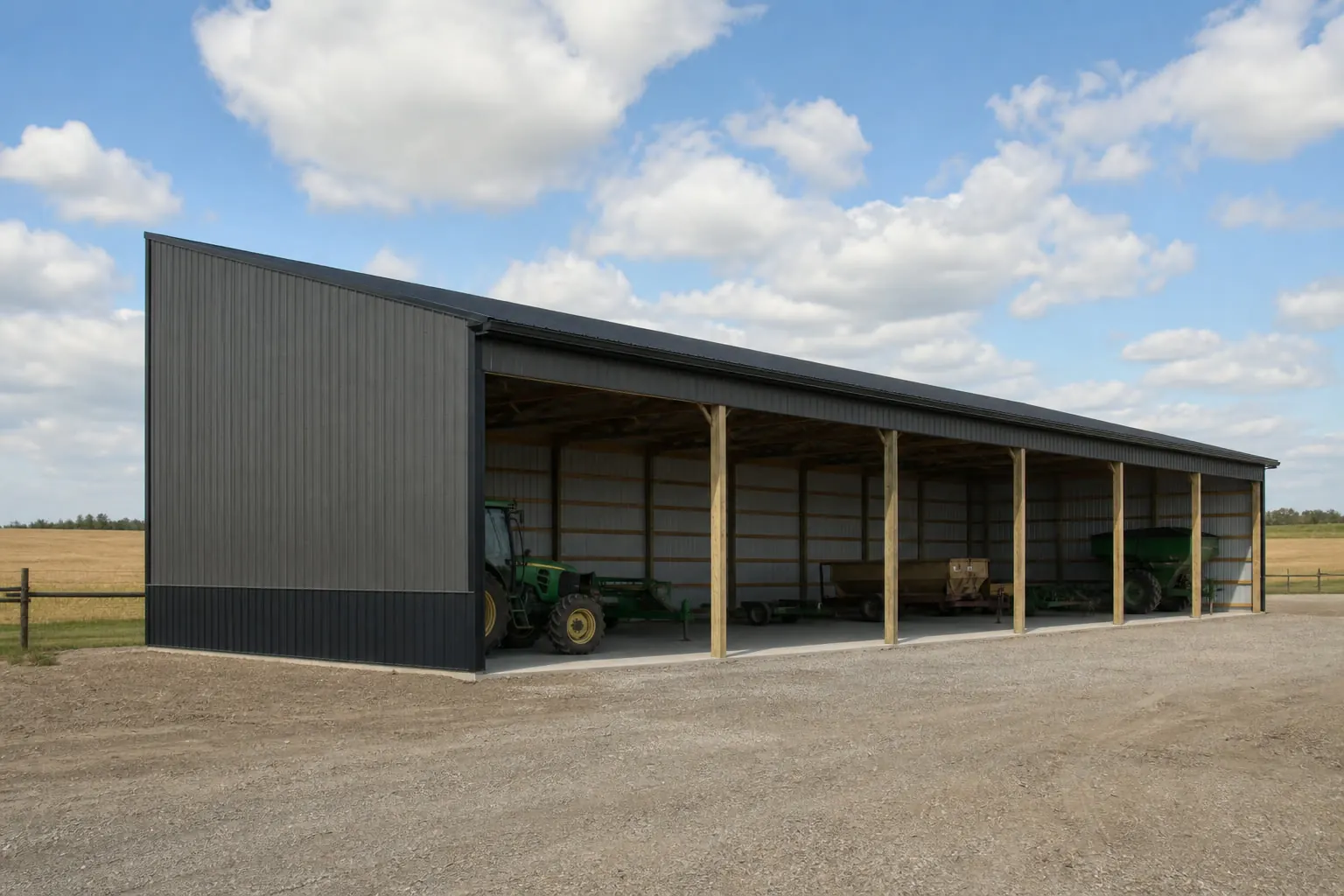
Climate
Minnesota's north-south winter divide
A Minneapolis-area normal does not describe a shed sited near the Canadian border, and the gap between the two changes structural and door-seal decisions.
The Minneapolis-St. Paul station's 1991-2020 normal — 31.62 inches of annual precipitation and 51.2 inches of snowfall — is a reasonable reference point for buyers in the metro and southern half of the state, but it is only one station. The National Weather Service's Duluth office, which tracks International Falls, documents that station as one of the routinely coldest reporting points for January temperatures in the entire contiguous United States, with a period of record stretching back to 1895. A buyer planning a shed in Minnesota's north woods is looking at a materially different winter than one planning near the Twin Cities.
That gap matters for practical shed decisions: how much roof pitch to specify, how aggressive a door-seal and threshold detail to request, and whether unheated storage risks enough condensation cycling to justify a vapor barrier or roof insulation package. Rather than asking a supplier to build to 'Minnesota winter conditions,' pull the nearest NWS or NOAA station normal to your actual parcel and hand that to your engineer, then confirm design loads with your local building department, since neither this page nor a supplier catalog can substitute for a site-specific load determination.
The same logic applies to spring thaw. A shed built to handle Twin Cities-area freeze-thaw cycling may see a shorter or longer thaw window depending on latitude, which affects how quickly a gravel or concrete pad needs to shed meltwater before spring fieldwork begins.
Operations
Sizing for a consolidating farm base
Minnesota has fewer farms than five years ago, but the ones that remain are larger, and that consolidation trend is the reason equipment-shed footprints keep growing even as farm counts shrink.
USDA's 2022 Census of Agriculture counted 65,531 farms in Minnesota, a 5% decrease from 2017. At the same time, the state's total land in farms rose to 25,442,625 acres, pushing the average farm size up to 388 acres, also a 5% increase over the same period. Read together, those numbers describe consolidation: fewer, larger operations working more acreage each, typically with larger and more numerous pieces of equipment to cover that ground.
That consolidation shows up directly in shed planning. A buyer replacing an older, smaller shed on a farm that has grown since the last building went up should size the new structure for the operation's current scale, not its historical footprint. Reusing an old door width or clear-span dimension because 'that's what we've always had' is a common way buyers under-build for equipment that has grown wider, taller, or simply more numerous since the last shed was framed.
USDA's data also shows the state's farms are not uniform: 22,948 farms (about 35%) fall into the 180-plus acre size classes, while 4,401 farms (7%) are quite small, at just 1 to 9 acres. A shed brief for a large row-crop operation and one for a small specialty or hobby acreage are genuinely different projects, and treating them the same way — same door count, same clear span, same layout — wastes money on one end or under-serves storage needs on the other.
Site Context
Minnesota's ecological provinces and shed siting
The Minnesota DNR's Ecological Classification System maps the state into named provinces and sections, and each carries different site-clearing, drainage and soil considerations for an equipment shed pad.
Eastern Broadleaf Forest Province
Historically forested terrain across central and southeastern Minnesota. Sites here more often require tree clearing and stump removal before grading, and buyers should budget time for that step separately from the building timeline.
North Central Glaciated Plains Section
Flatter, glacially shaped farmland typical of much of Minnesota's row-crop belt. Site prep here tends to focus on drainage and pad compaction rather than clearing, since the terrain is already largely open.
Blufflands Subsection (southeast)
The steep bluff terrain of southeastern Minnesota, shaped by the Mississippi River valley's relief, can complicate pad leveling and access-road grading in a way flatter parts of the state do not.
Get Minnesota Equipment Shed Quotes
Tell us your county and operation scale. We route it with Minnesota's climate and farm-scale context already attached.
Configuration
Common Minnesota equipment shed layouts
Minnesota's split between large consolidated operations and smaller acreages produces a few recurring shed configurations.
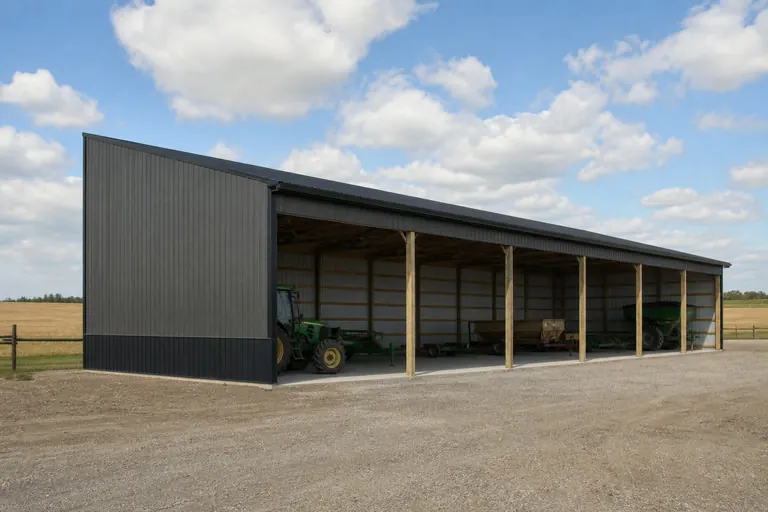 The Consolidated Fleet BayA wide clear-span shed sized for a growing operation's expanding equipment line, reflecting the state's trend toward fewer, larger farms.The Small-Acreage Multi-Use ShedA modest footprint serving the smaller end of Minnesota's farm-size distribution, often mixing equipment storage with hay or general use.
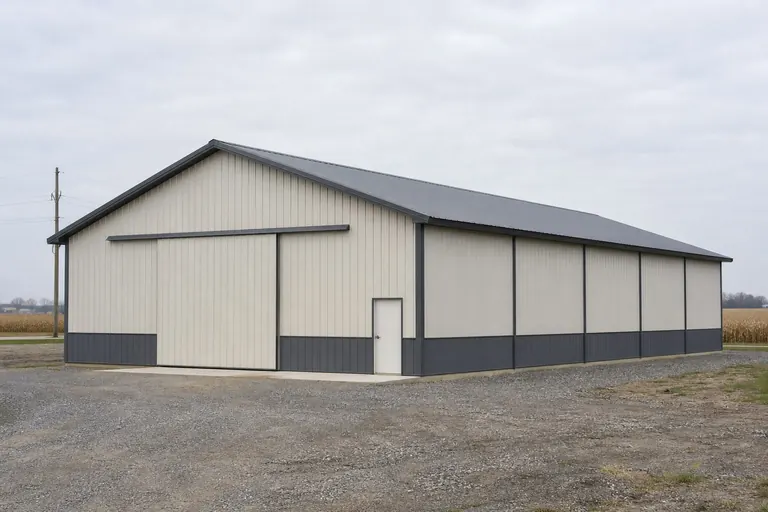 The Cold-Climate Sealed ShedA design emphasizing tighter door seals and roof detailing for buyers in the state's colder northern reaches near the Duluth NWS coverage area.
Example Configuration — for planning purposes only.
Before You Order
A buyer checklist for a Minnesota equipment shed
Because Minnesota's climate and farm scale both vary sharply across the state, a few upfront confirmations prevent costly redesigns.
- Pull the nearest station's climate normal, not a statewide figureReference the NOAA normal or NWS station data closest to your actual parcel rather than a single Minnesota-wide precipitation or snow figure.
- Size for the operation's current scale, not its historical oneIf the farm has grown since the last shed was built, size door width and clear span for today's equipment fleet, not a legacy footprint.
- Confirm design loads with your local building departmentSnow and wind design values are set locally; confirm them with your engineer of record before finalizing steel gauge and bracing.
- Account for site clearing if you're in a forested provinceSites in the Eastern Broadleaf Forest Province may need tree and stump clearing budgeted separately from the shed construction timeline.
Questions
Minnesota Equipment Shed FAQ
Honest answers for Minnesota farm and property storage planning.
No single statewide design figure applies. Confirm your specific snow and wind design values with your local building department or a licensed engineer, since conditions differ sharply between the Twin Cities area and the state's northern reaches.
The NWS Duluth office documents International Falls as routinely among the coldest stations in the contiguous 48 states. We do not convert that into a design value here; ask your engineer to reference the station data closest to your site.
USDA's 2022 Census of Agriculture recorded 65,531 farms, down 5% since 2017, while land in farms rose to 25,442,625 acres, pushing average farm size to 388 acres. Fewer, larger operations is the clear trend.
Permitting is handled locally. Contact your county or township building department to confirm agricultural-exemption status, setbacks and any inspection requirements before finalizing plans.
It can. University of Minnesota soils research documents glacial till, outwash and loess-derived parent materials that vary by county, so foundation and drainage decisions should be based on your specific site's soil rather than a statewide assumption.
Sources for the Minnesota facts on this page
This page states no code requirement, wind speed, snow load, permit rule, price or supplier claim. The state-specific facts it does use are listed with their publisher below.
Minneapolis-St. Paul's 1991-2020 annual normal precipitation is 31.62 inches with 51.2 inches of annual snowfall.
NOAA National Centers for Environmental Information (NCEI) · 1991-2020 · Tier 1
https://www.ncei.noaa.gov/access/services/data/v1?dataset=normals-annualseasonal-1991-2020&stations=USW00014922&format=json&dataTypes=ANN-PRCP-NORMAL,ANN-SNOW-NORMALThe NWS Duluth office's climate reports show International Falls, MN routinely records some of the coldest January temperatures in the contiguous 48 states, based on the 1991-2020 climate normal period and a period of record back to 1895.
National Weather Service (NOAA), Duluth MN office · Period of record 1895-present; normals 1991-2020 · Tier 1
https://www.weather.gov/dlh/threadexMinnesota had 65,531 farms in 2022, a 5% decrease since 2017.
USDA National Agricultural Statistics Service (NASS) · 2022 · Tier 1
https://www.nass.usda.gov/Publications/AgCensus/2022/Online_Resources/County_Profiles/Minnesota/cp99027.pdfMinnesota had 25,442,625 acres of land in farms in 2022, with an average farm size of 388 acres, up 5% since 2017.
USDA NASS · 2022 · Tier 1
https://www.nass.usda.gov/Publications/AgCensus/2022/Online_Resources/County_Profiles/Minnesota/cp99027.pdfOf Minnesota's 2022 farms, 22,948 (about 35%) fall in the 180+ acre size classes, while 4,401 farms (7%) are 1 to 9 acres.
USDA NASS · 2022 · Tier 1
https://www.nass.usda.gov/Publications/AgCensus/2022/Online_Resources/County_Profiles/Minnesota/cp99027.pdfThe Minnesota DNR's Ecological Classification System divides the state into named provinces and sections such as the Eastern Broadleaf Forest Province, the North Central Glaciated Plains Section, and the Blufflands Subsection in the southeast.
Minnesota Department of Natural Resources (DNR) · DNR reference material · Tier 2
https://www.dnr.state.mn.us/ecs/index.html