
Commercial building · FL
Commercial Steel Buildings in Florida
A commercial steel building in Florida is checked against one statewide standard: the Florida Building Commission administers the Florida Building Code across every county. That single-authority baseline is worth knowing, because it is not universal among states. But the same code names a High-Velocity Hurricane Zone limited to Broward and Miami-Dade counties, so a commercial project inside those two counties follows a documentation and product-approval path the rest of the state does not. Add FEMA's National Risk Index, which scores communities across 18 defined hazard types, and a rural land base large enough that the 2022 Census of Agriculture counted 44,703 Florida farms averaging 217 acres each, and the real planning questions for a Florida commercial building are about which documentation track applies and what the specific parcel's ground looks like — not about a single generalized Florida commercial building rule.
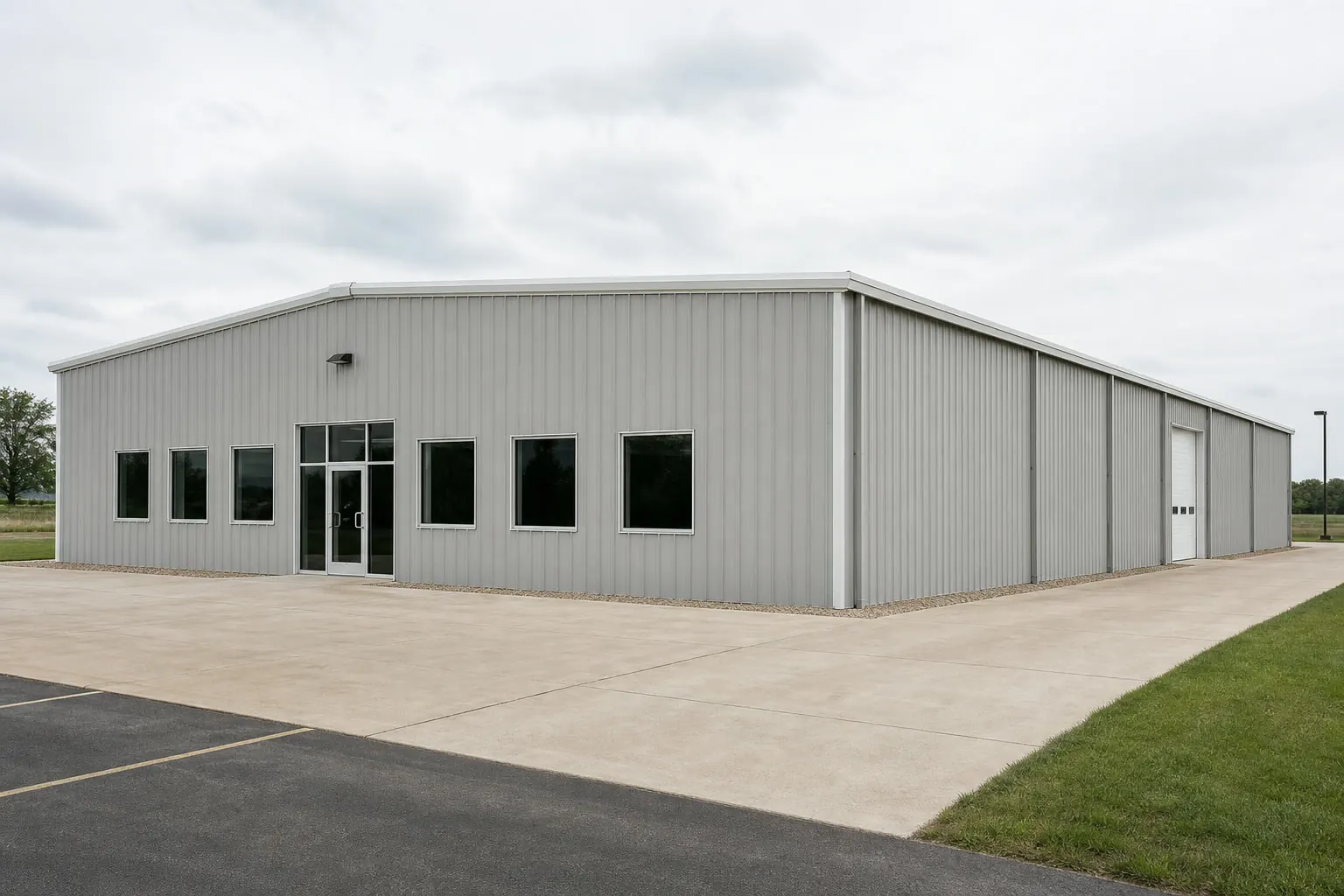
The intersection
One statewide code, but two documentation paths
Florida's single statewide code is a genuine baseline advantage for commercial planning, but it is not the whole story once a parcel sits inside the state's named hurricane zone.
The Florida Building Commission administers the Florida Building Code across all 67 counties, which means a commercial steel building's baseline structural and life-safety framework is consistent no matter where in Florida the project sits. That consistency is worth noting because it is not universal — some states leave code adoption and enforcement to individual cities and counties, which changes the review process from one municipality to the next.
The same statewide code, however, defines a High-Velocity Hurricane Zone consisting specifically of Broward and Miami-Dade counties. A commercial project inside that zone follows a distinct product-approval documentation path that a project in, say, Alachua or Marion County does not. This page does not state what that documentation requires — that is confirmed with the county building department — but knowing the fork exists before you request drawings or window and door specifications saves a redesign cycle.
FEMA's National Risk Index separately scores U.S. communities, including Florida counties, across 18 defined hazard types: hurricane, coastal flooding, inland flooding, wildfire and strong wind among them. Which of those actually drive design decisions on a given commercial parcel is a county-level question, not a statewide one, and it belongs in the same early conversation with your local building department.
Site conditions
Florida's rural land base changes what a commercial building sits on
A meaningful share of Florida commercial steel projects sit on rural, agricultural-adjacent land rather than dense commercial lots, and the ground itself is often low-lying.
USDA's 2022 Census of Agriculture counted 44,703 farms in Florida covering 9,701,400 acres, averaging 217 acres per farm. That scale of open land supports commercial steel uses tied to agriculture and rural logistics — packing, storage, equipment and light processing buildings — that a purely urban commercial reading of Florida would miss.
USGS mapping derived from digital elevation models also shows that large portions of Florida sit on low-lying ground, and the state is underlain by the Floridan aquifer system. Neither fact sets a specific site elevation or drainage requirement here; that is confirmed with your engineer and local building department. It does mean grading and drainage design deserve early attention on a Florida commercial pad, whether the site is rural or closer to a coastal metro. A loading dock or apron pad in particular needs to be graded so vehicle traffic does not compound ponding at the building's lowest wall line, which is a detail worth raising with a civil engineer before slab elevations are locked in.
Configuration
What Florida commercial steel buildings are commonly asked to do
Florida commercial briefs typically pair a working or storage bay with a smaller finished front, and rural-scale projects add agricultural and logistics use cases to that mix.
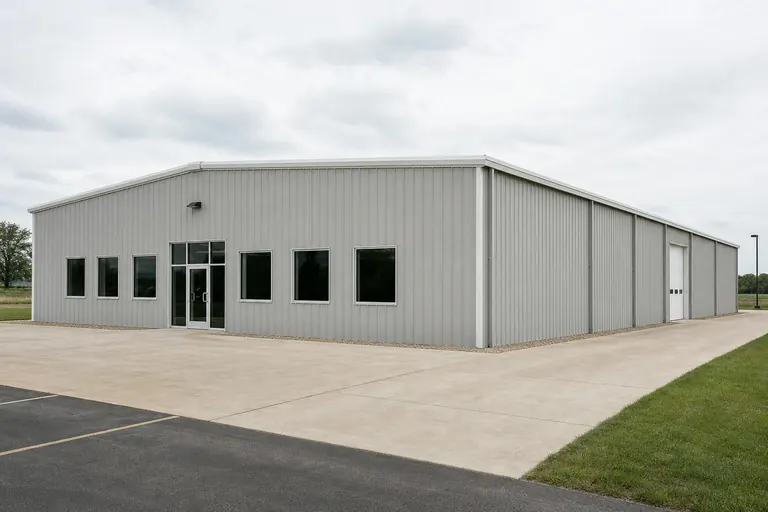 Warehouse or light industrialA clear-span working bay with loading access; door height and dock layout are worth fixing before floor plan design.Retail or showroom frontA finished, glazed front section attached to a simpler working bay; the transition wall is where most re-scoping happens.Rural or agricultural-adjacent storageOn Florida's larger farm parcels, a commercial-grade steel building often serves equipment, packing or bulk storage rather than a retail function.
Example Configuration — for planning purposes only.
Get Florida commercial building quotes
Tell us your county, HVHZ status if known, and your intended use split. We route it with the Florida and commercial context already attached.
Footprint
Sizes that suit common Florida commercial briefs
Commercial footprints vary widely by use; these ranges are a starting point before a site-specific plan is drawn.
40′ × 60′
2,400 sq ft
A common starting point for a single working bay with a small office corner.
60′ × 100′
6,000 sq ft
Room for a working bay plus a genuine retail or showroom front.
80′ × 150′
12,000 sq ft
Where loading access and multiple bays start to matter, including rural storage and packing uses.
Example Configuration — for planning purposes only.
Footprint pages carry layout and door detail; this page explains why Florida briefs land in this range.
Preparation
Before you request a Florida commercial quote
Four things resolved in advance make the difference between a comparable quote and a re-quote.
- Confirm whether your parcel is inside the HVHZBroward and Miami-Dade have a distinct product-approval documentation path; ask your county building department which path applies.
- Ask which of FEMA's 18 hazard types your county flagsHurricane, flooding and wind exposure vary by county even under one statewide code.
- Describe your site's scale and ground conditionsA rural parcel with drainage needs and an urban infill lot call for different site engineering.
- Fix the working-bay-to-office or storage ratioThis ratio drives more quote variance than square footage alone.
- Ask how loading apron grading ties into your drainage planVehicle traffic areas can concentrate runoff at a building's low wall line if grading is not planned alongside the pad design.
- Confirm dock-door count against your loading scheduleUnder-sizing dock access is a common source of a mid-build change order.
Questions
Florida commercial steel building questions
Questions we can answer honestly at state level, with the rest routed to whoever actually owns them.
Yes. The Florida Building Commission administers the Florida Building Code across the whole state, which gives commercial projects a consistent statewide baseline.
If your parcel is in Broward or Miami-Dade county, it sits inside the code-defined HVHZ and follows a distinct product-approval documentation path. Confirm specifics with the county building department.
There is no official typical size; use varies too widely. Most enquiries fall between 40x60 and 80x150 depending on whether the building is a single working bay, includes office or retail space, or serves rural storage.
We do not publish state-level prices, because the number depends on specification, HVHZ documentation where applicable, site work and material pricing. Our cost pages cover what drives the number.
It can. With 44,703 farms averaging 217 acres per the 2022 Census of Agriculture, many Florida commercial steel projects serve agricultural or logistics uses on larger parcels rather than dense commercial lots, which changes site access and grading planning.
Sources for the Florida facts on this page
This page states no code requirement, wind speed, snow load, permit rule, price or supplier claim. The state-specific facts it does use are listed with their publisher below.
The Florida Building Commission administers the Florida Building Code statewide.
Florida Building Commission · 8th Edition (2023), effective Dec 31, 2023 · Tier 2
https://www.floridabuilding.org/The Florida Building Code defines a High-Velocity Hurricane Zone (HVHZ) consisting of Broward and Miami-Dade counties.
Florida Building Commission (via UpCodes republication) · 2023 FBC, 8th edition · Tier 3
https://up.codes/d/high-velocity-hurricane-zone-hvhzFEMA's National Risk Index scores U.S. communities, including Florida counties, across 18 defined natural hazard types.
FEMA · current dataset · Tier 1
https://www.fema.gov/about/openfema/data-sets/national-risk-index-dataFlorida had 44,703 farms in 2022 per the USDA Census of Agriculture.
USDA National Agricultural Statistics Service (NASS) · 2022 · Tier 1
https://www.nass.usda.gov/Publications/AgCensus/2022/Full_Report/Volume_1,_Chapter_1_State_Level/Florida/Land in farms in Florida totaled 9,701,400 acres in 2022.
USDA NASS · 2022 · Tier 1
https://www.nass.usda.gov/Publications/AgCensus/2022/Full_Report/Volume_1,_Chapter_1_State_Level/Florida/USGS mapping highlights that large portions of Florida are low-lying, derived from USGS digital elevation models.
U.S. Geological Survey · n/a (map publication) · Tier 2
https://pubs.usgs.gov/sim/3047/