
Carport · NE
Carports in Nebraska
A carport in Nebraska has to answer for two things a homeowner in a calmer climate rarely thinks about: shedding a meaningful snow load off an open-frame roof, and standing up to wind exposure on a flat or gently rolling site with few windbreaks. Whether it's going up on a farmstead next to an existing pole barn or on a residential lot at the edge of an eastern Nebraska town, the structural conversation starts with the state's own climate and hazard data rather than a generic carport spec.
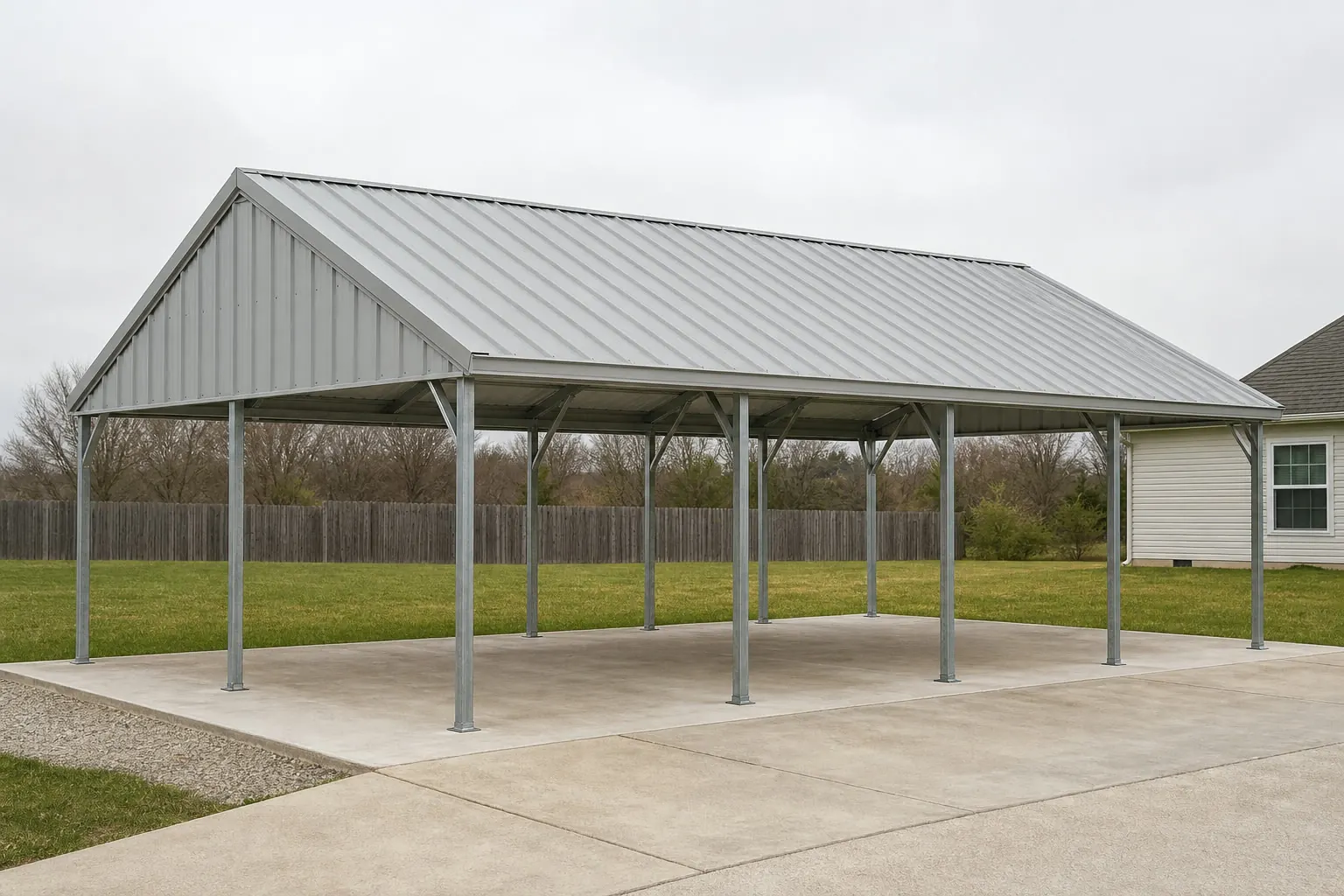
Climate
Designing an open roof for Nebraska's snow and rain
An open-frame carport in Nebraska needs to shed both winter snow and substantial seasonal rainfall, and the available benchmark data is strongest for the Omaha area.
The Omaha Eppley Airfield station's 1991-2020 normal reports 27.1 inches of annual snowfall alongside 31.86 inches of precipitation, the only complete Tier 1 dataset of its kind available for Nebraska. For a carport, which typically has a simpler, more exposed roof structure than an enclosed building, that snowfall figure matters directly: panel gauge, purlin spacing and roof pitch all need to be specified against an actual local snow load rather than an assumed mild-climate default. If your site is outside the Omaha area, particularly toward the Panhandle or the Sand Hills, ask your local building department or a licensed engineer for the applicable figure rather than assuming the Omaha normal transfers directly.
The precipitation side of that data point matters too. At nearly 32 inches a year, sustained rain events are common enough that a carport's roof panel overlap and end-cap sealing need real attention, especially where the structure sits close to a driveway or a residential entry where standing water or ice buildup at the drip edge becomes a daily nuisance rather than a rare event.
Because Nebraska's climate data outside Omaha is thinner in Tier 1 and Tier 2 sourcing, this guide does not extend the Omaha figures to the whole state. A carport buyer in a different county should treat the Omaha numbers as a reference point for how substantial Nebraska winters and rain seasons can be, and get their own site-specific figure before finalizing structural specifications.
Wind & Anchoring
Open terrain means anchoring is not optional
Nebraska's largely open landscape across its 77,358 square miles means a carport's anchoring system deserves real attention regardless of which county it's in.
An open-frame carport behaves differently in wind than an enclosed pole barn or garage: without walls to block airflow, the roof structure can experience significant uplift, and Nebraska's flat-to-rolling terrain across much of the state offers fewer natural windbreaks than a heavily wooded or mountainous state would. This guide does not assign a specific design wind speed, since that figure is set by your local building department or a licensed engineer for your exact site, but it's worth flagging that an anchoring detail adequate for a sheltered suburban lot elsewhere may be undersized for an exposed rural Nebraska parcel.
FEMA's National Risk Index gives Nebraska's 93 counties a mean composite hazard score of 25.8 out of 100, with Douglas County, home to Omaha, ranked the state's highest-risk county. That composite score blends multiple hazard categories rather than isolating wind specifically, so it's a starting prompt to pull your own county's detailed FEMA report rather than a finished answer about how much anchoring your carport needs.
Ground-anchor selection, whether ballasted, concrete-embedded posts, or mechanical ground anchors, should be confirmed against your soil type and site exposure with whoever is engineering the structure. A carport at the open edge of a farmstead faces different wind loading than one tucked beside an existing building, even within the same county.
Configuration
Common Nebraska carport configurations
Rural acreage layouts and residential edge-of-town lots both show up regularly in Nebraska carport planning.
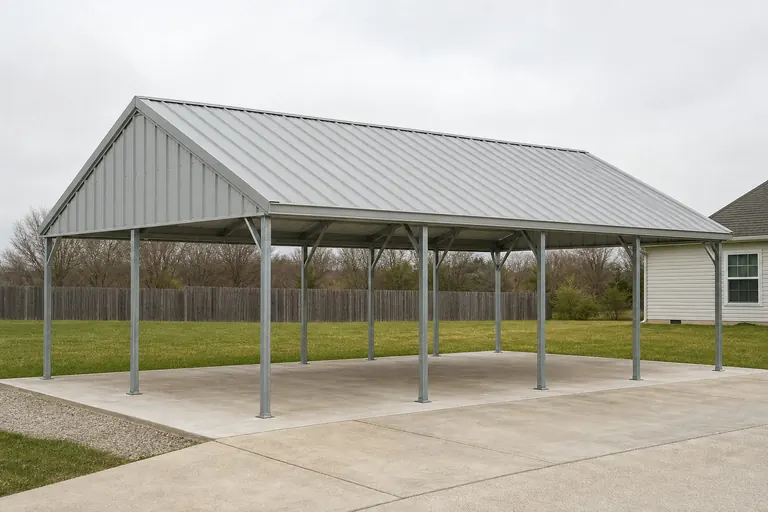 The Farmstead Vehicle BayA carport sited alongside an existing pole barn or shop building, sized for a truck and a second vehicle or light equipment.The Residential Driveway CarportA smaller footprint attached or adjacent to a home on an edge-of-town or acreage lot, prioritizing quick vehicle protection over storage depth.The Open-Site Equipment CoverA wider carport used to shelter equipment or trailers on an exposed rural parcel, where anchoring detail matters more than on a sheltered lot.
Example Configuration — for planning purposes only.
Start Your Nebraska Carport
Connect with builders who understand Nebraska's snow, wind and site-exposure conditions.
Footprints
Carport footprints common in Nebraska
Sizing generally follows whether the carport is covering one vehicle, two, or equipment alongside a farmstead.
12′ × 24′
288 sq ft
A single-vehicle footprint suited to a residential driveway or a smaller acreage lot.
20′ × 24′
480 sq ft
A two-vehicle footprint common for households wanting side-by-side covered parking.
24′ × 36′
864 sq ft
A wider footprint often used for a truck plus equipment or a small trailer on a farmstead or rural acreage.
Example Configuration — for planning purposes only.
Confirm anchoring requirements and any local permit threshold with your county or city building department before finalizing footprint and post spacing.
Before You Order
A decision checklist for a Nebraska carport
A few confirmations up front reduce the odds of a carport that's undersized for local conditions.
- Get a site-specific snow load if you're outside OmahaThe 27.1-inch snowfall normal is specific to the Omaha Eppley Airfield station; other counties need their own figure from a licensed engineer or building department.
- Confirm the anchoring system with your site's exposure in mindAn open rural parcel with few windbreaks needs anchoring attention that a sheltered suburban lot elsewhere might not.
- Pull your county's FEMA hazard reportThe statewide 25.8 mean composite score hides real county-to-county differences; check your own county's specific figures.
- Ask your local building department about permit thresholdsWhether a standalone carport needs a permit is set locally and can differ from the threshold for an enclosed structure or full housing unit.
Questions
Nebraska Carport FAQ
Straight answers for planning a carport in Nebraska.
The only complete Tier 1 snowfall normal available is for the Omaha Eppley Airfield station at 27.1 inches annually. If your site is elsewhere in the state, get a figure specific to your county from a licensed engineer or local building department.
Open-frame carports on exposed rural sites with few natural windbreaks generally need more attention to anchoring than a sheltered suburban lot. Your engineer or installer should size the anchoring system to your specific site exposure.
FEMA's National Risk Index gives Nebraska's 93 counties a mean composite score of 25.8 out of 100, with Douglas County ranked highest. Check your specific county's report through FEMA's tool rather than relying on the statewide average.
That depends on your local jurisdiction; permit thresholds for a standalone open-frame carport are set by the county or city building department and can differ from what applies to an enclosed structure.
The Omaha station's 31.86-inch annual precipitation normal means a carport roof needs solid panel overlap and end-cap sealing to handle sustained rain events, not just occasional snow melt.
Sources for the Nebraska facts on this page
This page states no code requirement, wind speed, snow load, permit rule, price or supplier claim. The state-specific facts it does use are listed with their publisher below.
The Omaha Eppley Airfield station's 1991-2020 annual normal precipitation is 31.86 inches with 27.1 inches of annual snowfall.
NOAA National Centers for Environmental Information (NCEI) · 1991-2020 · Tier 1
https://www.ncei.noaa.gov/access/services/data/v1?dataset=normals-annualseasonal-1991-2020&stations=USW00014942&format=json&dataTypes=ANN-PRCP-NORMAL,ANN-SNOW-NORMALThe Omaha Eppley Airfield station's 1991-2020 annual normal precipitation is 31.86 inches with 27.1 inches of annual snowfall.
NOAA National Centers for Environmental Information (NCEI) · 1991-2020 · Tier 1
https://www.ncei.noaa.gov/access/services/data/v1?dataset=normals-annualseasonal-1991-2020&stations=USW00014942&format=json&dataTypes=ANN-PRCP-NORMAL,ANN-SNOW-NORMALFEMA's National Risk Index reports Nebraska's 93 counties with a mean composite NRI risk score of 25.8 on FEMA's 0-100 relative scale (v1.20 release), with Douglas County (Omaha) ranked the state's highest-risk county.
Federal Emergency Management Agency (FEMA) · NRI v1.20 dataset · Tier 1
https://www.fema.gov/flood-maps/products-tools/national-risk-indexBuilding permit offices in Nebraska authorized construction of 8,877 new privately-owned housing units in 2023 (4,666 single-family buildings plus multi-unit structures).
U.S. Census Bureau · 2023 (final annual) · Tier 1
https://www2.census.gov/econ/bps/State/st2023a.txtNebraska's official Legislative Blue Book reports the state's total area (land and water) as 77,358 square miles, ranking it 16th among states in total area and 15th in land area alone.
Nebraska Legislature · Nebraska Blue Book reference edition · Tier 2
https://nebraskalegislature.gov/pdf/bluebook/25-37.pdf