
Barndominium · ND
Barndominiums in North Dakota
A North Dakota barndominium has to satisfy two things pulling in different directions. NOAA's State Climate Summary reports the state's average temperature has risen more than 2.6°F since the beginning of the 20th century, warming fastest in winter, so the deep-cold design case is real but shifting rather than static. Meanwhile USDA's 2022 Census of Agriculture puts North Dakota's average farm at 1,537 acres, among the largest in the country, which means the shop half is usually built to hold full-scale equipment rather than a couple of trucks. The project also lands in a construction market that cooled from 3,440 authorized housing units in 2022 to 2,618 in 2023, a 23.9% decline.
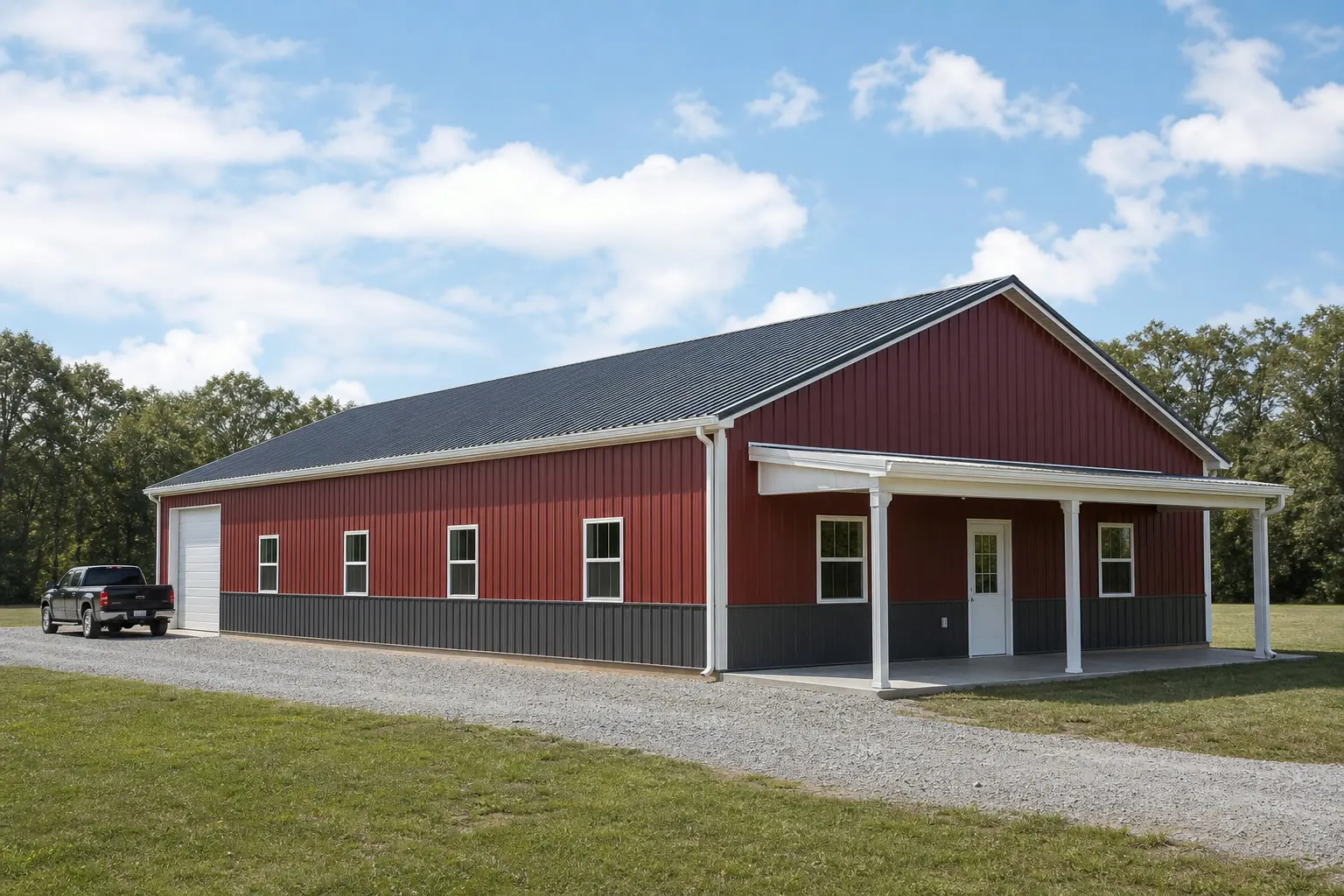
A Warming Winter, a Very Large Working Farm
North Dakota's barndominium buyer is usually planning around two facts at once. NOAA's State Climate Summary reports the state's average temperature has risen more than 2.6°F since the early 1900s, warming fastest in winter, which is changing — not eliminating — the deep-cold design case the living half of the building has to handle. At the same time, USDA's 2022 Census of Agriculture puts the state's average farm at 1,537 acres, one of the largest in the country, which is what usually sets the size and specification of the shop half. Neither fact tells you a design number; both tell you what to plan around before drawing a floor plan.
Envelope
Designing for a cold climate that is shifting, not static
A living envelope built only for North Dakota's historical deep-cold pattern misses a documented trend: winters are warming faster than the rest of the year.
NOAA's State Climate Summary for North Dakota reports statewide average temperatures have risen more than 2.6°F since the beginning of the 20th century, at a rate of roughly 0.2°F per decade, with the warming most evident in winter. That does not mean the deep-cold case has gone away — it means the freeze-thaw cycle is shifting, with more crossings of the freezing point than a purely historical design assumption would predict. For the barndominium's living half, that argues for continuous insulation, careful air sealing at the frame, and a mechanical ventilation plan that handles moisture from a tighter envelope, treated as core scope rather than an upgrade.
University of North Dakota graduate research has specifically studied soil frost depth climatology at Fargo, which is a useful reminder that frost behaviour is a documented, real local condition in this state even though this page does not state a design frost depth. That number belongs to your county building official, who will apply current local requirements to your specific parcel and foundation design — not to a statewide guide.
Design
Sizing the Shop From a 1,537-Acre Baseline
North Dakota's average farm size means the shop half is usually the larger design driver, and it deserves to be sized first.
- List every implement before drawing the houseAt an average operation of 1,537 acres, USDA figures suggest grain and row-crop equipment that needs real clear height and door width; establish those dimensions before the residential layout is fixed.
- Treat the shared wall as an exterior wallThe shop side will run colder and see more equipment traffic; insulating and air-sealing that wall as if it faces outdoors protects the living side's comfort and moisture control.
- Plan grain dust, fuel and combustion-air handlingA shop attached to living space needs ventilation and detection designed in from the start, not retrofitted after move-in.
- Confirm dwelling classification with the countyHow a North Dakota county treats a residence attached to an agricultural-style structure can affect inspections and financing; ask before design begins.
- Get a site-specific frost and drainage readFrost depth research exists for Fargo specifically; your own site's frost and drainage behaviour should come from your county building official, not an assumed statewide figure.
Get North Dakota barndominium quotes
Tell suppliers your region of the state, the equipment the shop half must hold and your target living-space finish level. We route it with the North Dakota and barndominium context already attached.
Site context
North Dakota's four physiographic regions and what they mean on site
NDSU Extension divides North Dakota into four named physiographic regions, and the differences between them show up in grading, drainage and access before the building ever goes up.
Red River Valley
Flat, historically lake-bed terrain in the east. Level ground generally simplifies pad preparation, but flat sites can also concentrate drainage problems that are worth resolving with a site contractor before the slab is poured.
Glaciated Plains
Rolling, glacially shaped terrain across much of central and eastern North Dakota, with more natural variation in grade than the Red River Valley.
Missouri Coteau
A hummocky, pothole-dotted landscape where drainage patterns can be genuinely local; confirming how water moves across a specific parcel is worth doing before fixing the building's footprint or driveway.
Great Plains (southwest)
NDSU Extension describes this portion sloping gently upward toward the Rocky Mountains, with hilly to gently rolling terrain and occasional buttes, which can mean more site grading than the state's flatter regions.
Footprint
Footprints that suit a North Dakota working-farm brief
Shop scale, driven by North Dakota's large average farm size, is usually the variable that sets the overall footprint.
40′ × 60′
2,400 sq ft
A compact shop-house pairing where the equipment list is modest relative to the state's average.
40′ × 80′
3,200 sq ft
A common North Dakota balance: full living quarters at one end, a real equipment bay at the other.
60′ × 100′
6,000 sq ft
Where full-scale grain or row-crop equipment needs to fit indoors alongside a complete residence.
Example Configuration — for planning purposes only.
Establish shop door and eave dimensions from your actual equipment before the overall footprint is fixed.
Construction market
Scheduling into a cooling permit market
The Census Bureau recorded North Dakota's authorized housing units falling from 3,440 in 2022 to 2,618 in 2023, a 23.9% decline.
That figure describes the statewide residential permitting trend, not a barndominium-specific number or a price signal. What it reasonably argues for is booking a builder's schedule earlier than you might have a couple of years ago, and confirming directly whether the same crew handles both the steel shell and the residential finish work, since a thinner market can mean those are two separately scheduled trades.
Questions
North Dakota barndominium questions
Honest state-level answers, with anything jurisdiction- or lender-specific routed to who actually owns it.
Not exactly. NOAA's State Climate Summary reports the state has warmed more than 2.6°F since the early 1900s, warming fastest in winter, which shifts the freeze-thaw pattern rather than removing deep cold as a design case. Continuous insulation, air sealing and ventilation remain core scope for the living half.
Size it from your actual equipment list. USDA's 2022 Census of Agriculture puts North Dakota's average farm at 1,537 acres, one of the largest in the country, so many shops need to hold full-scale grain or row-crop equipment rather than personal vehicles.
Yes, for site work. NDSU Extension names four physiographic regions — the Red River Valley, Glaciated Plains, Missouri Coteau and the southwestern Great Plains — with real differences in terrain and drainage that affect grading and foundation planning.
We do not state one. University of North Dakota research has specifically studied frost depth climatology at Fargo, which confirms it is a real, documented local condition, but a design figure for your parcel should come from your county building official.
Plan for a cooling market. The Census Bureau recorded a 23.9% drop in authorized housing units from 2022 to 2023, so booking early and asking directly about current lead times is a reasonable precaution.
Sources for the North Dakota facts on this page
This page states no code requirement, wind speed, snow load, permit rule, price or supplier claim. The state-specific facts it does use are listed with their publisher below.
NOAA's State Climate Summary for North Dakota reports statewide average temperatures have risen more than 2.6°F since the beginning of the 20th century, at a rate of about 0.2°F per decade, with warming most evident in winter.
NOAA National Centers for Environmental Information (NCEI) · 2022 summary · Tier 1
https://statesummaries.ncics.org/downloads/NorthDakota-StateClimateSummary2022.pdfNOAA NCEI publishes a narrative 'Climate of North Dakota' describing the state's continental climate with cold winters and warm summers, and significant year-to-year variability.
NOAA National Centers for Environmental Information (NCEI) · Historical narrative (NCEI climate normals series) · Tier 1
https://www.ncei.noaa.gov/data/climate-normals-deprecated/access/clim60/states/Clim_ND_01.pdfNorth Dakota had 38,537,022 acres of land in farms in 2022, an average farm size of 1,537 acres — among the largest average farm sizes of any US state.
USDA NASS · 2022 · Tier 1
https://www.nass.usda.gov/Publications/AgCensus/2022/Online_Resources/County_Profiles/North_Dakota/cp99038.pdfNorth Dakota had 25,068 farms in 2022, down 5% since 2017.
USDA National Agricultural Statistics Service (NASS) · 2022 · Tier 1
https://www.nass.usda.gov/Publications/AgCensus/2022/Online_Resources/County_Profiles/North_Dakota/cp99038.pdfNorth Dakota's statewide total of privately-owned housing units authorized by building permits fell from 3,440 in 2022 to 2,618 in 2023, a decrease of 23.9%.
U.S. Census Bureau · 2023 (with 2022 comparison) · Tier 1
https://www.census.gov/construction/bps/pdf/2023annualhighlights.pdfNorth Dakota State University Extension describes the state as subdivided into four main physiographic regions: the Great Plains, the Missouri Coteau, the Glaciated Plains, and the Red River Valley, with southwestern North Dakota's Great Plains portion sloping gently upward toward the Rocky Mountains and marked by hilly to gently rolling terrain with occasional buttes.
North Dakota State University Extension · NDSU Extension reference document · Tier 2
https://www.ndsu.edu/agriculture/sites/default/files/2025-05/ndclimate.pdfUniversity of North Dakota graduate research has specifically studied soil frost depth climatology at Fargo, North Dakota, reflecting the region's seasonal freeze-thaw cycle as a documented local condition.
University of North Dakota Scholarly Commons · Study period 1981-2001 · Tier 3
https://commons.und.edu/cgi/viewcontent.cgi?article=13549&context=theses