
Steel home · AL
Steel Homes in Alabama
A wood-framed house built in Alabama spends its whole life defending against two things a steel-framed one does not: termites and rot, both fed by the Gulf-influenced humidity NOAA describes as part of Alabama's humid subtropical climate. That baseline case for steel gets more specific once you add where the home actually sits. The Alabama Cooperative Extension System maps seven distinct soil areas statewide, from Black Belt clay to Coastal Plain sand, and with 37,362 farms averaging 231 acres as of 2022, many Alabama landowners have enough acreage to pair a steel-framed residence with an attached shop or barn under one roofline. The state authorized 20,337 new housing units in 2023, up 4.3% from the year before, so a steel home applicant is entering a permitting system that reviews custom residential plans routinely, not as a novelty.
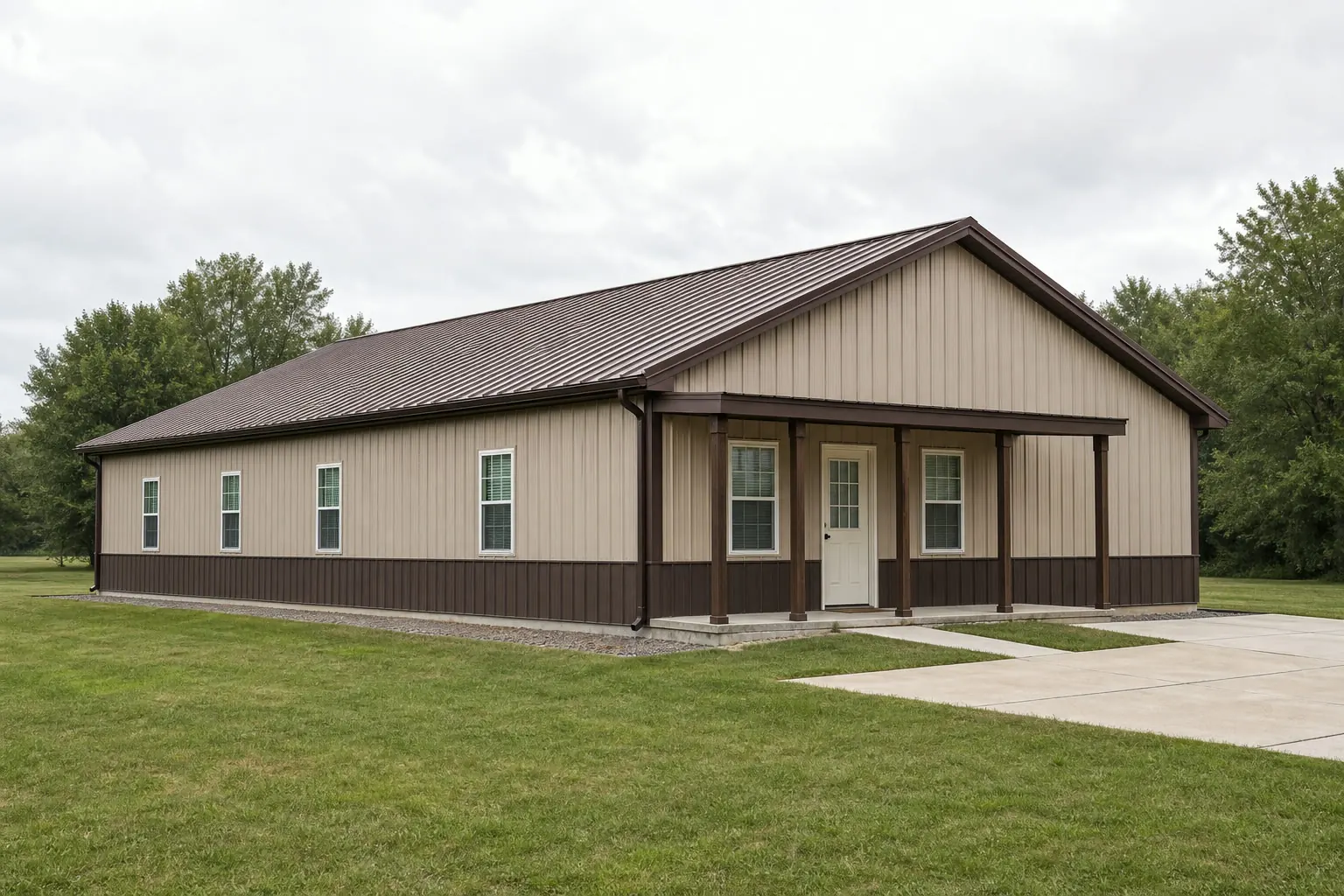
The Case for Steel
Termites, humidity, and why Alabama homeowners look at steel
Before soil or permitting enters the conversation, Alabama's climate itself makes a case for steel framing that a drier, cooler state simply doesn't have to make.
Subterranean termites are active across the entire Southeast, and Alabama's warm, humid conditions keep them feeding on structural wood for most of the year rather than only in a short summer window. A steel frame doesn't give termites anything to eat, which removes an entire category of long-term maintenance risk that a wood-framed Alabama house has to actively manage with treatment and inspection.
NOAA's narrative description of Alabama's climate as humid subtropical, with hot, humid, Gulf-influenced summers, points to the same conclusion from a different angle: sustained moisture is hard on wood framing and wood rot follows termite damage as a second, related risk. Neither issue disappears with steel, but the frame itself stops contributing to it.
None of that changes what a steel home costs or how fast it goes up; those questions belong with a local builder. What it does change is the baseline reason an Alabama buyer considers steel in the first place, before soil type or lot size ever come up.
That baseline reason also holds up better over time than a one-time treatment does. Termiticide barriers and periodic wood-rot repairs are recurring costs on a wood-framed Alabama house; a steel frame simply removes the recurring line item rather than deferring it, which is why the pest argument tends to matter more to long-term owners than to a buyer comparing only day-one construction costs.
Regional Comparison
Black Belt vs. Coastal Plain: what changes in a steel home brief
Once pest and humidity reasoning is settled, the next question is where in Alabama the home actually sits, since the same steel shell resolves into two different foundation specs.
| Consideration | Black Belt Prairie | Coastal Plain |
|---|---|---|
| Primary soil challenge | Dense clay with seasonal shrink-swell | Sandy soil with fast drainage but poor water resistance |
| Foundation approach | Reinforced slab with thickened edge | Graded, elevated slab with strong perimeter drainage |
| Insulation focus | Standard humid-climate vapor control | Heightened condensation control given wetter conditions |
| Site prep intensity | Moderate, focused on soil movement | Moderate, focused on grading and drainage |
Primary soil challenge
- Black Belt Prairie
- Dense clay with seasonal shrink-swell
- Coastal Plain
- Sandy soil with fast drainage but poor water resistance
Foundation approach
- Black Belt Prairie
- Reinforced slab with thickened edge
- Coastal Plain
- Graded, elevated slab with strong perimeter drainage
Insulation focus
- Black Belt Prairie
- Standard humid-climate vapor control
- Coastal Plain
- Heightened condensation control given wetter conditions
Site prep intensity
- Black Belt Prairie
- Moderate, focused on soil movement
- Coastal Plain
- Moderate, focused on grading and drainage
Regional Design
Alabama's soil areas, region by region
The Alabama Cooperative Extension System's seven mapped soil areas turn the table above into a statewide picture.
Black Belt Prairie (Central Alabama)
Dense, dark clay spanning roughly 12 to 21 central counties shrinks and swells seasonally, so foundation engineering should plan for that movement rather than assume a fixed base.
Coastal Plain (South Alabama)
One of Alabama's largest mapped soil areas. Sandy soils drain well but call for careful grading and drainage planning given sustained humid-season rainfall.
Limestone Valleys, Uplands & Piedmont Plateau (North & East Alabama)
More varied, rockier terrain in these mapped soil areas pushes the priority toward a site-specific foundation evaluation rather than a one-size approach.
Plan your Alabama steel home
Connect with residential steel specialists who can design a home for your specific Alabama soil area and climate.
Performance
The thermal break carries the humidity argument through the wall
A steel frame that isn't detailed correctly can turn into exactly the moisture problem it was chosen to avoid.
A properly insulated steel home performs as well as, or better than, a comparable wood-frame house, but only if the frame is separated from both exterior siding and interior drywall by a continuous layer of insulation. Skip that thermal break and Alabama's humid outdoor air condenses on the cooler steel wherever it touches drywall directly, which is a worse outcome than the pest and rot risk steel was chosen to avoid in the first place.
Closed-cell spray foam is the common answer because it delivers a high R-value while doubling as a vapor barrier, cutting condensation risk at the point where warm, humid Gulf air meets the steel frame.
- Closed-Cell Spray Foam
- Manages both heat and Alabama's year-round humidity in one material.
- Vapor Barrier Slabs
- Keeps ground moisture out of the living space, particularly on Coastal Plain sites.
- Soil-Area-Specific Foundation Design
- Adjusted for Black Belt clay movement, Coastal Plain drainage, or northern Alabama's rockier terrain.
Planning Ahead
Acreage and backup power: two Alabama-specific planning items
Two practical items come up disproportionately often for Alabama steel-home buyers, for reasons the state's own farm data and hazard exposure explain.
- Decide the shop-to-home footprint split earlyAmong Alabama's 37,362 farms averaging 231 acres, pairing a residence with an attached shop or barn is common enough that settling the split before floor plans are drawn avoids a costly redesign.
- Raise backup power with your electrical contractor at design stageFEMA's National Risk Index scores Alabama counties across 18 hazard types, and for most homeowners the real consequence of severe weather is a multi-day power outage rather than structural damage; a tight steel envelope holds comfortable temperatures longer without AC, which changes how long backup power needs to last.
- Confirm permit expectations with your local departmentWith 20,337 housing units authorized statewide in 2023, most Alabama building departments are practiced at reviewing custom residential plans, including non-traditional framing, so ask early rather than assume added scrutiny.
Questions
Alabama Steel Home FAQ
Addressing common questions for prospective metal home owners in Alabama.
Alabama's warm, humid subtropical climate keeps termites active for most of the year and encourages wood rot; a steel frame removes both risks at the structural level, which is a bigger factor in Alabama than in a drier or colder state.
Yes. Many owners among Alabama's 37,362 farms choose steel homes because they can be integrated with an attached shop or barn, commonly known as a barndominium layout.
Yes. The Alabama Cooperative Extension System maps seven soil areas statewide; Black Belt clay generally needs a reinforced slab, while Coastal Plain sand needs elevated siting and stronger drainage grading. A local soil check confirms which applies to your lot.
A continuous thermal break and closed-cell spray foam insulation are the standard approach to prevent interior condensation, given NOAA's description of Alabama's humid subtropical climate and hot, humid summers.
We don't provide specific pricing, but steel homes often offer long-term savings through reduced pest and moisture-related maintenance. Confirm current cost comparisons with a local builder for your specific plan and soil area.
It is generally treated the same as a standard custom home permit. Alabama's building departments processed 20,337 new housing unit authorizations in 2023, so most local offices are practiced at residential review, including non-traditional framing methods.
Sources for the Alabama facts on this page
This page states no code requirement, wind speed, snow load, permit rule, price or supplier claim. The state-specific facts it does use are listed with their publisher below.
NOAA NCEI publishes a narrative 'Climate of Alabama' describing the state's humid subtropical climate with mild winters and hot, humid summers, and Gulf-influenced precipitation.
NOAA National Centers for Environmental Information (NCEI) · Historical narrative (NCEI climate normals series) · Tier 1
https://www.ncei.noaa.gov/data/climate-normals-deprecated/access/clim60/states/Clim_AL_01.pdfThe Alabama Cooperative Extension System identifies seven major soil areas across the state, including the Limestone Valleys and Uplands, Blackland Prairie, Coastal Plain, Major Flood Plains and Terraces, Coastal Marshes and Beaches, Appalachian Plateau, and Piedmont Plateau, based on an NRCS soil-area map.
Alabama Cooperative Extension System (Auburn University) · ACES reference publication · Tier 2
https://www.aces.edu/blog/topics/crop-production/major-soil-areas-of-alabama/The Alabama Black Belt, named for its dark, rich prairie soils, spans roughly 12 to 21 counties across the central part of the state depending on the criteria used to define it.
Encyclopedia of Alabama (Auburn University / Alabama Humanities Alliance) · Reference article · Tier 2
https://encyclopediaofalabama.org/article/black-belt-region-in-alabama/Alabama had 37,362 farms in 2022, down 8% from 2017.
USDA National Agricultural Statistics Service (NASS) · 2022 · Tier 1
https://www.nass.usda.gov/Publications/AgCensus/2022/Online_Resources/County_Profiles/Alabama/cp99001.pdfAlabama had 8,629,101 acres of land in farms in 2022, an average farm size of 231 acres, up 9% from 2017.
USDA NASS · 2022 · Tier 1
https://www.nass.usda.gov/Publications/AgCensus/2022/Online_Resources/County_Profiles/Alabama/cp99001.pdfAlabama had 20,337 total housing units authorized by building permits in 2023, up 4.3% from 19,499 in 2022.
U.S. Census Bureau · 2023 (annual) · Tier 1
https://www.census.gov/construction/bps/pdf/2023annualhighlights.pdfFEMA's National Risk Index is an interactive county/tract-level tool covering 18 natural hazards, including hurricane, tornado, flooding, and wildfire, that can be queried for Alabama counties such as Mobile and Jefferson.
Federal Emergency Management Agency (FEMA) · Current NRI release · Tier 1
https://www.fema.gov/flood-maps/products-tools/national-risk-index