
Shouse · MT
Steel Shouses in Montana
A shouse in Montana — a residence and a shop combined under one roof — is usually sited on land that is bigger, and less densely served, than the term 'rural parcel' suggests elsewhere. USDA's 2022 Census of Agriculture puts the state's average farm at 2,374 acres, calculated from 57,601,320 acres spread across 24,266 farms, the largest average size among the states in this evidence pack, even as that farm count fell 10% since 2017. That scale changes what a shouse buyer plans for: longer access drives, a bigger role for on-site utility infrastructure, and a genuine choice about where on a large parcel the living-and-shop building actually sits. Layer on a construction market where the U.S. Census Bureau recorded a 33.3% drop in authorized housing units between 2022 and 2023, and the practical Montana shouse conversation is as much about sequencing and contractor availability as it is about the building itself.
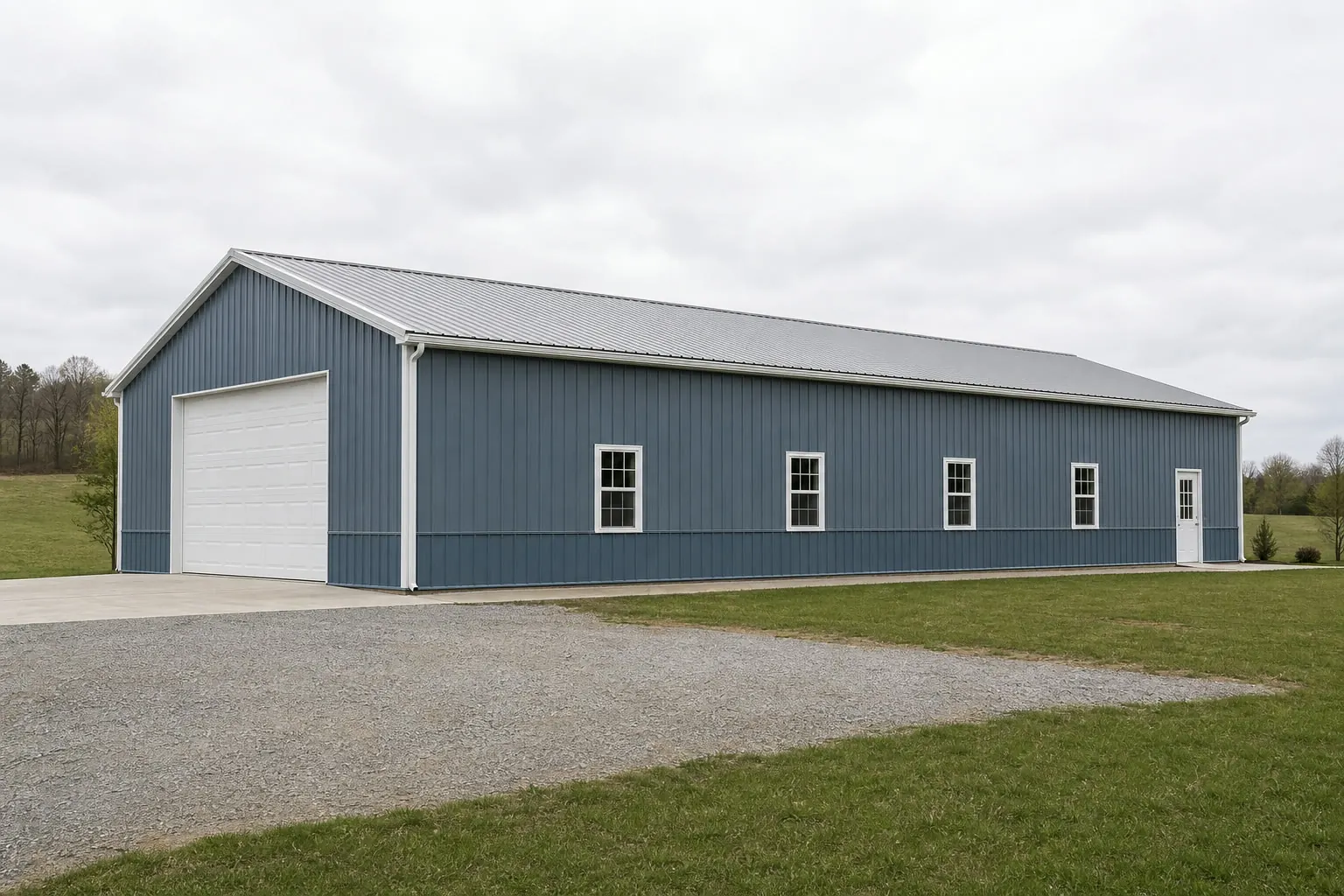
In Montana, Parcel Scale Sets the Shouse Site Plan
A shouse assumes a residence and a shop can share one building, and in Montana that pairing usually lands on a much bigger property than the phrase 'rural lot' implies elsewhere. USDA's 2022 Census of Agriculture puts Montana's average farm at 2,374 acres — calculated from 57,601,320 acres spread across 24,266 farms — the largest average size among the states covered in this evidence pack, even as that farm count dropped 10% since 2017. On acreage that size, where the shouse sits on the parcel, how far utilities have to travel, and how the access drive is routed become real design decisions rather than afterthoughts.
Site Logic
Placing a Shouse on an Oversized Parcel
Montana's unusually large average farm size changes where and how a shouse gets sited, more than the building's design itself.
On a 2,374-acre average holding, a shouse buyer typically has genuine flexibility in choosing a building site — near an existing access road versus deeper on the property, close to an existing well versus a new one, upslope versus down. That flexibility is an advantage, but it also means the decision needs to be made deliberately rather than defaulting to 'wherever the driveway already goes,' since a poor choice on a property this size is expensive to reverse later.
The 10% decline in Montana's farm count since 2017, paired with the state's already-large average parcel size, points toward continued consolidation onto fewer, bigger holdings. For a shouse buyer, that often means the property was recently subdivided from, or remains part of, a larger working operation, which is worth confirming with the county assessor before finalizing where a residential-and-shop structure can legally sit relative to any remaining agricultural use on the land.
Utility distance follows directly from parcel scale. A well, septic system, and power run sized for a shouse sited well back from the road frontage should be priced and confirmed with a local contractor before the building footprint is locked in, since on Montana's larger average parcels this is frequently a bigger variable in the total project than the building shell itself.
Shop Program
What the Shop Half Is Usually Built to Do
Montana's land-use mix points a shouse's shop half toward livestock and range support more often than crop processing.
A NASS Ag Facts sheet reports Montana's farm and ranch land running about 28% cropland, 5% woodland, with the remainder chiefly permanent pasture and rangeland. For a shouse buyer whose shop half supports the working side of the property, that land-use mix points toward equipment storage, feed handling, and livestock-support space more often than grain-processing infrastructure, which should inform door height, bay depth, and floor drainage choices before the plan is finalized.
Because a shouse combines living space and shop space under one roof, separating the residence entrance and yard from shop and equipment traffic is worth resolving on the site plan before construction starts, particularly on a larger Montana parcel where that separation is easier to achieve than on a small suburban lot but also easier to get wrong if it isn't planned deliberately.
Get Montana Shouse Quotes
Tell us your parcel size, which side of the Divide your site is on, and your living-to-shop split. We route it with your Montana context attached.
Site Context
Two Different Montana Siting Contexts
Which side of the Continental Divide a shouse sits on changes the practical site-planning questions.
Mountainous West
Steeper terrain and watersheds draining toward the Pacific; grading a level shouse pad and routing a longer, graded access drive typically drive more of the site budget here than the building itself.
High-Plains East
More open, generally flatter ground; wind exposure and the distance to utility infrastructure are usually the bigger siting questions on this side of the state.
Preparation
Before You Request a Montana Shouse Quote
These items resolve most of the re-quoting risk specific to building a shouse in Montana.
- Confirm your contractor's current backlogMontana's authorized housing units fell 33.3% between 2022 and 2023, so lead time varies with where the local construction cycle currently sits — ask directly rather than assuming a fixed timeline.
- Decide the building site on the parcel deliberatelyOn an average Montana farm parcel of roughly 2,374 acres, where the shouse sits changes utility-run distance and access-drive length; don't default to the nearest existing driveway without checking the alternatives.
- Confirm any remaining agricultural use or subdivision statusMontana's farm count fell 10% since 2017 amid ongoing consolidation; check with the county assessor whether the parcel remains tied to a working operation before finalizing the residential-and-shop plan.
- Give the living-to-shop ratio and shop programMontana's land-use mix leans toward livestock and range support rather than crop processing; describe the actual intended shop use so door height and bay depth are specified correctly.
- Ask your local building department for design valuesThe Billings-station climate normal does not represent the whole state; confirm snow load and frost depth for your specific site rather than assuming a single figure applies statewide.
Footprint
Sizes That Suit Common Montana Shouse Briefs
Montana shouse footprints tend toward the larger end given the working-land context most parcels sit in.
40′ × 60′
2,400 sq ft
A compact shouse pairing a small residence with a modest shop bay.
50′ × 80′
4,000 sq ft
Room for a family-sized living area alongside a working shop bay.
60′ × 100′
6,000 sq ft
Larger shop space for livestock or range equipment access alongside a full residence.
Example Configuration — for planning purposes only.
Footprint pages carry layout and door detail; confirm access-drive length and utility-run distance with your contractor before finalizing a size.
Questions
Montana Shouse Questions
Questions we can answer honestly at state level, with the rest routed to whoever actually owns them.
USDA's 2022 Census of Agriculture puts Montana's average farm size at 2,374 acres, the largest average in this evidence set. On a parcel that size, where the shouse sits, and how far utilities have to run, are real design decisions rather than assumptions.
That depends on your contractor's current workload. The U.S. Census Bureau recorded a 33.3% drop in authorized Montana housing units between 2022 and 2023, so lead times vary; ask directly about backlog before committing to a schedule.
Montana farm and ranch land runs roughly 28% cropland, 5% woodland, with the balance chiefly pasture and rangeland, so shop programs more often support livestock and range equipment than crop processing.
Yes. Montana splits into a mountainous west and high-plains east along the Continental Divide, and grading, access-drive length, and wind exposure differ meaningfully between the two.
No. NOAA's 1991-2020 normal for the Billings station is specific to that location and does not represent western mountain valleys or the state's Hi-Line. Confirm structural design values with your local building department.
There is no official typical size. Enquiries commonly range from about 40x60 for a compact home-and-shop combination up to 60x100 where the shop side supports livestock or range equipment.
Sources for the Montana facts on this page
This page states no code requirement, wind speed, snow load, permit rule, price or supplier claim. The state-specific facts it does use are listed with their publisher below.
Montana had 24,266 farms in 2022, a 10% decrease since 2017.
USDA National Agricultural Statistics Service (NASS) · 2022 · Tier 1
https://www.nass.usda.gov/Publications/AgCensus/2022/Online_Resources/County_Profiles/Montana/cp99030.pdfMontana had 57,601,320 acres of land in farms in 2022, the largest average farm size of any of the four states covered here at 2,374 acres.
USDA NASS · 2022 · Tier 1
https://www.nass.usda.gov/Publications/AgCensus/2022/Online_Resources/County_Profiles/Montana/cp99030.pdfA NASS Montana Ag Facts sheet reports the state's farm and ranch land in 2022 broken down as 28% cropland, 5% woodland, and the remainder chiefly permanent pasture and rangeland.
USDA National Agricultural Statistics Service (NASS), Montana Field Office · Based on 2022 Census of Agriculture · Tier 1
https://www.nass.usda.gov/Statistics_by_State/Montana/Publications/Special_Interest_Reports/MT-Montana-Ag-Facts-04082025.pdfBuilding permit offices in Montana authorized construction of 4,307 new privately-owned housing units in 2023, a 33.3% decrease from 6,460 units in 2022, one of the five largest percentage declines of any state that year.
U.S. Census Bureau · 2023 (final annual) · Tier 1
https://www.census.gov/construction/bps/pdf/2023annualhighlights.pdfMontana is split into two broad geographic regions by the Rocky Mountains: mountainous terrain in the west and rolling high-plains grassland in the east, with the Continental Divide separating watersheds draining to the Pacific, the Gulf of Mexico, and Hudson Bay.
University of Montana · Reference material · Tier 2
https://www.umt.edu/this-is-montana/columns/stories/montana_regions_1of3.phpThe Billings, MT station's 1991-2020 annual normal precipitation is 15.43 inches with 35.0 inches of annual snowfall.
NOAA National Centers for Environmental Information (NCEI) · 1991-2020 · Tier 1
https://www.ncei.noaa.gov/access/services/data/v1?dataset=normals-annualseasonal-1991-2020&stations=USC00240802&format=json&dataTypes=ANN-PRCP-NORMAL,ANN-SNOW-NORMAL