
Shouse · LA
Shouses in Louisiana
A shouse combines living quarters with a shop or equipment bay under one roof, which in Louisiana means answering two site questions at once: is this rural parcel on stable ground given the state's documented coastal land loss, and how does the combined structure hold up to a storm cycle NOAA says recurs roughly every three years? Louisiana's farmland has also consolidated into fewer, larger holdings, the exact pattern a shouse buyer combining home and workspace on one property tends to fit.
The intersection
What a Louisiana site actually changes about a shouse
Combining home and workshop raises the stakes on site selection in Louisiana, where coastal land subsidence and recurring storms are both documented, checkable facts rather than vague regional reputation.
A shouse puts living space and a shop or equipment bay under the same roof, which means every siting decision affects both halves at once. In Louisiana that matters because USGS has documented almost 3,000 square kilometers of the state's low-lying coastal wetlands converting to open water between 1956 and 2004, driven substantially by land subsidence in the Mississippi River delta plain. That is a coastal, delta-specific finding — it does not describe every Louisiana parcel — but it is a real reason to get a site-specific survey rather than assume any piece of rural south Louisiana ground behaves the same as ground further north or further from the coast.
The second layer is storm recurrence: NOAA NCEI's state climate summary states hurricanes strike Louisiana on average once every three years. For a standalone shop, that mostly affects equipment and inventory. For a shouse, the same recurrence affects where you sleep, which is why anchoring, elevation and drainage deserve a more careful conversation with your builder than they might for a pure outbuilding.
None of this becomes a foundation spec, a flood-zone determination or a wind rating on this page — those are parcel-specific answers from your builder's engineer and your local building department. What changes here is that a Louisiana shouse buyer should treat site survey and hazard-data review as a first step, not a formality after the floor plan is set.
Land pattern
Why Louisiana's farm consolidation fits the shouse concept
USDA's most recent Census of Agriculture describes a Louisiana rural landscape trending toward fewer, larger holdings — the setting where combining a home and shop on one parcel is most practical.
USDA NASS counted 25,006 farms in Louisiana in 2022, a 9% decrease since 2017, while average farm size rose to 319 acres, up 9% over the same period. That consolidation trend describes a landowner managing more acreage with fewer resources — exactly the profile that benefits from putting a residence and an equipment or workshop bay on the same footprint instead of building two separate structures across a large property.
That said, Louisiana's residential building pace stayed steady too, with 14,247 new housing units authorized in 2023 and 14,310 in 2024. A shouse buyer on a rural parcel is building against that backdrop of ordinary home construction activity, not a fringe or unusual choice — it is simply a less common configuration than a standalone house.
- Consolidated acreage owner
- Wants one building for home and equipment rather than managing two structures across a large parcel.
- Rural workshop-first buyer
- Started with a shop need and added living space, common on larger Louisiana holdings.
- Both profiles
- Share the same coastal-siting and storm-recurrence planning questions above.
Data sources
Which Louisiana climate and hazard data actually applies to your parcel
NOAA's most recent climate normals and FEMA's parcel-level hazard tool are the two references worth checking before you finalize siting, rather than relying on a general impression of Louisiana weather.
NWS New Orleans/Baton Rouge now publishes 30-year climate normals covering 1991-2020, replacing the older 1981-2010 baseline that many older planning references still cite. For a shouse, where the same roof shelters both living space and a shop, that updated normal is the more current baseline for thinking through humidity, rainfall and seasonal temperature swings that affect insulation and ventilation choices in the combined structure. NOAA NCEI also publishes a descriptive 'Climate of Louisiana' narrative covering the state's subtropical, Gulf-influenced weather patterns by region, useful background before you talk specifics with your builder.
For hazard exposure, FEMA's National Risk Index is the tool built for this exact question: it scores hurricane, coastal flooding and inland flooding, among 18 tracked hazards, at the county and Census-tract level rather than as a single statewide figure. A shouse buyer should look up their specific parish and tract there before assuming a neighboring parish's exposure applies to their own parcel. Louisiana's total land area of 43,203.9 square miles per the 2010 Census is compact enough that exposure still varies sharply parish to parish, so the state total is context, not a substitute for checking your own tract.
Get Louisiana shouse quotes
Tell us your parish, parcel size and shop-to-living ratio. We route it with the Louisiana and shouse context already attached.
Configuration
What Louisiana shouses are usually asked to do
A working shop paired with modest living quarters is the core Louisiana shouse brief, sized to fit a rural or consolidated parcel.
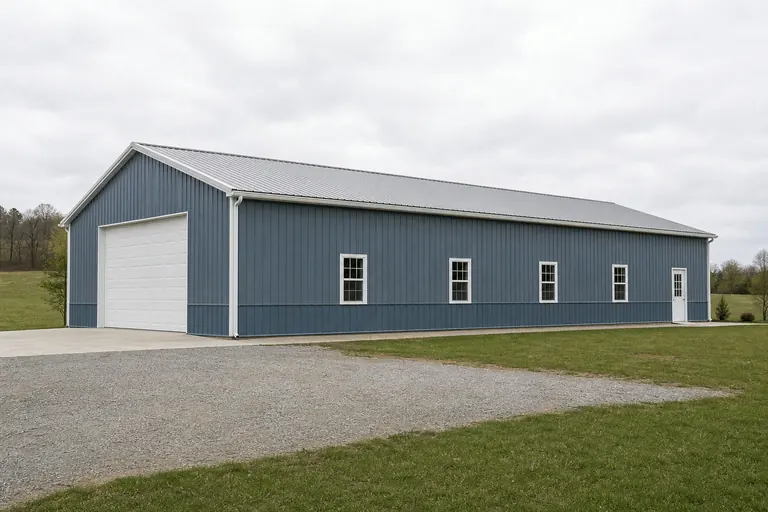 Equipment shop with attached living quartersA workshop or equipment bay with a residential section for full-time or part-time living.Rural home-office and workshop comboLiving space paired with a shop for hobbies, small business or equipment maintenance.Transitional build while a main house is plannedSome buyers use a shouse as a livable structure while building or renovating a separate home.
Example Configuration — for planning purposes only.
Footprint
Sizes that suit a Louisiana rural shouse
Louisiana shouse enquiries typically split square footage between a shop bay and a modest living section.
40′ × 60′
2,400 sq ft
A common starting footprint splitting shop and living space roughly evenly.
50′ × 80′
4,000 sq ft
More generous living quarters alongside a full equipment bay.
60′ × 100′
6,000 sq ft
Larger operations wanting significant equipment storage plus a full residence.
Example Configuration — for planning purposes only.
Footprint pages carry the layout detail for each of these; this page only explains why the Louisiana brief lands in this range.
Preparation
Before you request a Louisiana shouse quote
A few things resolved in advance keep the quote comparable and the structure suited to your parcel.
Step 1
Get a site-specific survey
Especially for coastal or low-lying parishes, given documented subsidence and wetland loss in the region.
Step 2
Check FEMA's National Risk Index
Review hazard data for your specific parcel before fixing floor elevation or foundation type.
Step 3
Contact your local building department
Confirm what your parish requires for a combined residential and shop structure before finalizing plans.
Step 4
Decide the shop-to-living ratio early
This drives utility placement, insulation zones and interior wall layout more than any other decision.
Questions
Louisiana shouse questions
Questions we can answer honestly at state level, with the ones we cannot routed to whoever actually owns them.
USGS has documented significant coastal wetland loss and subsidence in Louisiana's delta plain, so a site-specific survey is worth getting for any coastal-adjacent parcel. We do not make a blanket safety claim here — that depends on your specific site and your local building department.
Permit requirements depend on your parish and whether the structure includes living space, which typically triggers residential building code review. Your local building department is the only reliable source for that answer.
The core difference is design intent: a shouse is planned from the start as combined living and shop space, while a pole barn conversion adapts an existing barn design. Discuss which fits your use with your builder.
There is no official typical size, but most enquiries fall between a modest shop-plus-living footprint and a larger combined residence and equipment bay, reflecting Louisiana's larger average farm acreage.
We do not publish state-level prices; a credible number depends on your specification, finish level and site work. Our cost pages cover what drives the number.
Sources for the Louisiana facts on this page
This page states no code requirement, wind speed, snow load, permit rule, price or supplier claim. The state-specific facts it does use are listed with their publisher below.
Louisiana had 25,006 farms in 2022, a decrease of 9% since 2017.
USDA National Agricultural Statistics Service (NASS) · 2022 · Tier 1
https://www.nass.usda.gov/Publications/AgCensus/2022/Online_Resources/County_Profiles/Louisiana/cp99022.pdfLouisiana had 7,986,381 acres of land in farms in 2022, an average farm size of 319 acres (up 9% since 2017).
USDA NASS · 2022 · Tier 1
https://www.nass.usda.gov/Publications/AgCensus/2022/Online_Resources/County_Profiles/Louisiana/cp99022.pdfUSGS reports that in Louisiana's coastal delta plain, almost 3,000 square kilometers of low-lying wetlands converted to open water between 1956 and 2004, driven substantially by land subsidence in the Mississippi River delta plain.
U.S. Geological Survey (USGS) · March 2013 (data through 2004) · Tier 1
https://pubs.usgs.gov/fs/2013/3017/pdf/fs2013-3017.pdfNOAA NCEI's State Climate Summary for Louisiana states hurricanes strike Louisiana on average once every three years, and that Louisiana's temperatures have risen about 0.5°F since the beginning of the 20th century — less than a third of the warming for the contiguous United States as a whole.
NOAA National Centers for Environmental Information (NCEI) · State Climate Summaries series, 2022 · Tier 1
https://statesummaries.ncics.org/downloads/Louisiana-StateClimateSummary2022.pdfLouisiana had a total of 14,247 new privately-owned housing units authorized by building permits in 2023, rising slightly to 14,310 units in 2024.
U.S. Census Bureau · 2023-2024 · Tier 1
https://www2.census.gov/econ/bps/State/st2024a.txtNWS New Orleans/Baton Rouge released new 30-year (1991-2020) climate normals for the region, replacing the prior 1981-2010 normals used for local temperature and precipitation averages.
National Weather Service (NOAA), New Orleans/Baton Rouge LA office · 1991-2020 · Tier 1
https://www.weather.gov/lix/newnormalsFEMA's National Risk Index dataset assesses 18 natural hazards, including hurricane, coastal flooding, and inland flooding, which are especially relevant to Louisiana's Gulf Coast exposure, at the county and Census tract level via its interactive online tool.
Federal Emergency Management Agency (FEMA) · Current NRI release · Tier 1
https://www.fema.gov/flood-maps/products-tools/national-risk-indexLouisiana's total land area was measured at 43,203.9 square miles as of the 2010 Census.
U.S. Census Bureau · 2010 Census · Tier 1
https://www.census.gov/geographies/reference-files/2010/geo/state-local-geo-guides-2010/louisiana.html