
Shouse · FL
Shouses in Florida
A shouse joins a workshop or equipment bay to living quarters under one roof, and in Florida that pairing means the structure's most demanding day is a shared one: NOAA's Hurricane Research Division records Florida as having the most historical hurricane landfalls of any U.S. state, and the same event that has to protect the shop bay's contents also has to protect the people sleeping next door to it. Two counties, Broward and Miami-Dade, sit inside the Florida Building Code's High-Velocity Hurricane Zone, a separate code track that changes what gets specified before a shouse quote is even comparable across the state.
Code track
The High-Velocity Hurricane Zone changes the comparison in two counties
Broward and Miami-Dade counties sit inside a separate Florida Building Code track, so a shouse quote sourced there is not directly comparable to one from elsewhere in the state.
The Florida Building Code, administered statewide by the Florida Building Commission, carves out a High-Velocity Hurricane Zone consisting specifically of Broward and Miami-Dade counties. That is not a general Florida wind-loading rule — it is a named, county-bounded provision. A shouse buyer inside those two counties should confirm with their local building department how HVHZ requirements apply to a combined residential-and-shop structure before soliciting quotes, since a builder unfamiliar with that track may price or spec the job as if it were anywhere else in Florida.
Outside Broward and Miami-Dade, the Florida Building Code still applies statewide, but under its general provisions rather than the HVHZ track. Either way, this page does not state a wind speed, load figure or permit threshold, because those are set by code edition and local jurisdiction, not by this guide; your local building department or the authority having jurisdiction is the correct source for the number that actually governs your shouse.
Site conditions
What Florida's terrain means for a shouse foundation
Low-lying ground and a shallow, statewide aquifer system are two separate, documented reasons to get a site-specific survey before fixing floor elevation on a Florida shouse.
USGS elevation mapping highlights that large portions of Florida sit at low elevation, a statewide pattern rather than a coastal-only condition. For a shouse, where flooding inside the shop half of the building can quickly become a habitability problem for the living half, floor elevation and site drainage deserve attention before slab design is finalized, not as a change order afterward.
Underneath nearly all of that ground sits the Floridan aquifer system, a principal aquifer that USGS has studied extensively and that covers roughly 100,000 square miles across the southeastern U.S., including all of Florida. Its depth below the surface varies by location, so it is not a reason to avoid a site on its own — but it is a specific, checkable fact worth raising with a geotechnical or site engineer when deciding footing depth and stormwater management for a combined-use building.
Get Florida shouse quotes
Tell us your county, parcel size and shop-to-living ratio. We route it with the Florida and shouse context, including HVHZ status where relevant, already attached.
Configuration
What Florida shouses are typically asked to do
The Florida shouse brief usually pairs a working shop or equipment bay with a modest, storm-conscious living section on acreage large enough to support both.
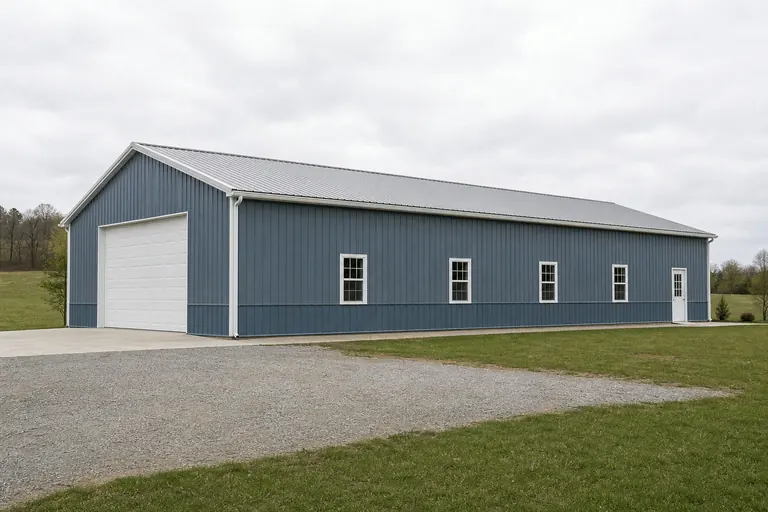 Equipment shop with attached living quartersA workshop or equipment bay paired with a residential section for full-time or seasonal living.Agricultural workshop-and-home combinationLiving space alongside a shop for equipment maintenance or small-scale farm operations, sized to Florida's larger average farm acreage.Storm-season base with on-site workspaceA single storm-hardened structure that combines shelter and a workspace rather than maintaining two separate buildings.
Example Configuration — for planning purposes only.
Footprint
Sizes that suit a Florida shouse brief
Florida shouse enquiries tend to split square footage between a shop bay and a modest living section, scaled to the parcel.
40′ × 60′
2,400 sq ft
A common starting footprint splitting shop and living space roughly evenly.
50′ × 80′
4,000 sq ft
More generous living quarters alongside a full equipment bay.
60′ × 100′
6,000 sq ft
Larger operations wanting significant equipment storage plus a full residence.
Example Configuration — for planning purposes only.
Footprint pages carry the layout detail for each of these; this page only explains why the Florida brief lands in this range.
Preparation
Before you request a Florida shouse quote
A handful of items resolved up front keep a Florida shouse quote comparable and appropriately specified.
Step 1
Confirm whether your parcel is inside the HVHZ
Broward and Miami-Dade counties fall under the Florida Building Code's High-Velocity Hurricane Zone track; confirm with your local building department if you are unsure.
Step 2
Check FEMA's National Risk Index for your county
Review hazard scoring across all 18 tracked categories, not hurricane exposure alone, before finalizing siting.
Step 3
Get a site-specific elevation and drainage assessment
Given how much of Florida's terrain is documented as low-lying, this should happen before floor elevation is set.
Step 4
Decide the shop-to-living ratio early
This drives utility placement, insulation zones and interior wall layout more than any single code requirement.
Questions
Florida shouse questions
Straightforward answers at the state level, with anything jurisdiction-specific routed to the office that actually decides it.
Only if your parcel is in Broward or Miami-Dade county; that zone is a distinct Florida Building Code track. Confirm applicability and requirements with your local building department.
Florida records the most historical hurricane landfalls of any U.S. state, so anchoring and opening protection deserve real attention on a shouse, where a shared roof covers both shop and living space. We do not make a blanket safety claim; that depends on your site, spec and local code.
The Floridan aquifer system underlies the whole state and can sit close to the surface in places, and much of Florida's terrain is mapped as low-lying. A site-specific survey before finalizing foundation and floor elevation is worth the cost.
A shouse is planned from the outset to combine living quarters and a shop under one structural envelope, so a storm or water event affecting the shop side directly affects the living side too — unlike a separate workshop building.
There is no official typical size, but enquiries commonly range from a modest shop-plus-living footprint up to a larger combined residence and equipment bay, reflecting the acreage scale of Florida's average farm holding.
We do not publish state-level prices here; a credible figure depends on specification, finish level, HVHZ status and site work. Our cost pages explain what drives the number.
Sources for the Florida facts on this page
This page states no code requirement, wind speed, snow load, permit rule, price or supplier claim. The state-specific facts it does use are listed with their publisher below.
NOAA's Hurricane Research Division records Florida as the U.S. state with the most historical hurricane direct hits/landfalls, based on the 1851-2018 dataset.
NOAA Atlantic Oceanographic and Meteorological Laboratory (AOML), Hurricane Research Division · 1851-2018 · Tier 1
https://www.aoml.noaa.gov/hrd/tcfaq/E19.htmlThe Florida Building Code defines a High-Velocity Hurricane Zone (HVHZ) consisting of Broward and Miami-Dade counties.
Florida Building Commission (via UpCodes republication) · 2023 FBC, 8th edition · Tier 3
https://up.codes/d/high-velocity-hurricane-zone-hvhzThe Florida Building Commission administers the Florida Building Code statewide.
Florida Building Commission · 8th Edition (2023), effective Dec 31, 2023 · Tier 2
https://www.floridabuilding.org/USGS mapping highlights that large portions of Florida are low-lying, derived from USGS digital elevation models.
U.S. Geological Survey · n/a (map publication) · Tier 2
https://pubs.usgs.gov/sim/3047/The Floridan aquifer system, a principal USGS-studied aquifer, underlies all of Florida and covers about 100,000 square miles across the southeastern U.S.
U.S. Geological Survey · n/a · Tier 2
https://fl.water.usgs.gov/floridan/intro.htmlFlorida had 44,703 farms in 2022 per the USDA Census of Agriculture.
USDA National Agricultural Statistics Service (NASS) · 2022 · Tier 1
https://www.nass.usda.gov/Publications/AgCensus/2022/Full_Report/Volume_1,_Chapter_1_State_Level/Florida/The average farm size in Florida was 217 acres in 2022.
USDA NASS · 2022 · Tier 1
https://www.nass.usda.gov/Publications/AgCensus/2022/Full_Report/Volume_1,_Chapter_1_State_Level/Florida/FEMA's National Risk Index scores U.S. communities, including Florida counties, across 18 defined natural hazard types.
FEMA · current dataset · Tier 1
https://www.fema.gov/about/openfema/data-sets/national-risk-index-data