
Shed · ME
Sheds in Maine
A shed is the building Maine buyers most often under-plan, because it is small, cheap relative to a house, and usually unheated — which is exactly the combination that lets an unconsidered foundation and a poorly placed door cost the most over time. Portland's NOAA 1991-2020 normals record January and February snowfall means of about 15-19 inches each and annual precipitation near 51 inches distributed through most months, so a Maine shed has to shed snow deliberately and tolerate near-constant moisture. The Maine Geological Survey also documents statewide glacial and post-glacial surficial deposits — till, marine clay, sand and gravel — which is the sourced reason a shed pad detail cannot be copied blindly from one site to the next.
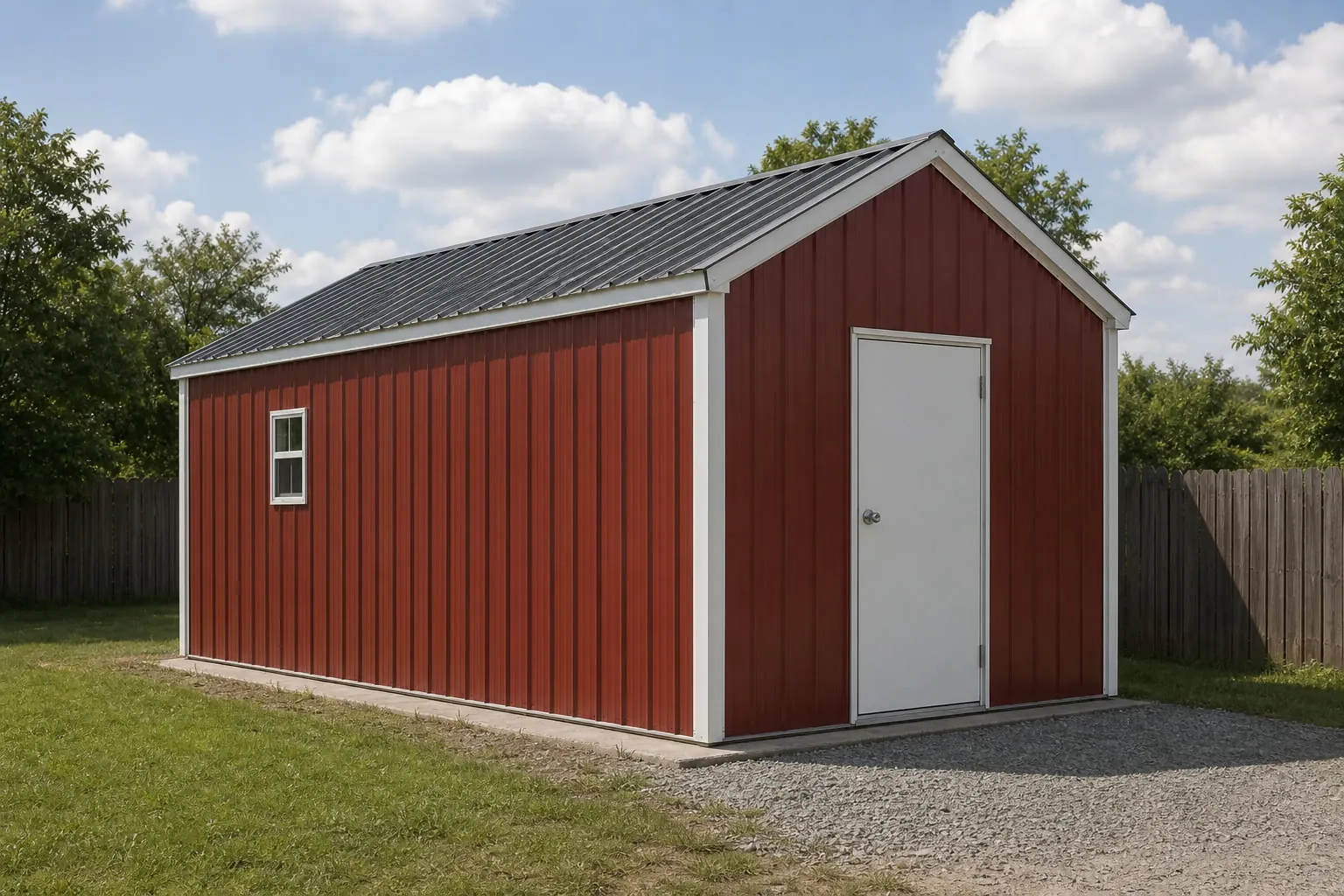
The Cheapest Building Still Needs the Most Careful Siting
A shed's low cost relative to a house leads buyers to skip decisions they would never skip on a bigger structure — namely, where exactly the snow goes and what the ground actually does underneath it. In Maine that shortcut is expensive. The Portland benchmark station's January and February snowfall means run roughly 15-19 inches each, and the Maine Geological Survey documents glacial and post-glacial surficial deposits statewide, meaning ground behaviour genuinely differs from site to site. Get the roof line and the pad right and a Maine shed is a maintenance-free building for decades; get either wrong and it is a door that will not open by January.
Foundation and Roof
Why Snow Path and Ground Both Decide a Maine Shed
An unheated Maine shed has to shed snow away from its own door and sit on a pad chosen for its actual site, not a generic default.
Snow does not sit still on a roof; it slides, drifts and piles wherever the geometry lets it. With January and February snowfall means near 15-19 inches each at the state's benchmark station, a Maine shed whose door sits under the shed line loses real access for weeks at a stretch. Orienting the roof so the shed path lands away from the entrance costs nothing at the design stage and saves a shovel-out every storm.
Ground behaviour is the second half of the problem, and it is genuinely variable in Maine. The Maine Geological Survey's description of statewide glacial and post-glacial deposits — till, marine clay, sand and gravel — means a gravel pad that performs well on one parcel can hold water and heave on another a few hundred feet away. A quick look at drainage and soil on the actual pad site, ideally during a thaw, tells you more than any generic foundation guide.
Moisture inside the building follows the same logic as outside it. At roughly 51 inches of annual precipitation spread through most months, an unheated Maine shed is a damp environment more of the year than not. Raised shelving, a floor-level airflow path, and keeping stored items off a bare slab all reduce the practical cost of that dampness without adding heat or insulation the building does not need.
Before You Order
Six Maine Shed Confirmations
Every one of these is a local or site-specific answer rather than a number this page will guess at.
- Ask your town what it allows without a permitMaine accessory-structure allowances are set locally. Confirm the footprint, height and setback that trigger a permit on your specific parcel before ordering.
- Get the frost depth used in your areaThis decides whether a gravel pad is adequate or whether footings below frost are the safer choice. It is inexpensive to obtain and costly to guess wrong.
- Choose the door face against the snow-shed lineWith winter snowfall means of 15-19 inches in January and February each at the benchmark station, a door under the shed path is the single most avoidable siting mistake.
- Look at the pad site during a thawStatewide surficial deposits documented by the Maine Geological Survey vary enough that a quick check of drainage and soil at the actual pad location is worth the visit.
- Confirm delivery access for winter conditionsMaine's 7,036 farms show how rural many properties here are; a driveway fine in autumn may not support a delivery vehicle after the first real snow.
- Decide now if the shed will ever need powerTrenching in frozen Maine ground is not realistic for several months a year. If power is even a possibility later, run the conduit when the pad goes in.
Get shed quotes for your Maine property
Tell suppliers your town, your intended foundation, and how the site drains through a thaw. Those answers make Maine shed quotes comparable.
Footprints
Shed Footprints That Work on Maine Properties
Maine shed buyers commonly need seasonal equipment storage, which pushes footprints slightly larger than a pure garden shed.
12′ × 20′
240 sq ft
Holds a mower and a snow blower with room to move past both — a practical minimum once winter equipment is stored inside from November.
16′ × 24′
384 sq ft
Adds a bench wall or a second seasonal machine without approaching footprints many towns treat differently.
20′ × 30′
600 sq ft
A rural-parcel utility shed sized for implement storage plus covered working space out of the weather.
Example Configuration — for planning purposes only.
Confirm your town's accessory-structure threshold before selecting a footprint; the size pages carry the dimensional detail.
Evidence Position
What This Page Will Not Tell You
No Maine frost depth, snow load, permit threshold or price is asserted here. Those are local values and we hold no sourced statewide figure for any of them.
The Maine facts on this page are limited to sourced material: NOAA NCEI 1991-2020 normals for the Portland Jetport station, the Maine Geological Survey's statewide surficial-deposit description, USDA NASS 2022 Census of Agriculture farm counts, and U.S. Census Bureau 2024 housing-unit authorization figures for Maine.
A shed is small enough that buyers are tempted to skip the local questions entirely. That instinct costs little in a mild climate and considerably more here, where a snow-blocked door or a heaving pad shows up within the first winter rather than years later.
Questions
Maine Shed Questions
The Maine-specific questions a general shed page cannot answer.
It depends on your town, and there is no single statewide figure we will publish. Maine accessory-structure allowances are set locally, so confirm the footprint, height and setback that require a permit on your specific parcel before ordering.
Often, for lighter storage on well-drained ground, but it depends on your site. The Maine Geological Survey documents statewide glacial and post-glacial deposits, so soil and drainage genuinely vary; check your actual pad location, ideally during a thaw.
Away from the roof's snow-shed path. With Portland-station January and February snowfall means near 15-19 inches each, a door positioned under the shed line can be buried for weeks at a stretch.
Likely, at least seasonally. With annual precipitation near 51 inches spread through most months, an unheated Maine shed sits in a persistently damp environment; raised shelving and floor-level airflow reduce the practical impact without adding heat.
Maine had 7,036 farms in 2022, so many sheds go up on larger rural parcels. The building itself is the same; the planning differs in delivery access, distance to power, and whether the local department treats the use as agricultural.
Pricing is handled by the cost silo. The Maine-variable elements are the foundation work chosen for your site's ground conditions and whatever access improvements a rural delivery route requires.
Sources for the Maine facts on this page
This page states no code requirement, wind speed, snow load, permit rule, price or supplier claim. The state-specific facts it does use are listed with their publisher below.
The Portland, ME NOAA 1991-2020 normals show winter monthly snowfall means around 15-19 inches in January and February, indicative of a snow-heavy northern New England winter.
NOAA National Centers for Environmental Information (NCEI) · 1991-2020 · Tier 1
https://www.ncei.noaa.gov/access/services/data/v1?dataset=normals-monthly-1991-2020&format=pdf&stations=USW00014764Portland, ME's NOAA 1991-2020 climate normals show annual precipitation totals of about 51 inches, distributed fairly evenly through the year with over 3 inches of rain most months.
NOAA National Centers for Environmental Information (NCEI) · 1991-2020 · Tier 1
https://www.ncei.noaa.gov/access/services/data/v1?dataset=normals-monthly-1991-2020&format=pdf&stations=USW00014764The Maine Geological Survey describes most of the state's surface as mantled by glacial and post-glacial sediments (till, marine clay, sand and gravel) deposited during and after the last ice age, which ended roughly 10,000-16,000 years ago.
Maine Geological Survey (Dept. of Agriculture, Conservation & Forestry) · MGS reference material · Tier 2
https://www.maine.gov/DACF/mgs/explore/surficial/facts/surficial.htmMaine had 7,036 farms in 2022, down from 7,600 in 2017.
USDA National Agricultural Statistics Service (NASS) · 2022 (with 2017 comparison) · Tier 1
https://www.nass.usda.gov/Publications/AgCensus/2022/Full_Report/Volume_1,_Chapter_1_State_Level/Maine/st23_1_001_001.pdfBuilders in Maine were authorized to construct 6,034 new privately-owned housing units in 2024, of which 4,650 were single-unit structures.
U.S. Census Bureau · 2024 (final annual estimates) · Tier 1
https://www.census.gov/construction/bps/stateannual.html