
Shed · AZ
Steel Sheds in Arizona
A shed is usually the smallest accessory building on a property, which means the question that matters most in Arizona is not the structure itself but whether your specific jurisdiction requires a permit at that footprint at all. Arizona has no single statewide building-code agency for construction; its uniform statewide code adoption covers only the fire code, and Arizona Revised Statutes §11-861 and §34-461 confirm counties and municipalities set their own construction-code rules, including any small-structure exemption threshold. Land status matters too: Congressional Research Service data puts roughly 28.1 million of Arizona's 34.4 million acres in federal ownership, and the Arizona State Land Department separately manages more than 9 million surface acres of State Trust land, so confirming a shed site is genuinely private, buildable land is a real first step in parts of the state. The National Weather Service's documented monsoon-season dust storms, running June 15 to September 30, are a practical siting and anchoring consideration for a lightweight structure. This page works through those Arizona-specific realities.
The intersection
The first Arizona shed question is whether it needs a permit at all
A shed's small footprint often puts it near a permit exemption threshold, and in Arizona that threshold is set locally, not statewide.
Arizona has no single statewide building-code agency for construction; its uniform statewide code adoption applies only to the fire code, per UpCodes' summary of Arizona building codes. Construction-code adoption, including whatever small-structure exemption threshold applies to a shed, is a county or municipal decision under Arizona Revised Statutes §11-861 for counties and §34-461 on local code applicability. That means the same shed footprint can be permit-exempt in one Arizona jurisdiction and require a permit in the next, and there is no single statewide square-footage figure to look up.
The practical move is to call your specific city or county building department with your shed's exact dimensions before ordering, rather than relying on a rule of thumb from another state or even a neighboring Arizona county.
Site reality
Confirm the land, then plan for a documented dust hazard
Arizona's land ownership pattern and its monsoon dust storms are two separate, sourced reasons to think through shed siting before ordering.
Congressional Research Service data puts roughly 28.1 million of Arizona's approximately 34.4 million acres in federal ownership, and the Arizona State Land Department separately reports managing more than 9 million surface acres of State Trust land, about 13% of the state's surface area. Neither of these figures describes your specific parcel, but together they explain why confirming a rural or fringe Arizona shed site is genuinely private land, clear of federal or trust-land boundary issues, is worth doing before a foundation is poured.
Separately, NOAA's National Weather Service documents blowing dust and dust storms, or haboobs, tied to North American Monsoon thunderstorm outflows running June 15 through September 30 each year, as one of Arizona's underrated weather hazards. A lightweight shed is more exposed to wind-driven debris and grit intrusion than a heavier enclosed building, so anchoring method and door/vent placement facing away from prevailing outflow direction are reasonable questions to raise with your installer if the site sees frequent monsoon activity.
- Confirm parcel status against federal and State Trust land records
- A large share of Arizona's total acreage sits outside private ownership entirely.
- Ask your local department about the shed permit exemption threshold
- There is no single statewide figure; it is set city by city and county by county.
- Discuss anchoring and vent placement for monsoon dust exposure
- The June 15 - September 30 window is when NWS documents outflow-driven dust events.
Configuration
What Arizona sheds are commonly asked to do
Arizona shed briefs split between compact residential storage and larger working-acreage support.
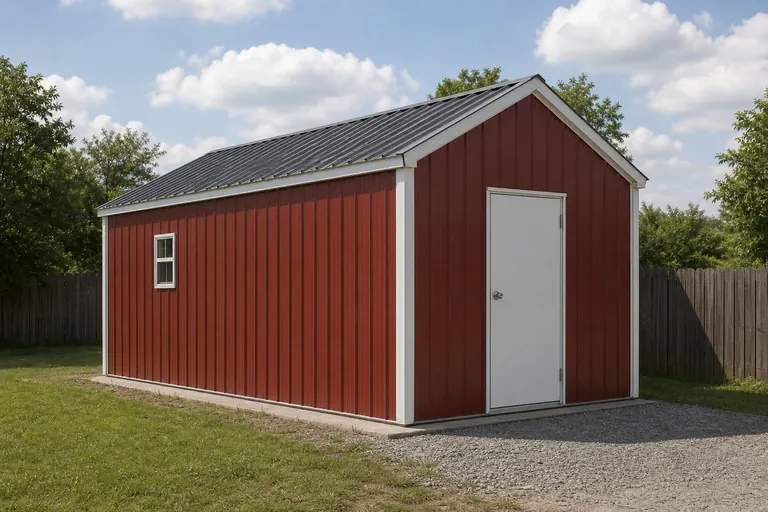 Backyard or residential storageA compact single-purpose building for tools and equipment, most likely to sit near a local permit-exemption threshold.
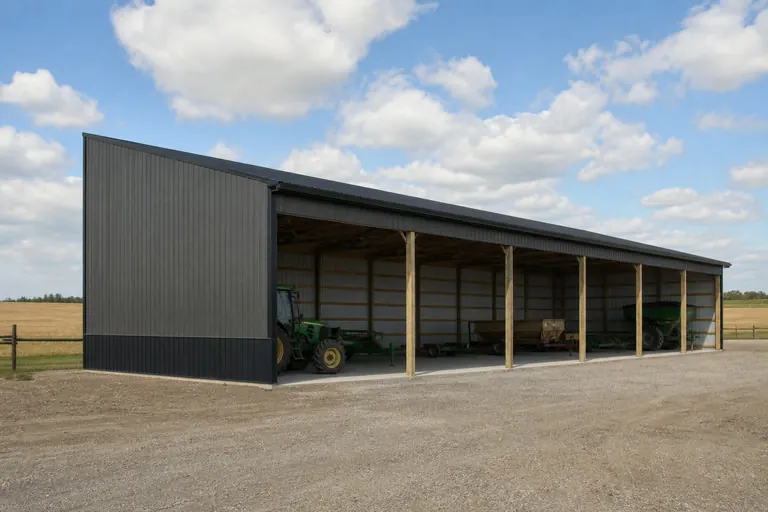 Ranch or agricultural storageFeed, tack, or small-equipment storage on Arizona's larger farm parcels, which averaged 1,528 acres in the 2022 Census of Agriculture.Rural accessory building near public landA shed sited on private land bordering federal or State Trust acreage, where confirming the boundary matters more than elsewhere.
Example Configuration — for planning purposes only.
Get Arizona shed quotes
Tell us your city or county, parcel status and intended use. We route it with the Arizona and shed context already attached.
Footprint
Sizes that suit common Arizona shed briefs
Most enquiries stay compact, but a large-parcel agricultural brief can call for more room.
10′ × 12′
120 sq ft
A small footprint for tool and equipment storage, worth checking against your local permit-exemption threshold.
12′ × 20′
240 sq ft
A common step up when feed or tack storage is added to general storage.
16′ × 24′
384 sq ft
Enough depth for a small equipment bay alongside storage on a larger parcel.
Example Configuration — for planning purposes only.
Footprint pages carry layout and door detail; this page explains only the Arizona permit and siting context.
Preparation
Before you request an Arizona shed quote
Steps that address the parts of an Arizona shed project a generic quote will not cover.
- Call your local building department with exact shed dimensionsArizona sets permit-exemption thresholds locally; there is no statewide figure to assume.
- Verify your parcel's ownership statusRoughly 28.1 million of Arizona's 34.4 million acres are federally owned, and over 9 million more acres are State Trust land.
- Plan anchoring for monsoon-season dust and wind outflowNWS documents this hazard specifically for the June 15 - September 30 window.
- State the shed's full intended use up frontA shed quoted as basic storage but used for feed or equipment is a common source of a second round of quoting.
Questions
Arizona shed questions
Honest state-level answers, with jurisdiction-specific and land-status questions routed to the office that actually decides them.
It depends on your specific city or county, since Arizona has no single statewide building-code agency for construction and permit-exemption thresholds are set locally. Call your building department with your shed's exact dimensions to confirm.
State Trust land, which the Arizona State Land Department reports covers more than 9 million surface acres, is managed for designated beneficiaries and is not simply open for private construction. Confirm boundary and access questions with the Land Department before siting a shed nearby.
NWS documents monsoon-driven blowing dust and dust storms between June 15 and September 30 as a real Arizona hazard. It is a reasonable prompt to discuss anchoring method and vent orientation with your installer, though it does not set a specific design number.
There is no official typical size. Compact 10x12 to 12x20 footprints are common for residential storage, while agricultural parcels sometimes call for more room.
We do not publish state-level prices, because a credible number depends on specification, site work and current material pricing. Our cost pages cover what drives the number.
It can. With a large share of Arizona's acreage in federal or State Trust ownership, confirming your specific parcel is private, buildable land is a more consequential step here than in states where private land dominates.
Sources for the Arizona facts on this page
This page states no code requirement, wind speed, snow load, permit rule, price or supplier claim. The state-specific facts it does use are listed with their publisher below.
Arizona building codes are governed at the local jurisdiction level rather than by a single statewide building code agency; the state's uniform statewide adoption applies only to the Fire Code.
UpCodes (citing Arizona State Fire Marshal statewide fire code adoption) · current, accessed 2024/2025 · Tier 3
https://up.codes/codes/arizonaArizona Revised Statutes govern how counties and municipalities adopt construction codes by reference, confirming code adoption is a local government function.
Arizona State Legislature · current statute text · Tier 2
https://www.azleg.gov/ars/11/00861.htmNWS documents blowing dust and dust storms (haboobs) as an underrated Arizona weather hazard, tied to monsoon thunderstorm outflows.
NOAA/National Weather Service · July 2016 · Tier 1
https://www.weather.gov/media/wrh/online_publications/TMs/TM-290.pdfCRS's federal land ownership dataset lists Arizona federal acreage at roughly 28.1 million acres (2013 data) against total state acreage of approximately 34.4 million acres.
Congressional Research Service · data as of FY2013, report dated March 3, 2017 · Tier 1
https://www.everycrsreport.com/files/20170303_R42346_95ce191e74ed8e08054bb5476971544bc55823f2.htmlArizona has more than 9 million surface acres of State Trust land, about 13% of the state's total surface land ownership.
Arizona State Land Department · current, accessed 2024 · Tier 2
https://land.az.gov/our-agency-mission