
RV Garage · AZ
RV Garages in Arizona
An RV garage is built around one number most other outbuildings never think about: the clear height of a single overhead door sized for a motorhome. In Arizona, that door faces a documented seasonal hazard the National Weather Service calls one of the state's most underrated: blowing dust and dust storms, or haboobs, generated by North American Monsoon thunderstorm outflows between June 15 and September 30 each year. A tall, wide door left open during a construction delivery or a routine pull-in during that window is a different proposition than the same door in a dust-free month. Layer on where the building actually gets sited: Congressional Research Service data puts roughly 28.1 million of Arizona's 34.4 million acres in federal hands, and the Arizona State Land Department manages more than 9 million additional surface acres of State Trust land, so a meaningful share of the state's land area is not open for private RV garage construction at all. And because Arizona has no single statewide building-code agency outside the fire code, the permit conversation for whatever private parcel you do have starts and ends with your specific city or county building department.
The intersection
A tall door opening and a documented dust hazard
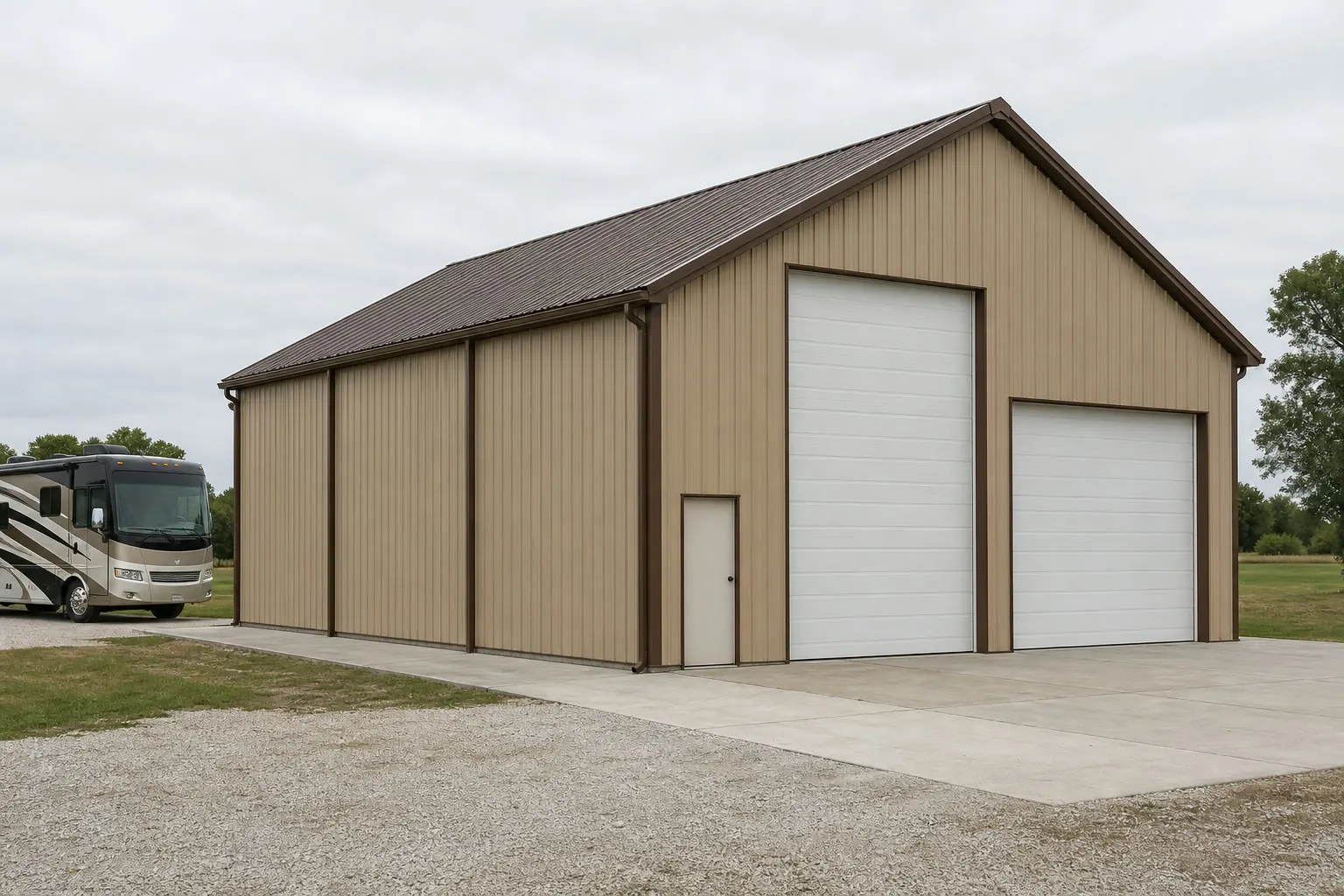
An RV garage's largest single feature — its tall overhead door — is left open longest during loading, and Arizona's monsoon season is when that matters most.
The National Weather Service's Tucson office defines the North American Monsoon in Arizona as running from June 15 to September 30 each year, a fixed calendar window rather than a rainfall trigger. A separate NOAA technical memorandum names blowing dust and dust storms, known locally as haboobs, as one of the state's most underrated weather hazards, tied directly to monsoon thunderstorm outflows. An RV garage's defining feature is a single wide, tall door built to swallow a motorhome, and that door spends more time open during a pull-in or pull-out than a standard garage door does. Scheduling deliveries, move-ins, and even routine RV access around forecast outflow boundaries during the monsoon window is a practical habit worth adopting rather than an overreaction.
None of this changes the door's structural specification, which your builder and local department set. It does mean the interior finish, any stored equipment near the door, and the building's ventilation and filtration plan are worth discussing with dust intrusion in mind if the site sees frequent monsoon outflow activity.
Site reality
Confirm the land is actually yours to build on before you plan the layout
Arizona's land ownership pattern means a larger share of the state's acreage sits outside private hands than in most states.
Congressional Research Service federal land ownership data puts Arizona's federal acreage at roughly 28.1 million acres against a total state acreage of approximately 34.4 million — a large majority of the state's land base. Separately, the Arizona State Land Department reports managing more than 9 million surface acres of State Trust land, about 13% of the state's total surface ownership, held in trust for beneficiaries such as public schools rather than open for general private development. For an RV garage buyer eyeing a rural or fringe parcel, confirming the land is fee-simple private property, and not adjacent to or encumbered by trust or federal land in a way that limits access or setbacks, is a genuine first step rather than a formality.
Where the parcel is confirmed private land, the building permit question then falls entirely to the local jurisdiction, because Arizona's uniform statewide code adoption applies only to the fire code. Arizona Revised Statutes §11-861 and §34-461 confirm that counties and municipalities adopt construction codes by reference themselves, so the RV garage permit process — and the specific wind, snow or seismic values a plan must meet — is a city or county answer, not a state one.
- Verify parcel ownership and any State Trust land adjacency
- The Arizona State Land Department is the authority for trust-land questions near your site.
- Confirm which building department has jurisdiction
- Arizona's fire code is the only uniformly adopted statewide code; construction codes are set locally.
- Ask about design wind speed and any seismic requirement directly
- No single statewide figure exists to cite; your building department has the current adopted value.
Configuration
How Arizona RV garage projects tend to be configured
Given a land base weighted toward larger rural and semi-rural private parcels, Arizona RV garage projects often include more than a single bay.
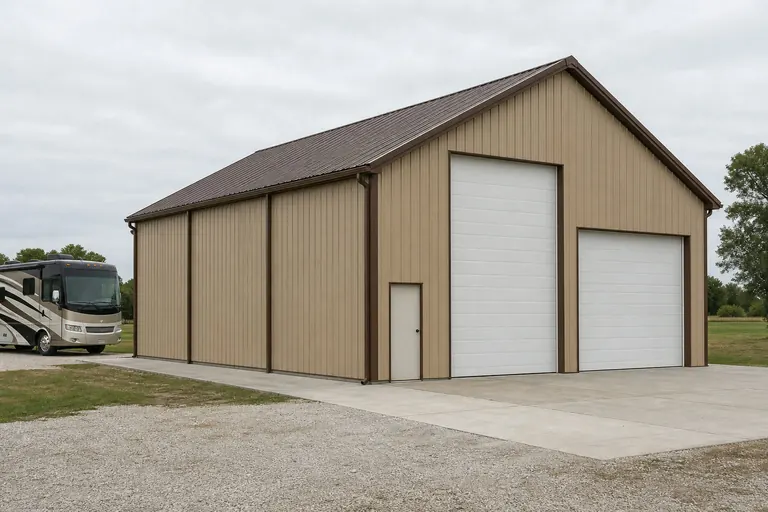 Single-RV garage with standard vehicle bayOne tall overhead door beside a standard-height door, the type's core layout, suited to a suburban or exurban lot.RV garage with attached workshop or storage bayAdded enclosed space for maintenance, tools, or off-season gear, feasible where the private parcel has room to spare.Multi-bay enclosed storage on a larger private parcelSeveral tall doors under one roofline, more realistic on the acreage-scale private parcels the state's agricultural data documents.
Example Configuration — for planning purposes only.
Get Arizona RV garage quotes
Tell us your RV height, footprint, jurisdiction and land status. We route it with the Arizona and RV-garage context already attached.
Footprint
Sizes that fit an Arizona RV garage site
Door height sets the starting point regardless of state, but larger private parcels support longer footprints than a tight suburban lot.
30′ × 40′
1,200 sq ft
A single Class A motorhome bay with a standard vehicle bay alongside.
40′ × 60′
2,400 sq ft
Room for the motorhome bay plus a workshop or extra storage bay.
50′ × 80′
4,000 sq ft
Multi-bay enclosed storage, realistic on a larger private rural parcel.
Example Configuration — for planning purposes only.
Footprint pages carry the room-by-room layout and door-height detail; this page explains only the Arizona site and land-status context.
Preparation
Before you request an Arizona RV garage quote
These steps address the parts of an Arizona project a generic RV garage quote will not cover.
- Confirm your parcel is private land, clear of trust or federal encumbranceArizona's federal and State Trust land together cover a large share of the state's acreage.
- Identify your specific building departmentArizona has no single statewide building-code agency outside the fire code, so your city or county sets the process.
- Ask about dust and drainage grading around the padMonsoon outflow events bring both blowing dust and sudden, heavy rainfall to the same site within the June 15 - September 30 window.
- Plan delivery and door-open timing around monsoon forecasts if building in seasonA wide, tall door left open during an outflow event is a practical dust and grit exposure, not a structural one.
Questions
Arizona RV garage questions
Direct answers at the state level, with anything jurisdiction-specific routed to the office that actually decides it.
NOAA documents blowing dust and dust storms (haboobs) as a real Arizona weather hazard tied to North American Monsoon outflows between June 15 and September 30. It is a practical scheduling and ventilation consideration for a large door opening during that window, not a structural design factor.
No. Arizona's uniform statewide code adoption applies only to the fire code. Construction codes for a building like an RV garage are adopted and enforced by the specific city or county under Arizona Revised Statutes §11-861 and §34-461.
State Trust land, which the Arizona State Land Department reports covers more than 9 million surface acres, is managed for the benefit of designated trust beneficiaries and is not simply available for private construction. Confirm parcel status with the Land Department before planning any build near or on trust land.
There is no official minimum. What matters more in Arizona is confirming the parcel is private land free of federal or trust-land encumbrance; roughly 28.1 million of the state's 34.4 million acres are federally owned, so this step is worth doing early.
We do not publish state-level prices, because a credible number depends on door height, footprint, site work and current material costs. Our cost pages explain what drives the number; a quote reflects your specific project.
NOAA's 2022 State Climate Summary identifies drought as a serious threat in Arizona and documents about 2.5°F of warming since the early 1900s. That context does not change the building's structure, but it is a reasonable prompt to ask about dust filtration and ventilation for a sealed building used in dry, dusty conditions.
Sources for the Arizona facts on this page
This page states no code requirement, wind speed, snow load, permit rule, price or supplier claim. The state-specific facts it does use are listed with their publisher below.
The North American Monsoon in Arizona runs from June 15 to September 30 each year (a fixed calendar definition, not a rainfall trigger).
NOAA/National Weather Service (Tucson office) · current/ongoing definition · Tier 1
https://www.weather.gov/media/twc/Monsoon.pdfNWS documents blowing dust and dust storms (haboobs) as an underrated Arizona weather hazard, tied to monsoon thunderstorm outflows.
NOAA/National Weather Service · July 2016 · Tier 1
https://www.weather.gov/media/wrh/online_publications/TMs/TM-290.pdfCRS's federal land ownership dataset lists Arizona federal acreage at roughly 28.1 million acres (2013 data) against total state acreage of approximately 34.4 million acres.
Congressional Research Service · data as of FY2013, report dated March 3, 2017 · Tier 1
https://www.everycrsreport.com/files/20170303_R42346_95ce191e74ed8e08054bb5476971544bc55823f2.htmlArizona has more than 9 million surface acres of State Trust land, about 13% of the state's total surface land ownership.
Arizona State Land Department · current, accessed 2024 · Tier 2
https://land.az.gov/our-agency-missionArizona building codes are governed at the local jurisdiction level rather than by a single statewide building code agency; the state's uniform statewide adoption applies only to the Fire Code.
UpCodes (citing Arizona State Fire Marshal statewide fire code adoption) · current, accessed 2024/2025 · Tier 3
https://up.codes/codes/arizona