
Riding arena · CO
Riding Arenas in Colorado
A riding arena's clear span and mounted-rider clearance are fixed by the discipline it serves, but where that fixed volume sits changes with Colorado's terrain. The Colorado Geological Survey maps the state into the Southern Rocky Mountains, the Great Plains' High Plains and Colorado Piedmont subprovinces, the Wyoming Basin and the Colorado Plateau, and Colorado also carries the highest mean elevation of any U.S. state alongside a flat eastern two-fifths. Add a federal land footprint that a 2013 Congressional Research Service dataset put at roughly 23.8 million acres, and an arena buyer in Colorado is planning a large-footprint building on a state where terrain, elevation and land tenure vary more within its borders than a single 'Colorado arena' answer can cover.
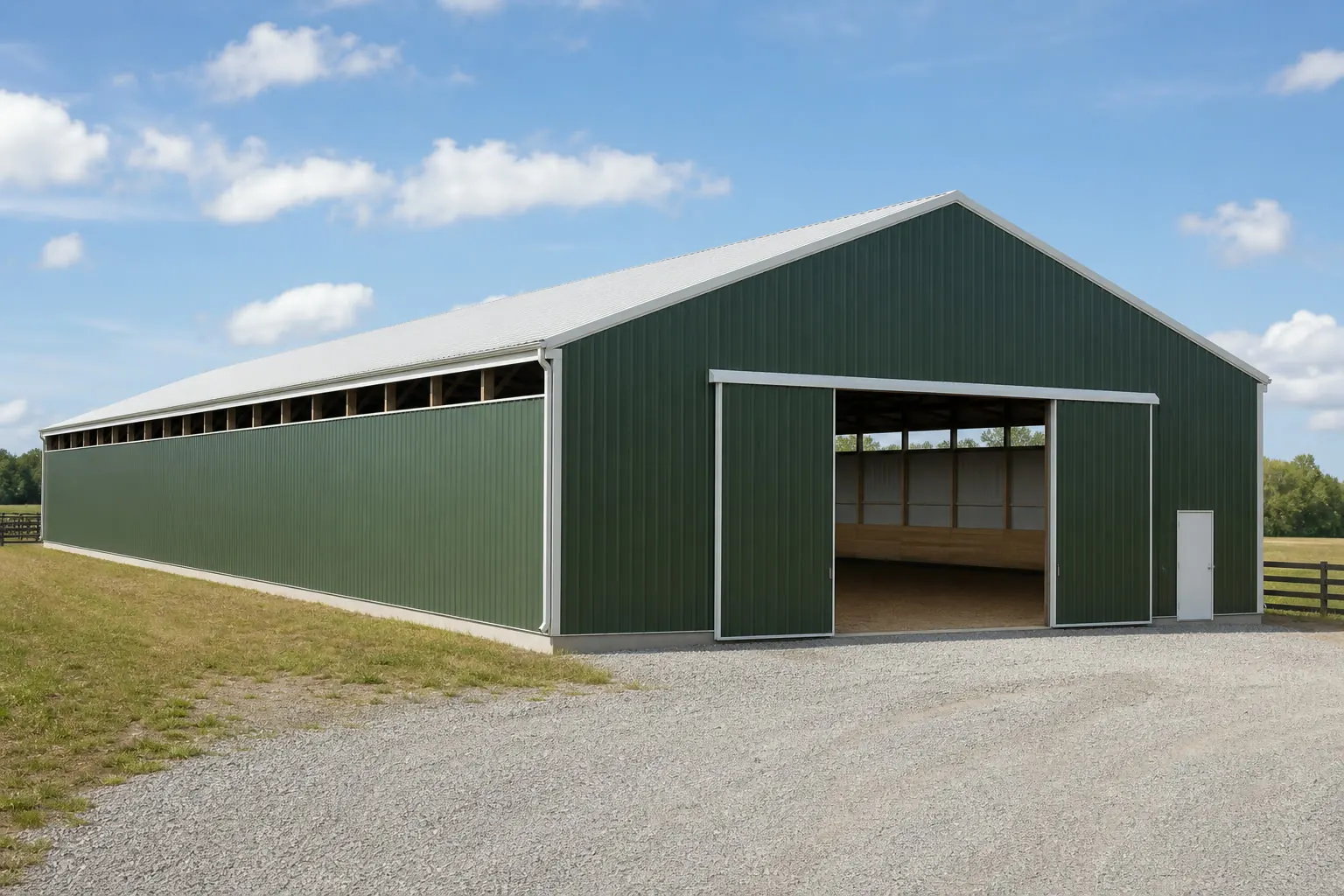
The intersection
One clear span, four kinds of ground under it
A riding arena's clear span and mounted clearance are fixed by the discipline, but the pad it sits on changes with Colorado's terrain province.
A riding arena is planned around a fixed working volume: the clear span and mounted-rider clearance a discipline requires do not change because the building is in Colorado rather than anywhere else. What does change is the ground under that fixed volume. The Colorado Geological Survey's physiographic map divides the state into the Southern Rocky Mountains, the Great Plains — with its own High Plains and Colorado Piedmont subprovinces — the Wyoming Basin, and the Colorado Plateau, and an arena's pad, drainage and grading plan should be set by which of those the parcel sits in.
On the Colorado Piedmont or High Plains, an arena pad generally deals with flat, open ground where the main site-work question is drainage away from the building rather than working against a slope. In the Southern Rocky Mountains province, foothill and valley parcels more often need grading and retaining work before the pad goes in, since the same terrain that makes for scenic sites also means water moves downhill through the site rather than sitting flat.
Elevation compounds the terrain question. Colorado carries the highest mean elevation of any U.S. state, with 54 peaks above 14,000 feet including Mount Elbert at 14,440 feet, against an eastern two-fifths that stays flat. An arena built at a higher mountain elevation is worth engineering for a different snow-accumulation pattern across its wide roof than one built on the plains, even though the clear span and interior clearance the discipline requires stay the same in both places.
Land and access
Federal land context and getting equipment to the surface
Colorado's substantial federal land footprint makes boundary and access confirmation worth doing before an arena's orientation and driveway are set.
A 2013 Congressional Research Service dataset reported Colorado's federal acreage at roughly 23.8 million acres against a total state acreage figure near 23.6 million in the same table, a discrepancy the report itself attributes to year-to-year BLM and Department of Defense reporting adjustments in western states. Read cautiously rather than as a precise percentage, the underlying point still holds: Colorado carries a large federal land footprint, and a rural equestrian parcel is more likely than in many states to border public land somewhere along its edge.
That matters for a riding arena specifically because the building depends on regular equipment access — a tractor or groomer has to reach the surface to maintain it — separate from the horse-and-rider entrance. Confirming the parcel's legal boundary and access route before finalizing the arena's orientation avoids discovering later that the planned equipment route crosses land the property does not actually control.
Get Colorado riding arena quotes
Tell us your property's terrain province and elevation, and we route your request with that context attached.
Configuration
What a Colorado riding arena is usually asked to do
Terrain province and elevation shape the arena brief more than the fact that the building is in Colorado at all.
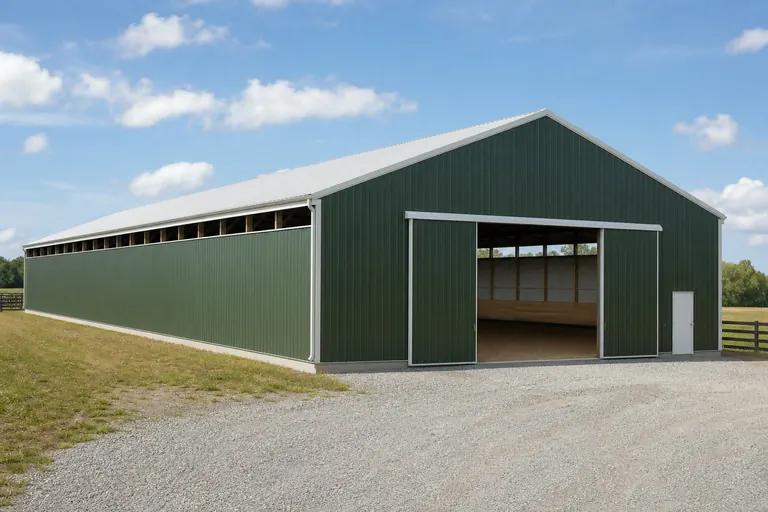 Plains and Piedmont training arenaA wide clear-span arena on flat Great Plains or Colorado Piedmont ground, where drainage away from the pad and wind loading on the roof plane are the leading site questions.Foothill and mountain-valley arenaAn arena sited in the Southern Rocky Mountains province, where grading, retaining work and elevation-driven snow accumulation take priority over the flat-ground drainage question.Rural acreage arena near public landA parcel bordering or near federal land, where confirming boundary and access before siting the building matters more than on an interior suburban lot.
Example Configuration — for planning purposes only.
Preparation
Before you order a Colorado riding arena
A short list of checks keeps a large clear-span building from being sited on assumptions Colorado's terrain and land pattern do not support.
- Identify your physiographic provinceConfirm whether the parcel sits in the Southern Rocky Mountains, the Great Plains (and which subprovince), the Wyoming Basin or the Colorado Plateau before setting the pad and drainage plan.
- Engineer for your elevation band, not a statewide averageA mountain-elevation site and a plains site can see different snow-accumulation behavior across the same wide roof; confirm the engineered value with your local building department.
- Confirm the county or city's jurisdiction before designingColorado has no single statewide authority for general construction, so the engineered span, snow load and permit process are set locally.
- Check the parcel boundary against nearby federal landColorado's large federal land footprint makes it worth confirming legal access and boundary lines before finalizing the arena's orientation and driveway.
- Plan a separate equipment route from the rider entranceA tractor or groomer needs to reach the surface without crossing the same pinch point riders and horses use; site the building with both routes in mind from the start.
Questions
Colorado riding arena questions
Honest answers scoped to what Colorado's terrain, elevation and land-tenure facts actually change, with engineering and pricing routed to the parties who own them.
It can change the engineered snow-load expectation for the roof, since a mountain-elevation site and a plains site see different accumulation patterns even at the same clear span. The clear span and mounted clearance themselves are set by the riding discipline, not the elevation.
No. Colorado has no single statewide building-code agency for general construction; the Office of the State Architect's authority is limited to state-owned buildings, so an arena's engineering and permit rules come from the county or municipality.
Colorado carries a substantial federal land footprint, so a rural equestrian parcel is more likely than in many states to border public land. Confirming the boundary and legal access route before siting the arena avoids access problems later.
Colorado's split into the Southern Rocky Mountains, Great Plains subprovinces, Wyoming Basin and Colorado Plateau gives buyers a documented reference for how different one part of the state can be from another, which is worth checking against your own parcel rather than assuming a single statewide condition.
Span and length are set by the riding discipline rather than by the state; consult the riding-arena type page for how discipline drives width and length before sizing for a Colorado site.
We do not publish state-level prices, since cost depends on span, site work and specification. Our cost pages explain what drives the number.
Sources for the Colorado facts on this page
This page states no code requirement, wind speed, snow load, permit rule, price or supplier claim. The state-specific facts it does use are listed with their publisher below.
Colorado's highest point, Mount Elbert, reaches 14,440 feet elevation (NAVD 88), reflecting the extreme high-mountain-to-plains elevation range relevant to mountain snow load versus valley/plains conditions.
Wikipedia (cross-referencing USGS elevation data) · current · Tier 1
https://en.wikipedia.org/wiki/Mount_ElbertColorado is described as having the highest mean elevation of any U.S. state and contains 54 peaks above 14,000 feet, with the eastern two-fifths of the state being flat plains, underscoring the mountain-vs-plains contrast for snow and wind exposure.
NETSTATE.com (general geography reference) · current reference page · Tier 2
https://www.netstate.com/states/geography/co_geography.htmThe Colorado Geological Survey's physiographic map divides the state into the Southern Rocky Mountains, the Great Plains (with High Plains, Colorado Piedmont, and Raton Basin subprovinces), the Wyoming Basin, and the Colorado Plateau.
Colorado Geological Survey · current reference map · Tier 2
https://coloradogeologicalsurvey.org/wp-content/uploads/ON-010-09-04.pdfCRS's federal land ownership dataset lists Colorado federal acreage at roughly 23.8 million acres (2013 data) against total state acreage of approximately 23.6 million acres reported in the same table (figures should be read alongside the report's narrative, as western-state totals were affected by year-to-year BLM/DOD adjustments).
Congressional Research Service · data as of FY2013, report dated March 3, 2017 · Tier 1
https://www.everycrsreport.com/files/20170303_R42346_95ce191e74ed8e08054bb5476971544bc55823f2.htmlColorado has no single statewide building code agency for general construction; the state's Office of the State Architect only sets minimum codes for state-owned/state-lease-purchased buildings, while other construction is subject to local adoption per the Division of Housing and Colorado's Planning for Hazards program.
Colorado Office of the State Architect; Colorado Department of Local Affairs, Division of Housing · current, accessed 2024/2025 · Tier 2
https://osa.colorado.gov/building-codesColorado has no single statewide building code agency for general construction; the state's Office of the State Architect only sets minimum codes for state-owned/state-lease-purchased buildings, while other construction is subject to local adoption per the Division of Housing and Colorado's Planning for Hazards program.
Colorado Office of the State Architect; Colorado Department of Local Affairs, Division of Housing · current, accessed 2024/2025 · Tier 2
https://osa.colorado.gov/building-codes