
Pole barn · ME
Pole Barns in Maine
A Maine pole barn gets planned against a smaller, contracting farm base rather than an expanding one. USDA's 2022 Census of Agriculture counted 7,036 Maine farms, down from 7,600 in 2017, working 1,225,046 acres in farms at an average of just 174 acres each — a fraction of the multi-thousand-acre averages seen in some other pole-barn states. Underneath that ground, the Maine Geological Survey describes most of the state's surface as mantled by glacial and post-glacial sediments — till, marine clay, sand and gravel — deposited during and after the last ice age roughly 10,000 to 16,000 years ago, a genuinely different starting material than exposed bedrock. NOAA's 1991-2020 normals for the Portland Jetport station separately show January and February mean snowfall of roughly 15 to 19 inches each, with annual precipitation near 51 inches spread fairly evenly across the year. No single one of those facts sets a design number, but together they point a Maine pole barn project toward footing depth, roof shedding and post-frame moisture handling well before size and layout become the live questions.
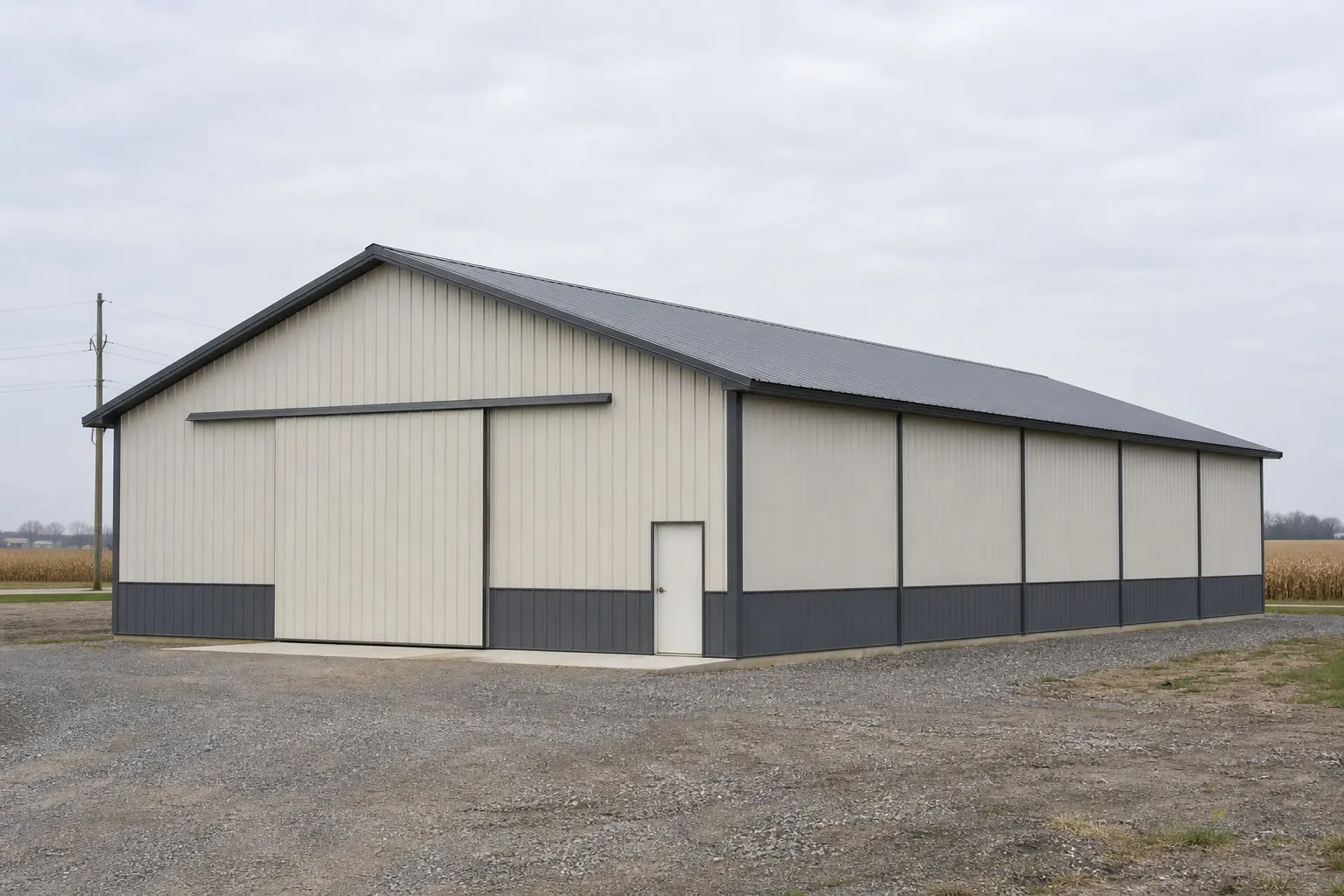
The intersection
A shrinking, small-parcel Maine farm base changes the sizing question
Maine's farm count and average acreage are both modest and both declining, which points a pole barn brief toward current operational needs rather than growth headroom.
USDA's 2022 Census of Agriculture counted 7,036 farms in Maine, down from 7,600 in 2017. Total land in farms stood at 1,225,046 acres, for an average farm size of just 174 acres — small by comparison with states where multi-thousand-acre operations set the norm. Fewer farms working roughly the same modest average acreage is a different trend line than the consolidation-onto-larger-operations pattern seen elsewhere.
For a pole barn buyer, that combination argues for sizing the building against the specific operation's actual equipment list, hay volume or livestock count rather than assuming expansion. A 174-acre-class Maine parcel is more likely to need a building that fits efficiently within existing field boundaries and driveway access than one designed with room to double in scale.
This is a state average, not a site-specific figure — Maine's farm mix spans dairy, orchard, blueberry barren and diversified small-acreage operations, and actual needs vary by operation type. What the 2022 Census data supports is the direction: plan for the parcel you have, and treat any future expansion as a separate conversation with your builder rather than a default assumption baked into today's footprint.
Site & soil
Glacially reworked ground means footing work starts with a soil check, not an assumption
Most of Maine's surface sits on glacial and post-glacial sediment rather than exposed bedrock, and that composition varies enough within the state to matter for a post-frame footing plan.
The Maine Geological Survey describes most of the state's surface as mantled by glacial and post-glacial sediments — till, marine clay, sand and gravel — deposited during and after the last ice age, which ended roughly 10,000 to 16,000 years ago. That statewide description covers a genuinely wide range of soil conditions: dense compacted till in one area, soft marine clay in a low-lying coastal plain, sandy well-drained ground elsewhere. A post-frame building's embedded posts rely directly on the bearing and drainage behavior of whatever is actually under a given site.
None of that translates into a single footing depth or post-embedment spec this page can state, because Maine does not have one uniform soil profile to design against. What it does mean is that a soil check — even an informal one from an experienced local contractor — is worth doing before finalizing post spacing and footing detail, rather than importing a generic post-frame spec from a different region's soil conditions.
Where a site sits on marine clay or a documented wet area, drainage planning around the pole barn's perimeter becomes as important as the footing itself, since standing water against embedded posts is a longer-term concern than a one-time storm event.
- Ask about the specific soil type on your parcel
- Till, marine clay and sand/gravel all behave differently under embedded posts; a local read beats a statewide assumption.
- Plan perimeter drainage from the start
- Glacially derived clay and low-lying ground can hold water against footings if grading isn't addressed upfront.
- Loop in a local foundation contractor before finalizing post spacing
- Bearing capacity varies enough across Maine that a site-specific read is worth the extra step.
Climate
A snow-heavy, wet-year-round climate shapes roof and ventilation choices
Station-level NOAA normals point toward heavy winter snowfall and steady year-round precipitation, both worth raising with a builder even without a single statewide design figure to cite.
- Discuss roof pitch and truss spacing with your builderNOAA's Portland Jetport 1991-2020 normals show January and February mean snowfall around 15-19 inches each, a signal worth a design conversation even though it isn't a certified design snow load.
- Confirm the actual design snow load with your local building departmentOnly the authority having jurisdiction can confirm the adopted design figure that applies to your specific town or county.
- Plan gutters and drainage for a wet year, not just winterAnnual precipitation near 51 inches at the Portland station is spread fairly evenly through the year, with over 3 inches most months.
- Ventilate for stored hay or feed moistureConsistent year-round precipitation raises humidity exposure for open or semi-open storage; ridge or gable venting is worth specifying up front.
- Ask about ice-and-snow load on any lean-to or overhangAn attached lean-to sheds snow differently than the main roof and is worth its own load conversation with your builder.
Get Maine pole barn quotes
Tell us your parcel size, target town and equipment or hay storage needs. We route it with the Maine and pole barn context already attached.
Configuration
What Maine pole barns are commonly asked to do
Smaller working parcels and a wet, snowy climate shape the briefs most often seen in the state.
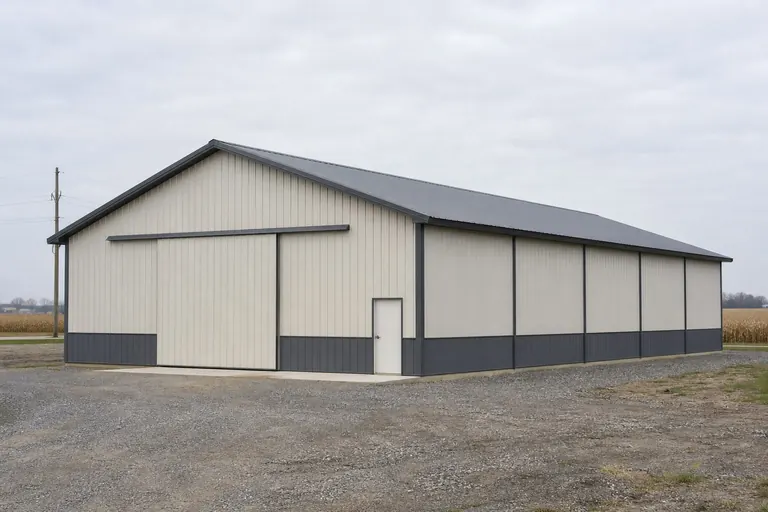 Hay and feed storageDry, ventilated storage sized against a modest-acreage operation rather than a large-scale one.Equipment and implement storageClear-span bays sized for the equipment list of a smaller Maine farm parcel, with room for a tractor and attachments.Firewood and general dry storageA common secondary use on smaller rural parcels where heating needs and outdoor storage both compete for barn space.
Example Configuration — for planning purposes only.
Footprint
Sizes that suit a modest-acreage Maine parcel
A starting range consistent with Maine's smaller average farm size, before a site- and soil-specific plan is drawn.
30′ × 40′
1,200 sq ft
A common starting point on a 174-acre-class parcel for equipment or hay storage.
40′ × 60′
2,400 sq ft
Combined hay and equipment storage where the operation needs more capacity.
Example Configuration — for planning purposes only.
Confirm soil conditions and local snow-load requirements before finalizing a size; footprint pages carry the layout detail.
Questions
Maine pole barn questions
Questions we can answer honestly at the state level, with jurisdiction- and site-specific items routed to who owns them.
It's a useful sizing signal. USDA's 2022 Census recorded 7,036 Maine farms, down from 7,600 in 2017, averaging just 174 acres. That points toward sizing a pole barn against your current operation rather than assuming future growth.
The Maine Geological Survey describes most of the state's surface as glacial and post-glacial sediment — till, marine clay, sand and gravel — rather than exposed bedrock. Soil type varies by site, so a local check before finalizing footing depth is worth doing.
We can't state a design snow load here — that's set by your local building department. NOAA's Portland Jetport normals do show mean snowfall around 15-19 inches in each of January and February, which is a reasonable prompt to discuss roof pitch and truss spacing with your builder.
Permit requirements, including any agricultural-use treatment, are set by your specific town or county. Confirm with your local building department before finalizing a design.
Yes. NOAA's Portland Jetport normals show annual precipitation near 51 inches, spread fairly evenly through the year rather than concentrated in one season, which is worth factoring into gutter and drainage planning year-round.
We do not publish state-level prices, because a credible number depends on specification, site work, soil conditions and current material pricing. Our cost pages cover what drives the number; a quote covers your building.
Sources for the Maine facts on this page
This page states no code requirement, wind speed, snow load, permit rule, price or supplier claim. The state-specific facts it does use are listed with their publisher below.
Maine had 7,036 farms in 2022, down from 7,600 in 2017.
USDA National Agricultural Statistics Service (NASS) · 2022 (with 2017 comparison) · Tier 1
https://www.nass.usda.gov/Publications/AgCensus/2022/Full_Report/Volume_1,_Chapter_1_State_Level/Maine/st23_1_001_001.pdfMaine had 1,225,046 acres of land in farms in 2022, an average farm size of 174 acres.
USDA NASS · 2022 · Tier 1
https://www.nass.usda.gov/Publications/AgCensus/2022/Full_Report/Volume_1,_Chapter_1_State_Level/Maine/st23_1_001_001.pdfThe Maine Geological Survey describes most of the state's surface as mantled by glacial and post-glacial sediments (till, marine clay, sand and gravel) deposited during and after the last ice age, which ended roughly 10,000-16,000 years ago.
Maine Geological Survey (Dept. of Agriculture, Conservation & Forestry) · MGS reference material · Tier 2
https://www.maine.gov/DACF/mgs/explore/surficial/facts/surficial.htmThe Portland, ME NOAA 1991-2020 normals show winter monthly snowfall means around 15-19 inches in January and February, indicative of a snow-heavy northern New England winter.
NOAA National Centers for Environmental Information (NCEI) · 1991-2020 · Tier 1
https://www.ncei.noaa.gov/access/services/data/v1?dataset=normals-monthly-1991-2020&format=pdf&stations=USW00014764Portland, ME's NOAA 1991-2020 climate normals show annual precipitation totals of about 51 inches, distributed fairly evenly through the year with over 3 inches of rain most months.
NOAA National Centers for Environmental Information (NCEI) · 1991-2020 · Tier 1
https://www.ncei.noaa.gov/access/services/data/v1?dataset=normals-monthly-1991-2020&format=pdf&stations=USW00014764