
Pole barn · AK
Pole Barns in Alaska
A pole barn depends on its posts reaching stable ground, which makes Alaska's permafrost mapping the first planning question rather than a footnote. USGS's statewide reference map and its newer 30-meter modeled probability layer both document continuous and discontinuous permafrost across large portions of the state, and an embedded post that would be routine in a temperate climate can face frost jacking or instability on affected ground. At the same time, USDA's 2022 Census of Agriculture counted 1,173 Alaska farms, up 18% from 2017, averaging 742 acres each — real but modest growth on a working-land base that varies widely by operation. This page works through what those two facts change about a pole barn's post depth and its sizing.
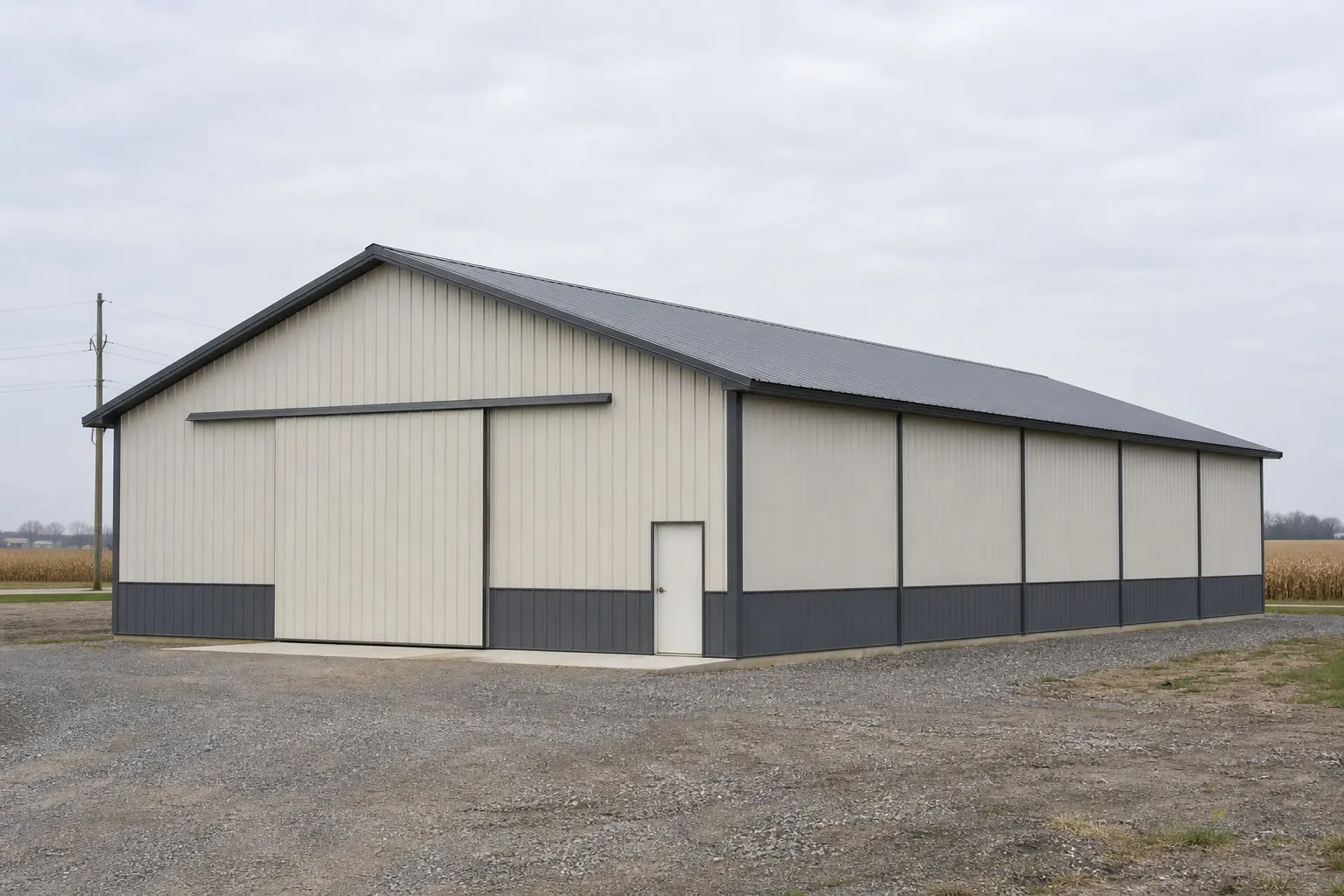
The intersection
A pole barn's posts are only as good as the ground under them
Post-frame construction relies on embedded posts holding position over time, which is exactly the assumption Alaska's permafrost mapping calls into question on affected ground.
A conventional pole barn embeds its posts directly in the ground, relying on soil friction and depth below the frost line to hold the structure steady through freeze-thaw cycles. USGS's reference Permafrost Map of Alaska, a longstanding statewide resource still cited by the agency, documents continuous and discontinuous permafrost across large parts of the state — ground where the standard embedded-post assumption can break down as the active layer above the permafrost table freezes and thaws seasonally.
USGS's EROS Center has since produced a modeled probabilistic map of near-surface permafrost, within one meter of the surface, at 30-meter resolution. That resource lets a buyer get an early read on a specific parcel before paying for an on-site geotechnical investigation, which remains the actual design input once a site looks likely to be affected.
Where ground is confirmed unfrozen and stable, a standard embedded-post pole barn foundation can proceed much as it would elsewhere. Where permafrost is likely, options such as pier foundations bearing below the active layer, or engineered footings designed around ground temperature, are the kind of conversation to have with a structural engineer before a building package is finalized.
Foundation
Deciding the post-footing approach for an Alaska pole barn
A simplified path from ground screening to a footing decision.
| Step | Resource or action | Outcome |
|---|---|---|
| Initial screen | USGS reference Permafrost Map of Alaska | Identifies whether the region is in a mapped continuous/discontinuous permafrost zone |
| Refined screen | USGS EROS 30-meter modeled near-surface permafrost probability map | Narrows likelihood at the specific parcel before a boring is commissioned |
| Ground truth | On-site geotechnical investigation | Confirms depth to stable ground and informs post-footing design |
| Design decision | Structural engineer | Specifies embedded post, pier, or engineered footing based on the above |
Initial screen
- Resource or action
- USGS reference Permafrost Map of Alaska
- Outcome
- Identifies whether the region is in a mapped continuous/discontinuous permafrost zone
Refined screen
- Resource or action
- USGS EROS 30-meter modeled near-surface permafrost probability map
- Outcome
- Narrows likelihood at the specific parcel before a boring is commissioned
Ground truth
- Resource or action
- On-site geotechnical investigation
- Outcome
- Confirms depth to stable ground and informs post-footing design
Design decision
- Resource or action
- Structural engineer
- Outcome
- Specifies embedded post, pier, or engineered footing based on the above
Agricultural scale
Sizing an Alaska pole barn against a growing but modest farm base
Alaska's agricultural sector is expanding in farm count but remains varied enough in scale that a pole barn's size should follow the operation, not a state average.
USDA's 2022 Census of Agriculture counted 1,173 Alaska farms, up 18% from 2017, working 869,852 acres of land in farms, for an average of 742 acres per operation — itself down 14% since 2017 as the mix shifted toward more, and on average somewhat smaller, operations. That direction matters more than the raw average: a growing number of newer or smaller operations means many Alaska pole barns are being planned for a defined, specific equipment list rather than a large-scale commercial footprint.
Because the average spans everything from diversified small farms to larger livestock operations, treating 742 acres as a design number for door width or eave height would be a mistake. The right starting point is the buyer's actual equipment — tractor width, hay handling gear, livestock access — measured directly rather than inferred from a statewide figure.
For operations still finalizing scope, it's worth sizing the pole barn's footprint with room to add a bay later rather than over-building on day one, particularly given the added cost of an engineered foundation on permafrost-flagged ground.
- Measure equipment before setting bay width
- List the largest implement or vehicle that must pass through the door before fixing dimensions.
- Don't size off the statewide average
- 742 acres is an average across widely varying operation types and sizes.
- Leave room to expand
- A phased addition can be cheaper than over-building a foundation on ground that may need engineering.
Get Alaska pole barn quotes
Tell suppliers your equipment list, whether your site needs permafrost screening, and your delivery route. We route it with the Alaska and pole-barn context already attached.
Permitting & access
Confirm permitting and delivery locally, not from a prior project
Both the permitting environment and how materials reach the site vary enough by jurisdiction that a fresh check is worth doing on every project.
Permitting volatility
Census Bureau data shows statewide authorized housing units rose 62.1% from 2022 to 2023, indicating a permitting environment that moves year to year; confirm current requirements with the specific borough or municipal office rather than a past project's experience.
Road-connected sites
Sites with year-round road access to a materials hub generally see more predictable delivery timing for a pole barn kit.
Seasonal-access sites
Sites relying on barge or air freight should have the material order timed to that shipping season, well ahead of a target build date.
Preparation
Before ordering an Alaska pole barn
These steps address the two Alaska-specific risks — ground condition and access — before a kit is ordered.
- Screen the parcel against both USGS permafrost resourcesCheck the reference map and the 30-meter modeled probability layer before assuming a standard embedded-post foundation.
- Commission a geotechnical investigation if the screen flags riskGround truth is the actual design input for post depth or footing type.
- List the equipment the barn must holdSize door width and eave height from measured equipment, not a statewide acreage average.
- Confirm current permit requirements locallyStatewide permit volume moved 62.1% year over year; get the current process from your borough or municipal office.
- Confirm the delivery route and seasonRoad, barge or air access varies by site; time the material order to the actual shipping window.
Questions
Alaska pole barn questions
Honest state-level answers, with anything jurisdiction- or engineer-specific routed to who actually owns it.
Only if the ground supports it. USGS's permafrost mapping documents continuous and discontinuous permafrost across parts of the state, and on affected ground a standard embedded post can face frost jacking, so a site-specific screen and, if needed, an engineered footing are the right approach.
Start with USGS's reference Permafrost Map of Alaska and the newer 30-meter modeled near-surface probability map from USGS's EROS Center, then confirm with an on-site geotechnical investigation before finalizing foundation design.
Size it from your own equipment list. USDA's 2022 Census of Agriculture puts the average Alaska farm at 742 acres, but that figure spans a wide range of operation types and shouldn't dictate door width or eave height on its own.
Farm count is: USDA counted 1,173 Alaska farms in 2022, up 18% from 2017. Total acreage in farms and average farm size moved differently over the same period, so check the current numbers rather than assuming a single trend applies to acreage as well.
Permit requirements depend on your borough or municipality. Statewide authorized housing units swung 62.1% between 2022 and 2023 per Census Bureau data, which suggests confirming current requirements directly with your local building department rather than relying on a past project.
Sources for the Alaska facts on this page
This page states no code requirement, wind speed, snow load, permit rule, price or supplier claim. The state-specific facts it does use are listed with their publisher below.
USGS's Permafrost Map of Alaska (Ferrians, 1965, IMAP 445) documents the widespread distribution of continuous and discontinuous permafrost across the state, a longstanding reference still cited by USGS.
U.S. Geological Survey (USGS) · Originally published 1965; USGS reference · Tier 1
https://www.usgs.gov/maps/permafrost-map-alaskaUSGS's Earth Resources Observation and Science (EROS) Center maintains a modeled probabilistic map of near-surface (within 1 meter) permafrost distribution across Alaska at 30-meter resolution.
U.S. Geological Survey (USGS), EROS Center · USGS EROS reference dataset · Tier 1
https://www.usgs.gov/media/images/modeled-probabilistic-map-near-surface-permafrost-within-alaskaAlaska had 1,173 farms in 2022, up 18% from 2017.
USDA National Agricultural Statistics Service (NASS) · 2022 · Tier 1
https://www.nass.usda.gov/Publications/AgCensus/2022/Online_Resources/County_Profiles/Alaska/cp99002.pdfAlaska had 869,852 acres of land in farms in 2022, an average farm size of 742 acres, down 14% from 2017.
USDA NASS · 2022 · Tier 1
https://www.nass.usda.gov/Publications/AgCensus/2022/Online_Resources/County_Profiles/Alaska/cp99002.pdfAlaska had 937 total housing units authorized by building permits in 2023, up 62.1% from 578 in 2022.
U.S. Census Bureau · 2023 (annual) · Tier 1
https://www.census.gov/construction/bps/pdf/2023annualhighlights.pdf