
Horse barn · AZ
Horse Barns in Arizona
Two Arizona-specific facts shape a horse barn project more than climate alone does. The 2022 Census of Agriculture recorded 16,710 Arizona farms averaging 1,528 acres each, a land-use pattern of large working parcels that a horse property often sits within or alongside. Separately, the Arizona State Land Department manages more than 9 million surface acres of State Trust land, about 13% of the state's total surface ownership — a distinct leasing category from private land that matters if your parcel borders it. Add the National Weather Service's fixed monsoon definition, June 15 through September 30, with blowing dust and haboob events documented as tied to that season's thunderstorm outflow, and the barn's ventilation, dust management and site drainage become genuinely Arizona-specific design questions rather than generic desert-building assumptions.
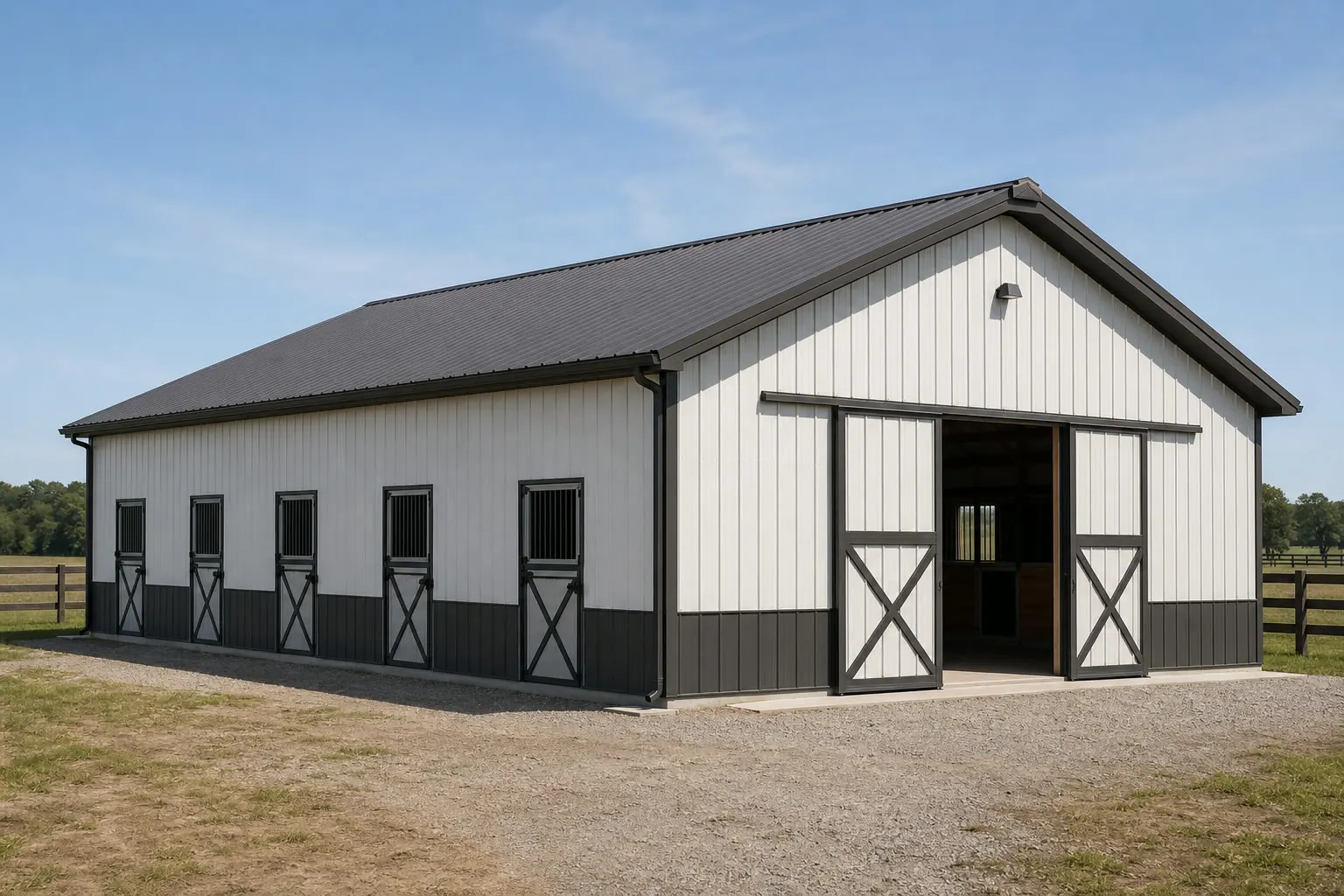
The Arizona variable
Large parcels, mixed ownership, and what that means for a barn
Arizona's 2022 Census of Agriculture reports an average farm size of 1,528 acres across 16,710 farms and 25,525,087 total acres in farms — a scale that shapes access, water and utility planning before the barn design itself.
A horse property sitting inside or adjacent to that large-parcel pattern often has a longer approach drive, a longer utility run to the barn site and a real question about whether power and water already reach the planned pad. None of that is unique to horse barns, but the acreage context in Arizona means it comes up more consistently than it would in a state where the typical agricultural parcel is much smaller.
Ownership at the boundary matters too. Arizona State Land Department trust land covers more than 9 million surface acres, about 13% of the state's surface ownership, and federal land covers roughly 28.1 million of the state's 34.4 million total acres. A property that borders either category should confirm the specific access, fencing and easement terms with the managing agency — the State Land Department for trust land, the relevant federal agency for public land — rather than assume the boundary behaves like a line between two private parcels.
Site context
Low desert, transition zone and plateau properties differ
Arizona's physiographic split affects heat, elevation and access for a horse property differently depending on where it sits.
Low desert basins
Summer heat and the monsoon dust window are the dominant design considerations; shade and airflow through the barn matter as much as stall count.
Transition and foothill country
Elevation moderates summer heat somewhat, but access roads can be steeper and utility runs longer to reach a pad set back from the main road.
Colorado Plateau (northeast)
Higher, cooler ground with its own seasonal access considerations distinct from the low desert monsoon pattern.
Climate
The monsoon window is a barn design conversation, not just a weather note
NWS defines the Arizona monsoon as a fixed June 15 to September 30 window and documents blowing dust and haboob events as tied to that season's thunderstorm outflow.
For a horse barn, that translates into two practical questions worth raising with your builder: how the aisle and stall ventilation performs when you need airflow for heat but want to close against a sudden dust-laden outflow gust, and how the apron and paddock drainage handle the abrupt runoff that can follow a monsoon storm cell after weeks of dry ground.
NOAA's state climate summary also documents roughly 2.5°F of warming since the early 1900s and identifies drought as a serious ongoing hazard in Arizona, which is part of the reason water access and heat management deserve early attention in a barn brief here rather than being treated as an afterthought behind the stall layout.
Get Arizona horse barn quotes
Tell us your county, whether your parcel borders public or trust land, and how many stalls you need. We pass the site context through with the enquiry.
Process
There is no single Arizona building-code office to call
Arizona has no single statewide building-code agency for general construction; its uniform statewide code adoption reaches only the Fire Code, and Arizona Revised Statutes confirm that counties and municipalities adopt construction codes locally.
That means the answer to 'does my barn need a permit' and 'does an agricultural exemption apply' comes only from your county or city building department, not from a statewide rule. Ask early, and ask specifically about how your jurisdiction classifies an equine structure, since that classification can change the documentation and inspection path more than the building's size does.
If your parcel borders State Trust or federal land, raise that in the same conversation — some jurisdictions treat setback and access requirements differently near a public-land boundary, and it is worth knowing before you fix the barn's location on the site.
Footprint
Barn footprints that suit Arizona sites
Arizona briefs on larger parcels often add covered outdoor space and shaded runs rather than enclosing everything, since heat management favors airflow over full enclosure for much of the year.
30′ × 40′
1,200 sq ft
Small private barn with two to three stalls and a shaded aisle.
36′ × 48′
1,728 sq ft
Adds a tack and feed room while keeping the aisle open for airflow.
40′ × 60′
2,400 sq ft
Centre-aisle layout with room for wash and storage without crowding the aisle.
40′ × 100′
4,000 sq ft
Where the brief adds a covered run or shelter alongside the stall block, common on larger Arizona parcels.
Example Configuration — for planning purposes only.
Stall and aisle dimensions live on the footprint pages; this page explains why Arizona briefs on large parcels often add shaded, open-air space.
Questions
Arizona horse barn questions
State-level answers where they exist, and honest routing where they do not.
Arizona has no single statewide building-code agency for general construction, so the answer depends on your city or county. Ask your local building department how it classifies an agricultural or equine structure before finalizing a design.
Confirm with the Arizona State Land Department first. Trust land covers more than 9 million surface acres statewide, about 13% of Arizona's surface ownership, and is leased under different terms than private land, which can affect fencing and access near the boundary.
NWS defines the monsoon as running June 15 through September 30 and documents blowing dust and haboob events tied to that season's storm outflow. That is worth a specific ventilation and drainage conversation with your builder, though we do not publish a design specification here.
We could not verify a current, primary-sourced Arizona equine population figure in this pass, so we make no claim about it. The USDA Census of Agriculture's equine inventory tables are the right place to check directly.
There is no official typical size. On the larger parcels common in Arizona, briefs most often fall between roughly 30x40 for a small private barn and 40x100 where covered outdoor space is added, driven by use rather than a regional norm.
It can. With roughly 28.1 million of Arizona's 34.4 million acres federally owned, a rural property is more likely than in many states to border public land, which can raise access, fencing or grazing questions worth confirming with the managing agency.
Sources for the Arizona facts on this page
This page states no code requirement, wind speed, snow load, permit rule, price or supplier claim. The state-specific facts it does use are listed with their publisher below.
The 2022 Census of Agriculture counted 16,710 farms in Arizona (down 12% from 2017).
USDA National Agricultural Statistics Service (NASS) · 2022 · Tier 1
https://www.nass.usda.gov/Publications/AgCensus/2022/Online_Resources/County_Profiles/Arizona/cp99004.pdfLand in farms in Arizona totaled 25,525,087 acres in the 2022 Census, down about 2% from 2017.
USDA NASS · 2022 · Tier 1
https://www.nass.usda.gov/Publications/AgCensus/2022/Online_Resources/County_Profiles/Arizona/cp99004.pdfAverage Arizona farm size in the 2022 Census was 1,528 acres, up about 12% from 2017.
USDA NASS · 2022 · Tier 1
https://www.nass.usda.gov/Publications/AgCensus/2022/Online_Resources/County_Profiles/Arizona/cp99004.pdfArizona has more than 9 million surface acres of State Trust land, about 13% of the state's total surface land ownership.
Arizona State Land Department · current, accessed 2024 · Tier 2
https://land.az.gov/our-agency-missionCRS's federal land ownership dataset lists Arizona federal acreage at roughly 28.1 million acres (2013 data) against total state acreage of approximately 34.4 million acres.
Congressional Research Service · data as of FY2013, report dated March 3, 2017 · Tier 1
https://www.everycrsreport.com/files/20170303_R42346_95ce191e74ed8e08054bb5476971544bc55823f2.htmlThe North American Monsoon in Arizona runs from June 15 to September 30 each year (a fixed calendar definition, not a rainfall trigger).
NOAA/National Weather Service (Tucson office) · current/ongoing definition · Tier 1
https://www.weather.gov/media/twc/Monsoon.pdfNWS documents blowing dust and dust storms (haboobs) as an underrated Arizona weather hazard, tied to monsoon thunderstorm outflows.
NOAA/National Weather Service · July 2016 · Tier 1
https://www.weather.gov/media/wrh/online_publications/TMs/TM-290.pdfArizona building codes are governed at the local jurisdiction level rather than by a single statewide building code agency; the state's uniform statewide adoption applies only to the Fire Code.
UpCodes (citing Arizona State Fire Marshal statewide fire code adoption) · current, accessed 2024/2025 · Tier 3
https://up.codes/codes/arizona