
Hobby shop · UT
Hobby Shops in Utah
A hobby shop in Utah is usually built on a working farm or ranch parcel rather than a suburban lot — the 2022 Census of Agriculture puts the state's average farm at 604 acres, up about 3% from 2017 — and that scale changes what a small building actually needs to do. It also gets built inside a state with an unusually extreme elevation spread: Utah Agriculture in the Classroom lists Kings Peak at 13,528 feet against Beaver Dam Wash at only 2,350 feet, a difference of more than 11,000 feet within one state's borders. A shop planned near the desert floor and one planned in highland ranch country are answering different climate questions even though both sit in Utah, and both sit on a private-land slice that is proportionally thinner than in most states given the roughly 33.3 million federal acres the Congressional Research Service counts statewide.
Working-Land Context
A Shop Built Into a 604-Acre Operation
On the typical Utah farm, a hobby shop is less a leisure structure and more a working annex to equipment and maintenance needs.
The 2022 Census of Agriculture put Utah's average farm at 604 acres, up about 3% from 2017, across 17,386 total farms statewide (down roughly 6% from 2017). On a parcel that size, a hobby shop often ends up serving double duty: restoring an old tractor, fabricating fence or irrigation parts, or simply providing a dedicated bay for maintenance work that would otherwise happen in the open. That role shapes the brief differently than a suburban hobby room, since the shop needs to sit within practical reach of equipment yards and existing outbuildings rather than tucked behind a house.
Total land in farms across Utah came to 10,494,923 acres in the same 2022 Census, down about 3% from 2017 — a reminder that even with generous average parcel sizes, Utah's agricultural land base is shrinking slightly rather than growing. A hobby shop site plan on a working Utah parcel is worth locking in sooner rather than assuming more room will always be available later.
Climate Range
Two Utah Shops, Two Different Envelopes
Utah's elevation range is wide enough that a shop's insulation and access planning has to be tied to the actual site, not to a generic statewide description.
Utah Agriculture in the Classroom's reference sheet lists Kings Peak at 13,528 feet as the state's highest point and Beaver Dam Wash at 2,350 feet as its lowest — an elevation range exceeding 11,000 feet. The same source splits the state into desert (33%), steppe (43%), and highland/mountain (24%) climate zones. A shop planned for a low desert basin faces dust and heat-management questions; one planned for highland ranch country faces snow-season access and a shorter comfortable build window. Neither description transfers cleanly to the other.
That elevation spread also affects a more mundane decision: how far the shop sits from the property's existing electrical service. On a 604-acre average parcel, a hobby shop sited a few hundred feet — or more — from the main panel can require a dedicated sub-panel and a longer trenched run than the same building would need on a quarter-acre suburban lot. Pricing that run with an electrician before finalizing the site avoids a shop that ends up under-served for the tools it was built to house.
- Match Insulation to Actual Elevation
- Don't borrow a design assumption from a different climate zone across the state.
- Confirm Land Tenure Before Siting
- With roughly 33.3 of Utah's 33.6 million acres federally owned, verify the parcel is genuinely private.
- Price the Electrical Run Early
- Distance from the main panel on a large parcel is a real site-plan cost, not an afterthought.
Application
Utah Hobby Shop Configurations
Workshop styles suited to Utah's working-farm scale and elevation split.
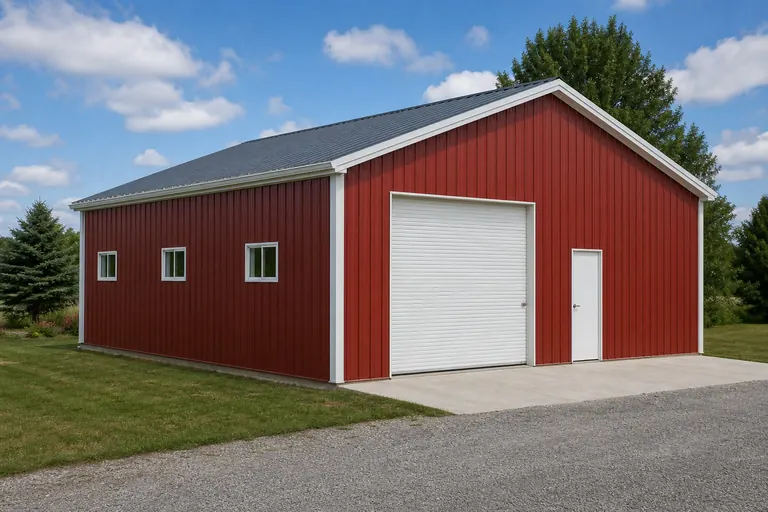 Ranch Fabrication ShopA high-clearance bay for equipment repair and fabrication on a working Utah parcel.Highland Restoration GarageInsulated space tuned for snow-season access and a shorter build window in mountain ranch country.Desert-Basin WorkshopA dust-and-heat-managed shop for lower-elevation Basin and Range parcels.
Example Configuration — for planning purposes only.
Footprint
Sizing the Utah Workshop
Reflecting the dual-purpose nature of hobby shops on larger Utah parcels.
24′ × 30′
720 sq ft
A compact single-use shop for woodworking or light maintenance.
30′ × 40′
1,200 sq ft
A multi-use hobby space with room for a vehicle, suited to a working parcel.
40′ × 60′
2,400 sq ft
Professional-grade workshop for restoration and heavier fabrication.
Example Configuration — for planning purposes only.
Footprint choice should account for equipment clearance and the property's actual elevation and access; consult our size pages for layout detail.
Build Your Utah Workshop
Ready for a shop tuned to your parcel's elevation and scale? Get a quote for a Utah-suited hobby shop today.
Preparation
Before You Site a Utah Hobby Shop
A hobby shop is small enough to be an afterthought in the site plan, which is exactly why these questions get skipped and later regretted.
- Confirm the parcel is genuinely privateGiven how much of Utah is federally or trust-owned, verify tenure with the county recorder or SITLA before committing to a site.
- Match the design to your actual elevationDon't reuse a design assumption drawn from a different zone; get a local reading.
- Price the power run before the slabDistance from the main service on a large parcel drives trenching cost more than the shop's own electrical load.
- Plan access for snow-season months if you're in highland countryA shop that's hard to reach for three months of the year loses much of its working value.
Terrain
The Province Under the Slab Is a Separate Question From the Elevation Above It
Utah Division of State History places the state at the convergence of three physiographic provinces, and that geology, not just elevation, shapes a hobby shop's foundation approach.
A hobby shop in the Rocky Mountain Province, near the Uinta or Wasatch ranges, sits on ground where slope and variable soil depth near the foothills make grading the first foundation question, independent of whether the site is high or low in elevation terms. A shop on the Colorado Plateau may hit exposed bedrock the excavator has to work around, while a shop in the Basin and Range's broad valley floors is more likely to face a drainage question across flat ground than a slope question.
None of that duplicates the elevation-and-climate-zone reasoning above: two parcels at similar elevation can sit in different provinces and need different foundation approaches, just as two parcels in the same province can sit at very different elevations and need different insulation approaches. A shop buyer benefits from checking both independently rather than assuming one predicts the other.
Questions
Utah Hobby Shop FAQ
Honest answers grounded in Utah's own scale and terrain evidence.
Not necessarily bigger, but the layout often needs to serve equipment maintenance alongside hobby use. With average farms at 604 acres, many Utah hobby shops end up doubling as a repair bay for the operation.
Yes, meaningfully. The state spans from 2,350 feet at Beaver Dam Wash to 13,528 feet at Kings Peak, and splits into desert, steppe, and highland/mountain climate zones. A shop's insulation and access plan should be based on the actual site elevation, not a statewide assumption.
Check first. Roughly 33.3 million of Utah's approximately 33.6 million acres are federally owned, and SITLA manages additional state trust land. Confirm tenure with the county recorder before finalizing a shop site.
There's no fixed rule. A shop close to the house is cheaper to wire and easier to visit daily; one sited farther out near other outbuildings benefits from proximity to equipment but costs more to run power to.
There's no official standard size, but a 24x30 to 40x60 range covers most single- and multi-use Utah hobby shops. Confirm clearance needs against your specific equipment before finalizing.
Sources for the Utah facts on this page
This page states no code requirement, wind speed, snow load, permit rule, price or supplier claim. The state-specific facts it does use are listed with their publisher below.
Average Utah farm size in the 2022 Census was 604 acres, up about 3% from 2017.
USDA NASS · 2022 · Tier 1
https://www.nass.usda.gov/Publications/AgCensus/2022/Online_Resources/County_Profiles/Utah/cp99049.pdfThe 2022 Census of Agriculture counted 17,386 farms in Utah (down about 6% from 2017).
USDA NASS · 2022 · Tier 1
https://www.nass.usda.gov/Publications/AgCensus/2022/Online_Resources/County_Profiles/Utah/cp99049.pdfUtah's highest point is Kings Peak at 13,528 feet and its lowest point is Beaver Dam Wash at 2,350 feet, illustrating the mountain-versus-valley elevation and climate contrast used in state education materials.
Utah Agriculture in the Classroom (agclassroom.org, hosted via Utah State University Extension network) · current reference sheet · Tier 3
https://cdn.agclassroom.org/ut/lessons/cc/ut_elevation_precip_maps.pdfUtah has three distinct climate zones: desert (33% of the state), steppe (43%), and highland/mountain (24%), reflecting the valley-to-mountain precipitation and snowfall contrast.
Utah Agriculture in the Classroom · current reference sheet · Tier 3
https://cdn.agclassroom.org/ut/lessons/cc/ut_elevation_precip_maps.pdfCRS's federal land ownership dataset lists Utah federal acreage at roughly 33.3 million acres (2013 data) against total state acreage of approximately 33.6 million acres.
Congressional Research Service · data as of FY2013, report dated March 3, 2017 · Tier 1
https://www.everycrsreport.com/files/20170303_R42346_95ce191e74ed8e08054bb5476971544bc55823f2.htmlUtah lies at the convergence of three physiographic provinces: the Rocky Mountain Province (Uinta and Wasatch mountains) in the northeast, the Colorado Plateau in the east/southeast, and the Basin and Range in the west.
Utah Division of State History (History to Go) · current reference page · Tier 2
https://historytogo.utah.gov/unique-setting/Utah's Division of Professional Licensing (DOPL), within the Department of Commerce, administers the Uniform Building Standards Act and works with the Uniform Building Code Commission to promote statewide uniformity in code enforcement.
Utah Department of Commerce, Division of Professional Licensing · current, accessed 2024/2025 · Tier 2
https://commerce.utah.gov/dopl/uniform-building-codes/