
Hobby shop · MD
Hobby Shops in Maryland
A hobby shop in Maryland has to answer to whichever of the state's three physiographic regions it sits in. On the humid Coastal Plain near the Chesapeake, moisture control inside the shop matters more than anything else. On the Piedmont slopes through the Baltimore exurbs, siting and drainage around the pad take priority. In the western mountain provinces, access and a wider seasonal temperature swing shape the build. This page treats those as three different Maryland conversations rather than one generic answer.
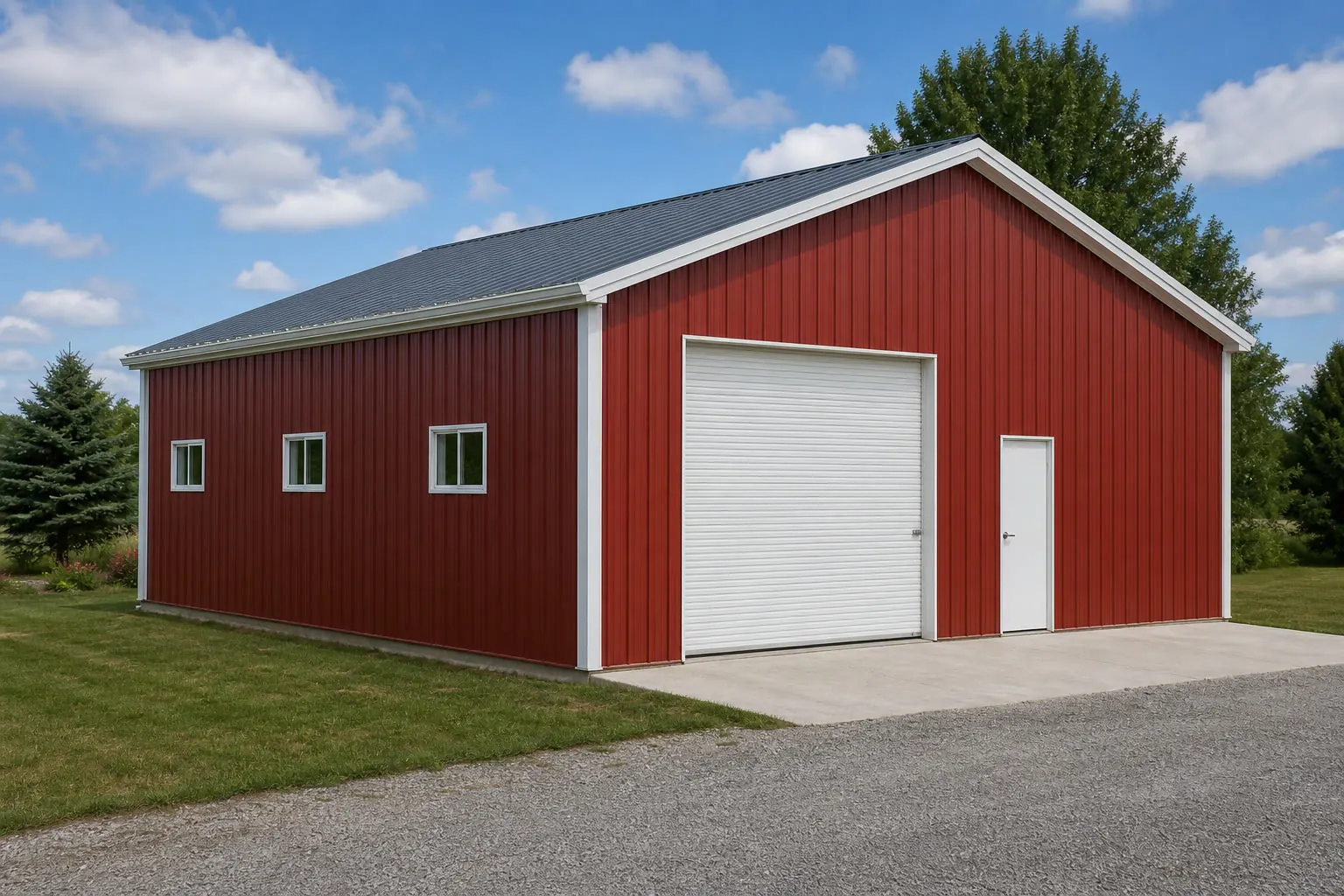
Three regions, one small state
Maryland's Coastal Plain, Piedmont, and western mountain provinces sit close enough together that a hobby shop plan built for one does not automatically suit another. This page walks through what actually changes depending on which of the three you are building in.
Climate
Moisture control depends on which part of Maryland you're in
The only precipitation figure we can verify is a BWI-area station normal of roughly 44-46 inches annually, and it is most representative of the Coastal Plain and central Maryland, not the whole state.
A hobby shop near the Chesapeake or on the Eastern Shore is sitting in air that stays humid for much of the year, which matters most for woodworking, upholstery, or any hobby involving materials sensitive to moisture. A vapor barrier under the slab, a dehumidification plan, and ventilation that does not simply pull more damp outside air in are worth planning for from the start rather than retrofitting once tools start rusting or wood starts cupping.
Move into the Piedmont belt through central Maryland and the humidity story softens somewhat, but the terrain problem grows. A shop sited on a slope needs its pad graded so that roof runoff and site drainage move away from the building and away from the driveway rather than pooling at the door or eroding the approach after a heavy storm.
In the western mountain counties, where the Blue Ridge, Valley and Ridge, and Appalachian Plateau provinces meet, the practical concern shifts again toward a wider seasonal temperature swing and constrained rural access. A narrow mountain access road can limit what delivery vehicle or crane can reach the site, which is worth confirming with a builder before committing to a specific footprint or door configuration.
None of these regional differences replace a site visit or a conversation with your county's building department. They exist so a Maryland buyer knows which questions to ask depending on where in the state the shop will actually sit.
Because FEMA's National Risk Index tracks 18 separate hazard types across Maryland's 24 jurisdictions, and coastal flood exposure concentrates near the Chesapeake rather than statewide, checking your specific county's hazard profile is a more useful step than assuming a single statewide risk level applies to your shop.
Insulation strategy tracks the same regional split as moisture control. A Coastal Plain shop benefits from vapor-barrier detailing aimed at keeping ambient humidity out of the wall cavity year-round, since the climate rarely delivers a truly dry stretch. A western Maryland shop, by contrast, deals with a wider swing between summer and winter conditions, so the insulation conversation there is more about holding a stable interior temperature for tools, finishes, and any equipment sensitive to freeze-thaw cycling than about excluding humidity specifically.
Siting
Working with a tighter Maryland parcel
Maryland's average farm size of 158 acres is comparatively tight, which changes how far a shop can sensibly sit from utilities.
In larger farm states, a hobby shop can sit a considerable distance from the main house without much added cost. On a Maryland-sized parcel, that distance is usually shorter, which is good news for utility trenching costs but still worth planning deliberately: decide where power and water will run before the pad is poured, not after.
Maryland authorized 16,823 new housing units in 2024, a steady statewide volume that means local building departments are used to processing detached-structure permits regularly. That is a reason to bring a clear site plan and a specific description of the shop's use to your first conversation with the department, since a well-documented application tends to move faster through an already-busy queue.
- Plan utility runs early
- Decide the shop's distance from the house and its power and water routing before finalizing the pad location.
- Check your county's hazard profile
- Use the FEMA National Risk Index to see which of the 18 tracked hazards apply most to your specific jurisdiction.
- Confirm access for your region
- Western Maryland's mountain roads can limit delivery and crane access; confirm this before selecting a footprint.
- Match insulation strategy to your region
- Prioritize vapor-barrier detailing on the humid Coastal Plain and temperature-stability detailing in the wider-swing western counties.
Get Maryland hobby shop quotes
Tell us your region of the state and your rough footprint. We route it with the Maryland and hobby shop context already attached.
Before you order
Maryland hobby shop planning checklist
Confirm these locally before finalizing a floor plan; none of them are set by a single statewide rule.
Step 1
Identify your physiographic region
Coastal Plain, Piedmont, or western mountain siting each call for a different drainage and moisture-control plan.
Step 2
Plan for humidity if you're near the Chesapeake
A vapor barrier, dehumidification, and controlled ventilation matter more on the Coastal Plain than in higher, drier parts of the state.
Step 3
Check your county's FEMA NRI hazard profile
Hazard exposure varies significantly between coastal and inland Maryland jurisdictions.
Step 4
Confirm access for a western Maryland site
Narrow mountain roads can constrain delivery vehicle size; confirm with your builder before finalizing dimensions.
Footprints
Hobby shop footprints common in Maryland
Maryland's tighter average parcel size tends to keep footprints modest relative to larger farm states.
24′ × 30′
720 sq ft
A single-project bay suited to a tighter Coastal Plain or Piedmont lot.
30′ × 40′
1,200 sq ft
Room for a vehicle lift or a dedicated finishing area.
40′ × 60′
2,400 sq ft
A larger combination shop where the parcel has room, more common on western Maryland acreage.
Example Configuration — for planning purposes only.
Confirm your county's detached-structure setback and height limits before selecting a footprint.
Questions
Maryland hobby shop FAQ
Answered honestly at the state level, with anything requiring local or regional judgment routed to the people who actually own that answer.
It depends where in Maryland you are. Near the Chesapeake and on the Coastal Plain, humidity is a real concern reflected in the BWI-area precipitation normal; in the higher, drier western counties, it matters less. Plan moisture control around your specific region.
Yes. Piedmont sites deal with grading and runoff on sloped ground, while Eastern Shore sites deal with flat, slow-draining terrain and, in some areas, tidal flood exposure. These are different siting problems, not variations on the same one.
It can. FEMA's National Risk Index tracks 18 hazard types across Maryland's 24 jurisdictions, and coastal flood exposure concentrates near the Chesapeake, so check your county's specific profile rather than assuming a statewide risk level.
There is no official typical size. Because Maryland's average parcel is comparatively tight, footprints commonly land between 24x30 and 40x60 depending on region and use.
Permitting runs through local county or municipal building departments. Confirm requirements with your specific jurisdiction before finalizing a plan.
Sources for the Maryland facts on this page
This page states no code requirement, wind speed, snow load, permit rule, price or supplier claim. The state-specific facts it does use are listed with their publisher below.
The Maryland Geological Survey describes the state as spanning three distinct physiographic regions -- the Coastal Plain, the Piedmont, and the combined Blue Ridge, Valley and Ridge, and Appalachian Plateau provinces -- extending from the Atlantic coast to the western mountains.
Maryland Geological Survey · MGS reference material · Tier 2
https://www.mgs.md.gov/geology/geology_of_maryland.htmlThe BWI Airport (Baltimore/Annapolis area) NOAA 1991-2020 climate normals show total annual precipitation of roughly 44-46 inches spread fairly evenly across the year.
NOAA National Centers for Environmental Information (NCEI) · 1991-2020 · Tier 1
https://www.ncei.noaa.gov/access/services/data/v1?dataTypes=MLY-TMAX-NORMAL%2CMLY-TMIN-NORMAL%2CMLY-TAVG-NORMAL%2CMLY-PRCP-NORMAL%2CMLY-SNOW-NORMAL&dataset=normals-monthly-1991-2020&format=pdf&stations=USW00013752FEMA's National Risk Index is the federal tool for county- and state-level natural hazard exposure data for Maryland's 24 jurisdictions, covering 18 hazard types including coastal flooding, hurricane, and winter weather.
Federal Emergency Management Agency (FEMA) · Current NRI release · Tier 1
https://www.fema.gov/flood-maps/products-tools/national-risk-indexMaryland had 1,978,036 acres of land in farms in 2022, an average farm size of 158 acres.
USDA NASS · 2022 · Tier 1
https://www.nass.usda.gov/Publications/AgCensus/2022/Full_Report/Volume_1,_Chapter_1_State_Level/Maryland/st24_1_001_001.pdfBuilders in Maryland were authorized to construct 16,823 new privately-owned housing units in 2024, of which 10,885 were single-unit structures.
U.S. Census Bureau · 2024 (final annual estimates) · Tier 1
https://www.census.gov/construction/bps/stateannual.html