
Commercial building · MT
Commercial Steel Buildings in Montana
A commercial building in Montana is planned against two facts that rarely show up together: the state's working-land base is consolidating into fewer, much larger operations, and total residential construction activity fell by a third in a single recent year. USDA's 2022 Census of Agriculture counted 24,266 Montana farms, down 10% since 2017, spread across 57,601,320 acres at an average of 2,374 acres per farm — the largest average farm size among the states in this evidence set. At the same time, the U.S. Census Bureau recorded a 33.3% drop in new privately-owned housing units authorized statewide between 2022 and 2023, one of the five steepest year-over-year declines nationally that year. Neither figure describes commercial permitting directly, but together they describe a state where fewer, larger landowners and a visibly cyclical building market both shape how a commercial project gets scoped, bid, and scheduled.
Working-Land Backdrop
Fewer, Larger Operations Are Driving Commercial Demand
Montana's commercial building demand tied to agriculture increasingly comes from a shrinking number of much larger operations rather than a broad base of small parcels.
USDA's 2022 Census of Agriculture counted 24,266 farms in Montana, a 10% decrease from 2017, spread across 57,601,320 acres in farms. Divide those two numbers and the average Montana farm runs 2,374 acres — the largest average farm size among the states covered in this evidence pack. For a commercial buyer, that combination points toward facilities built for fewer, larger accounts: bigger feed or equipment storage buildings, consolidated handling facilities, and distribution points serving a wider service radius, rather than a proliferation of small-scale local storage buildings.
The land-use split behind those acreage numbers also matters for interior planning. A NASS Ag Facts sheet reports Montana's farm and ranch land running roughly 28% cropland, 5% woodland, with the remainder chiefly permanent pasture and rangeland. That mix skews commercial demand toward livestock-support buildings — feed storage, handling facilities, veterinary or shearing support structures — more than toward grain-processing plants, which is a different interior specification than a crop-heavy state would require.
A buyer scoping a commercial building tied to a Montana ranching operation should therefore start from the operation's herd size and service radius rather than from a generic commercial-warehouse template, since the acreage and land-use data both point toward larger, more consolidated facilities than a small-farm state would need.
Market Timing
A Construction Market That Swings Sharply Year to Year
The U.S. Census Bureau's authorized-housing-unit data shows Montana's construction activity is genuinely cyclical, which should factor into how a commercial project is bid and scheduled.
The Census Bureau's 2023 annual building permits report counted 4,307 total new privately-owned housing units authorized statewide, down 33.3% from 6,460 units in 2022 — one of the five largest percentage declines of any state that year. That figure covers housing rather than commercial construction directly, but it is a useful proxy for the broader local construction economy: contractor capacity, material lead times, and subcontractor availability tend to move with the same cycle, whether the project on the books is residential or commercial.
For a commercial buyer, the practical implication is to ask a prospective contractor directly where their current backlog sits before assuming a bid timeline. A quote taken during a slack period in the local construction cycle may carry a very different lead time than the same building requested during a busier stretch, and that timing question is worth raising before a schedule is locked to a business opening date.
- Ask About Current Backlog
- Montana's construction volume swings enough year to year that contractor lead time is not a fixed number.
- Confirm Material Lead Times Locally
- A statewide construction slowdown does not guarantee shorter lead times in every county; verify with your contractor.
- Scope for Consolidated Operations
- Larger average farm and ranch sizes point toward bigger, fewer commercial facilities rather than many small ones.
Site Selection
The Continental Divide Splits the Siting Conversation
Montana's geography divides cleanly into a mountainous west and a high-plains east, and a commercial site plan should be scoped to whichever half a parcel sits in.
Mountainous West (Rocky Mountains)
Steeper terrain, more constrained buildable pads, and watersheds draining toward the Pacific; access grading and drainage design typically carry more weight in the site budget here.
High-Plains East
Rolling grassland with generally more open, buildable ground; wind exposure and long access-road distances to service and utility infrastructure are the more common site-planning questions.
Get Montana Commercial Building Quotes
Tell us which side of the Divide your site is on, your intended use, and your operation's scale, and we'll route the right questions with your Montana context attached.
Exposure and Design
Why a Statewide Hazard Score or Climate Number Doesn't Settle a Site
FEMA's county-level hazard data and NOAA's single-station climate normal both show why a Montana commercial buyer should route design questions locally rather than to a statewide average.
FEMA's National Risk Index reports a mean composite risk score of 33.3 out of 100 across Montana's 56 counties on its v1.20 dataset. A mean, by definition, is not any one county's number: some Montana counties will score meaningfully above that average and some below it. A commercial buyer should pull the county-specific NRI report for the parcel in question rather than treat 33.3 as a description of their site.
On climate, NOAA's National Centers for Environmental Information publish a 1991-2020 normal for the Billings, MT station showing 15.43 inches of annual precipitation and 35.0 inches of annual snowfall. That is a single-station figure, and it is explicitly not representative of Montana's western mountain valleys or the Hi-Line region in the state's north, both of which see materially different precipitation and snowfall patterns. Structural design values — snow load, frost depth, wind exposure — should come from the local building department for the specific parcel, not from a Billings-area reference point applied statewide.
Configuration
How Montana Commercial Buildings Get Used
Montana's land-use mix and construction-cycle context shape the commercial building briefs seen in the state.
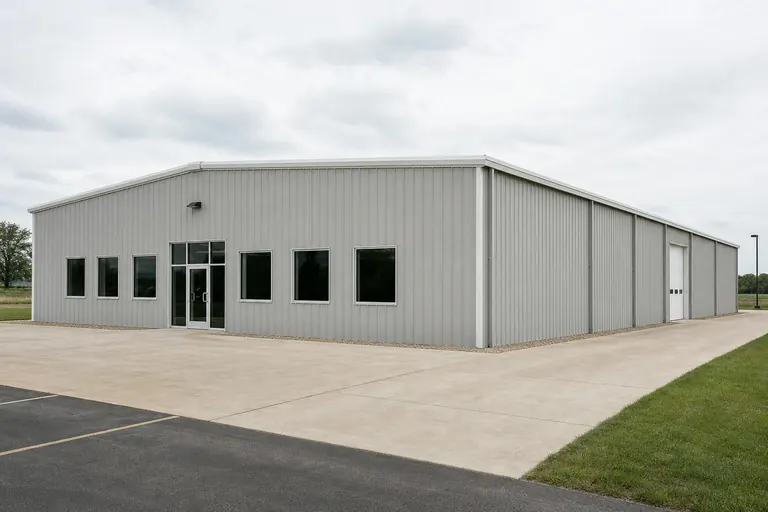 Ranch-Support Storage and HandlingFeed storage, equipment bays, and livestock-handling support buildings scoped for the larger average Montana ranch parcel, sized for a consolidated operation rather than a small-farm footprint.Light Industrial / DistributionClear-span working bays serving a wider service radius than a denser state would require, given Montana's low overall population density and large average parcel size.Retail or Office FrontA finished front section attached to a working bay, more often found in the state's handful of metro corridors along the high-plains east.
Example Configuration — for planning purposes only.
Footprint
Sizes That Suit Common Montana Commercial Briefs
A reasonable starting range before a site-specific plan is drawn.
40′ × 60′
2,400 sq ft
A single working bay with a small office corner.
60′ × 100′
6,000 sq ft
Room for a working bay plus a retail or showroom front.
80′ × 150′
12,000 sq ft
Larger ranch-support or multi-bay light-industrial footprints for a consolidated operation.
Example Configuration — for planning purposes only.
Footprint pages carry layout detail; confirm code, snow load, and permit specifics with your local building department before finalizing a plan.
Questions
Montana Commercial Steel Building Questions
Questions answered honestly at the state level, with the rest routed to the party that owns them.
USDA's 2022 Census of Agriculture reports an average Montana farm size of 2,374 acres, the largest average size in this evidence set, and a 10% drop in farm count since 2017. That points toward fewer, larger operations, which tend to need bigger, more consolidated storage and handling facilities.
It varies year to year. The U.S. Census Bureau recorded a 33.3% drop in authorized housing units statewide between 2022 and 2023, one of the sharpest declines nationally that year. Ask a prospective contractor directly about their current backlog rather than assuming a fixed lead time.
Yes. Montana splits into a mountainous west and a high-plains east along the Continental Divide, and site prep, grading, and access considerations differ meaningfully between the two.
FEMA's National Risk Index scores Montana's 56 counties individually, with a mean composite score of 33.3 out of 100 statewide. Pull the report for your specific county rather than relying on the statewide average.
No. NOAA's 1991-2020 normal for the Billings station reflects that specific location. Montana's western mountain valleys and the Hi-Line see substantially different precipitation and snowfall, so confirm structural design values with your local building department.
There's no official typical size; use varies by industry and operation scale. Many enquiries fall between 40x60 and 80x150 depending on whether the building serves ranch support, light-industrial, or retail/office use.
Sources for the Montana facts on this page
This page states no code requirement, wind speed, snow load, permit rule, price or supplier claim. The state-specific facts it does use are listed with their publisher below.
Montana had 24,266 farms in 2022, a 10% decrease since 2017.
USDA National Agricultural Statistics Service (NASS) · 2022 · Tier 1
https://www.nass.usda.gov/Publications/AgCensus/2022/Online_Resources/County_Profiles/Montana/cp99030.pdfMontana had 57,601,320 acres of land in farms in 2022, the largest average farm size of any of the four states covered here at 2,374 acres.
USDA NASS · 2022 · Tier 1
https://www.nass.usda.gov/Publications/AgCensus/2022/Online_Resources/County_Profiles/Montana/cp99030.pdfA NASS Montana Ag Facts sheet reports the state's farm and ranch land in 2022 broken down as 28% cropland, 5% woodland, and the remainder chiefly permanent pasture and rangeland.
USDA National Agricultural Statistics Service (NASS), Montana Field Office · Based on 2022 Census of Agriculture · Tier 1
https://www.nass.usda.gov/Statistics_by_State/Montana/Publications/Special_Interest_Reports/MT-Montana-Ag-Facts-04082025.pdfBuilding permit offices in Montana authorized construction of 4,307 new privately-owned housing units in 2023, a 33.3% decrease from 6,460 units in 2022, one of the five largest percentage declines of any state that year.
U.S. Census Bureau · 2023 (final annual) · Tier 1
https://www.census.gov/construction/bps/pdf/2023annualhighlights.pdfMontana is split into two broad geographic regions by the Rocky Mountains: mountainous terrain in the west and rolling high-plains grassland in the east, with the Continental Divide separating watersheds draining to the Pacific, the Gulf of Mexico, and Hudson Bay.
University of Montana · Reference material · Tier 2
https://www.umt.edu/this-is-montana/columns/stories/montana_regions_1of3.phpBuilding permit offices in Montana authorized construction of 4,307 new privately-owned housing units in 2023, a 33.3% decrease from 6,460 units in 2022, one of the five largest percentage declines of any state that year.
U.S. Census Bureau · 2023 (final annual) · Tier 1
https://www.census.gov/construction/bps/pdf/2023annualhighlights.pdf