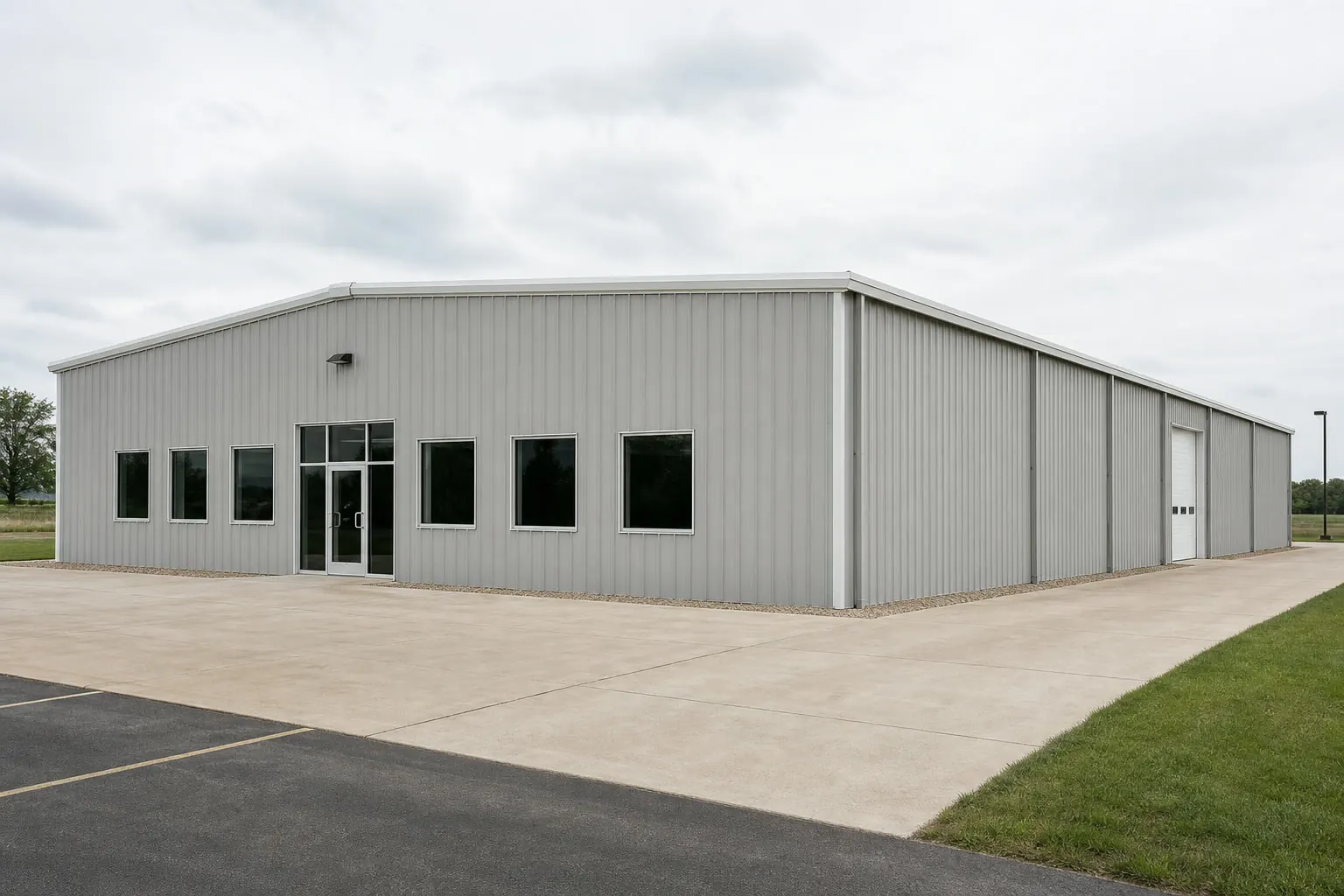
Commercial building · AZ
Commercial Steel Buildings in Arizona
A commercial steel building in Arizona is planned against a land base where the open-market private option is smaller than it looks on a map: the Congressional Research Service puts roughly 28.1 of Arizona's 34.4 million acres in federal hands, and the Arizona State Land Department separately administers more than 9 million acres of trust land under lease or auction rules. Layer on USDA's 2022 count of 16,710 Arizona farms — down 12% from 2017 but averaging 1,528 acres each, up about 12% — and a growing share of Arizona's agricultural commercial demand comes from fewer, larger operations. Add that permitting runs through the local building department rather than a single statewide code office, and a fixed June 15–September 30 monsoon calendar with a documented dust-storm hazard, and the practical Arizona commercial project starts with site availability and local process rather than a generic building spec.
Economic backdrop
Fewer, larger farms drive Arizona's ag-commercial demand
Arizona's agricultural sector is consolidating, and that shapes the scale of commercial storage and processing buildings the state actually needs.
USDA's 2022 Census of Agriculture counted 16,710 farms in Arizona, down 12% from the 2017 count. At the same time, average farm size climbed to 1,528 acres, up about 12% — a classic consolidation pattern where fewer operations are working comparable or greater total acreage. Total land in farms stood at 25,525,087 acres, down only about 2% despite the drop in farm count.
For a commercial building buyer, that consolidation trend means the addressable market skews toward fewer, larger-capacity storage, processing and equipment buildings rather than many small operations each needing modest structures. A layout brief scoped for a 1,500-acre-class operation looks different — wider clear spans, larger truck courts, higher-capacity handling equipment — than one written for a small hobby-scale farm.
That said, an average is not a design number. Actual acreage and equipment vary by crop and operation type, and Arizona's farm mix ranges from irrigated cropland to large-acreage grazing operations. The right move is still to size the building against the specific operation's equipment list and throughput, using the consolidation trend only as context for why larger-capacity briefs are increasingly common in the state.
Reference
Arizona's 2022 agricultural scale, at a glance
USDA Census of Agriculture figures a commercial buyer can use as planning context.
| Measure | 2022 figure | Change from 2017 |
|---|---|---|
| Number of farms | 16,710 | Down about 12% |
| Total land in farms | 25,525,087 acres | Down about 2% |
| Average farm size | 1,528 acres | Up about 12% |
Number of farms
- 2022 figure
- 16,710
- Change from 2017
- Down about 12%
Total land in farms
- 2022 figure
- 25,525,087 acres
- Change from 2017
- Down about 2%
Average farm size
- 2022 figure
- 1,528 acres
- Change from 2017
- Up about 12%
Site availability
Land tenure narrows the open-market commercial site pool
A large share of Arizona's land area is not available for a straightforward private commercial purchase, which affects how early site-availability confirmation should happen.
CRS's federal land ownership dataset puts Arizona's federal acreage at roughly 28.1 million of the state's approximately 34.4 million total acres. Federal land under Bureau of Land Management, Forest Service or other federal jurisdiction is not a candidate for private commercial development without a separate federal process, if one is available at all.
The Arizona State Land Department separately manages more than 9 million surface acres of state trust land, about 13% of the state's surface area. Trust land is leased or sold at public auction to generate revenue for designated beneficiaries, so a commercial site on trust land follows a different acquisition path — and timeline — than buying deeded private ground outright.
Practically, this means a commercial buyer scoping a new Arizona site should confirm land status with the county assessor or a title company before committing to a location, layout or timeline. A parcel that looks available on a map may in fact require a State Land Department lease application, a public auction bid or an entirely different site.
- Confirm deeded status early
- A title search or county assessor check before design work avoids planning around land that isn't a straightforward private purchase.
- Budget time for a trust-land lease path
- If the best available site is state trust land, the lease or auction process adds steps a private purchase does not.
- Don't assume federal land is an option
- Federal acreage generally isn't available for private commercial development; treat it as excluded unless a specific federal program says otherwise.
Get Arizona commercial building quotes
Tell us your land status, target jurisdiction and operation scale, and we'll route the right questions with your Arizona context attached.
Site selection
Terrain differs enough to change the sitework conversation
USGS's historical physiographic survey work identifies the Colorado Plateau as a distinct Arizona region; the rest of the state's terrain deserves its own site-specific look rather than a single assumption.
Colorado Plateau (northeast Arizona)
USGS documents this as roughly 45,000 square miles of high-elevation terrain in the state's northeast, a genuinely different foundation and grading conversation than lower desert ground.
Remaining Arizona terrain
USGS confirms Arizona has three physiographic regions total, but a current source precisely naming and mapping the other two was not verified in this pass; get a site-specific geotechnical read rather than assuming desert-basin conditions apply everywhere outside the plateau.
Any commercial parcel statewide
NOAA's 2022 State Climate Summary documents drought as a serious statewide threat, worth factoring into any commercial building's water-supply and landscaping plan regardless of which terrain region the site sits in.
Timing & process
Monsoon timing and local permitting both need confirming early
Two Arizona-specific facts change scheduling and process for a commercial building project: a fixed monsoon calendar and locally set permitting.
NOAA/NWS's Tucson office defines the North American Monsoon in Arizona as running June 15 through September 30 each year — a calendar definition, not a rainfall trigger. A separate NOAA technical memorandum names blowing dust and dust storms tied to monsoon thunderstorm outflows as an underrated Arizona weather hazard. For a commercial site with an active loading dock or exposed construction phase, that combination is worth a scheduling conversation with your builder, particularly around exterior work and outdoor material staging.
On process, UpCodes' review of Arizona code adoption confirms the state has no single statewide building-code agency for commercial construction; only the Fire Code is adopted uniformly statewide. Arizona Revised Statutes §11-861 and §34-461 confirm that counties and municipalities adopt construction codes by reference locally. That means the commercial permitting timeline, plan-review requirements and inspection sequence are all set by the specific city or county your site sits in, not by a single Arizona rulebook.
Footprint
Sizes that suit common Arizona commercial briefs
A reasonable starting range before a site- and jurisdiction-specific plan is drawn.
40′ × 60′
2,400 sq ft
A single working bay with a small office corner for a smaller operation.
60′ × 100′
6,000 sq ft
Room for ag storage or a working bay plus retail/office front.
80′ × 150′
12,000 sq ft
Larger-capacity ag storage or multi-bay light-industrial footprints fitting consolidated operations.
Example Configuration — for planning purposes only.
Confirm land status and local permit requirements with your building department before finalizing a size, and size any truck court against the trailers your operation actually uses.
Questions
Arizona commercial steel building questions
Questions answered honestly at the state level, with jurisdiction- and site-specific items routed to who owns them.
USDA's 2022 Census of Agriculture recorded 16,710 Arizona farms, down 12% from 2017, with average farm size up about 12% to 1,528 acres. That trend concentrates commercial ag-storage and processing demand on fewer, larger-capacity operations.
Not necessarily. CRS data shows roughly 28.1 of Arizona's 34.4 million acres are federally owned, and the Arizona State Land Department separately holds more than 9 million acres of trust land under lease or auction rules. Confirm deeded private status before planning a site.
No. UpCodes confirms Arizona has no single statewide building-code agency for commercial construction beyond the uniformly adopted Fire Code; A.R.S. §11-861 and §34-461 confirm counties and municipalities adopt codes locally. Confirm requirements with your specific building department.
It can affect scheduling. NOAA/NWS defines Arizona's monsoon as running June 15 through September 30 each year, and a NOAA technical memorandum documents blowing dust tied to monsoon outflows as a hazard worth planning around for exposed construction or loading-dock operations.
There's no official typical size; use varies by industry and operation scale. Enquiries commonly range from 40x60 for a small trade premises up to 80x150 or larger for consolidated ag-storage or light-industrial operations.
Sources for the Arizona facts on this page
This page states no code requirement, wind speed, snow load, permit rule, price or supplier claim. The state-specific facts it does use are listed with their publisher below.
The 2022 Census of Agriculture counted 16,710 farms in Arizona (down 12% from 2017).
USDA National Agricultural Statistics Service (NASS) · 2022 · Tier 1
https://www.nass.usda.gov/Publications/AgCensus/2022/Online_Resources/County_Profiles/Arizona/cp99004.pdfAverage Arizona farm size in the 2022 Census was 1,528 acres, up about 12% from 2017.
USDA NASS · 2022 · Tier 1
https://www.nass.usda.gov/Publications/AgCensus/2022/Online_Resources/County_Profiles/Arizona/cp99004.pdfCRS's federal land ownership dataset lists Arizona federal acreage at roughly 28.1 million acres (2013 data) against total state acreage of approximately 34.4 million acres.
Congressional Research Service · data as of FY2013, report dated March 3, 2017 · Tier 1
https://www.everycrsreport.com/files/20170303_R42346_95ce191e74ed8e08054bb5476971544bc55823f2.htmlArizona building codes are governed at the local jurisdiction level rather than by a single statewide building code agency; the state's uniform statewide adoption applies only to the Fire Code.
UpCodes (citing Arizona State Fire Marshal statewide fire code adoption) · current, accessed 2024/2025 · Tier 3
https://up.codes/codes/arizonaNWS documents blowing dust and dust storms (haboobs) as an underrated Arizona weather hazard, tied to monsoon thunderstorm outflows.
NOAA/National Weather Service · July 2016 · Tier 1
https://www.weather.gov/media/wrh/online_publications/TMs/TM-290.pdfEarly USGS geological survey work divides Arizona into three physiographic regions, with the Colorado Plateau occupying the northeast portion of the state (about 45,000 sq. mi. within Arizona).
U.S. Geological Survey · historical USGS publication · Tier 2
https://pubs.usgs.gov/gf/111/text.pdf