
Carport · MT
Carports in Montana
Montana's 147,040 square miles are cut in two by the Continental Divide, with the Rocky Mountains rising through the west and rolling high-plains grassland running east toward the Dakotas. That split matters for a carport more than for almost any other light structure on a property, because it means there is no single Montana weather story to design against — a valley site near Billings and a ranch site along the Hi-Line face different wind, exposure, and drift patterns even though they're in the same state. Add in that Montana's average farm runs 2,374 acres, the largest footprint referenced anywhere in this evidence set, and a carport here is frequently a stand-alone structure built for access and equipment, not a driveway extension tucked beside a house.
Geography
One State, Two Weather Stories
The Continental Divide runs through Montana and separates a mountainous west from a high-plains east, which means a carport plan should start with which side of that line the property sits on.
The University of Montana describes the state as split into two broad regions by the Rockies: mountainous terrain to the west, where the Divide sends water toward the Pacific, and rolling high-plains grassland to the east, where drainage runs toward the Gulf of Mexico and Hudson Bay. That's a genuine geographic fact, not a weather forecast, but it points at something practical — a carport sited in the western valleys deals with a different terrain and wind pattern than one built out on the eastern plains, even though both addresses are in Montana.
The most commonly cited Montana climate figures, including 35.0 inches of annual snowfall, come from a single Billings station reading covering the 1991-2020 normal period. Billings sits on the plains side of the state, so that figure describes conditions there specifically, not a mountain valley or a Hi-Line ranch two hundred miles away. Whichever side of the Divide a property sits on, the structural numbers that actually matter — wind exposure category, ground snow load, and any local drift rules — come from the authority having jurisdiction for that specific county, not from a single statewide figure.
Site Selection
What Changes Depending on Where You Build
Three siting conversations that shift depending on which part of Montana a carport goes up in.
Western Mountain Valleys
Steeper terrain and tree-lined properties can offer some windbreak, but valley-floor sites can also funnel wind; a site walk with your builder before foundation layout is worth the time.
Eastern High Plains
Long, open sightlines with fewer windbreaks mean orientation of the open bay matters more, and drifting snow along a structure's leeward side is a real design question for your engineer.
Hi-Line and Northern Tier
Farthest from the Billings reference station used in most cited climate figures, so treat any statewide snow number as a rough starting point only, and confirm locally.
Scale and Use
Building for Montana's Ranch Scale
At 2,374 acres average, a Montana farm is the largest average parcel referenced in this evidence set, which shapes both where a carport sits and what it's built to hold.
USDA's 2022 Census of Agriculture counted 24,266 Montana farms covering 57,601,320 acres, for an average of 2,374 acres per operation — a 10% decline in farm count since 2017, but still land held in unusually large individual parcels. A related NASS Ag Facts sheet breaks that land into roughly 28% cropland and 5% woodland, with the balance chiefly permanent pasture and rangeland, which tells you most working Montana acreage is grazing and range country, not row crops close to a barn.
On that kind of ground, a carport is often a stand-alone structure positioned near a working corral, a fuel tank, or an equipment yard rather than tucked beside the house, and there may be no adjacent building anywhere close by to blunt prevailing wind. That makes orientation of the open bay, and a conversation with your local building department about any agricultural-exemption or setback rules that apply on farm-zoned land, worth settling before you finalize a layout.
Census Bureau permit data shows Montana authorized 4,307 new housing units in 2023, down 33.3% from 6,460 the year before — one of the largest year-over-year drops recorded nationally that year. That's a construction-activity signal, not a price claim: it's a reason to ask a prospective contractor about current scheduling and lead times for a project in your specific county rather than assume statewide availability.
- Orient for Open Wind
- On large, treeless parcels, decide the open bay's facing before locking in a footprint.
- Confirm Ag-Zoning Rules
- Farm and ranch land can carry different permit or setback requirements than residential lots.
- Ask About Scheduling
- With statewide permit activity down sharply in 2023, check current contractor lead times locally.
Plan Your Montana Carport
Tell us which side of the Divide your property sits on, and we'll route the right siting and structural questions to you.
Design
Carport Configurations Suited to Montana Sites
Three configurations shaped by Montana's terrain split and ranch-scale parcels.
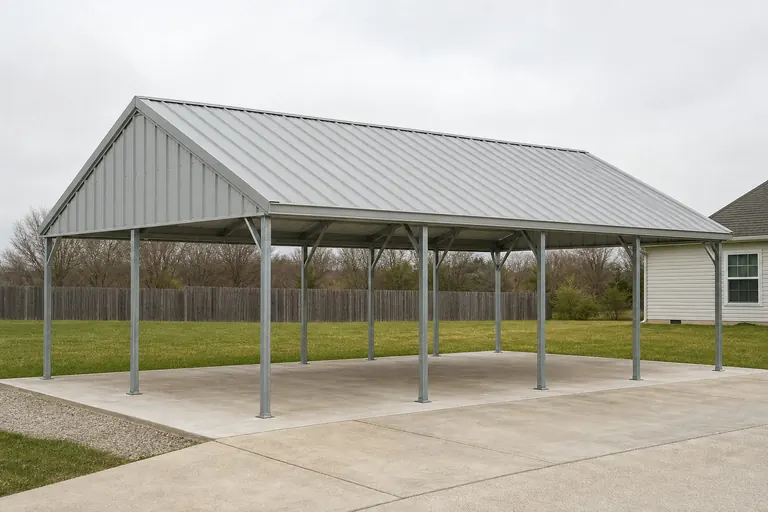 Plains Ranch CarportA wind-oriented, open-bay design for exposed high-plains sites east of the Divide.Mountain Valley CarportA steeper-pitch design for western valley sites, planned with a local engineer rather than a statewide snow figure.Equipment Bay CarportTaller eaves and a deeper bay to cover trucks, trailers, or ranch implements on larger acreage.
Example Configuration — for planning purposes only.
Footprint
Common Montana Carport Footprints
A starting range before a site-specific plan accounts for your side of the Divide.
18′ × 20′
360 sq ft
A compact single-vehicle carport for a town or valley residential lot.
20′ × 30′
600 sq ft
Room for a vehicle plus general storage on a standard rural parcel.
24′ × 40′
960 sq ft
A longer bay suited to trucks, trailers, or ranch equipment on larger acreage.
Example Configuration — for planning purposes only.
Confirm any local snow-load or wind-load requirement with your building department before finalizing a size, especially given how far a Hi-Line or mountain site can be from the Billings reference climate station.
Questions
Montana Carport Questions
Honest answers, with technical questions routed to your local authority.
Not reliably. The commonly cited 35.0-inch annual snowfall figure comes from a single Billings station covering the 1991-2020 normal period. Mountain sites west of the Continental Divide and northern Hi-Line locations can differ substantially, so confirm design expectations with your local building department.
For general geography, yes — the Divide splits Montana into a mountainous west and high-plains east with different terrain and drainage patterns. For structural design numbers like wind and snow load, your county's authority having jurisdiction is the source to confirm regardless of which side you're on.
On many rural Montana properties, where the average farm covers 2,374 acres, a carport is more often a stand-alone structure sited near working areas like a corral or equipment yard than an attachment to the home.
FEMA's National Risk Index scores all 56 Montana counties individually, with a statewide mean composite score of 33.3 out of 100. Pull your own county's report at hazards.fema.gov rather than relying on that statewide average.
There's no statewide guarantee either way, but Census Bureau data shows Montana's authorized housing units fell 33.3% from 2022 to 2023, so it's worth asking a prospective builder directly about current scheduling in your county.
There's no official typical size, but working carports on larger Montana parcels often run longer and taller than a residential model to fit trucks, trailers, or ranch equipment. Confirm eave height against what you plan to store.
Sources for the Montana facts on this page
This page states no code requirement, wind speed, snow load, permit rule, price or supplier claim. The state-specific facts it does use are listed with their publisher below.
Montana is split into two broad geographic regions by the Rocky Mountains: mountainous terrain in the west and rolling high-plains grassland in the east, with the Continental Divide separating watersheds draining to the Pacific, the Gulf of Mexico, and Hudson Bay.
University of Montana · Reference material · Tier 2
https://www.umt.edu/this-is-montana/columns/stories/montana_regions_1of3.phpMontana had 57,601,320 acres of land in farms in 2022, the largest average farm size of any of the four states covered here at 2,374 acres.
USDA NASS · 2022 · Tier 1
https://www.nass.usda.gov/Publications/AgCensus/2022/Online_Resources/County_Profiles/Montana/cp99030.pdfThe Billings, MT station's 1991-2020 annual normal precipitation is 15.43 inches with 35.0 inches of annual snowfall.
NOAA National Centers for Environmental Information (NCEI) · 1991-2020 · Tier 1
https://www.ncei.noaa.gov/access/services/data/v1?dataset=normals-annualseasonal-1991-2020&stations=USC00240802&format=json&dataTypes=ANN-PRCP-NORMAL,ANN-SNOW-NORMALBuilding permit offices in Montana authorized construction of 4,307 new privately-owned housing units in 2023, a 33.3% decrease from 6,460 units in 2022, one of the five largest percentage declines of any state that year.
U.S. Census Bureau · 2023 (final annual) · Tier 1
https://www.census.gov/construction/bps/pdf/2023annualhighlights.pdfFEMA's National Risk Index reports Montana's 56 counties with a mean composite NRI risk score of 33.3 on FEMA's 0-100 relative scale (v1.20 release).
Federal Emergency Management Agency (FEMA) · NRI v1.20 dataset · Tier 1
https://www.fema.gov/flood-maps/products-tools/national-risk-index