
Carport · ME
Carports in Maine
An open-sided carport in Maine spends its winter doing the one job a garage's walls don't have to worry about as directly: shedding snow off an unsupported roof. NOAA's 1991-2020 normals for the Portland Jetport station record mean January and February snowfall of roughly 15 to 19 inches each, on top of annual precipitation near 51 inches spread fairly evenly through the year. Under that load, the ground itself is not one uniform material — the Maine Geological Survey describes most of the state's surface as mantled by glacial and post-glacial sediments (till, marine clay, sand and gravel) left behind roughly 10,000 to 16,000 years ago, which varies enough by site to change footing behavior. Census data separately shows Maine authorizing 6,034 new privately-owned housing units in 2024, a comparatively modest annual construction volume that puts most carport projects on established lots rather than fresh subdivisions. None of that sets a specific post spec, but together it explains why a Maine carport conversation starts with roof and footing, not paint color.
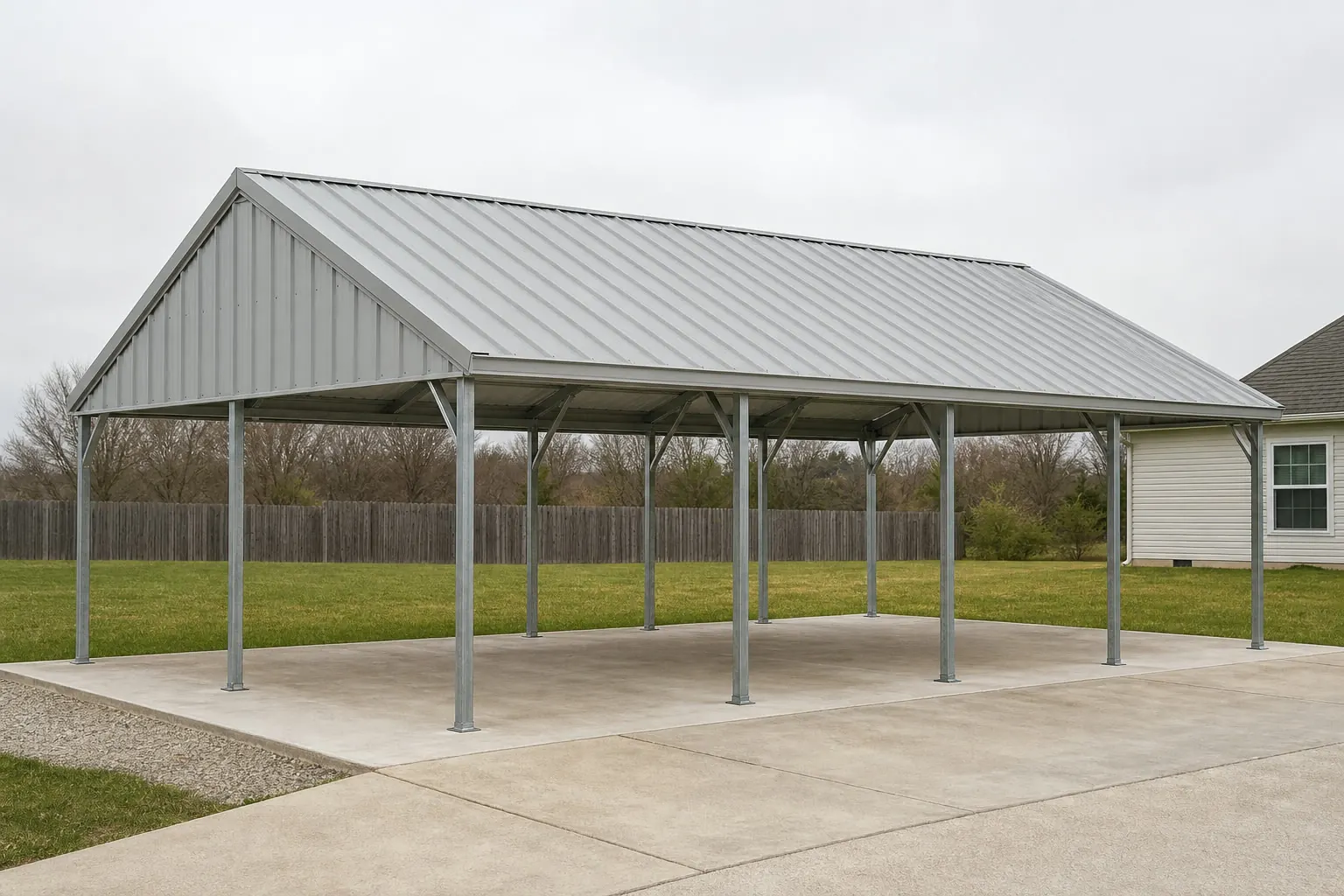
The climate
An open roof in Maine has real snow to shed, on a documented schedule
Station-level NOAA normals show a genuinely snow-heavy Maine winter, which is the first design conversation for an unsupported carport roof.
NOAA's 1991-2020 normals for the Portland Jetport station record mean snowfall of roughly 15 to 19 inches in each of January and February — two months, not one storm, of sustained snow accumulation risk. An open-sided carport roof carries that load with no interior walls to help distribute it, which is a structurally different problem than the same accumulation on a fully enclosed garage.
That normal is a station-level figure, not a certified statewide design snow load, and Portland's coastal-influenced totals may differ from an inland or northern Maine site. What the data does support is the direction: a carport roof pitch and truss or purlin spacing conversation with a local builder or engineer is worth having before finalizing a spec, rather than assuming a shallow-pitch, minimal-support roof will perform the same way here as it would in a milder climate.
None of this should be read as a specific engineering requirement — the authority having jurisdiction sets the actual design snow load for your town, and that is the number a builder ultimately has to meet.
Site & soil
Footing behavior depends on which glacial deposit sits under the slab
Maine's surface is broadly glacial and post-glacial in origin, but that description covers a genuinely wide range of soil conditions site to site.
The Maine Geological Survey describes most of the state's surface as mantled by glacial and post-glacial sediments — till, marine clay, sand and gravel — deposited during and after the last ice age, which ended roughly 10,000 to 16,000 years ago. A carport post footing bears on whichever of those materials is actually present at a given site: dense till behaves very differently under load than soft marine clay or free-draining sand and gravel.
Combined with annual precipitation near 51 inches spread fairly evenly through the year at the Portland station, a Maine carport footing sees sustained moisture exposure rather than an occasional wet season. Where a site sits on marine clay or a low-lying area with poor drainage, that moisture exposure is worth flagging to whoever pours the footings, since standing water against a post base is a longer-term durability concern beyond the initial installation.
A soil check ahead of finalizing post spacing and footing depth is a reasonable step given this variability, rather than assuming one Maine carport spec fits every site in the state.
- Ask what glacial material is under your specific site
- Till, marine clay and sand/gravel drain and bear load differently under a carport post.
- Grade for drainage around post bases
- Steady year-round precipitation makes standing water at a footing a real long-term concern, not just a winter one.
- Confirm your local design snow load before finalizing roof spec
- Only your town's building department can confirm the adopted figure that applies to your carport.
Preparation
Before you request a Maine carport quote
A short list that keeps a snow-heavy, glacially variable state from becoming a mid-project surprise.
- Call your town or county building departmentConfirm the adopted design snow load and any permit requirements for an open-sided structure before finalizing a spec.
- Ask about roof pitch and shedding for your specific roof styleNOAA's Portland normals show heavy January/February snowfall; discuss how your chosen roof style sheds it.
- Get a soil read for your site before setting footing depthGlacial till, marine clay and sand/gravel all bear load differently across Maine.
- Plan for year-round moisture, not just snow seasonAnnual precipitation near 51 inches is spread evenly through the year, affecting drainage around post footings.
Get Maine carport quotes
Tell us your vehicle count, town and rough footprint. We route it with the Maine and carport context already attached.
Configuration
What Maine carports are usually asked to do
Existing driveways on established lots, rather than new-construction packages, drive most Maine carport requests.
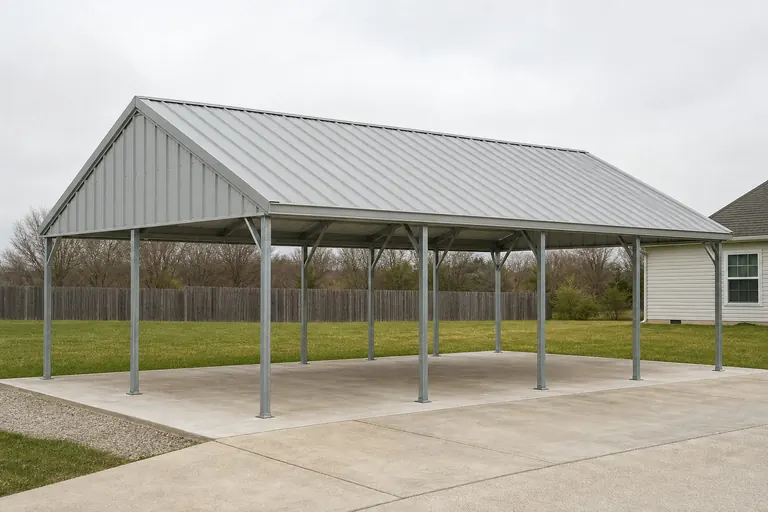 Driveway snow-shed coverCoverage aimed at keeping snow and ice off a windshield, sized to a household's existing paved area.Truck or trailer bayA wider, longer footprint for a truck, boat trailer or equipment on a rural Maine lot.
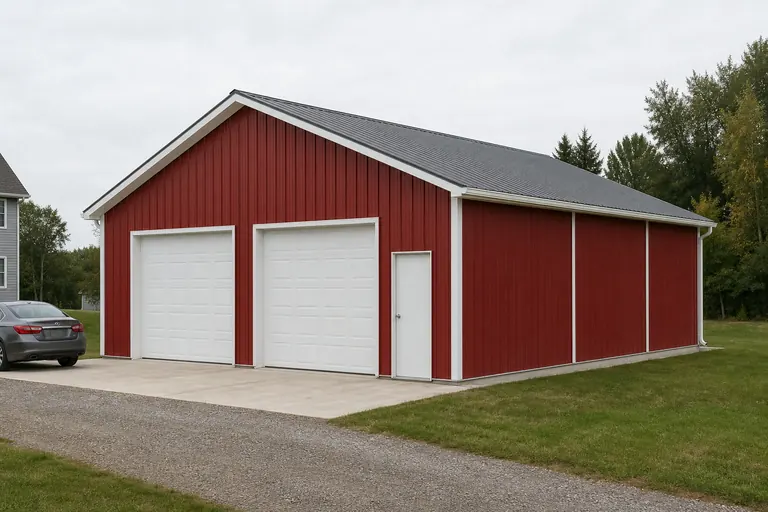 Enclosed upgrade pathWhere full weather exclusion matters more than install speed or cost, a detached garage is the enclosed alternative worth comparing.
Example Configuration — for planning purposes only.
Footprint
Sizes that suit Maine carport projects
Common footprints for established Maine lots, before roof and footing detail is finalized locally.
12′ × 24′
288 sq ft
A single-vehicle footprint on an established Maine driveway.
20′ × 24′
480 sq ft
A two-vehicle footprint for a household needing side-by-side coverage.
24′ × 30′
720 sq ft
Added depth for a truck, trailer or equipment plus a vehicle.
Example Configuration — for planning purposes only.
Footprint pages carry post and layout detail; this page covers only the Maine snow, precipitation and soil context.
Questions
Maine carport questions
State-level answers only, with jurisdiction- and site-specific items routed to who owns them.
It's worth a real conversation. NOAA's Portland Jetport normals show mean snowfall around 15-19 inches in each of January and February, which is a strong signal to discuss roof pitch and support spacing with your builder, though your town's building department sets the actual design snow load.
The Maine Geological Survey describes most of the state's surface as glacial and post-glacial sediment — till, marine clay, sand and gravel — rather than uniform bedrock. Soil type varies by site, so a local check before setting footing depth is worthwhile.
Requirements are set by your specific town or county. Confirm with your local building department before finalizing a design.
Yes. NOAA's Portland Jetport normals show annual precipitation near 51 inches spread fairly evenly through the year, which affects drainage planning around post footings year-round, not just in winter.
Both are viable; the tradeoff is full weather exclusion versus a faster, lower-cost open-sided install. A carport still needs a real roof-shedding and footing conversation given Maine's documented winter snowfall.
We do not publish state-level prices, because a credible number depends on your specification, site work and current material pricing. Our cost pages cover what drives the number; a quote covers your building.
Sources for the Maine facts on this page
This page states no code requirement, wind speed, snow load, permit rule, price or supplier claim. The state-specific facts it does use are listed with their publisher below.
The Portland, ME NOAA 1991-2020 normals show winter monthly snowfall means around 15-19 inches in January and February, indicative of a snow-heavy northern New England winter.
NOAA National Centers for Environmental Information (NCEI) · 1991-2020 · Tier 1
https://www.ncei.noaa.gov/access/services/data/v1?dataset=normals-monthly-1991-2020&format=pdf&stations=USW00014764Portland, ME's NOAA 1991-2020 climate normals show annual precipitation totals of about 51 inches, distributed fairly evenly through the year with over 3 inches of rain most months.
NOAA National Centers for Environmental Information (NCEI) · 1991-2020 · Tier 1
https://www.ncei.noaa.gov/access/services/data/v1?dataset=normals-monthly-1991-2020&format=pdf&stations=USW00014764The Maine Geological Survey describes most of the state's surface as mantled by glacial and post-glacial sediments (till, marine clay, sand and gravel) deposited during and after the last ice age, which ended roughly 10,000-16,000 years ago.
Maine Geological Survey (Dept. of Agriculture, Conservation & Forestry) · MGS reference material · Tier 2
https://www.maine.gov/DACF/mgs/explore/surficial/facts/surficial.htmBuilders in Maine were authorized to construct 6,034 new privately-owned housing units in 2024, of which 4,650 were single-unit structures.
U.S. Census Bureau · 2024 (final annual estimates) · Tier 1
https://www.census.gov/construction/bps/stateannual.html